How to Identify Wood: A Practical Visual Guide
Picking up a board at a lumber yard or pulling a chair out of an estate sale, you’ve probably wondered: what kind of wood is this? Knowing how to identify wood matters more than most buyers realize. Oak and poplar look similar painted, but one costs three times as much. Cherry and mahogany can both appear reddish-brown under a coat of oil, yet they behave completely differently in a workshop. Pine may pass for Douglas fir until it dents under a fingernail test.
Wood identification isn’t guesswork, and you don’t need decades of experience to get it right. Four features carry most of the diagnostic weight: grain pattern, color and texture, end grain structure, and weight. Work through all four, and most common species reveal themselves quickly.
To identify wood, examine four features in order: grain pattern (straight, wavy, or interlocked), pore visibility (large open pores suggest oak or ash; tight invisible pores point to maple or cherry), natural color in daylight, and end grain structure. End grain is the most accurate single method. Comparing all four narrows most species to one or two candidates.
How to Identify Wood by Grain Pattern
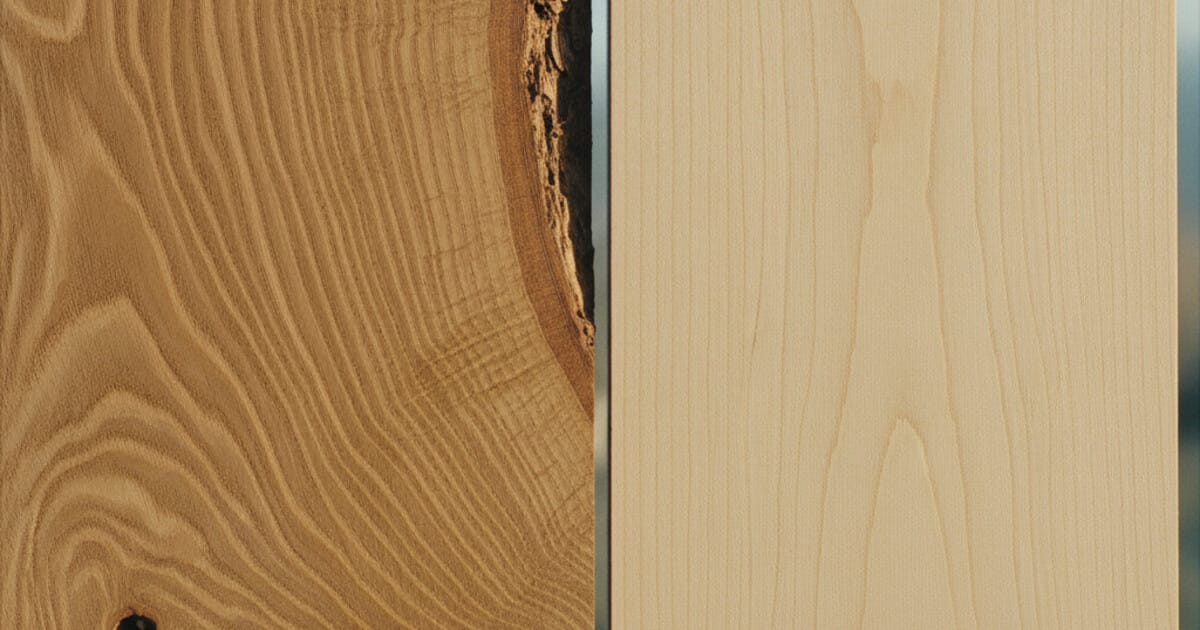
Wood grain forms as the tree grows outward in seasonal rings. Ring-porous hardwoods like oak, ash, and hickory produce large, visible pores in their spring growth and smaller pores through summer, creating a distinct banded look in face grain. Diffuse-porous hardwoods like maple, birch, and cherry scatter uniform, fine pores through the entire growth ring, giving a smooth, homogeneous appearance. Softwoods (pine, fir, spruce) have no pores at all but show clear dark-to-light transitions between latewood and earlywood. Grain direction matters too: straight grain runs parallel to the board edge; interlocked or wavy grain creates a ribbon or figure pattern on quarter-sawn faces. Knots mark where branches once grew, and their size and spacing reflect the species’ branching habit. A clear, unfinished face in natural light reveals these features most accurately. Finishing products (polyurethane, oil, wax) seal and alter apparent color, so always assess raw wood when possible.
Running a fingernail across the surface adds a quick density read. Open pores in a ring-porous species feel slightly rough even when sanded. Diffuse-porous wood like hard maple feels almost glassy. That tactile difference often confirms what your eyes are already suspecting.
Grain figures (bird’s eye, curly, quilted, burl) appear in many species but aren’t species-specific on their own. Hard maple shows bird’s eye most famously, but cherry, walnut, and even ash can produce it under the right growing conditions. Figure narrows the candidates; it doesn’t close the case.
For a deeper breakdown of how pore structure differs across species families, see our guide to wood grain types and patterns.
Identifying Wood by Color and Weight
Raw, unstained wood in natural light gives the most honest read on color. Air exposure and light shift most species toward yellow, orange, or gray over months, so a fresh cross-cut at the end of a board often shows the true baseline color better than the weathered face.
Some reliable color baselines:
- Walnut: chocolate-brown heartwood with a pale sapwood border, often streaky at the transition zone
- Cherry: salmon-pink when freshly cut, shifting to a warm reddish-brown over one to two years
- Hard maple: nearly white to light cream, very consistent tone across most boards
- Ash: light tan to pale brown, similar to oak but with a finer, tighter pore pattern
- White oak: yellow-brown to light tan; some boards carry a slight greenish cast
- Pine: pale yellow with resinous knots; darker latewood bands are clearly visible even without magnification
- Poplar: cream to greenish-gray, with mineral streaks of purple or green that look unusual but are perfectly normal
- Birch: pale cream to light tan, consistent and fine-grained, often mistaken for maple at a glance
Color alone is rarely definitive. Stain, finish, and aging can push almost any species toward another. Use it as your starting point, not your conclusion.
Weight is a fast secondary check. Hickory, white oak, and hard maple are noticeably heavier than pine, poplar, or basswood at comparable thickness. If a board surprises you with how much it weighs, that’s a diagnostic signal worth following.
For a breakdown of density and performance differences across wood families, see hardwood vs softwood.
Reading End Grain: The Most Reliable Method
End grain is the cross-section you see at a board’s cut end. Lumber yards usually have a test piece or offcut available. On furniture, check the underside of a table leg or the back edge of a shelf where the raw wood is exposed.
Under a loupe or a smartphone camera zoomed close, three structures tell the story:
Ring-porous species (oak, ash, chestnut, hickory): A clear ring of large pores marks the start of each growth ring, followed by a zone of smaller pores. Annual rings read clearly without much magnification. Oak’s rings are especially dramatic.
Diffuse-porous species (maple, birch, cherry, walnut): Pores are scattered evenly throughout each ring rather than clustered at the outer edge. The rings are visible but not from dramatic pore clusters. The surface looks more uniform.
Softwoods (pine, fir, spruce, cedar): No pores. The rings appear as alternating light earlywood and dark latewood bands. Resin canals may appear as small dark dots in some species.
Ray cells are a second feature worth noting on end grain. They radiate outward from the pith and appear as streaks or lines. Oak rays are wide and prominent, visible to the naked eye as tan or white streaks. Maple rays are narrow and numerous. Beech rays are wide and closely spaced, giving the end grain a characteristic “peppered” look.
You don’t need a microscope for this. A macro shot on a smartphone in good light captures enough detail to confirm genus in most cases.
Common Wood Species and Their Key Features
Here’s a quick reference for species you’re most likely to encounter in furniture, flooring, and lumber yards:
Oak (red and white): Ring-porous with very prominent rays. Large, open pores. Ray fleck is striking on quarter-sawn surfaces. White oak has tighter pores and a pinkish-tan cast; red oak is more orange-tan and slightly coarser. White oak is used in wine and whiskey barrels because its tyloses plug the pores, making it water-resistant.
Walnut: Semi-ring-porous to diffuse-porous. Chocolate-brown heartwood, often steamed to pull the pale sapwood closer to the heartwood color. Open pores but smaller than oak. Heavy for its appearance.
Hard Maple: Diffuse-porous, nearly white. Very fine pores that are nearly invisible without magnification. Extremely heavy and dense for a light-colored wood. Bird’s eye or curly figure is a reliable visual marker when present.
Cherry: Diffuse-porous, salmon-pink when fresh and darkening dramatically over years. Fine, smooth grain. Often confused with mahogany, but cherry’s rays are fine and the color shifts more uniformly with light exposure.
Ash: Ring-porous, pale to medium tan, with a very straight grain and clear growth rings. Similar pore pattern to oak but rays are much narrower. Increasingly harder to source in the northeastern US because of emerald ash borer losses.
Pine: Softwood, no pores. Resin canals appear as small dark dots on end grain. Knots are common in construction grades. Yellow pine is very dense and hard; white pine is lightweight and easy to work.
Birch: Diffuse-porous, pale cream to light tan. Fine, consistent grain. Often mistaken for maple. Birch rays are more numerous and the surface has a slightly duller sheen than hard maple.
Poplar: Diffuse-porous, light and soft for a hardwood. Cream base color with frequent green or mineral streaks in the heartwood. Very light weight. Often used as a secondary wood (drawer bottoms, cabinet backs) in traditional furniture construction.
For applying these cues to furniture pieces specifically, see how to identify wood in furniture.
How to Identify Wood from a Photo
A smartphone camera captures enough detail for identification in most cases, as long as you photograph the right features.
What to shoot:
- End grain in natural light (most diagnostic)
- Face grain close-up, unfinished or in raw grain showing natural color
- Color in neutral daylight (incandescent or LED light skews yellow and misleads color reads)
- A full shot of the board or piece for overall context
The Tree Identifier app includes a wood type recognition feature trained on grain pattern, texture, and surface appearance. Point it at a piece of wood, take a photo, and it returns a wood species match. The same app identifies living trees from leaf, bark, flower, and fruit photos, so it covers both use cases in one place. You can try the wood identifier tool in your browser before downloading the app.
Two shots generally work better than one. An end-grain close-up plus a face-grain shot in natural light gives the AI enough information to separate species that look nearly identical in a single image. Between those two photos, most common species produce a confident match.
If the wood is finished, focus on end grain and weight. Finish penetrates unevenly at cut ends, so the pore structure stays readable even through a coat of polyurethane. Color reads from finished faces are unreliable; color from end grain is less affected.
Frequently Asked Questions
Can you identify wood from a photo?
Yes, with the right photos. End grain in natural light is the most diagnostic shot. Face grain and color photos add supporting evidence but aren’t reliable alone. The Tree Identifier app’s wood recognition feature identifies species from grain pattern, texture, and appearance and works on raw and finished wood.
What’s the easiest way to tell hardwood from softwood?
Look at the end grain under magnification. Hardwoods have visible pores (tiny holes across the surface); softwoods have none, showing only alternating light and dark annual bands. A quick density check confirms it: softwoods like pine dent noticeably under fingernail pressure; most hardwoods won’t.
How do I tell oak from ash? They look almost identical.
Both are ring-porous with large open pores, but oak has very prominent rays: wide tan or white streaks radiating outward from the center on both face grain and end grain. Under a smartphone camera macro, oak rays are clearly visible. Ash rays are narrow and much less distinct. Color also differs slightly: ash runs paler and more uniform, while oak often has a yellower or faintly greenish cast in some boards.
Does staining make wood identification impossible?
Harder, but not impossible. Focus on end grain (stain penetrates unevenly there, so pore structure stays readable) and on weight and density. Surface stain doesn’t change how the wood feels or how heavy it is. If you can access an unfinished edge or the underside of a piece, the raw grain there shows the species’ real color and structure.
What wood is hardest to identify from photos?
Tropical hardwoods sold under trade names (lauan, meranti, Philippine mahogany) are genuinely difficult because those names cover multiple species with overlapping grain. Light-colored woods like maple, birch, beech, and sycamore also converge toward similar pale fine-grained appearances without obvious distinguishing features. In these cases, end grain and ray pattern are the only reliable separators.
Wood identification sharpens fast with practice. Keep a few labeled reference samples on hand, photograph end grain in good light, and use the Tree Identifier app when you’re stuck. It’s free to download on iOS and Android with 2 identifications per day at no cost, covering both living trees and wood species in one tool.
Identify a tree from your photo — free
Upload a leaf, bark, or whole-tree photo and get the species in seconds. No signup.
Confidence:
Unlock the full species profile
Free in the app — with unlimited identifications.


AI result for guidance — the app gives full species details and works offline.
Want unlimited identifications?
Get the full species profile, photos and details — free in the app, with unlimited scans.
- Unlimited identifications
- Full species profiles & details
- Works offline, anywhere
- Save and revisit your finds
Elena Torres
Tree Identifier Team