Oak vs Maple Leaf: How to Tell Them Apart
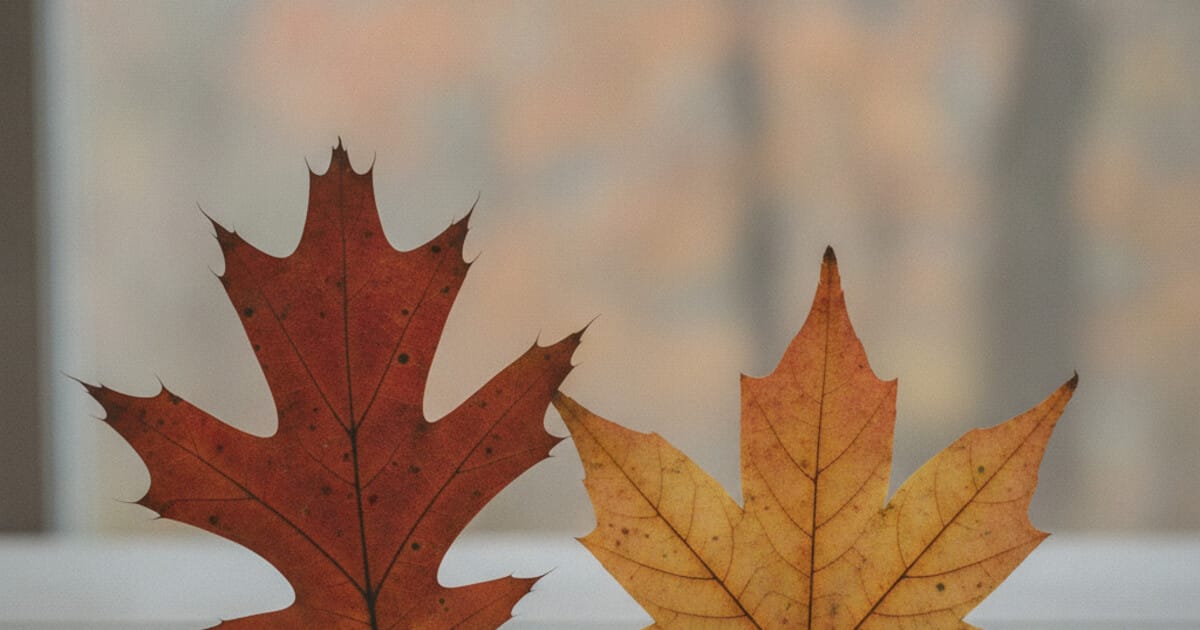
Standing under an unfamiliar tree, most people make a snap call: maple or oak. They’re right about half the time. Both genera have lobed leaves that turn spectacular colors in fall, and at arm’s length the leaves can look nearly identical.
The oak vs maple leaf confusion is one of the most common ID questions among new tree-watchers. Three clues sort them out cleanly, and none of them require a botany textbook.
Oak and maple leaves both have lobes, which is why they get mixed up. Check the branching first (maple opposite, oak alternate), then lobe structure (maple lobes radiate from the petiole base in a palmate pattern; oak lobes grow from a central midrib), and finally seeds (paired helicopters for maple, acorns for oak). Those three checks take under a minute.
Oak vs Maple Leaf: The Shape Differences
Both trees have lobed leaves. Look at the lobing structure carefully, and the two genera sort themselves out.
Maple leaves are palmate. The lobes radiate from a single point where the petiole meets the blade, like fingers spreading from a palm. Most maples have 5 lobes, though red maple often shows 3. The sinus shape (the gap between lobes) varies by species: sugar maple has U-shaped sinuses giving lobes a rounded look, red maple has V-shaped sinuses making the leaf look spikier, and silver maple has extremely deep narrow sinuses that give the whole leaf an almost star-like outline.
Oak leaves are pinnate in structure. A single central midrib runs the length of the leaf, with lobes growing outward on both sides. White oak group species (white oak, bur oak, chestnut oak) have rounded lobes with smooth, blunt tips. Red oak group species (red oak, pin oak, scarlet oak) have pointed lobes with a small bristle at each tip. That bristle tip (a tiny hair-like projection at the very end of each lobe) appears on no maple and settles the call instantly.
Leaf size also separates them in practice. Oak size varies enormously by species: willow oak leaves run just 2 to 4 inches long, chestnut oak leaves can reach 9 inches. Most maple leaves fall between 3 and 6 inches, with silver maple toward the larger end.
Botanically, oak leaves belong to the genus Quercus (over 90 native North American species) and maple to Acer (about 13 native species). The leaf architecture reflects that evolutionary distance. Oaks belong to the beech family (Fagaceae); maples belong to the soapberry family (Sapindaceae). Despite looking similar to a casual observer, they share no recent common ancestry. The palmate venation of maple leaves (veins radiating outward from the petiole base) differs structurally from the pinnate venation of oaks, where a single central vein runs the length of the leaf. Botanists separate them in under 10 seconds using venation alone. The fall color difference is also diagnostic: sugar maple produces anthocyanins that drive intense orange and red, while red oak’s fall color comes mostly from carotenoids, yielding a deeper, flatter crimson rather than the bright orange-yellow of sugar maple. For individual oak species and their lobing patterns, the oak tree identification guide covers all the major groups.
The Branching Pattern: Year-Round Oak vs Maple Tell
The leaf shape clues work spring through fall. This one works year-round, including winter when both trees are bare.
Maple branches grow in opposite pairs. Any twig on a maple has buds or lateral branches growing directly across from each other. Step back 15 feet and the Y-shaped, paired branch structure shows in the silhouette. Leaves emerge in spring from opposite buds, opening as pairs.
Oak branches are alternate. Each bud attaches at a different point along the stem, staggered rather than mirrored. Oak branch tips often cluster several buds together at the tip, a useful winter mark on its own.
Botanists use the mnemonic MAD to remember which deciduous trees have opposite branching: Maple, Ash, Dogwood. Every other species (oaks, elms, birches, hickories, beeches) is alternate. Once that’s locked in, you can rule out maple from 30 feet away before examining a single leaf.
In practice: when you spot a lobed-leaf tree from across a meadow, walk close enough to see branch junctions before you look at leaves. The branching pattern is visible at 20 feet. Leaf details sometimes require you to be within 2 feet. Starting with branching saves a lot of squinting.
The branching check is especially useful in early spring before leaves fully open. Young maple leaves emerge in pairs from opposite buds; young oak leaves unfurl from staggered buds, sometimes clustered at the branch tip.
Seeds: Acorns vs Helicopter Seeds
When the leaves alone aren’t settling it, check the seeds on the tree or on the ground beneath it.
Oaks produce acorns. No other North American tree genus does. The acorn is a rounded nut sitting in a scaly or fringed cap. White oak acorns ripen in their first fall; red oak acorns take two full years to mature and sit in a deeper, wider cap. In fall and early winter, a thick carpet of rounded nuts with scaly caps beneath a large tree is as definitive an ID as any leaf.
Maples produce samaras: the paired winged seeds that autorotate as they fall, commonly called helicopters or whirlybirds. Each seed has a wing, and they grow in pairs joined at the base in a V or U shape. Most maples release them in spring or early summer, though silver maple drops its samaras as early as April.
One common mix-up: ashes also produce samaras. Ash samaras are single-winged paddles, not paired helicopters. Paired wings forming a V = maple. Single paddle per seed, hanging in loose clusters = ash. The ash tree identification guide covers the ash vs maple samara distinction in more detail.
Oak vs Maple Look-Alikes: Common Confusions
A few specific pairings cause most of the trouble in the field.
Red maple vs. pin oak. Both have deeply cut, pointed lobes and turn vivid red in fall. Opposite branching resolves it: any twig on a red maple has buds directly across from each other; pin oak is always alternate. Pin oak leaves also taper more sharply toward the base and are widest near the outer end.
Sugar maple vs. white oak. Both have broad, rounded-lobe profiles that overlap visually in the canopy. The leaf base settles it: white oak leaves taper toward the stem, while sugar maple leaves have a heart-shaped or flat base where the petiole attaches. Sugar maple is widest near the middle; white oak is widest toward the outer third.
Silver maple vs. scarlet oak. Both have deeply cut lobes that look star-shaped from a distance. Silver maple leaves have pale, nearly white undersides and a long flexible petiole. Every scarlet oak lobe tip carries a bristle. The opposite vs alternate branching check closes the ID if the leaves alone aren’t enough.
For species-level detail, the maple tree identification guide covers sugar, red, and silver maple side by side. For the two most-searched oak species, red oak tree identification and white oak tree identification walk through the specific features that separate each from its lookalikes.
How Tree Identifier Helps
Field guides cover the theory. When you’re standing next to an actual tree in variable light with a partial leaf view, a photo closes the gap.
Tree Identifier lets you photograph the leaf, bark, or overall tree form and get a species ID in seconds. Both oak and maple are among the most photographed and trained genera in the database, so confidence scores for these two groups tend to run high.
For the clearest leaf result, photograph the leaf from above on a flat surface in good daylight. A second photo of the bark gives you a confirmation check. The app accepts leaves, bark, flowers, and fruit, so there are multiple paths to a confident call.
It’s free to start with 2 identifications per day and works offline, so it’s reliable in remote forests without cell service.
Frequently Asked Questions
How do you tell an oak leaf from a maple leaf?
Check three things in order: branching pattern (maple branches are opposite, oaks alternate), lobe structure (maple lobes radiate from the petiole base in a palmate pattern; oak lobes grow outward from a central midrib), and seeds (paired helicopters for maple, acorns for oak). The branching check works even in winter with no leaves on the tree.
Which maple species looks most like an oak?
Silver maple causes the most confusion because its deeply cut, star-like lobes resemble pin oak or scarlet oak from a distance. Up close, silver maple has pale, almost white undersides and a long petiole. The cleaner separator is branching: silver maple twigs have buds directly across from each other; oaks are always alternate.
Do oak and maple trees grow in the same places?
Often, yes. Red maple and red oak share woodland habitat across eastern North America. Sugar maple and white oak overlap throughout the Great Lakes region and New England. Both appear in mixed hardwood forests, which is part of why the leaf confusion is so common in the field.
What’s the single easiest clue to remember?
Opposite branching means maple (or ash or dogwood, the MAD group). If twigs grow directly across from each other and the seeds are paired helicopters, it’s maple. This check works all year, including winter with no leaves on the tree.
Are oak acorns and maple seeds ever confused?
Almost never. Acorns are solid rounded nuts with a scaly cap; maple samaras are flat, winged, and come in pairs. The only realistic mix-up is between maple samaras and ash samaras, which are also winged but grow as single paddles rather than joined pairs. Oak acorns don’t look like any maple seed.
When you’re standing at the tree and still uncertain, Tree Identifier gets you an answer in seconds from a single photo of the leaf or bark. Free to start, offline-ready for remote trails, and available on iOS and Android.
Identify a tree from your photo — free
Upload a leaf, bark, or whole-tree photo and get the species in seconds. No signup.
Confidence:
Unlock the full species profile
Free in the app — with unlimited identifications.


AI result for guidance — the app gives full species details and works offline.
Want unlimited identifications?
Get the full species profile, photos and details — free in the app, with unlimited scans.
- Unlimited identifications
- Full species profiles & details
- Works offline, anywhere
- Save and revisit your finds
Elena Torres
Tree Identifier Team