Shingle Oak Tree Identification: 7 Reliable Signs
Shingle oak (Quercus imbricaria) catches people off guard the same way willow oak does. The leaves have no lobes. Pick one up in a forest where you expect oak leaves to look like a hand with pointed fingers, and a shingle oak leaf reads more like a small magnolia or a bay leaf: oblong, smooth-edged, and tipped with a single tiny bristle. That combination is exactly what makes shingle oak tree identification tricky at first and straightforward once you know the signs.
The name goes back to early European settlers who split the straight-grained wood into roof shingles. The species grows across a wide strip of the eastern and central United States, from southern Michigan and New Jersey south to Georgia and west to Kansas and Nebraska. It handles more site variety than most oaks: you’ll find it on dry sandstone ridges and rocky slopes in one county, and in moist stream bottoms in the next.
Shingle oak (Quercus imbricaria) is identified by its oblong, unlobed leaves 3-6 inches long with smooth margins and a single bristle tip at the apex, round acorns with a cap covering one-third to one-half the nut, and gray-brown bark with narrow ridges. It belongs to the red oak group, so acorns take two growing seasons to ripen.
7 Signs That Identify Shingle Oak Trees
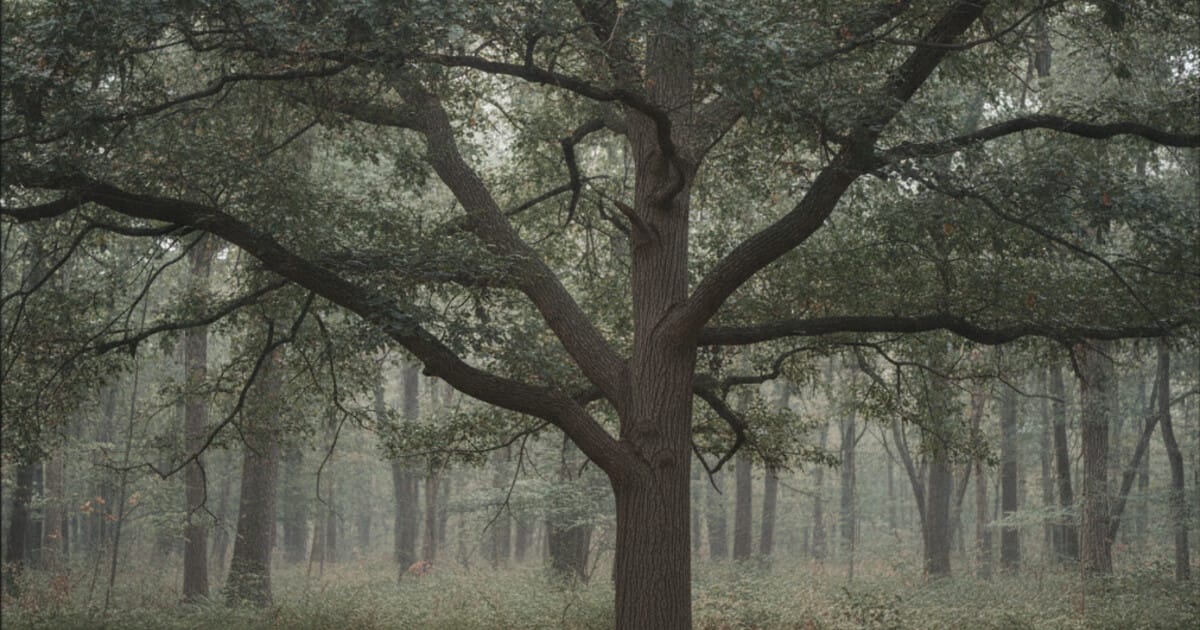
Shingle oak is a medium to large deciduous tree with its range covering roughly 30 states from southern Michigan and New Jersey south to northern Georgia and Alabama, then west through Tennessee, Missouri, Kansas, and Nebraska. Mature trees reach 40-60 feet tall with a crown spread of similar size, occasionally exceeding 100 feet on rich bottomland soils. The tree belongs to the red oak group (section Lobatae), sharing with red oak and willow oak the key traits of bristle-tipped leaves and acorns that need two full growing seasons to mature. Unlike most red oaks, shingle oak grows on dry upland ridges and sandstone outcrops as well as moist stream bottoms, giving it a wider habitat range than typical red or pin oak. Acorns feed wood ducks, ruffed grouse, wild turkey, and white-tailed deer through fall and winter. Mature trees commonly live 200 or more years in undisturbed stands.
1. Oblong, Unlobed Leaves With a Single Bristle Tip
The leaf is the first feature to check. Shingle oak leaves are 3-6 inches long and 1-3 inches wide, oblong in outline, with smooth, untoothed margins. The apex ends in a single small but distinct bristle tip. That pairing of unlobed margins plus a bristle tip is the key: the leaf doesn’t look like most oaks, but the bristle tip confirms it belongs to the red oak group.
Hold a leaf at arm’s length. The outline is longer than wide, broadest near the middle, with margins that taper smoothly to that bristled point. There’s nothing frilly about the edge.
This is the fastest way to distinguish shingle oak from the majority of red oaks in its range, which have deeply lobed leaves. Only willow oak shares the unlobed-leaf pattern within the red oak group in the eastern US, and willow oak’s leaf is far narrower.
2. Broader Leaf Than Willow Oak, With a Shiny Upper Surface
Among unlobed oaks, leaf width separates the two most frequently confused species. Shingle oak leaves run 1-3 inches wide. Willow oak leaves are far narrower at 1/2 to 3/4 inch. Both have smooth margins and a single bristle tip, but shingle oak’s oblong leaf is two to four times wider, giving it a distinctly different silhouette in the field.
The upper surface is dark green and slightly shiny, especially on younger leaves in good sunlight. The underside is paler, with small tufts of pale hair in the axils where veins branch from the midrib. That hair tuft, while small, is consistent across the species and worth checking with a hand lens when you want a confirming detail beyond the leaf shape.
Water oak is the other unlobed-to-partially-lobed oak to consider within shingle oak’s range, but water oak leaves vary widely on the same tree, from spatula-shaped to three-lobed at the tip. Shingle oak leaves are consistently oblong throughout.
3. Round Acorns With a Cap Covering One-Third to One-Half the Nut
Shingle oak acorns are nearly round, 1/2 to 5/8 inch across, sometimes slightly longer than wide. The cap is bowl-shaped to moderately deep, with thin, tightly pressed scales, covering one-third to one-half of the nut.
That relatively deep cap coverage is different from willow oak, whose cap covers only about 25% of the acorn. Both species produce small, round acorns, but shingle oak’s cap proportionally wraps more of the nut, giving the acorn a helmeted look compared to willow oak’s more saucer-like cap.
Because shingle oak is in the red oak group, acorns take two full growing seasons to ripen. In late summer and fall you can find green year-one acorns and maturing brown year-two acorns on the same tree at the same time. Finding two size classes of acorns together is a reliable red oak group indicator.
4. Gray-Brown Bark With Narrow Ridges
Young shingle oaks have smooth, gray to brown-gray bark. As the tree ages, the bark breaks into narrow, interlacing ridges separated by shallow furrows, gray-brown overall.
The texture is noticeably different from black oak and red oak, which develop much deeper, nearly blackened furrows. It’s also lighter and more textured than the flat, plated bark of white oak. Shingle oak bark sits between those two extremes: more textured than white oak, less dramatic than black oak.
On large old trees the ridges become more prominent, but the bark keeps a relatively fine texture compared to other red oaks. In a mixed stand, shingle oak’s moderate bark furrowing combined with its unlobed leaf gives you two independent features to confirm the ID at once.
5. Marcescent Leaves That Persist Into Winter
One of shingle oak’s most useful cold-season field marks is its tendency to hold dead brown leaves on the branches long after neighboring trees have dropped. This leaf persistence, called marcescence, is especially strong in shingle oak among the red oaks.
By December and January, a shingle oak in the Midwest may still carry its dried leaves while surrounding red oak and black oak trees stand bare. The dried leaves rattle in the wind and keep their oblong outline, making the species identifiable by shape even in the middle of winter.
On dry ridges in Illinois, Indiana, or Missouri where several oak species mix, a tree holding dead, smooth-edged leaves through winter is almost certainly shingle oak. That cold-season persistence cuts the identification time to seconds once you know to look for it.
6. Broad Oval to Rounded Crown
Open-grown shingle oaks develop a broad oval to rounded crown with dense branching. The silhouette is similar to willow oak’s rounded form but with slightly coarser branch structure because of the wider leaves.
In parks and old yard plantings, the rounded crown is easy to spot from a distance. Lower branches on mature trees often have a slightly drooping, graceful curve. In wooded settings the crown is more irregular, but the dense branching and fine-textured foliage still distinguish it from coarser-crowned red oak and black oak nearby.
In winter, the marcescent leaves combined with the broad-crowned silhouette are the two features most useful at a distance. A wide-crowned tree holding dried brown leaves on a rocky slope in January is strong evidence for shingle oak before you’ve reached the trunk.
7. Wider Habitat Range Than Most Red Oaks
Most eastern red oak group members favor specific conditions: red oak and black oak on dry upland slopes, pin oak on wet flats and bottomlands, willow oak in floodplains. Shingle oak is notably tolerant across that whole spectrum.
In its core range across Missouri, Illinois, Indiana, and Kentucky, you’ll find shingle oak on dry sandstone ridges alongside post oak and black oak, and also in moist creek bottoms alongside pin oak and sycamore. That flexibility reflects the species’ natural distribution across both upland and lowland sites.
When you encounter an unlobed oak on dry rocky ground in the central states, shingle oak is the first species to consider. In the Southeast, water oak occupies similar rocky sites but shows more variable leaf shapes on the same tree, usually with some lobing near the leaf tip on at least a few leaves.
Shingle Oak vs. Similar Species: Quick Comparison
The species most often confused with shingle oak are willow oak, water oak, and pin oak.
| Feature | Shingle Oak | Willow Oak | Water Oak | Pin Oak |
|---|---|---|---|---|
| Leaf shape | Oblong, unlobed | Lance-shaped, very narrow | Spatula to 3-lobed at tip | Deeply 5-7 lobed |
| Leaf width | 1-3 in | 1/2-3/4 in | 1-3 in (variable) | 2-5 in |
| Bristle tip | Single at apex | Single at apex | Single or few | Tips on each lobe |
| Acorn cap | ~1/3-1/2 coverage | Shallow saucer, ~25% | Shallow, ~25-30% | Very shallow, <25% |
| Habitat | Dry ridges to moist bottoms | Bottomlands, wet flats | Bottomlands, wet sites | Wet flats, bottomlands |
| Winter leaves | Marcescent, persists | Usually drops | Usually drops | Sometimes marcescent |
Leaf width is the fastest separator from willow oak. Shingle oak’s oblong leaf is two to four times wider. Water oak is best separated by its variable leaf shape: water oak leaves on the same branch can range from unlobed to distinctly three-lobed at the tip, while shingle oak leaves are consistently oblong throughout the tree.
How Tree Identifier Helps With Shingle Oak Identification
Shingle oak’s unlobed leaf is distinctive once you’ve seen it. Before that first encounter, the smooth-edged outline can send a field guide search through willows, magnolias, and other non-oaks before landing on the right answer.
Tree Identifier lets you photograph a leaf, bark section, or whole tree and returns a species ID with a confidence score in seconds. The app handles multiple photo types, so you can submit a leaf photo and a bark photo from the same tree to cross-check the result. It works offline too, which matters on dry ridges and remote woodland slopes where cell coverage disappears.
Download Tree Identifier on iOS or Android for your next walk in an eastern or midwestern forest. You get 2 free identifications per day, no subscription required.
Frequently Asked Questions
What do shingle oak leaves look like?
Shingle oak leaves are 3-6 inches long and 1-3 inches wide, oblong with smooth, untoothed margins and a single small bristle tip at the apex. The upper surface is dark green and slightly shiny; the underside is paler with small hair tufts in the vein axils. The leaf has no lobes, resembling a bay or magnolia leaf more than a typical oak.
Is shingle oak in the red oak or white oak group?
Shingle oak belongs to the red oak group (Quercus section Lobatae). The single bristle tip at the leaf apex confirms this classification, even though the leaf carries no lobes. Red oak group members have bristle-tipped leaves and acorns that take two growing seasons to mature. White oak group members have rounded leaf tips and ripen acorns in one season.
Why is shingle oak called shingle oak?
Early European settlers split the straight-grained wood into roof shingles, which is how the tree got its name. Shingle oak’s wood splits cleanly along the grain and was practical for shingle production in 18th and 19th century construction. Today the lumber is typically sold mixed with other red oak species for flooring, cabinetry, and millwork.
Where does shingle oak grow?
Shingle oak’s range runs from southern Pennsylvania and New Jersey south to northern Georgia and Alabama, west through Tennessee, Kentucky, Missouri, Kansas, and Nebraska, and north to Iowa, Illinois, Indiana, and southern Michigan. It grows on dry upland ridges, rocky slopes, and sandstone outcrops as well as moist stream bottoms, giving it a wider habitat range than most red oaks.
How do you tell shingle oak from willow oak?
Leaf width is the fastest separator. Shingle oak leaves are 1-3 inches wide; willow oak leaves are only 1/2 to 3/4 inch wide. Both are unlobed with a single bristle tip at the apex, but shingle oak’s leaf is noticeably broader and more oblong. Shingle oak’s acorn cap also covers more of the nut (one-third to one-half) compared to willow oak’s shallow saucer cap.
Shingle oak is one of the more rewarding oaks to learn because it breaks the pattern. No lobes on an oak sends most people to the wrong section of the field guide, but the bristle tip anchors it firmly in the red oak group. Tree Identifier can confirm an ID from a leaf or bark photo in seconds, with offline support for dry ridge and remote woodland sites.
Identify a tree from your photo — free
Upload a leaf, bark, or whole-tree photo and get the species in seconds. No signup.
Confidence:
Unlock the full species profile
Free in the app — with unlimited identifications.


AI result for guidance — the app gives full species details and works offline.
Want unlimited identifications?
Get the full species profile, photos and details — free in the app, with unlimited scans.
- Unlimited identifications
- Full species profiles & details
- Works offline, anywhere
- Save and revisit your finds
Elena Torres
Tree Identifier Team