Trees With Heart-Shaped Leaves: 8 Species Identified
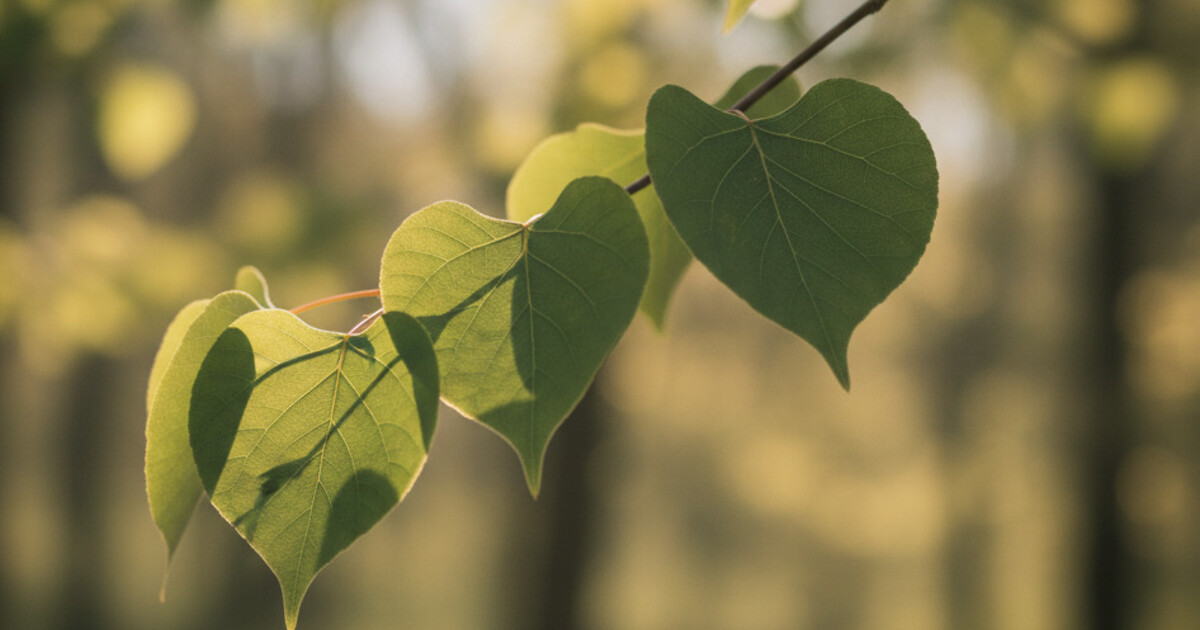
Spotted a tree with perfectly heart-like leaves and no idea what it is? You’re not alone. Heart-shaped leaves belong to a surprisingly varied group of trees, from small ornamentals in suburban yards to large forest canopy species that top 80 feet.
The leaf shape has a botanical name: cordate. Once you know which trees carry it, narrowing down the species gets a lot faster. This guide covers 8 common trees with heart-shaped leaves in North America, with the key features that separate each one from the rest.
The most common trees with heart-shaped leaves in North America are Eastern Redbud, American Linden, Northern Catalpa, Katsura Tree, Red Mulberry, Princess Tree, Quaking Aspen, and Eastern Cottonwood. Eastern Redbud has the most classically symmetrical heart shape. Catalpa and Princess Tree have the largest leaves, sometimes reaching 12 inches across. Leaf size, texture, and bark color help narrow down which species you’re looking at quickly.
How to Identify a Tree With Heart-Shaped Leaves
Not all cordate leaves are the same. Some are small and waxy smooth; others are rough-textured and enormous. Before scrolling through species photos, take note of four things at the tree:
- Leaf size: Small (1-3 inches), medium (3-6 inches), or giant (6+ inches)?
- Texture: Smooth and slightly glossy, or rough like sandpaper?
- Leaf arrangement: Opposite (paired across from each other on the twig) or alternate (staggered)?
- Bark: Smooth gray, ridged, or shaggy and peeling?
These four clues narrow the field from 8 candidates to 2 or 3 in about a minute.
Trees with heart-shaped leaves span several unrelated plant families, which means the cordate leaf shape evolved independently as an adaptation for capturing sunlight in forest understories and along woodland edges. The cordate base creates a wide surface area while keeping the petiole attachment near the center of mass, an efficient structural design. Eastern Redbud (Cercis canadensis) has the most symmetrical heart-shaped leaf of any common North American tree: roughly 3-5 inches across, smooth above and pale beneath. American Linden (Tilia americana) has a distinctly asymmetric base where one side sits lower than the other. Northern Catalpa produces the largest heart-shaped leaves of any common native tree, often reaching 10-12 inches long. Katsura (Cercidiphyllum japonicum) turns unmistakable in fall, when its small round-heart leaves emit a burnt caramel scent as they decompose on the ground. These four species account for most “what is this heart-leaf tree?” sightings in urban and suburban North America.
8 Trees With Heart-Shaped Leaves
1. Eastern Redbud (Cercis canadensis)
Redbud is the defining example of a heart-shaped leaf in North America. The leaves are round at the base, 3-5 inches wide, smooth on top, and slightly pale underneath, with a thin waxy feel.
In spring, redbud blooms before its leaves emerge, covering bare branches in clusters of small magenta-pink flowers. That bloom-before-leaf habit is the fastest field ID in March and April.
Bark is gray-brown with irregular scaly ridges on older trees. Redbud grows 20-30 feet tall, often with a spreading, multi-stemmed form along forest edges and creek banks across the eastern US.
For a deeper look at this species, including white-flowering cultivars and Forest Pansy, the Redbud Tree Identification guide covers them all.
2. American Linden / Basswood (Tilia americana)
Linden leaves look heart-shaped at first glance, but there’s a specific tell: the base is asymmetric. One side of the heart curves lower than the other. Once you spot it, this asymmetry is impossible to unsee.
Leaves are 3-6 inches long, slightly rough on top, with serrated edges. The underside has small tufts of hair in the vein axils.
In summer, linden produces clusters of cream-yellow flowers hanging from a distinctive strap-like bract. That bract is the single best field ID cue when the tree is in bloom. Linden grows 60-80 feet tall in rich, moist forests.
The Linden Tree Identification guide covers basswood versus European linden, including the key leaf and fruit differences.
3. Northern Catalpa (Catalpa speciosa)
Catalpa has some of the biggest heart-shaped leaves of any common North American tree. They grow 8-12 inches long with a sharp pointed tip, a cordate base, and a soft hairy texture on the underside.
The leaves are arranged opposite or sometimes in whorls of three on the twig. That whorled arrangement is unusual and immediately distinguishes catalpa from most other large-leaf species.
In early summer, catalpa produces large clusters of white tubular flowers with purple and yellow interior markings. By fall, those become long dangling seed pods, 12-18 inches long, that hang through winter.
See Catalpa Tree Identification for the northern versus southern catalpa comparison and how to tell them apart.
4. Katsura Tree (Cercidiphyllum japonicum)
Katsura is an ornamental tree native to Japan and China, planted in parks and campuses across North America. Its leaves are small, round-heart shaped, about 2-4 inches across, with a finely scalloped edge and a neatly symmetrical look that resembles redbud.
The fall giveaway: fallen katsura leaves smell like burnt caramel or brown sugar. It’s not subtle, and it’s unlike any other tree.
Bark is shaggy and gray-brown on older trees, peeling in long vertical strips. The tree grows 40-60 feet tall with a broad spreading crown. In a yard setting, it often gets confused with redbud early in the season, before the size difference becomes obvious.
5. Red Mulberry / White Mulberry (Morus rubra / Morus alba)
Mulberry leaves are famously variable. On the same tree you might find smooth oval leaves, mitten-shaped lobed leaves, and multi-lobed leaves that look almost like fig leaves. Many mulberry leaves, especially on young shoots, have a clearly cordate (heart-shaped) base.
Leaves are 2-5 inches long with a rough, sandpaper-like texture on top. The difference between species: red mulberry (native) has a rougher upper surface; white mulberry (introduced from China) has a shinier upper surface.
The fruit is the fastest ID cue: dark red-purple clusters in early summer on red mulberry, white or pale pink on white mulberry. The Mulberry Tree Identification guide covers both species and their differences in detail.
6. Princess Tree / Royal Paulownia (Paulownia tomentosa)
Princess tree produces dramatically oversized heart-shaped leaves. Mature leaves grow 6-12 inches across; leaves on young vigorous shoots can reach 24 inches wide. They’re soft, velvety underneath, and bright green.
In spring, paulownia produces large clusters of lavender-purple trumpet flowers before the leaves appear, covering the branches like a supersized lilac.
Princess tree is classified as invasive in much of the eastern US. It seeds aggressively and grows extremely fast, reaching 20-30 feet in just a few years. If you find a tree with giant heart leaves on a disturbed roadside or stream bank, this is a strong candidate.
7. Quaking Aspen (Populus tremuloides)
Aspen is famous for its shimmering leaves, but the shape is broadly heart-shaped to triangular at the base. Leaves are small, 1-3 inches wide, round to slightly pointed at the tip, with fine teeth around the edges.
The defining feature is the flattened petiole (leaf stem), which causes the leaf to rotate and flutter in the slightest breeze. That constant shimmer is the easiest aspen field ID from a distance, well before you can see the leaf shape clearly.
Bark is smooth, pale greenish-white to cream on younger trees. Aspen grows across the northern US and Rocky Mountain states, often in large clonal groves where every tree in the stand is connected underground.
8. Eastern Cottonwood (Populus deltoides)
Cottonwood leaves have a triangular-heart shape, sometimes called deltoid (after the Greek delta symbol). They’re 3-5 inches wide, with coarse rounded teeth and a flat petiole similar to aspen.
Cottonwood grows large, reaching 80-100 feet along riverbanks and floodplains across most of North America.
In late spring, female trees release masses of cottony white seeds that drift through the air like snow. That cotton is the most unmistakable ID cue for this species, visible from hundreds of feet away.
How Tree Identifier Helps
Spotted a heart-leaved tree and still not sure which of these 8 it is? A photo resolves most cases in seconds.
Tree Identifier works from photos of leaves, bark, flowers, and fruit. Take a clear shot of the leaf (both sides if possible), then another of the bark, and the app’s AI cross-references both to return a confident species match. You get detailed species information with each result: habitat, characteristics, and uses.
The free tier gives you 2 identifications per day. The app also works offline, so it’s reliable even in areas without cell service.
Download Tree Identifier on iOS or Android to identify any tree you encounter.
Frequently Asked Questions
What tree has the most perfectly heart-shaped leaves? Eastern Redbud (Cercis canadensis) has the most classically symmetrical heart-shaped leaves of any common North American tree. The leaves are round at the base with nearly perfect bilateral symmetry, about 3-5 inches across, smooth on top and slightly pale beneath. Redbud also blooms in magenta-pink flower clusters before its leaves emerge each spring.
What tree has very large heart-shaped leaves? Northern Catalpa and Princess Tree (Paulownia tomentosa) both produce very large heart-shaped leaves. Catalpa leaves typically reach 8-12 inches long. Paulownia leaves on vigorous young shoots can reach 24 inches across. Catalpa is identified by its long dangling seed pods; Paulownia by its lavender spring flowers.
How do I tell heart-shaped tree leaves apart? Check four things: leaf size (catalpa and paulownia are large; redbud, katsura, and aspen are small to medium), leaf texture (mulberry is rough; redbud and katsura are smooth), leaf arrangement on the twig (catalpa is opposite or whorled; most others are alternate), and bark appearance. These narrow the field to 1 or 2 candidates quickly.
Do mulberry trees always have heart-shaped leaves? Not consistently. Mulberry leaves are highly variable, sometimes on the same tree. Some are smooth ovals, some are lobed like a mitten, and some have a clearly cordate base. Young shoot growth tends to show the most pronounced heart base. The rough sandpaper texture on top is a more reliable mulberry ID cue than leaf shape alone.
Is katsura tree common in North America? Katsura isn’t native, but it’s widely planted in parks, college campuses, and botanical gardens across North America. It’s a popular ornamental for its reliable fall color and distinctive caramel scent. In the wild, you’re unlikely to encounter it, but in urban and suburban settings, it’s quite common.
Conclusion
Eight trees, one leaf shape, a dozen ways to tell them apart. Redbud has the most iconic symmetrical heart. Catalpa and Paulownia have the biggest leaves. Linden has an asymmetric base. Katsura smells like caramel in fall. Aspen and cottonwood have flattened petioles that make the leaves shimmer constantly.
If you’re still unsure which one you’ve found, Tree Identifier can match a photo to a species in seconds, even offline on remote trails.
Elena Torres
Tree Identifier Team