Trees With Smooth Gray Bark: 7 Species Identified
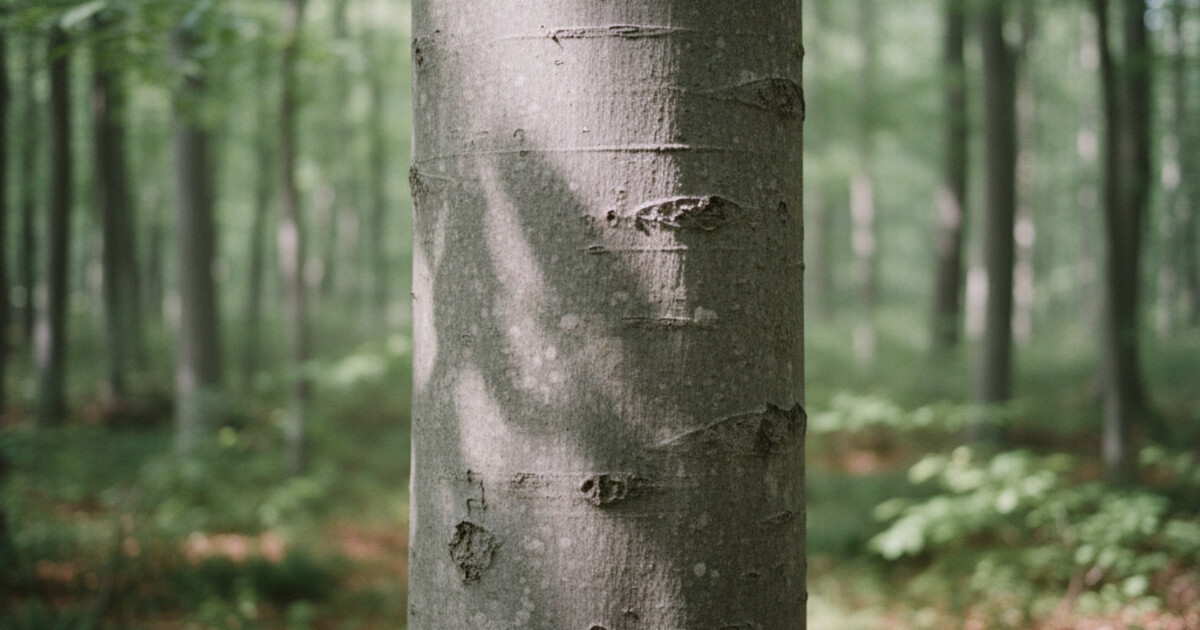
Walk through most North American forests and bark tells the story. Oaks crack into thick, scaly plates. Ashes build deep, interlocking ridges that run the full height of the trunk. Shagbark hickory peels away in long, shaggy strips that look like they’re ready to fall off. But a small group of trees keeps their bark smooth and gray, sometimes for centuries. If you’ve spotted one of those pale, tight-barked trunks and couldn’t name it, this guide covers the 7 most common species you’re likely to have found.
Smooth gray bark is rare enough to be genuinely useful as a field ID clue. It cuts the candidate pool from hundreds of possible species down to a short list.
The most common trees with smooth gray bark in North America are American Beech, American Hornbeam, Quaking Aspen, Serviceberry, American Basswood, Gray Birch, and Hackberry. American Beech is the most distinctive: its bark stays smooth and silver-gray for the tree’s entire life, even on 200-year-old specimens. Leaf shape and habitat help confirm which species you’ve found.
Standing in front of one? Identify it from a photo in seconds — free, no sign-up needed.
What Smooth Gray Bark Can Tell You
Smooth bark has real biological functions. Trees that maintain tight, smooth bark tend to be slower-growing species adapted to shaded understory conditions, where moisture management and pest resistance matter more than rapid vertical growth. The smooth surface sheds water efficiently and gives insects and climbing plants fewer footholds.
Gray coloration comes from the compounds in the outer bark layers: lignins, tannins, and silica deposits. Most trees develop lenticels (breathing pores) that eventually expand and merge into furrows or ridges as they age. The trees on this list resist that process longer than most, some of them indefinitely.
Before you work through the species below, a quick note on what “smooth” actually means at the trunk. Run your hand along an American Beech and the bark feels like cool, firm skin, tight and unbroken from knee height to the crown. Touch a Hackberry and you’ll feel hard, corky bumps scattered across an otherwise gray surface. American Hornbeam is smooth but wavy, with a flexed, sinewy look. Gray Birch is chalky smooth but interrupted by distinctive black triangular patches where branches attach. These tactile details separate the look-alikes faster than any field guide photo.
American Beech, American Hornbeam, Quaking Aspen, Serviceberry, American Basswood, Gray Birch, and Hackberry are the seven most common trees with smooth or smooth-appearing gray bark in North America. Each species grows in specific habitat conditions and has leaf, fruit, or bud features that confirm identification when bark alone isn’t enough. American Beech dominates older hardwood forests in the eastern U.S. and is the only species in this group that maintains perfectly smooth bark from sapling to old growth. Hornbeam and Serviceberry grow in forest understories and along stream banks. Aspen covers large clonal stands in cooler northern regions and mountain elevations. Hackberry thrives in disturbed, urban, and floodplain settings. Gray Birch colonizes open, disturbed areas from New England to eastern Canada. Basswood grows in rich, moist soils throughout the East and Midwest. Leaf shape, habitat, and bark texture together confirm which species you’re looking at.
The tree bark identification guide covers the full range of bark types if you want to build a broader ID library alongside this list.
7 Trees With Smooth Gray Bark
1. American Beech (Fagus grandifolia)
American Beech has the smoothest gray bark of any large tree in eastern North America. The surface stays tight and pale silver-gray for the tree’s entire life, with no furrows or plates appearing even on 200-year-old specimens. It’s often compared to elephant hide: firm, slightly cool to the touch, and unbroken except by shallow horizontal lines.
Beech bark is also famously carvable. Because the surface never flakes or peels, initials carved into a beech trunk stay legible for decades as the tree grows around them. If you spot a large, smooth gray trunk covered in old carvings, you’ve almost certainly found a beech.
Beyond the bark: look for alternate leaves with sharp, parallel-veined teeth, and small, spiky husks in fall that hold triangular beechnuts. Beech often holds its dead leaves through most of winter, which helps with off-season ID. It grows throughout the eastern U.S. in older, undisturbed hardwood forests, often alongside sugar maple and hemlock.
The beech tree identification guide covers the three species you’re likely to encounter in North America, including European Beech and Copper Beech.
2. American Hornbeam (Carpinus caroliniana)
American Hornbeam goes by several names: Musclewood, Blue-Beech, and sometimes Ironwood (a name shared with a different species). Its bark is smooth but not flat. The trunk has a wavy, sinewy surface that looks like the muscles of a flexed arm, with smooth gray-blue to gray-brown ridges running vertically. Run your hand across it and the bark feels almost rippled.
Hornbeam is a small understory tree, typically 15-35 feet tall, that grows in the shade of larger trees along streams and in moist bottomlands. Its leaves look similar to birch: alternate, doubly-toothed, with prominent parallel veins. In fall and winter, look for papery, three-lobed bracts attached to the seeds, which hang in clusters.
It’s one of the densest hardwoods in North America, which is where the “Ironwood” nickname comes from. The wood is so hard it was historically used for tool handles and ox yokes. If you find a small, smooth-barked understory tree along a stream with that distinctive sinewy look, Hornbeam is the likely ID.
3. Hackberry (Celtis occidentalis)
Hackberry looks smooth and gray from a distance. Get closer and touch the trunk, and you’ll feel something different: hard, corky bumps and irregular ridges scattered across an otherwise flat, gray surface. These wart-like projections are distinctive, and they make Hackberry easy to separate from genuinely smooth-barked trees once you know to look for them.
The bark ranges from light gray to gray-brown and becomes more heavily corked with age. Young trees in their first decade can look nearly smooth.
Hackberry thrives in urban settings, roadsides, and floodplains. It’s one of the most pollution-tolerant trees in eastern North America. Leaves are alternate, lopsided at the base (asymmetrical where the leaf meets the stem), with a rough, sandpaper texture. In fall and winter, look for small, dark purple to black berries that persist on the branches long after the leaves drop. The hackberry tree identification guide covers how to separate it from elm, which shares similar leaf shape and grayish bark.
4. Quaking Aspen (Populus tremuloides)
Quaking Aspen has the smoothest bark of any tree in the American West. The trunk is chalky, pale gray-green to white-gray, with a powdery coating that comes off on your fingers when you touch it. The greenish tint is real: aspen bark contains chlorophyll and photosynthesize alongside the leaves, which gives younger bark a distinctly fresh, greenish cast.
Look for dark, eye-shaped scars where old branches fell away. These lenticel scars are scattered across the smooth surface and look almost like faces on the trunk. As aspen trees age past 50 years or so, the lower trunk develops darker, rougher patches or furrowing while the upper trunk stays smooth.
Aspen grows in large clonal stands across northern North America and mountain regions down through the Rockies. Its round leaves have flattened stalks rather than round ones, which allows them to tremble in the lightest breeze. In fall, aspen stands turn a clean, brilliant yellow. If you’re in a western mountain forest or the northern U.S. and see stands of chalky, smooth-barked trees shimmering in the wind, you’ve found aspen.
5. Serviceberry (Amelanchier spp.)
Serviceberry (also called Juneberry or Shadbush depending on region) has smooth, slate-gray bark with fine silvery lines that run vertically down the trunk. The surface is genuinely smooth to the touch on young to middle-aged trees. Older specimens can develop shallow, fine furrows, but the bark stays tight compared to most hardwoods.
Serviceberry is typically a small tree or multi-stemmed large shrub, 15-25 feet tall, that grows at forest edges, along streams, and in dappled shade. It’s one of the first trees to bloom in spring, with clusters of small white flowers that open before the leaves fully expand. By early summer, it produces dark purple berries that are edible and eaten heavily by birds. The fall color is orange to red.
It grows across the eastern U.S. and into Canada, often in the same forest understory conditions as Hornbeam. The two can be hard to tell apart at the trunk, but Serviceberry’s fine vertical striping on the bark is a useful separator. More details in the serviceberry tree identification guide.
6. American Basswood (Tilia americana)
American Basswood (also called American Linden) has smooth, pale gray bark on young and middle-aged trees. On a fresh-grown tree, the surface looks clean and flat, easy to mistake for beech at first glance. The key difference: on trees older than 60-80 years, Basswood develops narrow, shallow ridges, while Beech stays smooth indefinitely.
Leaves are large (3-6 inches), heart-shaped, and asymmetrical at the base. In early summer, Basswood produces small, fragrant, yellowish flowers attached to a long, distinctive papery bract that looks unlike anything else in North American forests. Those bracts stay on the tree as the flowers develop into small, round fruits. The flowers are a major nectar source, making Basswood one of the most important trees for honey production in the East.
Basswood grows in rich, moist soils across the eastern U.S. and Great Lakes region, often alongside sugar maple and yellow birch in northern hardwood forests.
7. Gray Birch (Betula populifolia)
Gray Birch is the birch you might not expect. Unlike Paper Birch and River Birch, which peel into papery strips, Gray Birch bark is chalky white to pale gray and relatively non-peeling. The trunk stays smooth, and the clearest identification feature is the black, triangular patches that form at branch attachment points. Those black chevron-shaped markings are unique in North American trees.
Gray Birch is a small, slender tree, typically 20-30 feet tall, that colonizes disturbed areas: old fields, roadsides, and recently cut or burned land. It’s a pioneer species that moves into open ground quickly and lives a relatively short life (40-50 years) before larger trees shade it out.
Common across New England and eastern Canada. The leaves are triangular-ovate with a long, tapering tip and doubly-toothed margins. If you want to compare it with the peeling birch species, the trees with peeling bark guide lays out the full range side by side.
How Tree Identifier Helps With Bark Identification
Bark ID is one of the harder skills to build from a field guide. Photo libraries help, but they can’t replicate standing at a trunk and noticing how the surface changes from the base to the crown, or how the texture looks in different light.
The Tree Identifier app lets you photograph bark directly and get an AI-powered species match. You don’t need a perfect leaf shot. The app identifies from bark texture, leaf shape, flowers, fruit, or whole tree photos, so whatever feature is most visible in the field is the one you can use.
It works offline too, which matters on remote trails without cell service. Download species data ahead of time and use the full identification feature without a signal. Start with 2 free identifications per day, no subscription required.
Frequently Asked Questions
What tree has smooth gray bark that doesn’t peel?
American Beech is the most common tree with smooth gray bark that stays completely non-peeling throughout its life. Its bark stays tight and unbroken from sapling to centuries-old tree. American Hornbeam and Serviceberry also have smooth, non-peeling gray bark, though they’re smaller trees. Gray Birch looks smooth but can develop very minor surface peeling on old trunks.
How do I tell American Beech from American Hornbeam?
Both have smooth gray bark, but Hornbeam has a wavy, sinewy trunk surface that looks like flexed muscle, while Beech is uniformly flat and smooth. Beech grows much larger (60-80 feet tall) compared to Hornbeam (15-35 feet). In fall, Beech has spiky fruit husks; Hornbeam has three-lobed papery bracts on its seeds. Habitat helps too: Beech grows in mature forest, Hornbeam in shaded understory along streams.
Does smooth gray bark change as a tree gets older?
For most species, yes. Hackberry and Basswood look much smoother as young trees and develop more texture with age. Quaking Aspen develops rough, dark patches at the base over time while the upper trunk stays smooth. American Beech is the exception: it stays smooth regardless of age. If you’re looking at a large, old tree with perfectly smooth bark, Beech is the top candidate.
Can you identify a tree from bark photos using an app?
Yes. Apps like Tree Identifier accept bark photos and use AI to match the texture, color, and pattern to species in the database. Bark can actually be a more reliable ID feature than leaves in winter or for species where leaf shape varies between individual trees.
Conclusion
Smooth gray bark is one of the most useful field clues you’ll find, precisely because so few trees have it. American Beech is the starting point: nothing else in eastern North America looks quite like that pale, tight, skin-like surface. From there, Hornbeam, Serviceberry, Basswood, Aspen, Gray Birch, and Hackberry fill out the list. Bark texture, leaf shape, and habitat together will get you to the right species in most cases. If you want a faster answer, a quick photo through Tree Identifier confirms the ID on the spot.
Identify a tree from your photo — free
Upload a leaf, bark, or whole-tree photo and get the species in seconds. No signup.
Confidence:
Unlock the full species profile
Free in the app — with unlimited identifications.


AI result for guidance — the app gives full species details and works offline.
Want unlimited identifications?
Get the full species profile, photos and details — free in the app, with unlimited scans.
- Unlimited identifications
- Full species profiles & details
- Works offline, anywhere
- Save and revisit your finds
Elena Torres
Tree Identifier Team