Cherry Plant Leaves: How to Identify Every Common Species
If you’re trying to identify a cherry tree in a garden, along a street, or on a woodland path, the leaves are your fastest shortcut. Cherry plant leaves share a distinctive combination of features that set them apart from plums, pears, and crabapples, but the differences are subtle enough to trip up anyone encountering them side by side for the first time.
The key is knowing what to look for before you even get close to the tree. Cherry leaves carry a characteristic marker at the leaf stalk that no other common ornamental or fruiting tree replicates. Once you’ve seen it a few times, you can call a cherry from ten feet away.
This guide covers what cherry plant leaves look like, how they vary across the main species, how they change through the seasons, and how to separate them from lookalike trees.
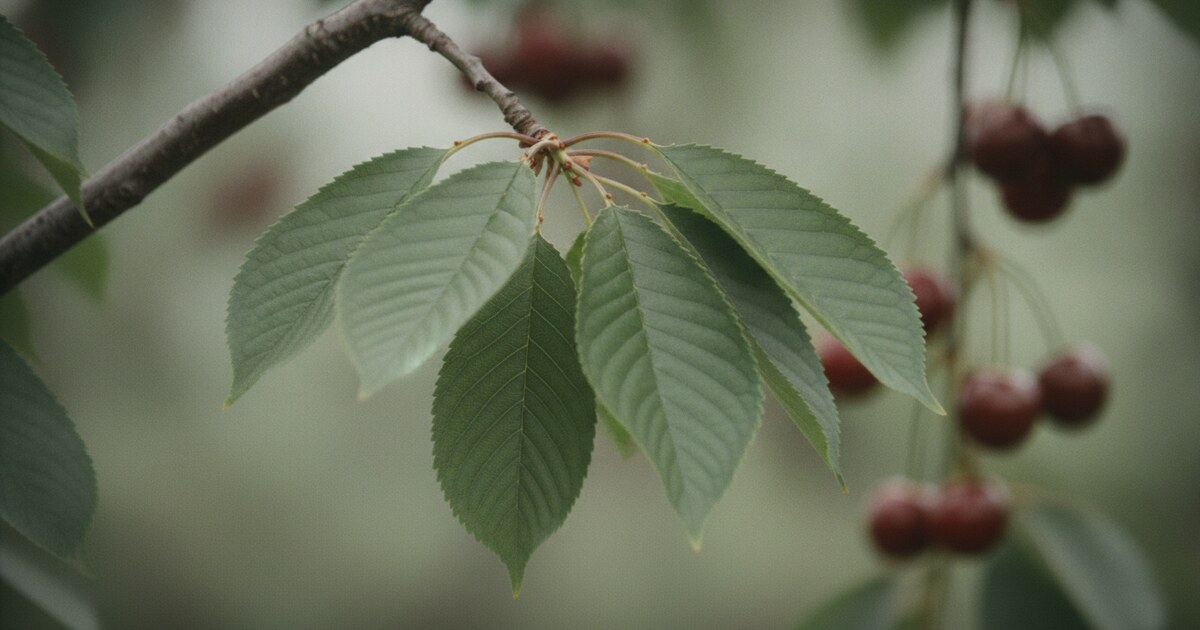
Cherry plant leaves are oval to lance-shaped, 5-15 cm long, with finely serrated edges and a pointed tip. The easiest confirmation is the leaf stalk: most cherry species carry 1 or 2 small reddish glands at the top of the petiole, right where it meets the blade. No other common garden tree has this gland.
What Cherry Plant Leaves Look Like
Cherry leaves are simple, meaning each leaf is a single piece rather than divided into leaflets. They attach to the branch one at a time in an alternating pattern, never in opposite pairs.
The shape is oval to lance-shaped, widest near the middle, tapering to a sharp point at the tip. The base curves gently down toward the stalk.
The edges carry fine, forward-pointing teeth that run all the way around. Run a fingernail along the margin and you’ll feel the serrations before you see them clearly. On ornamental varieties, each tooth often carries a secondary smaller tooth at its base, a doubly serrated edge that looks almost frilled under close inspection.
The upper surface is smooth and bright green. The underside is paler and may carry fine hairs along the main veins, particularly on wild species like bird cherry.
The single best field marker is the petiolar gland. Flip a cherry leaf over and check where the stalk meets the blade. Almost every cherry species has 1 or 2 small raised glands sitting right at that junction. On sweet cherry (Prunus avium), these are round and reddish. On black cherry (Prunus serotina), they’re placed at the top margin of the leaf blade itself rather than the stalk, and they’re copper-tipped rather than red. On sour cherry, they’re smaller and sometimes easy to miss.
Cherry plant leaves belong to the genus Prunus, which includes roughly 430 species. Leaves run 5-15 cm in length, oval to lance-shaped with a pointed tip and finely serrated margins. The most diagnostic field feature is the petiolar gland: 1 or 2 small raised glands at the junction of the leaf stalk and blade, present on nearly all cherry species. Sweet cherry (Prunus avium) carries 2 clear glands with leaves 7-12 cm. Sour cherry (Prunus cerasus) runs smaller at 4-8 cm. Black cherry (Prunus serotina) has narrower leaves, 6-14 cm long and 2-4 cm wide, with copper-tipped glands at the top margin of the leaf. Ornamental cherries like Prunus serrulata often show doubly serrated edges with secondary teeth at each primary tooth’s base. All cherry species arrange leaves alternately along the branch, and leaves turn yellow, orange, or red in autumn before dropping.
This one feature separates cherry plant leaves from plum, pear, and apple leaves. Those trees either lack the gland entirely or carry a less prominent version. Finding a clear reddish gland at the top of the stalk is the fastest single-point confirmation you have.
Cherry Plant Leaf Identification by Species
The genus Prunus covers dozens of cherry species, but most people encounter a handful regularly. Here’s what distinguishes each one’s leaves.
Sweet cherry (Prunus avium) produces leaves 7-12 cm long, oval to slightly broadened toward the tip, with a pointed apex and coarsely serrated margins. The 2 petiolar glands are prominent and reddish. Young leaves often emerge with a bronzy tint before turning dark green. This is the species most commonly found in orchards and large garden trees.
Ornamental cherry (Prunus serrulata and relatives) carries broader leaves, often 6-10 cm long and 3-5 cm wide, with a distinctly fringed, doubly serrated margin. The upper surface is smoother and glossier than sweet cherry. Some cultivars push out reddish-bronze leaves in spring before they green out through summer. The sakura tree guide covers each major ornamental cultivar and their specific leaf differences.
Sour cherry (Prunus cerasus) has smaller leaves than sweet cherry, running 4-8 cm. The upper surface is a shinier green, and the glands at the petiole are often less conspicuous. Sour cherry leaves also feel slightly stiffer to the touch.
Black cherry (Prunus serotina) is the common wild cherry of eastern North America. Its leaves are narrower and lance-shaped, 6-14 cm long. The glands are copper or rust-colored and sit near the top of the midrib rather than the stalk. The underside has a distinctive row of rusty hairs along the central vein. For bark, fruit, and full field guide details, see the black cherry tree identification article.
Bird cherry (Prunus padus) is common in British woodlands. Leaves are 6-12 cm with finely serrated edges and a dull rather than glossy surface. The glands sit on the stalk and are pale rather than red, making this species trickier to call with the gland test alone.
| Species | Leaf length | Gland color | Gland position | Serration |
|---|---|---|---|---|
| Sweet cherry (P. avium) | 7-12 cm | Reddish | Top of stalk | Coarse |
| Ornamental cherry (P. serrulata) | 6-10 cm | Reddish | Top of stalk | Doubly serrated |
| Sour cherry (P. cerasus) | 4-8 cm | Pale/small | Top of stalk | Medium |
| Black cherry (P. serotina) | 6-14 cm | Copper | Top of leaf margin | Fine |
| Bird cherry (P. padus) | 6-12 cm | Pale | Lower on stalk | Fine |
Cherry Leaves Through the Seasons
Cherry plant leaves aren’t the same color twice during the year. The timing and intensity of each change vary by species, but the pattern holds across the genus.
Spring brings crinkled new leaves that often carry a reddish or bronze tint on ornamental varieties and sweet cherry. By late spring they flatten out to full size and shade out to their characteristic green.
Summer leaves are bright to dark green above, paler below. The upper surface on sweet cherry and black cherry is smooth and hairless. This is the easiest season to use the petiolar gland test because the leaves are fully formed and easy to handle.
Fall color is understated compared to maples. Most cherry species turn yellow-green before shifting to yellow, orange, or dull red in October and November. Ornamental cherries tend to show more vivid reds than fruiting species. The color change typically happens fast, compressed into two to three weeks.
Winter leaves cherry trees bare from late November through March in most temperate climates. Without leaves, identification moves to bark, bud arrangement, and overall silhouette. The cherry tree identification guide covers winter ID methods alongside leaf identification for all four seasons.
Cherry Plant Leaves vs. Lookalike Trees
Cherry plant leaves are easiest to confuse with other Prunus species and with pome fruits like crabapple and pear. Here’s what separates them.
Cherry vs. plum. Plum leaves (Prunus domestica) are wider relative to their length, with a more rounded overall shape. The teeth tend to be blunter and less regular than cherry. The petiolar glands may be present on some plum varieties but are smaller and harder to spot. If the glands are obvious and the teeth are sharp and forward-pointing, it’s almost certainly a cherry.
Cherry vs. crabapple. Crabapple leaves typically lack petiolar glands entirely. They also have a less pointed tip and teeth that are often more rounded and irregular. The crabapple tree identification article covers leaf differences in full. When in doubt, check the stalk: no gland means no cherry.
Cherry vs. pear. Pear leaves have very fine teeth or sometimes almost none at all along the margins. They’re glossier than cherry and the texture feels leathery. Pear leaves also stay on the branch later into autumn than cherries in most climates.
Cherry vs. bird cherry. Bird cherry is a true Prunus, so the glands are present but paler and placed further down the stalk. Bird cherry leaves are also duller rather than semi-glossy, and the whole leaf feels slightly rougher to handle.
What Causes Yellow Leaves on a Cherry Plant?
Yellow leaves on a cherry plant have several possible causes. The pattern of yellowing points toward the right one.
Uniform yellowing across the whole canopy usually indicates a nutrient issue, most often nitrogen or iron deficiency. Nitrogen deficiency starts with older leaves at the base of the canopy and works upward. Iron deficiency (chlorosis) causes yellowing between the veins while the veins themselves stay green, giving the leaf a marbled look.
Small circular spots with yellowing around them point to cherry leaf spot, a fungal disease caused by Blumeriella jaapii. Infections start as small purple-red spots 3-6 mm across that later turn tan in the center. The infected tissue can drop out, leaving a “shot-hole” appearance. Wet springs favor this fungus, and infected leaves often drop early.
Yellowing that starts at leaf edges often signals drought stress or salt injury from road treatments or over-fertilizing near the root zone. Check soil moisture at root depth first.
Yellowing on a single branch only can indicate localized root damage, graft union problems in grafted trees, or a borer insect that’s cut off water flow to that branch.
Timing matters. Early yellowing in June or July is more likely to be disease or stress. Fall yellowing from September onward is natural senescence and needs no intervention.
Confirm It With Tree Identifier
Cherry plant leaves can be tricky to separate from other Prunus species in the field. The petiolar gland is a reliable marker, but distinguishing a reddish stalk gland from a copper leaf-margin gland, the difference between sweet cherry and black cherry, requires getting close and knowing what you’re looking for.
The Tree Identifier app can photograph a leaf, bark sample, or flower cluster and return a species-level identification in seconds. It works from multiple input types (leaves, bark, fruit, whole tree silhouette) and stores offline species data so it works on remote hikes without cell signal.
You get 2 free identifications per day with no subscription. For confirmed cherry IDs, the app shows habitat, range, and species characteristics you can compare against what you’re seeing in front of you.
Frequently Asked Questions
Do cherry plants need full sun? Most fruiting cherries need full sun (at least 6 hours of direct sunlight per day) to produce a good crop and stay disease-free. Ornamental cherries tolerate partial shade but show fewer flowers and develop a more open branch structure. Black cherry is the most shade-tolerant of the common species and often grows as an understory tree in mixed woodland.
How big are cherry plant leaves? Cherry leaf size varies by species. Sweet cherry runs 7-12 cm. Ornamentals like Prunus serrulata are similar at 6-10 cm. Sour cherry is smaller at 4-8 cm. Black cherry is longer but narrower: 6-14 cm long and only 2-4 cm wide. All fall into the small-to-medium range by tree standards.
What do cherry plant leaves look like in fall? Most cherry species turn yellow-green before shifting to yellow, orange, or dull red. The color is less vivid than maples. Ornamental cherries tend toward more noticeable reds, while sweet and sour cherry usually stay in the yellow-orange range. The color change typically runs over two to three weeks in October and November.
How do you tell cherry leaves from plum leaves? Cherry leaves are more elongated, taper to a sharper tip, and carry finer, more regular serrations than plum. The clearest difference is the petiolar gland: cherry has obvious reddish glands at the top of the leaf stalk, while plum may have smaller or absent glands. Cherry leaves also tend to have a shinier surface than plum.
What do cherry plant leaves smell like? Crush a fresh cherry leaf and you’ll get a faint almond-like scent from benzaldehyde compounds in the leaf tissue. Black cherry is especially notable for this. The smell is often described as marzipan or bitter almond, and it’s a useful field confirmation when other markers are ambiguous.
If you’ve got an unidentified tree in front of you, the Tree Identifier app can confirm a cherry species in seconds from a leaf or bark photo. It’s free on iOS and Android, with 2 free identifications per day. You can also try the free web tool if you’re already on your phone.
Identify a tree from your photo — free
Upload a leaf, bark, or whole-tree photo and get the species in seconds. No signup.
Confidence:
Unlock the full species profile
Free in the app — with unlimited identifications.


AI result for guidance — the app gives full species details and works offline.
Want unlimited identifications?
Get the full species profile, photos and details — free in the app, with unlimited scans.
- Unlimited identifications
- Full species profiles & details
- Works offline, anywhere
- Save and revisit your finds

Elena Torres
Tree Identifier Team