Pin Cherry Tree: How to Identify Prunus pensylvanica
You’re walking the edge of a recently burned patch or a stretch of forest that was logged a few seasons back when you spot a thicket of slender trees with glossy reddish bark and tiny clusters of bright red fruit. That’s almost certainly a pin cherry tree (Prunus pensylvanica), one of North America’s fastest-colonizing pioneer species. It claims disturbed ground quicker than nearly any other tree, making it a common sight in logged areas, roadsides, and forest margins from Newfoundland to the Rockies.
Pin cherry trees grow fast and die young, reaching about 30 feet and rarely surviving past 40 years. Despite their brief lives, they anchor forest recovery and feed dozens of wildlife species. This guide covers every field-identification feature so you can confirm a pin cherry from bark to fruit.
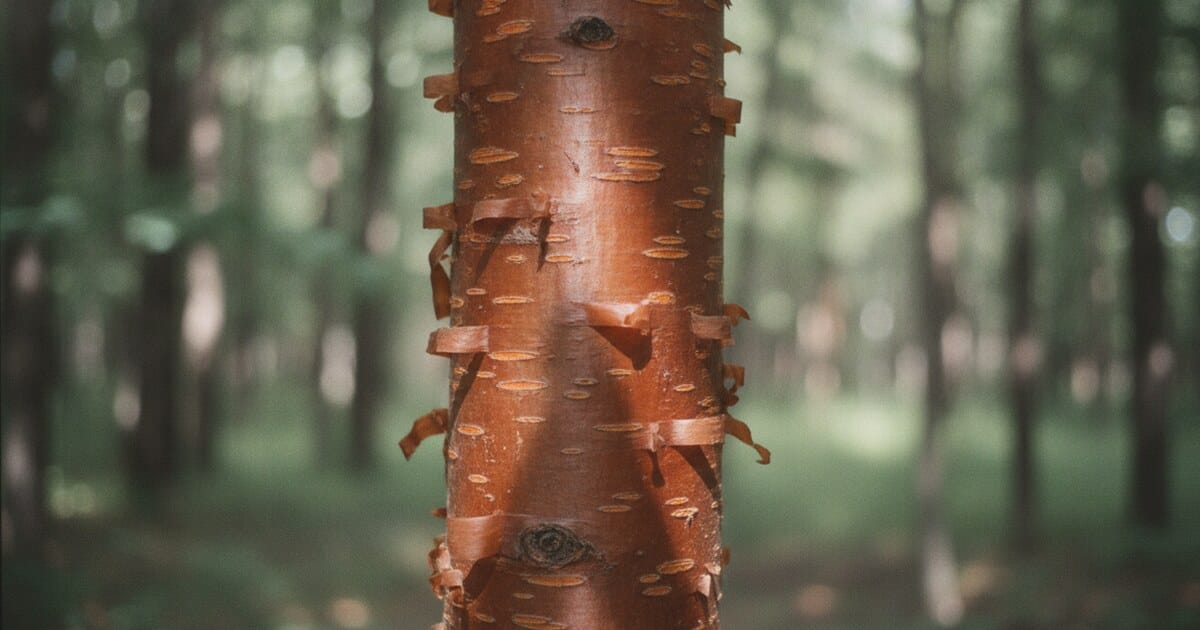
Pin cherry trees (Prunus pensylvanica) are small deciduous trees, 20-30 feet tall, with shiny reddish-brown bark marked by horizontal orange lenticels that peel in thin horizontal strips. Leaves are lance-shaped, 2-3.5 inches long, finely serrated. Flowers are white, 5-petaled, in clusters of 3-7, blooming May-June. Fruit are bright red drupes, about 1/4 inch across, ripening July-August.
Pin Cherry Tree at a Glance
| Feature | Detail |
|---|---|
| Scientific name | Prunus pensylvanica |
| Common names | Pin cherry, fire cherry, bird cherry, wild red cherry |
| Family | Rosaceae (rose family) |
| Height | 20-30 ft |
| Spread | 18-25 ft |
| Lifespan | 20-40 years |
| Hardiness zones | 2-5 |
| Fruit | 1/4 in. red drupe, July-August |
| Bark | Shiny reddish-brown, horizontal orange lenticels |
| Habitat | Disturbed ground, clearings, forest edges |
Bark: The Fastest Field ID
Bark is the best place to start when identifying a pin cherry. Even from 20 feet away, the smooth, shiny reddish-brown trunk stands out in a crowd of gray-barked hardwoods. Look for horizontal orange-colored bands called lenticels running around the trunk and branches.
These lenticels are breathing pores that let gas exchange through the bark, and on pin cherry they’re unusually prominent and orange-tinted.
Young bark peels in thin horizontal strips, similar to birch but tighter and more reddish. As the tree ages, the bark darkens from reddish-brown toward gray but keeps the horizontal lenticel pattern throughout its life. Scratch a twig or peel a small piece of bark and you’ll catch a faint bitter almond scent from prussic acid in the tissue, a trait shared across most Prunus species.
Pin cherry (Prunus pensylvanica) belongs to the rose family (Rosaceae) and is native to northern and eastern North America, ranging from Labrador and Newfoundland south to the mountains of North Carolina, then west through the Great Lakes region to the Pacific Northwest. It grows in USDA hardiness zones 2 through 5. At maturity, pin cherry typically reaches 20-30 feet tall with an 18-25 foot spread and a narrow columnar crown. Trunk diameter at breast height maxes out around 6.5 inches. The bark is the definitive field marker: shiny reddish-brown on young trees, with conspicuous horizontal orange lenticels that peel in horizontal strips. Leaves are lance-shaped to oval-elliptic, 2-3.5 inches long, with finely toothed margins. The petiole, 0.5-0.75 inches long, carries a pair of small glands near the blade base. Flowers appear in May-June in clusters of 3-7. Fruit are bright red drupes, 1/4 inch across, ripening in July-August. The tree is fast-growing but short-lived, with a lifespan of 20-40 years.
Leaves, Flowers, and Fruit
Leaves
Pin cherry leaves are alternate and simple, lance-shaped to narrowly oval with a pointed tip. Each leaf is 2-3.5 inches long and 0.75-1.5 inches wide. The margins are finely and evenly serrated.
The upper surface is dark green and shiny. Turn a leaf over and the underside is paler, sometimes with a few hairs along the veins.
Check the petiole: it carries a pair of small glands near where it meets the blade. That petiolar gland is a classic Prunus marker and helps separate pin cherry from non-cherry look-alikes. Fall color ranges from bright yellow to orange-red.
Flowers
Pin cherry blooms in May or June depending on latitude. The flowers are white, about 0.5 inches across, with 5 rounded petals and a spray of yellow-tipped stamens in the center. They appear in umbels of 3-7 flowers, all stems rising from one point, opening around the same time the leaves emerge or just after.
The flowers are mildly fragrant and attract early pollinators.
Fruit
Each drupe is about 1/4 inch across, bright red and shiny when ripe in July-August. The fruit hangs on long, slender stems in clusters of 3-5 along the branch. Inside is a single hard pit.
The flesh is quite tart and astringent straight off the tree, though birds and mammals eat it eagerly. People use pin cherries for jelly, jam, and wine, usually with added sugar to balance the tartness.
Pin Cherry vs. Similar Trees
Three species cause the most confusion: black cherry, chokecherry, and crabapple.
| Feature | Pin Cherry | Black Cherry | Chokecherry |
|---|---|---|---|
| Height | 20-30 ft | 60-80 ft | 15-30 ft |
| Bark (mature) | Reddish-brown, peeling strips, orange lenticels | Dark brown, rough scaly plates | Grayish-brown, finely fissured |
| Leaf width | 0.75-1.5 in. | 1-2 in. | 1.5-3 in. (broader) |
| Fruit cluster | Umbel, 3-5 drupes | Raceme, 20+ drupes | Raceme, 15-30 drupes |
| Ripe fruit color | Bright red | Dark red to black | Dark purple-black |
| Habitat | Pioneer, disturbed sites | Mature forest, roadsides | Disturbed sites, woodland edges |
Black cherry (Prunus serotina) is the easiest to separate. It grows far larger, reaching 60-80 feet, with rough, dark-brownish bark that breaks into small plates resembling burnt potato chips on mature trunks. Its fruit hangs in elongated racemes of 20 or more drupes, not short umbels. If you’re not sure whether the tree is a black cherry, bark texture and fruit cluster length are the two fastest checks.
Chokecherry (Prunus virginiana) is the trickiest look-alike. It shares similar habitat, similar fruit, and similar size. The key differences: chokecherry leaves are broader and more oval (1.5-3 inches wide vs. 0.75-1.5 inches for pin cherry), and the fruit hangs in long racemes of 15-30 drupes that turn dark purple-black at full ripeness. Chokecherry bark is darker and doesn’t have pin cherry’s distinctive orange lenticels.
Crabapple trees sometimes occupy the same disturbed-ground habitat. Crabapples have wider, more oval leaves with no petiolar glands, their bark doesn’t peel in horizontal strips, and they produce small apple-like pomes, not drupes. Many crabapples also carry short, spine-like spur branches on older growth.
Why Pin Cherry Is Called Fire Cherry
The common name “fire cherry” tells you a lot about how this tree makes its living. After a wildfire, logging operation, or severe windstorm knocks down the forest canopy, pin cherry is usually the first tree to claim the open ground.
The secret is in the seeds. Pin cherry seeds have an unusually thick coat that lets them stay dormant in the soil for 50-100 years, waiting for disturbance. When a fire burns through or a large tree falls and floods the ground with light, the altered temperature and light conditions trigger mass germination. Within two or three growing seasons, cleared land can fill with pin cherry saplings.
Pin cherry doesn’t hang around long once its job is done. The same fast growth that gets it to 15 feet in a few years also burns through its resources, and most individual trees die off at 20-40 years. By then they’ve shaded out competing weeds, improved the soil with leaf litter, and created the conditions shade-tolerant hardwoods need.
Ecologists call this the “nurse crop” function. The cherry tree family has several pioneer-adapted members, but Prunus pensylvanica is the most committed to the role.
Wildlife Value and Human Uses
The 1/4-inch red fruit feeds an outsized number of animals. Researchers have recorded 25 or more species of nongame songbirds eating pin cherries, including thrushes, waxwings, and robins.
Ruffed grouse and sharp-tailed grouse eat the buds heavily in winter. White-tailed deer browse the foliage and twigs, and larger mammals including black bears and foxes consume the fruit when it ripens.
The fruit is also edible for people, though you’d need to pick a good quantity given the small size of each drupe. Pin cherry jelly has a bright, tart flavor that pairs well with game meat or aged cheese. The pits contain cyanogenic compounds, as with all Prunus species, so don’t crush or eat them.
Pin cherry wood is light and soft, used mainly for fuel and pulpwood rather than furniture or millwork. It doesn’t have the commercial value of black cherry, but on a small homestead the dense thickets provide a ready firewood source. The trees are also planted for wildlife habitat and soil stabilization on disturbed sites.
Frequently Asked Questions
How big does a pin cherry tree typically grow?
Pin cherry typically reaches 20-30 feet tall with a spread of 18-25 feet. It grows fast, often adding 1-2 feet per year in good conditions, but the trade-off is a short lifespan of 20-40 years. Trunk diameter rarely exceeds 6.5 inches at breast height.
How do you tell a pin cherry from a chokecherry?
Look at the leaves and fruit clusters. Pin cherry has narrow lance-shaped leaves, 0.75-1.5 inches wide, while chokecherry leaves are broader and more oval (up to 3 inches wide). Pin cherry fruit hangs in short umbels of 3-5 drupes that stay red when ripe. Chokecherry fruit hangs in long racemes of 15-30 drupes and turns dark purple-black at full ripeness.
Is pin cherry fruit edible?
Yes, the flesh is edible. It’s quite tart and astringent raw, but pin cherries are used for jelly, jam, preserves, and wine with added sugar to balance the acidity. Don’t eat or crush the pits: like all Prunus species, pin cherry pits contain cyanogenic compounds.
Is Prunus pensylvanica the same as a cherry blossom tree?
No. Cherry blossom trees are ornamental Prunus varieties from East Asia, most commonly Prunus serrulata or Prunus x yedoensis, grown for their large pink or white flowers. Prunus pensylvanica is a North American native valued for wildlife habitat and forest recovery. Its flowers are small and white, not the showy blossoms associated with cherry blossom festivals.
Spotted a glossy-barked tree in the field and want to confirm the species? Tree Identifier can ID pin cherry and hundreds of other native trees from a single photo of the leaves, bark, or fruit. Download for iOS or Android, or try a free scan at treeidentifier.app/tools/tree-identifier.
Identify a tree from your photo — free
Upload a leaf, bark, or whole-tree photo and get the species in seconds. No signup.
Confidence:
Unlock the full species profile
Free in the app — with unlimited identifications.


AI result for guidance — the app gives full species details and works offline.
Want unlimited identifications?
Get the full species profile, photos and details — free in the app, with unlimited scans.
- Unlimited identifications
- Full species profiles & details
- Works offline, anywhere
- Save and revisit your finds

Elena Torres
Tree Identifier Team