Ornamental Trees: 15 Best Species and How to Spot Each
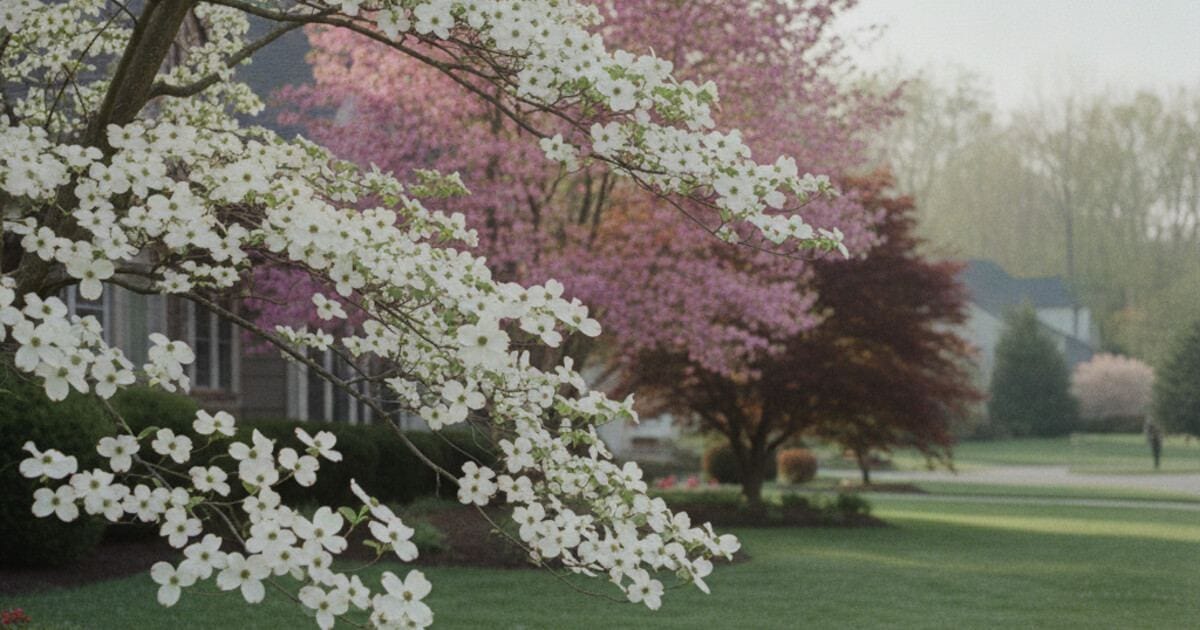
Drive through any older neighborhood in April and you can pick out the yards where someone chose their trees on purpose. A redbud lit up magenta against a fence. A dogwood floating white above the lawn.
Ornamental trees do one job: they make a yard worth looking at, and the good ones do it in more than one season. This guide covers 15 ornamental trees that earn their spot, organized by what they’re grown for, with the identification features that tell each one apart. I’ve keyed out most of these on community walks, and a few (like serviceberry and paperbark maple) I’d plant in almost any yard in the country.
The best ornamental trees for most yards are flowering dogwood, eastern redbud, Japanese maple, crape myrtle, and serviceberry. All five stay under 30 feet, offer at least two seasons of visual interest, and fit a typical suburban lot. In warm zones 9 to 11, jacaranda is the standout choice.
What Makes a Tree Ornamental?
An ornamental tree is planted primarily for its looks: flowers, foliage color, bark texture, or branching form, rather than for shade, fruit, or timber. Most ornamental trees mature between 15 and 30 feet, which puts them well under classic shade species like oaks and maples that reach 60 feet or more. That smaller size is the point. A 20-foot tree fits under power lines, sits safely 10 to 15 feet from a foundation, and keeps its flowers at eye level where you can actually see them. The strongest ornamental choices earn their spot in at least two seasons: serviceberry gives white flowers in April, berries in June, and orange fall color; paperbark maple peels cinnamon-colored bark all winter. Single-season trees like Bradford pear (two showy weeks, then 50 weeks of weak branching) are the ones landscapers now avoid.
Many of these trees are tougher than their looks suggest. Crape myrtles shrug off drought and 100-degree summers, and river birch handles soggy soil that would kill most flowering species.
If your goal is quick screening height or canopy rather than looks, that’s a different shopping list. Our fast growing trees guide ranks trees by growth speed, and the best shade trees for a backyard covers the big canopy species.
Flowering Ornamental Trees Worth Planting
Flowering species carry the ornamental category. These 6 are the ones people photograph and then ask about.
1. Flowering dogwood (Cornus florida). The white “petals” are actually 4 bracts, each with a notch at the tip, surrounding a cluster of tiny true flowers. ID checks: opposite leaves with veins that curve toward the tip, and mature bark broken into small square blocks, like alligator skin. Grows 15 to 30 feet in zones 5 to 9. Red berries feed birds in fall.
2. Eastern redbud (Cercis canadensis). Magenta-pink pea-shaped flowers open directly on bare branches and even on the trunk itself (a trait called cauliflory that almost no other North American tree shares). Heart-shaped leaves follow the flowers. Zones 4 to 9, 20 to 30 feet tall with a wide, flat crown.
3. Crape myrtle (Lagerstroemia indica). The South’s summer workhorse, blooming June through September when almost nothing else is. Flowers are crinkled like crepe paper, in white, pink, red, or purple. Off-season ID is easy too: smooth, mottled bark that sheds in patches of gray, tan, and cinnamon. Zones 6 to 10.
4. Saucer magnolia (Magnolia × soulangeana). Goblet-shaped pink-and-white flowers up to 6 inches across, opening on bare branches in early spring. Look for smooth gray bark and fuzzy, silver flower buds all winter. Grows 20 to 25 feet, zones 4 to 9. Frost can brown an early bloom, so northern gardeners often get 2 great years out of 3.
5. Yoshino cherry (Prunus × yedoensis). The Washington, D.C. cherry. Clouds of pale pink to white blossoms before the leaves, usually lasting 10 to 14 days. Check the bark: satiny gray-brown with horizontal lenticels (raised dash-like lines), the signature of the whole cherry group. Zones 5 to 8, 30 to 40 feet.
6. Jacaranda (Jacaranda mimosifolia). In zones 9 to 11, nothing matches it: purple trumpet-shaped flowers covering the whole canopy in late spring, then carpeting the ground below. Fern-like, twice-divided leaves make it easy to name even out of bloom. Reaches 25 to 40 feet in Southern California, Florida, and the desert Southwest.
Ornamental Trees Grown for Foliage and Bark
Flowers last weeks. Leaves and bark work from spring through winter, which is why these 5 anchor so many designed landscapes.
7. Japanese maple (Acer palmatum). The most planted ornamental foliage tree in America, with hundreds of cultivars from 4-foot mounds to 25-foot uprights. ID features: palm-shaped leaves with 5 to 9 pointed lobes, opposite branching, and layered, horizontal structure. Fall color runs scarlet to orange. Zones 5 to 8, best with afternoon shade in hot climates.
8. Smoke tree (Cotinus coggygria). After the small flowers fade in early summer, the spent stalks puff into hazy pink plumes, so the whole crown looks wrapped in smoke. Purple-leaved cultivars like ‘Royal Purple’ hold deep burgundy foliage all season. Oval, blue-green to purple leaves, 10 to 15 feet, zones 4 to 8.
9. Purple-leaf plum (Prunus cerasifera). Pale pink flowers come early, but the draw is foliage that stays dark burgundy from spring leaf-out to fall. One of the few purple-leaved trees that doesn’t fade to green in summer heat. Short-lived (15 to 20 years) but fast to establish. Zones 5 to 9.
10. Paperbark maple (Acer griseum). Cinnamon-brown bark peels back in thin, translucent curls year-round, and low winter sun lights it up. Leaves are trifoliate (3 leaflets), unusual for a maple. Slow-growing to 20 to 30 feet, zones 4 to 8. Expensive at the nursery because it’s hard to propagate, and worth it.
11. River birch (Betula nigra). Salmon-pink to cream bark exfoliates in papery sheets on young trunks. It’s one of the few ornamental-bark trees that also grows fast (2 to 3 feet a year) and tolerates wet clay, which is why it made our fast-growing list too. Usually sold multi-trunked. Zones 4 to 9.
Small Ornamental Trees for Tight Spaces
Under 25 feet, these 4 fit courtyards, corners near the house, and lots where a full-size tree won’t. For a deeper list built around cramped yards, see our best trees for small yards guide.
12. Serviceberry (Amelanchier × grandiflora). White star-shaped flowers in early April, blueberry-sized purple fruit in June (edible, and birds race you for it), then orange-red fall color. Smooth gray bark with faint vertical striping. Usually multi-stemmed, 15 to 25 feet, zones 4 to 9. The best four-season pick on this list.
13. Flowering crabapple (Malus cultivars). Spring bloom in white through deep rose, but choose by fruit: modern cultivars like ‘Prairifire’ and ‘Adirondack’ hold small red fruit into winter and resist the scab disease that defoliated older types. 15 to 20 feet, zones 4 to 8.
14. Star magnolia (Magnolia stellata). Blooms earlier than saucer magnolia, with strap-like white petals in loose stars, 12 to 18 per flower. Compact and shrubby at 15 to 20 feet, zones 4 to 8. Fuzzy winter buds confirm the magnolia family.
15. Japanese stewartia (Stewartia pseudocamellia). White camellia-like flowers in June and July, after most flowering trees finish. Bark flakes into a camouflage patchwork of orange, gray, and green. Slow to 20 to 40 feet, zones 5 to 8. Collectors’ favorite, and among the few on this list that genuinely dislike drought.
One siting note before you buy: even small ornamentals need room from foundations, walks, and pipes. Our guide to the best trees to plant near a house covers safe distances by species.
How to Identify an Ornamental Tree You Don’t Recognize
Ornamental trees are the hardest group to name from memory because so many are cultivars: a purple-leaf plum looks nothing like the wild plum in a field guide, and there are hundreds of crabapple varieties.
The Tree Identifier app is built for exactly this problem. Photograph the flowers, leaves, bark, or the whole tree, and the AI matches your photo against thousands of species with a confidence score for each result. Bark shots work surprisingly well for winter ID, when a crape myrtle and a stewartia both stand leafless. Each match includes the species’ characteristics and habitat, so you can check the details yourself against the tree in front of you.
You get 2 free identifications a day on iOS and Android, and offline mode covers you at an arboretum or park with no signal. Want to test it right now? The free web tree identifier runs in your browser: upload a photo of that mystery tree from your neighbor’s yard and see what comes back.
Frequently Asked Questions
What is the most popular ornamental tree?
By nursery sales, flowering dogwood, crape myrtle, and Japanese maple lead in the U.S. Crape myrtle dominates the South (it blooms for up to 100 days), while Japanese maple leads in cooler zones. Redbud has climbed fast in the last decade because it tolerates more soil types than dogwood.
What ornamental tree blooms the longest?
Crape myrtle, at 60 to 100 days from June into September. Most spring-flowering ornamentals like cherry, magnolia, and dogwood bloom for only 2 to 3 weeks. Reblooming lilac and chaste tree also stretch past a month, but neither matches a crape myrtle in full summer sun.
Are ornamental trees messy?
Some are. Purple-leaf plum and crabapple drop fruit; saucer magnolia sheds large petals that brown on pavement. Low-mess picks include serviceberry (birds strip the fruit within days), paperbark maple, stewartia, and seedless crape myrtle cultivars.
What’s the difference between an ornamental tree and a shade tree?
Size and purpose. Ornamental trees typically top out at 15 to 30 feet and are chosen for flowers, foliage, or bark. Shade trees like oaks and maples reach 50 feet or more and are chosen for canopy. A yard usually has room for one shade tree and several ornamentals.
Found an ornamental tree you can’t name, in a park, a nursery lot, or your own backyard? Snap a photo with Tree Identifier and get the species with a confidence score in seconds. It’s free to start with 2 identifications a day, or try the browser version first, no download needed.
Identify a tree from your photo — free
Upload a leaf, bark, or whole-tree photo and get the species in seconds. No signup.
Confidence:
Unlock the full species profile
Free in the app — with unlimited identifications.


AI result for guidance — the app gives full species details and works offline.
Want unlimited identifications?
Get the full species profile, photos and details — free in the app, with unlimited scans.
- Unlimited identifications
- Full species profiles & details
- Works offline, anywhere
- Save and revisit your finds
Elena Torres
Tree Identifier Team