Desert Willow: Identification, Flowers, and Growing Guide
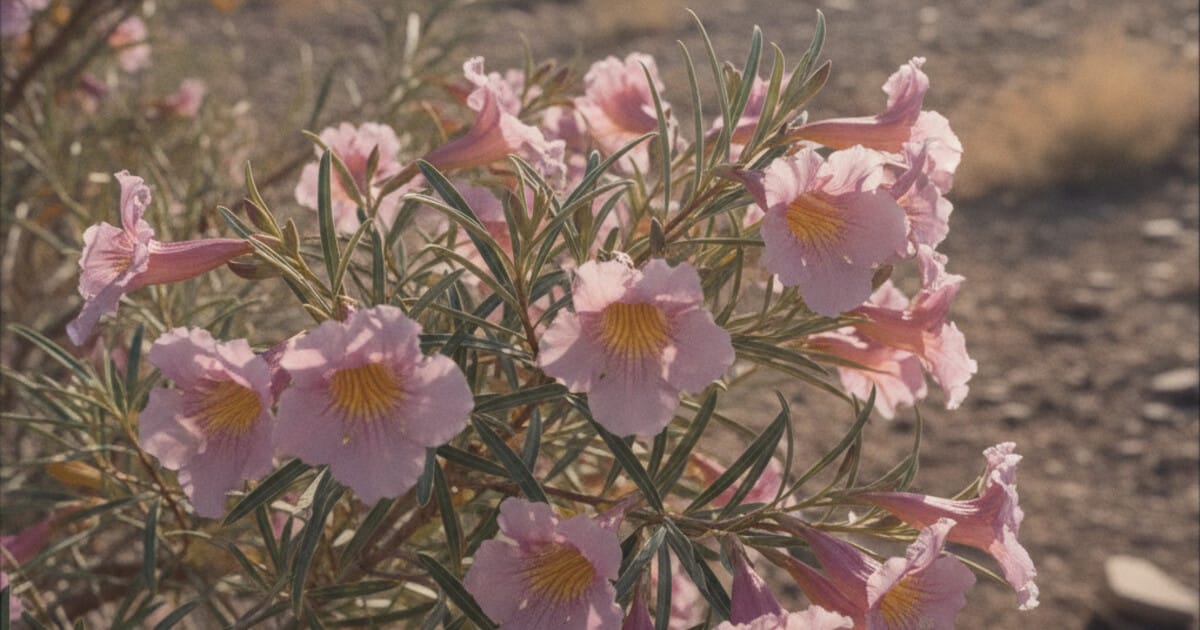
Desert willow (Chilopsis linearis) is one of the Southwest’s most distinctive native trees, flowering from May through September with showy trumpet blooms in shades of pink, lavender, and white. Despite the name, it’s not a willow at all. Botanists placed it in the Bignoniaceae family alongside catalpa and trumpet vine, but early settlers named it for its long, slender leaves, which look strikingly willow-like at a glance. You’ll find it growing naturally in dry washes, arroyos, and desert canyon floors from Texas west to California and deep into northern Mexico.
Desert willow (Chilopsis linearis) is a small, drought-tolerant tree native to the Chihuahuan and Sonoran Deserts. It grows 15-25 feet tall and blooms spring through fall with tubular, orchid-like flowers in pink, purple, or white. Narrow, 2-5-inch leaves and long, slender seed pods that persist through winter distinguish it from true willows, which belong to the unrelated Salicaceae family.
What Is the Desert Willow?
Chilopsis linearis is the sole species in its genus, making it botanically unique. The species name linearis refers to the linear, strap-like leaves. Its closest relatives are catalpa trees and trumpet creeper vine, which all share the same tubular flower structure with ruffled lobes. Despite the borrowed common name, desert willow has nothing in common with weeping willows or black willows.
Desert willow grows natively across the Chihuahuan and Sonoran Deserts, spanning southwestern Texas, New Mexico, Arizona, southern California, Nevada, and Utah in the US, extending south through Baja California, Sonora, and Chihuahua in Mexico. It colonizes dry washes, rocky arroyos, and alluvial fans that catch seasonal flash floods. In that habitat it thrives on 8-12 inches of annual rainfall once established. The tree typically reaches 15-25 feet tall and 10-15 feet wide, with old canyon wash specimens hitting 30 feet. Young trees grow 3-5 feet per year in good conditions. USDA zones 7-11 cover the full natural range, and established plants handle temperatures as low as -5°F with minimal trunk damage. Tubular flowers run 1-1.5 inches long and bloom May through September. Seed pods grow 4-12 inches long and hang on bare branches through winter, making the species identifiable even after leaf drop.
In the wild, desert willow grows in the same dry watercourses as cottonwood and Arizona sycamore, rooted in the sandy or gravelly deposits left by seasonal floods. In gardens, it’s one of the best-performing flowering trees for the Southwest specifically because it tolerates both summer heat and periods of no rain.
How to Identify a Desert Willow: Leaves, Flowers, and Pods
Four features make desert willow almost unmistakable in the field.
Leaves
The leaves are long and narrow, typically 2-5 inches long but less than half an inch wide, tapering to a fine point at both ends. They emerge slightly sticky in spring and feel smooth once fully mature. Color is medium to pale green, sometimes slightly gray-green. On young growth the leaves may appear opposite or in whorls; on older branches they tend toward alternate. The leaf shape is what gave the tree its common name: standing at a distance, a leafy desert willow really does look like a small willow.
Flowers
The flowers are the tree’s most reliable ID feature. Each bloom is tubular and trumpet-shaped, about 1-1.5 inches long, with ruffled, frilly petals that flare open at the face. The inside of the throat carries yellow or white streaks that guide pollinators toward the nectar. Color ranges from pure white through pale pink and lavender to deep purple, with bicolor forms (white with purple streaks or margins) common across wild populations. Flowering runs from May or June through late September in most of the range, making this one of the longest-blooming native trees in the Southwest. Hummingbirds and native bees are the primary visitors. For comparison with other flowering native trees, see the flowering tree identification guide.
Seed pods
After pollination, the flowers give way to long, slender pods. These pods look like narrow bean pods, measuring 4-12 inches long and about a quarter inch in diameter. They dry to brown or tan and split lengthwise in fall or winter to release papery-winged seeds. The pods often hang on bare branches through winter, which is a useful winter ID marker: a multi-stemmed desert shrub or small tree with drooping, narrow brown pods in a dry arroyo is almost certainly a desert willow.
Bark
Young branches are smooth and gray-green. Older trunks develop gray-brown bark that becomes shaggy and fibrous with age, peeling in thin strips. Multi-stemmed form is common because the tree often sprouts from the base after cold damage or cutting.
Desert Willow vs. True Willows: Key Differences
This is the comparison most people want when they search for desert willow. The leaf shape causes genuine confusion, but the two groups are easy to separate once you know what to look for.
True willows (genus Salix) belong to the Salicaceae family. Their flowers are inconspicuous catkins that appear in early spring, often before the leaves. Seeds release immediately after flowering with fluffy white fibers attached. True willows grow near permanent water: stream banks, pond edges, wetlands. Most are fast-growing but relatively short-lived.
Desert willow belongs to Bignoniaceae alongside catalpa and jacaranda. Its flowers appear in late spring after the leaves, continuing through summer, and they’re large and showy rather than catkin-like. Seed pods persist for months. Desert willow grows in dry sites and rots quickly in poorly draining soil. While it grows near seasonal water in the wild, it doesn’t need a permanent water source the way true willows do.
The quickest field distinction: flowers and location. A shrubby tree in a dry arroyo with trumpet-shaped pink or purple flowers and long narrow seed pods is a desert willow. A tree leaning over a creek with small early-spring catkins and cottony seeds is a true willow. The willow tree identification guide covers all major Salix species if you’re trying to distinguish those from each other.
Desert Willow Cultivars Worth Knowing
The straight species (Chilopsis linearis) performs well and is widely available at Southwest nurseries. Several named cultivars offer specific flower colors, more compact growth, or better cold hardiness.
- ‘Bubba’ (also sold as ‘Monow’): Dark purple flowers, vigorous growth, considered one of the most heat-tolerant selections. Common in Texas xeriscape plantings.
- ‘Regal’: Large purple and white bicolor flowers, strong upright habit to about 20 feet. Good for larger spaces.
- ‘Lucretia Hamilton’: Deep rose-pink, introduced by Rancho Santa Ana Botanic Garden, considered one of the longest-blooming selections.
- ‘White Storm’ (trade name for ‘Monhews’): Pure white flowers on a more compact plant, useful for contrast in mixed plantings.
- ‘Dark Storm’: Deep burgundy-purple flowers, compact at 12-15 feet, bred for colder zone 7 gardens.
For zone 7 gardens where cold hardiness matters, ‘Dark Storm’ and ‘Bubba’ are the safest named selections. In warmer zones (9-11), the straight species performs well and blooms abundantly.
Growing Desert Willow: Sun, Soil, and Water
Desert willow is one of the more straightforward native trees to establish in the Southwest, provided you get the drainage right.
Sun and soil. Full sun, well-draining soil. Sandy, rocky, or loamy sites all work. Desert willow fails in heavy clay or any spot where water pools after rain. In clay-heavy yards, raising the planting area by 6-12 inches or amending the planting hole with coarse sand and gravel gives roots enough drainage to survive.
Watering. Water weekly for the first growing season to build the root system. After the first year, taper to deep watering once every 2-3 weeks through summer. Established trees in zones 9-11 often handle rainfall alone. In hotter inland areas, monthly deep watering extends the bloom period into September. Overwatering is a more common cause of failure than underwatering once the tree is past its first year.
Cold tolerance. In zone 7, the top growth may die back in hard winters but roots typically survive and resprout from the base in spring. Cut dead trunks to the ground and let the strongest shoots develop. By the second year after freeze damage, most plants reach their prior height.
Pruning. Desert willow tolerates hard pruning. Remove dead or crossing branches in late winter before new growth starts. Single-trunk training is possible with consistent pruning of basal sprouts; the natural habit is multi-stemmed and somewhat open. Both forms flower equally well.
Wildlife value. Hummingbirds, particularly broad-tailed, black-chinned, and Costa’s hummingbirds, work the flowers heavily during migration corridors through the Southwest. Native bees, including carpenter bees and bumble bees, are regular pollinators. The canopy provides nesting cover for smaller birds.
Desert willow pairs well with other drought tolerant trees like palo verde, blue palo verde, and Texas mountain laurel, where the overlapping bloom seasons provide continuous color from spring through fall. For garden uses specifically in the Southwest, see also the guide to Texas native trees, which covers several species that share desert willow’s habitat and complement it well in xeriscape plantings.
How Tree Identifier Can Help
If you spot a desert willow in the field or want to confirm a garden specimen, Tree Identifier’s AI photo analysis works from leaf, flower, or bark photos. Upload a close-up of the tubular flower, the narrow leaves, or the distinctive seed pods and the app returns the species ID with native range details. The app covers thousands of Southwest native species including the Bignoniaceae relatives that share desert willow’s tubular flower type.
Tree Identifier is free to start with 2 daily identifications on iOS and Android. You can also try the web-based tree identifier tool directly in your browser for a quick check without downloading anything.
Frequently Asked Questions
Is desert willow a true willow?
Desert willow (Chilopsis linearis) is not a true willow. It belongs to the Bignoniaceae family alongside catalpa and trumpet vine. True willows belong to the Salicaceae family. The name comes from the long, narrow leaves, which resemble willow foliage, but the showy tubular flowers and persistent seed pods separate it clearly from any Salix species.
How fast does desert willow grow?
Desert willow grows 3-5 feet per year in good conditions during the first several years, slowing once it reaches mature height. In poor soils or without supplemental water during establishment, growth runs closer to 1-2 feet per year. By the third or fourth growing season in zones 8-11, most plants reach 10-15 feet and bloom heavily.
When does desert willow bloom?
Desert willow typically starts blooming in May or June and continues through September in most of its range. In warmer climates (zones 9-11) the bloom period can run from April into October. The long bloom period, covering most of summer, makes it one of the best flowering native trees for hummingbird and pollinator habitat in the Southwest.
How cold-hardy is desert willow?
Desert willow is hardy in USDA zones 7-11. Established plants survive temperatures down to about -5°F before significant trunk damage occurs. In zone 7, the top may die back in severe winters, but roots usually survive and the plant resprouts from the base. The cultivar ‘Dark Storm’ is among the hardiest named selections, bred for colder zone 7 gardens.
Where do desert willows grow naturally?
Desert willows grow naturally in dry washes, rocky arroyos, and alluvial fans across the Chihuahuan and Sonoran Deserts. Their native range covers southwestern Texas, New Mexico, Arizona, southern California, southern Nevada, and southwestern Utah in the US, with the range continuing south through Baja California, Sonora, and Chihuahua in Mexico.
Desert willow earns its place in any Southwest garden that gets genuine summer heat. Long bloom season, serious drought tolerance after year one, and flowers that pull in hummingbirds from July through September make it one of the most practical flowering trees in zones 7-11. Download Tree Identifier to identify desert willows and other Southwest native trees from leaf, bark, or flower photos, available on iOS and Android with offline mode for field use.
Identify a tree from your photo — free
Upload a leaf, bark, or whole-tree photo and get the species in seconds. No signup.
Confidence:
Unlock the full species profile
Free in the app — with unlimited identifications.


AI result for guidance — the app gives full species details and works offline.
Want unlimited identifications?
Get the full species profile, photos and details — free in the app, with unlimited scans.
- Unlimited identifications
- Full species profiles & details
- Works offline, anywhere
- Save and revisit your finds
Elena Torres
Tree Identifier Team