Florida Native Trees: 14 Species Every Homeowner Should Know
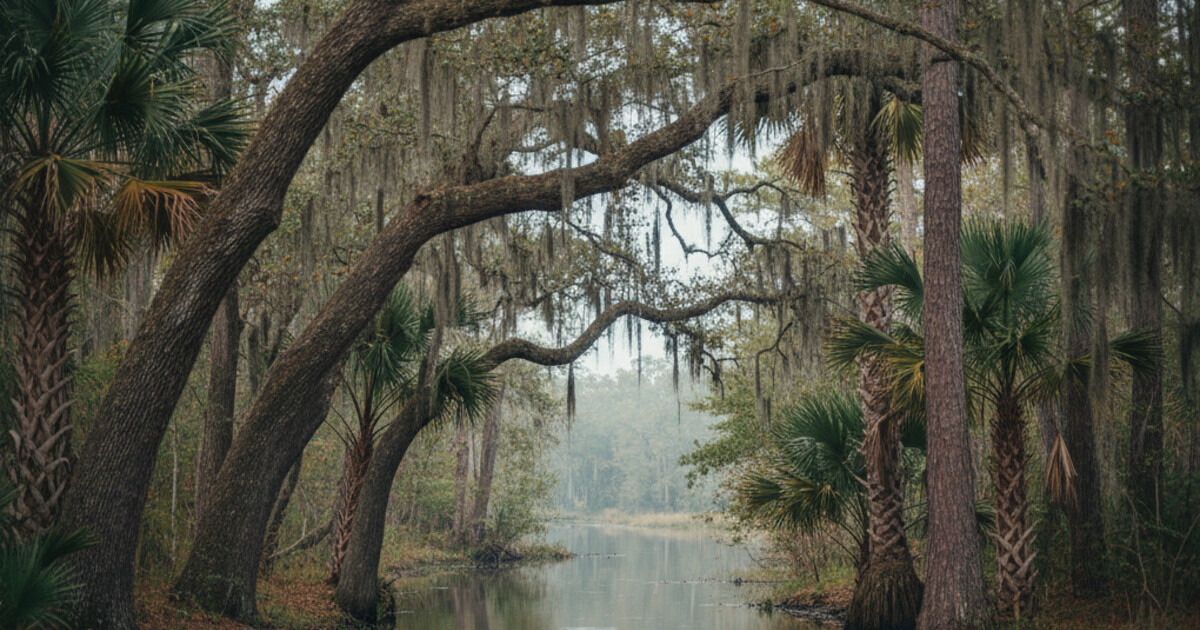
Florida has over 300 native tree species. That’s more than any other state east of the Mississippi. The combination of tropical, subtropical, and temperate climates creates a mix you won’t find anywhere else in the continental U.S.
Florida’s most recognizable native trees include live oak, bald cypress, sabal palm, southern magnolia, slash pine, red maple, gumbo limbo, and mangroves. You can identify them by leaf shape, bark texture, growth form, and which part of the state they grow in.
Whether you’re trying to identify a tree in your yard, picking natives for a new landscape, or just curious about what’s growing around you, this guide covers the 14 most important Florida native trees.
Why Plant Florida Natives?
Native trees are adapted to Florida’s sandy soils, summer downpours, droughts, salt spray, and hurricanes. They don’t need irrigation once established. They don’t need fertilizer. And they support local wildlife, from birds to butterflies to pollinators, in ways that non-native trees can’t match.
Florida-Friendly Landscaping programs actively encourage natives because they reduce water use, cut maintenance costs, and resist local problems better than imported species.
North Florida Native Trees
North Florida (roughly from Jacksonville to Tallahassee) has a climate closer to the rest of the Southeast. Winters bring occasional freezes, and the tree mix includes many species found throughout the southern Appalachians.
Live Oak (Quercus virginiana)
Live oak is Florida’s signature tree. The massive spreading canopy, draped with Spanish moss, defines the state’s landscape from Pensacola to Miami. A mature live oak can reach 50 to 80 feet tall with a canopy spread of 60 to 120 feet. Some specimens are over 500 years old.
The leaves are small (2 to 5 inches), leathery, dark green, and semi-evergreen. They drop briefly in spring and are immediately replaced. The bark is dark and deeply furrowed on old trees. Acorns are narrow and about 1 inch long.
Live oak is hurricane-resistant thanks to its dense wood and wide root system. It’s the best shade tree for large Florida properties.
Bald Cypress (Taxodium distichum)
Bald cypress is Florida’s iconic swamp tree. It grows in standing water, along rivers, and in floodplains throughout north and central Florida. The “knees” that poke up from the water around the trunk are its most recognizable feature.
Despite being a conifer, bald cypress is deciduous. The flat, feathery needles turn coppery-orange in fall before dropping. The trunk base is dramatically flared (buttressed), sometimes 6 to 10 feet across on old trees. Height ranges from 50 to 70 feet, occasionally taller.
The bark is fibrous, reddish-brown to gray, and peels in thin strips. Small round cones (about 1 inch) appear in fall.
Southern Magnolia (Magnolia grandiflora)
Southern magnolia is native from North Carolina to Florida and across the Gulf states. In Florida, it grows naturally in north and central regions. The tree reaches 60 to 80 feet tall with a dense, pyramidal to rounded crown.
The leaves are the key identifier: 5 to 8 inches long, thick, glossy dark green on top, fuzzy brown underneath. They’re evergreen and leathery. The flowers are huge (8 to 12 inches across), white, fragrant, and bloom from May to June. Red seed pods split open in fall to reveal bright red seeds.
Magnolia makes an excellent privacy screen because the branches grow low to the ground and the evergreen leaves provide year-round cover.
Slash Pine (Pinus elliottii)
Slash pine once covered vast stretches of Florida’s flatwoods. It grows 60 to 100 feet tall with a straight trunk and open, rounded crown. The needles are 8 to 12 inches long, growing in bundles of 2 (sometimes 3). Cones are 3 to 6 inches long, glossy brown.
The bark on mature trees is thick, platy, and orange-brown. Slash pine is fire-adapted. The thick bark protects the tree during low-intensity fires, and the open crown recovers quickly after burns.
Two varieties exist: typical slash pine in north and central Florida, and South Florida slash pine (P. elliottii var. densa) in the southern part of the state. The South Florida variety has denser wood and grows in rockier conditions.
Red Maple (Acer rubrum)
Red maple is one of the few Florida natives that provides fall color. The leaves turn red to orange-red in November and December. In spring, tiny red flowers appear before the leaves, followed by red winged seeds (samaras) that spin like helicopters.
The leaves have 3 to 5 lobes with serrated edges, 2 to 5 inches across. Bark is smooth and gray on young trees, becoming darker and scaly with age. Red maple grows 40 to 60 feet tall in Florida and thrives in wet to medium soils.
It’s common along swamp edges and floodplains throughout north and central Florida. Florida’s red maples don’t color as intensely as those in New England, but they’re still the best fall-color option for the state.
Central Florida Native Trees
Central Florida (Orlando, Tampa, and surrounding areas) sits in the transition zone between temperate and subtropical. Many north Florida species reach their southern limit here, while tropical species begin to appear.
Sabal Palm (Sabal palmetto)
Sabal palm is Florida’s state tree. It grows 40 to 50 feet tall with a single straight trunk and a crown of fan-shaped leaves. Each leaf is 4 to 6 feet across, with a long, smooth petiole (stalk) that extends into the leaf blade.
The trunk is covered in distinctive “bootjacks,” which are the bases of old leaf stems that create a cross-hatched pattern. On older trees, these wear away to reveal a smooth, gray-brown trunk. Small white flowers appear in large branching clusters in June, followed by small black fruit.
Sabal palms handle salt spray, drought, poor soil, and hurricane-force winds. They grow throughout the state from the panhandle to the Keys.
Longleaf Pine (Pinus palustris)
Longleaf pine has the longest needles of any eastern pine: 8 to 18 inches, growing in bundles of 3. Young trees go through a “grass stage” lasting 3 to 7 years where they look like a clump of grass with no visible trunk. This stage protects the growing tip from fire.
Mature trees reach 60 to 80 feet with an open, irregular crown. The cones are the largest of Florida’s pines at 6 to 10 inches long. Bark is thick and platy, orange-brown.
Longleaf pine ecosystems once covered 90 million acres across the Southeast. Today, less than 3% remains. Restoration efforts are ongoing throughout Florida, making this tree both ecologically important and increasingly available at native nurseries.
Sweetgum (Liquidambar styraciflua)
Sweetgum grows 60 to 80 feet tall with star-shaped leaves that have 5 pointed lobes. Fall color ranges from yellow to orange to deep purple, sometimes all on the same tree. The spiky gumball fruit (1 to 1.5 inches across) is unmistakable and famously annoying to step on barefoot.
The bark is deeply furrowed on mature trees with corky ridges. Sweetgum grows in moist soils throughout north and central Florida. It’s a common tree in bottomlands and along streams.
South Florida Native Trees
South Florida (Palm Beach to the Keys) is subtropical to tropical. Many trees here are found nowhere else in the continental U.S.
Gumbo Limbo (Bursera simarouba)
Gumbo limbo is called the “tourist tree” because its bark is red and peeling, like a sunburned tourist. The shiny, copper-red bark peels in papery sheets to reveal green inner bark. It’s one of the most distinctive barks of any tree in North America.
The tree grows 25 to 50 feet tall with a spreading crown. Leaves are compound with 3 to 7 oval leaflets. Gumbo limbo is native to south Florida, the Caribbean, and Central America. It handles salt spray and hurricane winds well. After storms, broken branches stuck in the ground often take root and grow into new trees.
Mahogany (Swietenia mahagoni)
West Indian mahogany is native to extreme south Florida and the Keys. It’s the only mahogany species native to the continental U.S. The tree grows 40 to 50 feet tall with a dense, rounded crown. Leaves are compound with 4 to 8 oval leaflets.
The wood is the famous reddish-brown mahogany prized in furniture making. Florida specimens are protected and can’t be harvested. Bark is dark brown with broad, flat ridges.
Florida native trees are remarkably diverse, spanning temperate hardwoods like live oak and red maple in the north to tropical species like gumbo limbo and mahogany in the south. This range exists because Florida stretches across 7 degrees of latitude, from the temperate zone near Georgia to the tropical zone in the Keys. No other eastern state covers this climatic range. The result is a native tree flora that includes both deciduous species that drop their leaves in winter and evergreen tropical species that never go dormant. For homeowners, this means the right native tree depends entirely on where in Florida you live. A bald cypress that thrives in Tallahassee won’t work in Key West, and a mahogany that grows in Miami won’t survive a Panhandle winter.
Red Mangrove (Rhizophora mangle)
Red mangrove defines Florida’s coastal shorelines from roughly central Florida southward. The arching prop roots that extend from the trunk into the water are unmistakable. These roots create nursery habitat for fish and protect shorelines from erosion.
The leaves are thick, leathery, dark green, 3 to 5 inches long. Red mangrove produces long, pencil-shaped seedlings (propagules) that drop from the tree and float to new locations. The tree grows 15 to 25 feet tall in Florida.
Mangroves are protected by state law. You can’t trim, cut, or remove them without a permit.
Sea Grape (Coccoloba uvifera)
Sea grape grows along beaches and dunes throughout south and central Florida. The leaves are enormous (up to 8 inches across), round, thick, and leathery with red veins. They turn red before dropping. The tree produces clusters of green-to-purple grape-like fruit.
Sea grape grows 15 to 25 feet tall, often with multiple trunks. It tolerates salt spray, sandy soil, and wind. It’s one of the most common native trees on Florida beaches.
Trees for Small Florida Yards
Not every Florida lot can fit a live oak. These native species stay compact:
- Simpson’s stopper (Myrcianthes fragrans): 10 to 20 feet. Fragrant flowers, red berries. South Florida.
- Walter’s viburnum (Viburnum obovatum): 10 to 25 feet. White spring flowers. Statewide.
- Dahoon holly (Ilex cassine): 20 to 30 feet. Evergreen with red berries. Statewide.
- Redbud (Cercis canadensis): 20 to 30 feet. Pink spring flowers. North and central Florida.
Identifying Florida Trees With Tree Identifier
Florida’s tree diversity can make identification tricky, especially in south Florida where tropical species overlap with temperate ones. The Tree Identifier app handles it. Snap a photo of a leaf, bark, flower, or fruit, and the AI identifies the species from its comprehensive database. It works on both iOS and Android with 2 free identifications per day and runs offline, so spotty cell service in the Everglades or on a nature trail won’t slow you down.
Frequently Asked Questions
What is the most common native tree in Florida?
Sabal palm (Sabal palmetto) is the most widespread native tree in Florida, growing in every county from the panhandle to the Keys. Live oak is the second most common and dominates the canopy in many areas. Slash pine covers vast areas of flatwoods and is the most common pine species in the state.
What trees are native to south Florida but not north Florida?
Gumbo limbo, mahogany, red mangrove, sea grape, pigeon plum, paradise tree, and Jamaica caper are native to south Florida but can’t survive the freezes in north Florida. These tropical species are generally limited to USDA zones 10b and 11, roughly from Palm Beach County southward.
What’s the best native tree for a Florida backyard?
It depends on your region. In north Florida, live oak (for large yards) or redbud (for smaller spaces) are top picks. In central Florida, sabal palm or dahoon holly. In south Florida, gumbo limbo or Simpson’s stopper. All are low-maintenance once established and support local wildlife.
How do I identify a tree I found in Florida?
Start with leaf shape and type (needle vs. broadleaf, simple vs. compound, evergreen vs. deciduous). Check the bark pattern and any flowers or fruit present. The Tree Identifier app can speed this up. Photograph the most visible feature, and the AI will identify the species. It works with leaves, bark, flowers, and whole tree photos on iOS and Android.
Trying to identify a native tree in your Florida yard? Try Tree Identifier and snap a photo for an instant ID.
Identify a tree from your photo — free
Upload a leaf, bark, or whole-tree photo and get the species in seconds. No signup.
Confidence:
Unlock the full species profile
Free in the app — with unlimited identifications.


AI result for guidance — the app gives full species details and works offline.
Want unlimited identifications?
Get the full species profile, photos and details — free in the app, with unlimited scans.
- Unlimited identifications
- Full species profiles & details
- Works offline, anywhere
- Save and revisit your finds
Elena Torres
Tree Identifier Team