Maple vs Birch Wood: Hardness, Grain, and Best Uses
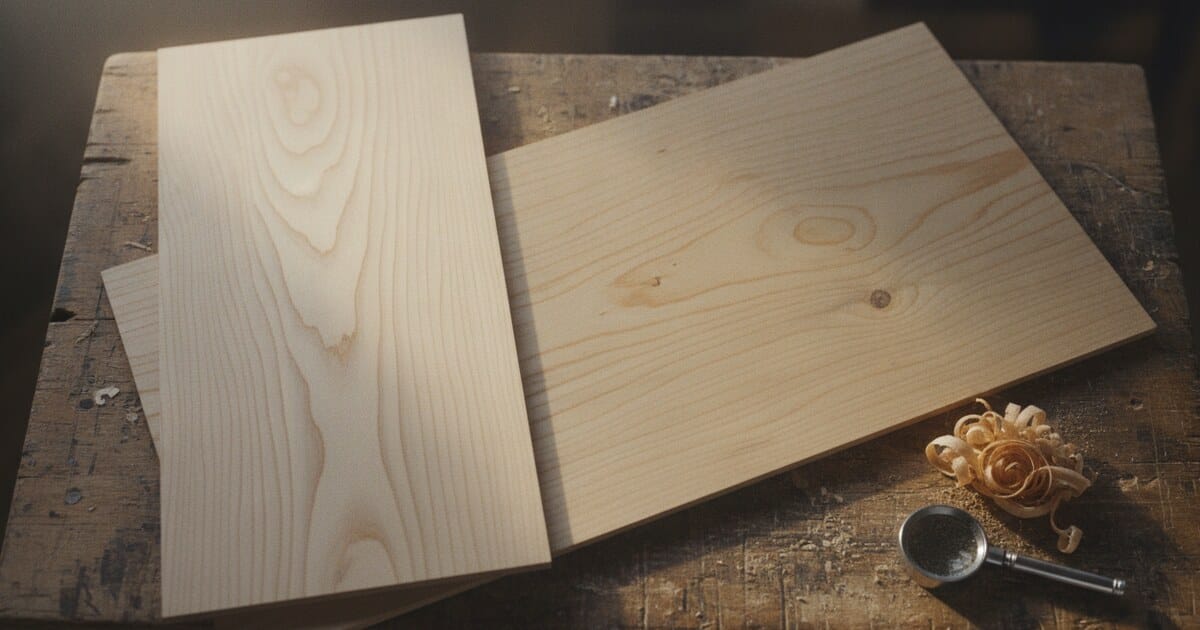
You’re standing in a lumber yard with two stacks of pale, cream-colored boards. One is hard maple. The other is birch. Pick the wrong one for a cutting board and you’ll end up with a species that dulls your knife faster than expected. Pick the wrong one for a drum shell and the tone goes flat. Maple vs birch wood is one of the trickiest comparisons in woodworking because both are light-colored North American hardwoods with fine grain, similar color, and overlapping uses in furniture, cabinets, and flooring. But they differ in ways that matter: hardness, how they move with humidity, how they take a finish, and the specific jobs each handles best.
Hard maple is harder (1,450 lbf Janka) and denser than birch (1,260 lbf for yellow birch), making it the better pick for cutting boards, butcher blocks, and heavy-use flooring. Birch is slightly softer, costs less per board foot, takes stain more evenly in some cases, and is the standard material for plywood, drum shells, and speaker cabinets.
How to Tell Maple and Birch Wood Apart
Both species look nearly identical as raw lumber. The reliable method uses three cues: end grain, color tone, and grain direction.
End grain. Both maple and birch are diffuse-porous, meaning their pores spread evenly across the growth rings rather than clustering in the earlywood zone. Under a loupe, maple pores are slightly finer and more uniform. Birch pores are marginally larger, and the ray patterns are so fine they’re nearly invisible without magnification. Maple rays show a subtle fleck or shimmer on quartersawn surfaces, particularly in figured stock. Learning to read end grain is the most reliable ID method for either species. For a deeper look at how pore pattern and ray structure work as identification tools, the guide on how to identify wood by grain covers both families in detail.
Color. Hard maple heartwood is pale cream to white, often with a faint pinkish cast. Birch heartwood runs yellow-white to light brown, with the sapwood of yellow birch carrying the warm yellow tint that gives the species its name. Side by side, maple reads as cooler-toned and birch reads as warmer.
Grain direction. Maple grain tends to run straight, though curly and bird’s-eye figures appear in some logs. Birch grain is often wavy or interlocked, which produces a subtle shimmer on planed surfaces but causes tearout when hand-planing against the grain.
Luster. Maple has a naturally higher sheen. Freshly planed maple looks almost glassy. Birch is more matte by comparison.
Hard maple (Acer saccharum) and yellow birch (Betula alleghaniensis) are both diffuse-porous North American hardwoods from the same eastern forest belt, running from Nova Scotia south through Appalachia and into the Great Lakes region. Hard maple registers 1,450 lbf on the Janka hardness scale with a density of 44 lbs per cubic foot. Yellow birch comes in at 1,260 lbf Janka and 43 lbs per cubic foot, close enough that the two species trade in and out of many of the same applications. Their key difference lies in wood movement: hard maple shrinks 9.9% tangentially and 4.8% radially during drying, while yellow birch shrinks more evenly at 9.5% tangential and 7.3% radial. That balanced ratio means birch holds its shape more predictably when humidity swings, while flatsawn maple boards are more prone to cupping. Both species span the eastern third of North America, with hard maple peaking commercially in Vermont, Michigan, and New York.
Maple vs Birch Wood: Hardness and Wood Movement
The biggest functional difference between these two woods is hardness, and it plays out in high-traffic applications.
Hard maple lands at 1,450 lbf on the Janka scale, the same rating used for professional bowling lane floors and kitchen cutting boards built to last decades. Soft maple (Acer rubrum) drops to roughly 950 lbf, comparable to black walnut. Yellow birch sits at 1,260 lbf. Paper birch, the species with the distinctive white bark used in decorative clumps, registers about 910 lbf, much closer to soft maple than yellow birch.
| Species | Janka (lbf) | Density (lbs/ft³) | Tangential shrink | Radial shrink |
|---|---|---|---|---|
| Hard maple | 1,450 | 44 | 9.9% | 4.8% |
| Yellow birch | 1,260 | 43 | 9.5% | 7.3% |
| Soft maple | ~950 | ~38 | 8.0% | 3.7% |
| Paper birch | ~910 | ~38 | 8.6% | 6.3% |
For flooring, hard maple’s Janka score handles foot traffic and chair legs better than birch over years of use. For furniture that won’t take heavy abuse, the gap between 1,450 and 1,260 is barely noticeable in daily wear.
Wood movement. The shrinkage numbers matter more for cabinet and furniture makers than hardness does. Birch’s more balanced tangential and radial shrinkage means the wood moves more evenly as humidity rises and falls through the seasons. Maple’s larger gap between tangential (9.9%) and radial (4.8%) shrinkage means flatsawn maple planks cup more easily. Quartersawn maple, where the growth rings run more vertically through the board, sidesteps this problem and is worth specifying for tabletops and wide panels.
Which Finishes Better: Maple or Birch?
This is the question most furniture makers actually care about, and both woods come with the same warning: blotching.
Maple is one of the trickier woods to stain evenly. Its tight, diffuse-porous structure absorbs stain at different rates depending on local grain direction. A gel stain or a pre-conditioner, such as a thin coat of dewaxed shellac or a commercial wood conditioner, applied before the pigment stain is almost always the right call. Water-based stains blotch less on maple than oil-based ones.
Birch has a similar blotching tendency, amplified by its wavy grain. Inconsistent grain direction means some sections absorb stain quickly while others barely drink it in, producing a streaky look. Some woodworkers consider this character; others find it frustrating. Birch does accept paint extremely well, and painted birch cabinets are one of the most cost-effective kitchen finishes available.
For painted cabinets or furniture, birch and maple perform about equally. For stained natural-wood finishes where you want color consistency, maple has the edge with proper prep. Clear finishes, a coat of oil or water-based polyurethane, look clean and sharp on both species and sidestep the blotching issue entirely.
Best Uses for Maple vs Birch Wood
The two species are close enough to substitute in many situations, but each has applications where it pulls ahead.
Where maple wins:
- Butcher blocks and cutting boards (hardness protects knife edges; tight grain resists bacteria in cut grooves)
- Bowling lane floors and gymnasium flooring (the 1,450 lbf Janka rating is an industry standard for sport surfaces)
- Dance floors (hard, smooth surface with consistent wear characteristics)
- Fine furniture with a natural or clear finish
- Turned pieces: bowls, chair legs, and balusters machine cleanly without tearout
Where birch wins:
- Plywood (Baltic birch plywood is a cabinet and shop-furniture standard; the tight, void-free faces machine cleanly)
- Speaker cabinets (birch’s density and internal damping produce tight, neutral sound reproduction)
- Drum shells (concert-quality drum makers use birch for its punchy mid-frequency response; Pearl, DW, and Tama all offer birch shells as a distinct tone option)
- Cabinet carcasses and face frames for painted applications, where the cost advantage over maple is substantial
- Interior trim and millwork
Acoustic note. The drum and speaker cabinet market specifically separates maple and birch by tonal character. Birch shells produce a brighter, more focused midrange with a faster attack. Maple shells are warmer with more low-end resonance. This distinction is one of the clearest examples of how wood selection translates into measurable functional outcome rather than aesthetics.
Kitchen cabinets. Maple handles kitchen humidity and temperature swings better over time and accepts a natural stained finish more evenly. Birch is the better value for painted cabinets, where lower cost and a smooth painted surface are the priorities. A common cost-saving combination is birch plywood for cabinet carcasses and solid maple for doors and face frames.
For a broader comparison of how hardness, density, and end grain structure separate species in the same hardness range, the oak vs walnut wood breakdown uses the same framework applied to two more commonly confused species.
How Tree Identifier Helps With Wood ID
Telling maple from birch in the lumber yard is hard enough. Telling them apart in a finished piece of furniture, without a label, can feel close to impossible.
Tree Identifier’s wood recognition feature is built for exactly this situation. Take a photo of the wood surface showing the grain, and the app reads the grain pattern, texture, and color tone to identify the species. It works on raw lumber, finished furniture, and cut boards. You get a species identification plus details on the wood’s properties and typical applications.
The app reads wood from multiple angles: a face-grain photo, an end-grain shot, or a close-up of the surface texture. That flexibility matters when working with finished furniture where you can’t always get a clean end-grain view. You can also try the free web tool at treeidentifier.app/tools/wood-identifier for a quick scan without downloading anything. The full guide to reading grain structure for species identification is at how to identify wood.
Frequently Asked Questions
Is maple harder than birch?
Yes. Hard maple registers 1,450 lbf on the Janka scale, about 15% harder than yellow birch at 1,260 lbf. Paper birch, the decorative species with white bark, is considerably softer at roughly 910 lbf and shouldn’t be swapped in for hard maple in structural or high-wear applications. Soft maple runs around 950 lbf, also well below hard maple.
Is birch cheaper than maple?
Generally, yes. Yellow birch typically runs $3-6 per board foot at retail lumber yards; hard maple runs $4-8. The gap widens significantly for figured maple (bird’s-eye, curly), which can reach $15-30 or more per board foot. Birch plywood is almost always less expensive than maple plywood, which explains its dominance in cabinet carcasses and shop furniture.
Can you substitute birch for maple in a woodworking project?
In many applications, yes. For furniture, cabinets, and millwork, birch performs well enough that it’s a standard maple substitute. For applications that rely on maximum hardness, such as cutting boards, butcher blocks, or gym flooring, hard maple is the stronger choice. Birch’s slightly less predictable grain also makes consistent stain results harder to achieve than with maple.
Which is better for kitchen cabinets, maple or birch?
Maple handles kitchen humidity and temperature swings better over time and accepts a natural stained finish more evenly. Birch is the better value for painted cabinets, where its lower cost and clean painted surface make it hard to beat. A common combination: birch plywood for cabinet boxes and maple or solid wood for face frames and doors.
How do I tell maple and birch apart from a photo?
Color tone is the fastest visual tell: maple leans cooler (cream-white), birch leans warmer (yellow-white to light brown). Grain direction helps too: maple runs straighter, birch is more wavy. On quartersawn surfaces, maple shows faint ray flecks that catch light, while birch rays are so fine they’re nearly invisible to the naked eye.
Snap a photo of the grain and run it through Tree Identifier’s wood recognition feature at treeidentifier.app. The app identifies maple, birch, and dozens of other species from a single photo, with 2 free identifications per day and no subscription required to start.
Identify a tree from your photo — free
Upload a leaf, bark, or whole-tree photo and get the species in seconds. No signup.
Confidence:
Unlock the full species profile
Free in the app — with unlimited identifications.


AI result for guidance — the app gives full species details and works offline.
Want unlimited identifications?
Get the full species profile, photos and details — free in the app, with unlimited scans.
- Unlimited identifications
- Full species profiles & details
- Works offline, anywhere
- Save and revisit your finds
Elena Torres
Tree Identifier Team