Pine vs Fir Wood: Hardness, Grain and Key Differences
Knowing which softwood you’re working with changes what you build and how long it lasts. Pine and fir wood show up in the same lumber yard aisles, serve similar framing and finish roles, and can look nearly identical after a coat of stain. They behave differently under a hand plane, wear at different rates underfoot, and respond to moisture in ways that matter for outdoor projects. To complicate matters further, the species most commonly called “fir” at American lumber yards, Douglas fir, isn’t a true fir at all. This guide covers the pine vs fir wood differences that show up in the shop: end grain tests that settle arguments fast, Janka ratings across common species, and which softwood to reach for depending on what you’re building.
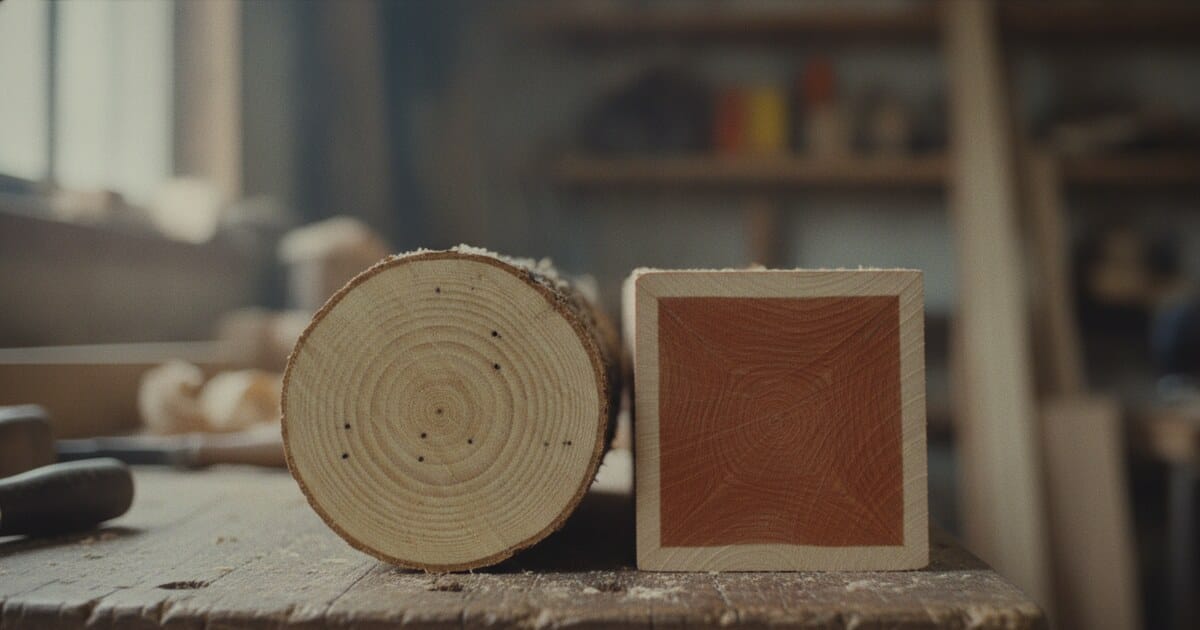
Pine and fir are both North American softwoods, but they differ in hardness, grain, and moisture resistance. Douglas fir (Janka 660 lbf) is harder than eastern white pine (380 lbf) but softer than Southern yellow pine (1,225 lbf). The fastest field test: check the end grain. Pine shows visible resin canal dots; true firs have none.
What Are Pine and Fir Wood?
Both belong to the family Pinaceae but sit in different genera. Pine is Pinus, with 126 species worldwide and about 50 native to North America. True firs are Abies, roughly 50 species globally with 9 native to North America. Douglas fir (Pseudotsuga menziesii) is a separate genus, earning the “fir” name from its needle and cone shape rather than from close botanical relation to Abies.
Pinus species grow across every climatic zone in North America, from eastern white pine (P. strobus) in the Great Lakes and Northeast to ponderosa pine (P. ponderosa) across the interior West to Southern yellow pine (P. palustris, P. taeda) dominating the Southeast. Abies species cluster at higher elevations: balsam fir in boreal forests of Canada and the northern US, white fir and Pacific silver fir in western mountain ranges. Pseudotsuga menziesii grows from coastal British Columbia south through California and into the Rocky Mountains, reaching 250-300 ft in old-growth stands and 40-80 ft in managed forests. Douglas fir accounts for roughly 25% of all framing lumber sold in the US. It runs Janka 660 lbf, harder than balsam fir (290 lbf) and white fir (400 lbf). Pine hardness spans the widest range of any retail softwood genus: 380 lbf for eastern white pine to 1,225 lbf for Southern yellow pine longleaf. Lumber sold simply as “pine” at a big-box store is usually Southern yellow pine or a Pacific Northwest mix, running 570-690 lbf.
For most buyers, the comparison comes down to Douglas fir against whichever pine species is stocked locally. That’s the pairing this guide focuses on.
How to Tell Pine from Fir Wood
The most reliable test is the end grain, and you can run it in the lumber aisle without any tools.
Pine species have resin canals: tiny circular ducts scattered through the growth rings, visible as small translucent dots (roughly 0.5-1 mm) against the darker grain. Hold the end grain at a raking angle to the light and the speckling shows clearly. True firs (Abies) have no resin canals at all. Their end grain looks uniformly smooth with no speckling. Douglas fir has resin canals, but fewer and smaller than most pines, often hard to spot without magnification. This end-grain check works even on finished boards: a fresh saw cut at the end exposes the pattern instantly.
Color gives a second read. Eastern white pine heartwood is pale yellow-cream with a soft luster. Ponderosa pine runs warm tan to orange-yellow. Southern yellow pine has rich amber-orange heartwood with sharp contrast between lighter earlywood and darker latewood bands. Douglas fir heartwood is the most distinctive of the group: reddish-orange with a slight pinkish cast, warmer and darker than most pines. True firs (balsam, white, subalpine) are very pale, ranging from nearly white to cream. For a deeper look at how grain patterns differ across softwood and hardwood species, the wood grain identification guide covers the full set of face-grain and end-grain tests.
Knot character gives a third read. Pine knots are typically larger and ringed by darker, resin-soaked wood that creates a stained halo on face grain. Douglas fir knots tend to be smaller, tighter, and harder. On Southern yellow pine boards, resin pockets show as dark streaks or pits. Douglas fir faces look cleaner at a glance, with tighter growth lines in slow-grown clear material.
Quick end-grain summary:
- Resin canal dots visible: pine yes, true fir no, Douglas fir faint or absent
- Color: pine cream to amber-orange; Douglas fir reddish-orange; true fir cream-white
- Knots: pine larger with resin staining; fir smaller and harder
Pine vs Fir Wood: Hardness and Strength
Hardness varies so widely within the pine family that “pine wood” as a single category is nearly meaningless for project planning without knowing the specific species.
| Species | Janka (lbf) | Density (lbs/ft³) |
|---|---|---|
| Balsam fir | 290 | 26 |
| Eastern white pine | 380 | 25 |
| White fir | 400 | 26 |
| Ponderosa pine | 460 | 28 |
| Douglas fir | 660 | 32 |
| Loblolly (Southern yellow pine) | 1,010 | 36 |
| Longleaf (Southern yellow pine) | 1,225 | 41 |
Douglas fir at 660 lbf sits roughly in the middle of the pine range: harder than most eastern pines, well below Southern yellow pine. Its stiffness (modulus of elasticity ~1.9 Mpsi) ranks among the highest of any North American softwood, which is why engineers specify it for beams, floor joists, and LVL (laminated veneer lumber). For context on where these softwoods sit relative to hardwoods and exotic species, the hardest types of wood guide covers the full Janka spectrum from Australian buloke (5,060 lbf) down to eastern white pine.
Southern yellow pine is dense enough for flooring, stair treads, and workbench tops. Douglas fir surfaces plane more cleanly because of its tighter, straighter grain. Eastern and western white pine are soft enough to dent with a thumbnail, limiting them to painted or lightly-used pieces.
Douglas Fir vs Pine: Moisture, Price, and Workability
Douglas fir resists moisture absorption better than most pines. One study measured pine absorbing up to 27% moisture content after 7 days of exposure; Douglas fir reached only 21.8% maximum over 48 days. Pine’s swelling also tends to be more permanent: the fibers expand and often stay that way, warping boards. Douglas fir’s swelling is more reversible once the environment stabilizes.
Douglas fir typically costs 15-25% more per board foot than comparable-grade pine at retail, though the gap shifts with commodity cycles and regional supply. For structural work where stiffness ratings matter (joists, headers, and beams), the premium is usually justified. For painted interior finish work where structural grades don’t matter, pine is cheaper and equally serviceable.
Workability splits cleanly along species lines. White and ponderosa pine cut and plane easily with sharp tools. Douglas fir’s density dulls edges faster, though its straight grain makes it predictable. Southern yellow pine clogs sandpaper and blades quicker than either because of its high resin content. Both species can be stained and finished, but Southern yellow pine’s bold grain contrast makes even stain absorption harder to achieve without a pre-conditioner.
Which Wood Should You Use?
Framing and structural lumber: Douglas fir is the national standard for floor joists, rafters, and headers in the western and northern US. Southern yellow pine is the structural default in the South, where it performs comparably and often costs less.
Workbenches and shop furniture: Douglas fir’s tight grain stays flat over time and resists denting better than softer pines under repeated mallet blows. Southern yellow pine is the value pick in the Southeast. Eastern white pine is too soft for any surface that takes regular impact.
Interior furniture and cabinetry: Douglas fir takes stain more evenly than most pines, making it the better choice for clear-finished pieces. For painted furniture, pine is cheaper and equally serviceable. Southern yellow pine’s bold grain can be a deliberate design feature in rustic or industrial work.
Softwood flooring: Southern yellow pine (1,010-1,225 lbf) is the standard softwood floor species, hard enough to compete with entry-level hardwoods. Douglas fir floors are common in older Pacific Northwest homes and hold up in lower-traffic rooms. Eastern white pine floors are too soft for modern use but develop a beautiful patina in historic restorations.
Outdoor and decking: Untreated pine and fir both last roughly 10-15 years outdoors. Pressure-treated Southern yellow pine is the standard for decks and outdoor structures. Douglas fir works in semi-exposed or covered outdoor conditions with regular sealing. For a broader grounding in how to identify any unmarked softwood before you cut it, the wood identification guide covers the full range of field tests from smell to weight to end grain.
If you’re working with an unlabeled board and need a fast species match, a photo of the grain or end grain does the job. The Tree Identifier app includes wood species recognition alongside its tree ID tools: photograph the grain and it returns a species match with detailed properties. Try the browser-based wood identifier tool for a quick check without downloading.
Frequently Asked Questions
What are the disadvantages of fir wood?
Douglas fir is denser than softer pines and dulls cutting edges faster, making hand-tool work more demanding. True firs (Abies) are soft and prone to checking when dried quickly, limiting their structural use. Neither Douglas fir nor true fir holds up outdoors without treatment, and both species check (develop surface cracks) when drying too fast in low humidity.
How do you tell pine from fir at the lumber yard?
Check the end grain. Pine has visible resin canal dots, small translucent specks scattered through the growth rings. True firs have no resin canals, so their end grain looks uniformly smooth. Douglas fir has faint resin canals that are hard to see without magnification. Color also helps: Douglas fir has a reddish-orange cast, while most pines run cream to amber-yellow.
Is Douglas fir more expensive than pine?
Typically 15-25% more per board foot at retail, though the gap varies by region and commodity prices. The premium reflects Douglas fir’s higher structural stiffness and better moisture resistance. For painted interior finish work where structural ratings don’t matter, pine is usually the better-value choice.
Is pine or fir better for furniture?
Douglas fir takes stain more evenly than most pines, making it the better choice for clear-finished furniture. Southern yellow pine (1,010-1,225 lbf) is hard enough for dining tables and workbenches. Eastern and western white pine are too soft for high-use furniture but work well for painted shelves and benches.
Why is Southern yellow pine so much harder than other pines?
Southern yellow pine is a group of species (P. palustris, P. taeda, P. echinata, P. elliottii) that grow in warm, humid conditions, producing dense latewood rings with high resin content. Longleaf pine (P. palustris) develops heartwood dense enough at 1,225 lbf Janka that 19th-century builders used it for floors and structural framing where builders today specify hardwoods.
Identify a tree from your photo — free
Upload a leaf, bark, or whole-tree photo and get the species in seconds. No signup.
Confidence:
Unlock the full species profile
Free in the app — with unlimited identifications.


AI result for guidance — the app gives full species details and works offline.
Want unlimited identifications?
Get the full species profile, photos and details — free in the app, with unlimited scans.
- Unlimited identifications
- Full species profiles & details
- Works offline, anywhere
- Save and revisit your finds
Elena Torres
Tree Identifier Team