How to Identify Reclaimed Wood: Species and Authenticity
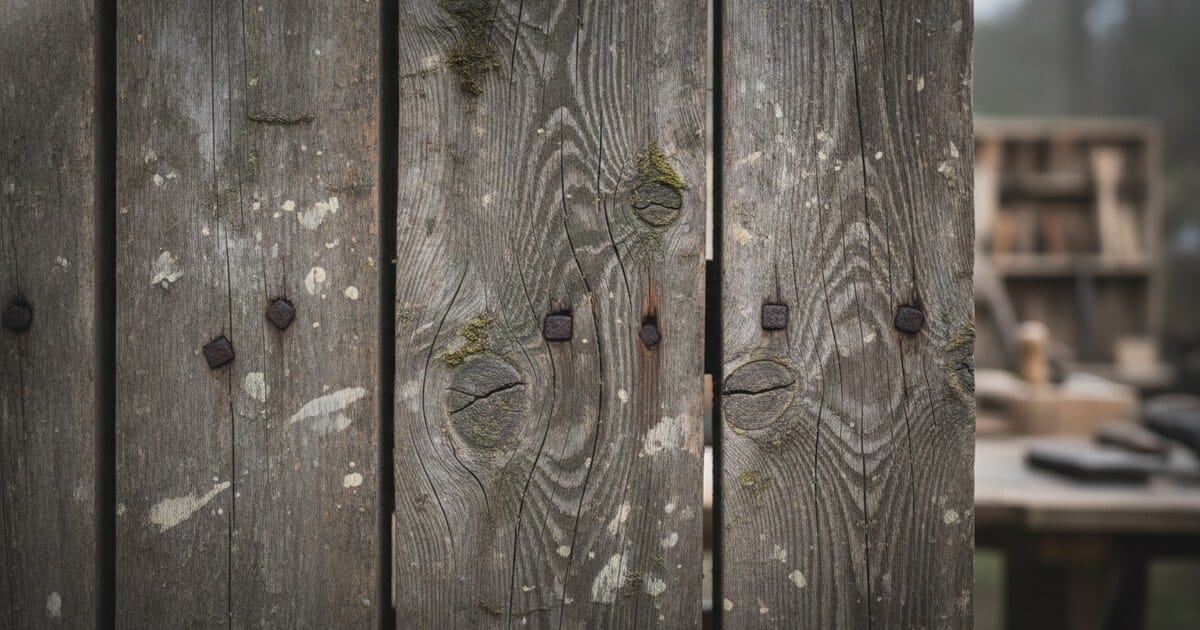
Old barn boards and factory floor planks don’t look like new lumber, and that’s the point. Decades of exposure, use, and age leave physical evidence that tells you what species you’re looking at and how long the wood has been around. That evidence also separates genuine reclaimed wood from the distressed new lumber that gets sold at similar prices.
Learning to identify reclaimed wood comes down to reading five things: the fastener holes left behind, the saw marks from the original mill, the grain density under the surface weathering, the weight and hardness of the species, and the smell when you make a fresh cut or sand a small patch. Most identifications are possible with natural light, a knife, and 10 minutes.
To identify reclaimed wood, start with the nail holes: hand-wrought holes (pre-1810) are tapered and irregular, square-cut holes (1810-1890) are rectangular, and wire nail holes (post-1890) are round. Then look at grain density under the patina. Old-growth timber shows 10-30 growth rings per inch versus 3-7 in modern plantation lumber.
How to Read the Age Markers in Reclaimed Wood
The fasteners are your most reliable timestamp. Blacksmiths forged nails by hand until around 1810, and the holes they left are tapered, slightly asymmetrical, and surrounded by rust staining that has soaked into the surrounding wood fibers over generations. Those stains don’t sit on the surface; they’re part of the wood now.
Square-cut nails replaced hand-wrought ones and stayed common until about 1890. Their holes are rectangular and often leave a visible impression of the nail’s flat face in the wood. Wire nails came in after 1890 and are still in use today, so round holes alone don’t confirm age. A mix of square-cut holes and consistent weathering patterns, though, points to pre-1890 construction.
Saw marks give you a second timestamp. Straight, parallel marks indicate a reciprocating saw from a water-powered mill, common before steam power spread in the mid-1800s. Curved arc marks came from circular saws, which were widespread after the 1840s. If a board shows straight marks on one face and arc marks on the trimmed edges, it was probably cut at a later mill for resizing or dimensioning.
The weathering also has texture you can feel. Genuine aged wood shows wear with rounded edges where decades of use have smoothed corners and exposed surfaces. The wood beneath the damaged spots has dried to match the surface color. Fresh distressing from mechanical tools tends to leave sharp edges and lighter wood underneath the scraped areas.
Common Species Found in Reclaimed Wood
The species you find in reclaimed wood depends heavily on where the building stood and what it was built for. Regional construction practices pulled from local timber supplies, so knowing the source narrows identification considerably.
Old-growth reclaimed timber from pre-1900 North American structures carries measurable characteristics that modern lumber can’t match. White oak dominated Eastern construction: 47 lbs/cubic foot, Janka 1,360, $8-18 per board foot in today’s reclaimed market. Heart pine from Southeastern longleaf forests ran through factories and warehouses from the 1850s through the 1920s; Janka 1,225-1,375, $10-22 per board foot when authenticated. American chestnut was heavily logged before a blight in 1904 eliminated it as a viable timber source by 1950; authenticated chestnut now runs $15-35 per board foot. Douglas fir built the West Coast at 34 lbs/cubic foot, $4-15 per board foot depending on grade. Eastern elm from Midwest farmsteads weighs 35-40 lbs/cubic foot with distinctive interlocking grain. All old-growth reclaimed species show 10-30 growth rings per inch versus 3-7 in modern plantation lumber, visible to the naked eye on freshly cut end grain.
Here’s how to tell the main species apart:
Heart pine is the most prized reclaimed species and the easiest to confirm. It has a warm amber-to-red color, a tight straight grain, and resin pockets that smell sweet and piney when you sand a fresh edge. Old-growth heart pine typically shows 15 or more growth rings per inch.
White oak has a distinctive ray fleck pattern on quartersawn surfaces, a brown color with gray undertones, and tyloses-filled pores that appear plugged under magnification. Red oak looks similar but has visibly open pores. White oak is the heavier of the two at 47 lbs/cubic foot versus 44 for red oak.
Douglas fir is reddish-brown to salmon-orange with wavy grain lines and a straight, uniform structure. At 34 lbs/cubic foot it’s noticeably lighter than oak. Old-growth fir from pre-1950 Western construction shows tighter rings than modern fir.
American elm has interlocking grain that runs in curves, visible on the face as a wavy pattern. It resists splitting along any straight line, which was a primary reason it was used in wagon wheel hubs and Midwest barn construction.
American chestnut is light for its size (30-35 lbs/cubic foot) with open, parallel pores on the face grain similar to oak but with less pronounced ray fleck. If a piece labeled chestnut is heavy, it isn’t chestnut.
For a deeper look at how grain patterns help distinguish species, see our guide to wood grain patterns.
How to Tell Authentic Reclaimed Wood from Distressed New Lumber
Distressed wood is manufactured to look old. Suppliers wire-brush it, stain it, beat it with chains, and sometimes bleach it to a gray patina that resembles natural weathering. It costs less to produce than genuine reclaimed material, and some suppliers misrepresent it.
The fastest check: flip the board over. Authentic reclaimed wood weathered from all sides, so the back shows its own marks, its own gray, its own history. Distressed new lumber is processed on the face only. The back is clean, pale, and smells like a fresh-cut board.
Nail holes are the second test. Authentic holes have rust staining that bleeds into the surrounding wood fibers; the stain is inside the wood, not on it. Manufactured holes in distressed lumber don’t have that bleed-out because the rust hasn’t had decades to migrate.
Variation is the third indicator. Authentic boards from the same reclaimed source differ from each other in color, grain direction, and weathering patterns. Distressed batches tend to look similar because they were processed with the same machine settings in a short window of time. Uniformity across a stack is a warning sign.
End grain is the clearest confirmation. Old-growth reclaimed wood shows tight, consistent ring spacing on any cut end. Modern lumber shows wider, more irregular spacing. This distinction is visible without any tools on most species.
Reputable reclaimed suppliers document the source building, region, and approximate construction date. That provenance should be available on request.
Identifying Wood Species Under Heavy Patina
Decades of weathering mute natural color and make grain patterns harder to read. The fix is straightforward: sand a small patch with 120-grit paper to remove the surface layer and expose the true grain and color beneath.
Under natural light on a freshly sanded patch, most species become identifiable within a minute. Heart pine turns warm amber. White oak shows its gray-brown base with visible ray structure. Douglas fir reveals its salmon-orange core. If the patch still looks ambiguous, cut a thin sliver from the end grain and examine the pore pattern under a 10x hand lens.
A wood identification app speeds things up when you’re working with an unfamiliar piece. The Tree Identifier app’s wood recognition feature reads grain texture, pore structure, and color from photos. Photograph a freshly sanded patch or a clean end-grain cut under natural light, then upload it. The app returns species identification with confidence scores, and its database covers the hardwoods and softwoods most common in North American reclaimed sources. The offline mode works for identifications in a yard or warehouse with no signal.
For a quick check without downloading anything, the wood identification tool at treeidentifier.app/tools/wood runs one free scan per visitor in your browser.
The general wood identification principles in our complete guide to identifying wood species give you the baseline framework that applies across reclaimed and new lumber alike.
Frequently Asked Questions
Is old barn wood safe to use indoors? Agricultural barn wood may carry pesticide residues, particularly organochlorines used before the 1970s. For structural use indoors, this is generally acceptable for residential purposes. Avoid using old barn wood for food-contact surfaces or children’s furniture without laboratory testing. Wood from old residential buildings, commercial interiors, and factory floors is typically lower risk than agricultural structures.
What tools do I need to identify reclaimed wood? Natural light and a pocket knife handle most identifications. A 10x loupe makes growth ring counting and pore structure much easier to see. A small digital scale helps confirm weight if you’re unsure between two dense species. Sandpaper in 120-grit is useful for exposing fresh grain on heavily weathered pieces.
What’s the difference between reclaimed and salvaged wood? Reclaimed wood comes from demolished or deconstructed structures: barns, factories, warehouses, bridges. Salvaged wood comes from natural sources, like logs pulled from riverbeds or storm-fallen trees. Both can be old-growth, but they carry different evidence. Salvaged wood typically lacks construction evidence like nail holes and saw marks, so identification relies more heavily on grain density and physical properties.
Does old-growth reclaimed wood hold fasteners better than modern lumber? Usually yes. Higher density means more wood fiber per inch for screws and nails to grip. Old-growth heart pine and oak are notoriously hard to drive screws into by hand, but they hold those fasteners securely once set. Pre-drilling is worth doing on any reclaimed hardwood above 1,000 Janka.
How accurate are wood identification apps on weathered reclaimed wood? Accuracy depends heavily on surface preparation. Heavy patina makes it harder for visual recognition to read grain structure. Sanding a small patch first before photographing gives the app clean data to work with. On a freshly sanded surface under natural light, results are reliable for common North American species.
If you’re working with a piece you can’t pin down, Tree Identifier’s wood recognition tool can help confirm the species from grain and texture photos. Sand a small patch, photograph it in natural light, and get a result in seconds. Download it for iOS or Android, or try the free web tool at treeidentifier.app/tools/wood.
Identify a tree from your photo — free
Upload a leaf, bark, or whole-tree photo and get the species in seconds. No signup.
Confidence:
Unlock the full species profile
Free in the app — with unlimited identifications.


AI result for guidance — the app gives full species details and works offline.
Want unlimited identifications?
Get the full species profile, photos and details — free in the app, with unlimited scans.
- Unlimited identifications
- Full species profiles & details
- Works offline, anywhere
- Save and revisit your finds
Elena Torres
Tree Identifier Team