Pumpkin Ash Tree Identification: 7 Reliable Signs
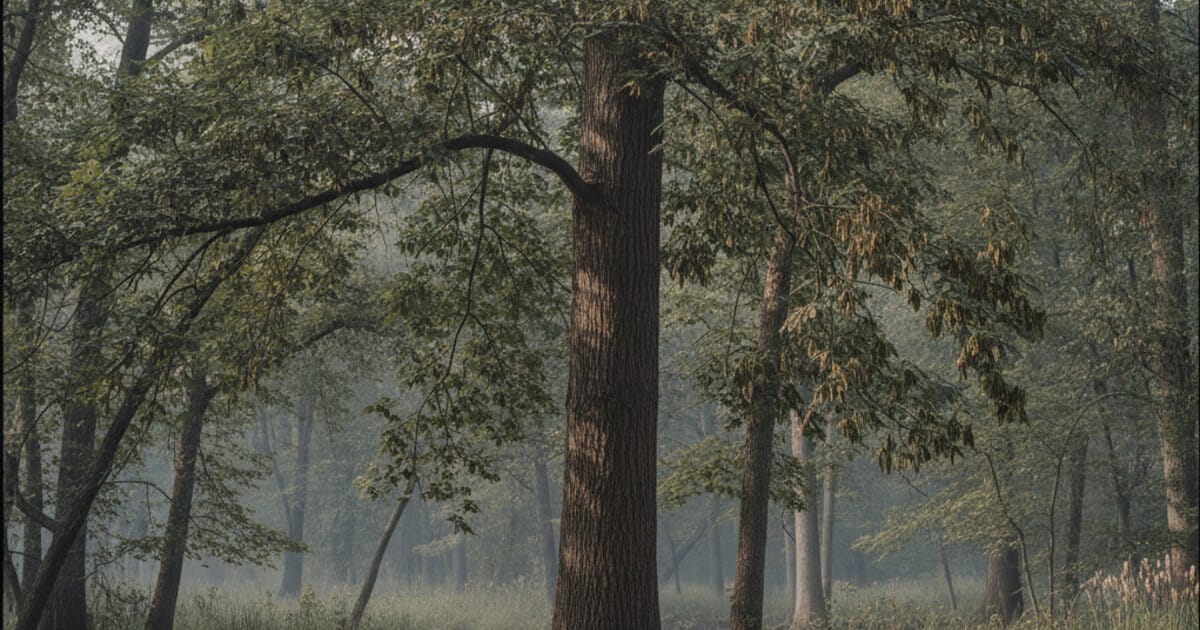
Pumpkin ash (Fraxinus profunda) is the largest native ash in North America, and it spends most of its existence in places most people never reach: deep river floodplains, seasonally flooded bottomlands, and alluvial swamps where the soil stays saturated for months at a time. Even experienced botanists sometimes walk past it, assuming the giant in the floodplain is just a white ash that found good ground.
The size alone should stop you. A mature pumpkin ash can reach 60 to 80 feet tall with a trunk diameter over 2 feet, noticeably larger than the green and white ash trees growing beside it. But size isn’t reliable on its own. The species has several field marks that, together, make pumpkin ash tree identification straightforward once you know what to look for. Here are 7 signs that confirm it.
Pumpkin ash (Fraxinus profunda) is identified by its exceptional size (60-80 feet tall), massive compound leaves up to 24 inches long with 7-9 hairy-veined leaflets, distinctly swollen petiolules at each leaflet base, and large inflated samaras with a noticeably rounded seed body. It grows only in deep, seasonally flooded bottomlands and river floodplains across the southeastern and central United States.
What Is Pumpkin Ash? Range, Habitat, and Conservation Status
Pumpkin ash (Fraxinus profunda) is a bottomland species tied to river systems across the southeastern United States, with scattered populations reaching into the Ohio River valley in Indiana, Ohio, and Illinois. Core range runs from Maryland and Virginia south through the Carolinas, Georgia, Alabama, Mississippi, Louisiana, and Arkansas. The species grows in deep alluvial floodplains and river swamp systems, where seasonal flooding lays down the nutrient-rich, poorly drained soils it requires. It’s never common: pumpkin ash grows as scattered individuals within mixed bottomland forests alongside overcup oak, water hickory, and green ash. Like all North American Fraxinus, it’s critically threatened by the emerald ash borer (Agrilus planipennis), first detected in Michigan in 2002 and now established in nearly all ash-bearing states. EAB kills untreated trees within 3 to 5 years of infestation by girdling the cambium layer under the bark. Pumpkin ash’s already scattered, small populations make it especially vulnerable to regional elimination. NatureServe ranks it as vulnerable to imperiled across most of its range, and Maryland lists it as Endangered under state law. Several state forestry programs actively monitor remaining populations in priority floodplain habitats.
The name “pumpkin ash” comes from the inflated, somewhat rounded shape of the samara seed body, which can look faintly gourd-like compared to the slender seed bodies on white or green ash. “Red ash” appears as an older name in some texts, though modern usage applies that name more consistently to green ash.
Pumpkin Ash Leaves: Massive, with Hairy Veins and Swollen Petiolules
The leaf is the most immediately striking feature. Each compound leaf typically runs 12 to 24 inches long, making it the largest compound leaf of any native North American ash. Most leaves hold 7 leaflets, with the range running 7 to 9.
The leaflets are broadly lance-shaped to oval, 4 to 7 inches long, with slightly serrate or nearly entire margins. The upper surface is dark green. Turn the leaf over and run a finger along the underside of the midrib: you’ll feel soft hair. Pumpkin ash leaflets are pubescent along the veins and midrib on the lower surface, often with visible rusty or whitish hairs. This hairiness is a key differentiator. White ash leaflets are smooth (glabrous) on the underside. Green ash leaflets can carry some hair, but green ash is a much smaller tree overall.
The petiolules (the individual stalks connecting each leaflet to the central rachis) are noticeably swollen or thickened at their base. This puffiness is subtle but consistent. It separates pumpkin ash from white and green ash, where petiolules are slender and uniform. Put a pumpkin ash leaf beside a white ash leaf from the same bottomland: the difference is immediate.
Leaves are opposite on the twig, like all ash species. The terminal leaflet is usually the largest in the set.
Pumpkin Ash Samaras: Inflated Seed Body and Wide Wing
Pumpkin ash samaras are large and recognizable. The seed body (the thicker, rounded end of the samara) is noticeably inflated or swollen compared to other eastern ashes. This is the trait that inspired the common name. Each samara runs 1.5 to 2.5 inches long with a broad, spatula-shaped wing.
In white ash, the seed body is cylindrical and firm. In pumpkin ash, it’s rounder and slightly puffed, wider relative to its length. The wing is broad and rounded at the tip. When you see clusters of large, paddle-shaped samaras with swollen seed bodies hanging from a tall bottomland tree, pumpkin ash is the right answer.
Samaras ripen in late summer and drop through fall, hanging in tight, heavy clusters on long stalks. If the tree isn’t fruiting, the leaf size, leaflet hairiness, and swollen petiolules carry the ID on their own. The samaras add certainty fast when present.
Bark and Buds: Rusty Tomentum on Young Growth
On young pumpkin ash trees, bark is gray-brown with shallow, flat-topped ridges separated by narrow furrows. As the tree matures, the furrows deepen and the ridges narrow. Old-growth trunks develop tightly interlocking furrows with a near-black surface, darker overall than mature white ash or green ash bark.
Bark alone won’t separate pumpkin ash from its relatives in the field. The buds are more useful. Pumpkin ash buds are dark brown to nearly black, often covered with rusty-orange or tawny pubescence: a fine layer of short hair visible up close. The same hairiness shows on young twigs and leaf rachises. This tomentum is a consistent trait across the species and connects directly to the general pubescent character of the leaves.
Blue ash has its distinctive 4-angled twigs, which pumpkin ash doesn’t share. Pumpkin ash twigs are round in cross-section, like most other eastern ashes. Combine rusty-hairy buds with massive leaf size and a bottomland setting, and the ID is solid even without fruit present.
Pumpkin Ash Habitat: Deep Floodplains, Nowhere Else
No single trait confirms pumpkin ash faster than where it’s standing. This species is a strict bottomland tree. It doesn’t grow on slopes, upland ridges, or in dry to mesic forests. It grows in seasonally flooded alluvial floodplains, river swamp systems, and poorly drained bottomlands with fine, silty soils deposited by regular flooding.
The ecological company is a reliable clue. In a pumpkin ash stand, you’ll typically find overcup oak, water hickory, swamp cottonwood, green ash, and eastern cottonwood in the canopy. Understory shrubs include buttonbush, swamp rose, and swamp privet. The ground may hold a foot or more of standing water during winter and spring, draining gradually through summer.
Pumpkin ash tolerates prolonged flooding far better than white ash or most upland trees. That tolerance pushes it into the deepest, least accessible parts of bottomland forests, which is also why most people have never encountered one.
If you’re on a dry hillside looking at a large ash, it’s a white ash. If you’re in knee-deep bottomland mud looking up at an ash with leaves the size of your forearm, it’s probably pumpkin ash.
How Pumpkin Ash Compares to Related Ash Species
A few direct comparisons help close the ID when you’re uncertain.
Pumpkin ash vs. white ash: White ash grows on upland to mesic sites and doesn’t tolerate prolonged flooding. Its leaves are smaller (8-15 inches), leaflets glabrous below, and petiolules slender. The seed body on white ash samaras is cylindrical rather than swollen. White ash is common throughout the eastern US; pumpkin ash is uncommon and strictly bottomland.
Pumpkin ash vs. green ash: Green ash is the most widespread native ash and grows in a wide range of conditions, including wet areas. But it’s a smaller tree (40-60 feet) with smaller leaves (6-12 inches) and slender petiolules. A massive bottomland ash with swollen petiolules and hairy-veined leaflets running 18 inches long is pumpkin ash.
Pumpkin ash vs. black ash: Black ash is a northern species with sessile leaflets that attach directly to the rachis with no petiolule at all. Pumpkin ash leaflets have visible individual stalks. The two species don’t share significant range: black ash is a Great Lakes and New England tree; pumpkin ash is southeastern.
Pumpkin ash vs. carolina ash: Carolina ash is a small tree (15-30 feet) of southeastern coastal swamps. Pumpkin ash is a large to very large tree (60-80 feet) of deep interior floodplains. Size alone distinguishes them in any shared range.
Frequently Asked Questions
What does pumpkin ash look like?
Pumpkin ash is a tall bottomland tree (60-80 feet) with very large compound leaves, often 12-24 inches long, holding 7 leaflets with hairy veins on the underside. The leaflet stalks (petiolules) are noticeably swollen at the base, and the samaras have a distinctly inflated, rounded seed body. It grows only in seasonally flooded river floodplains.
Why is it called pumpkin ash?
The name comes from the inflated, somewhat rounded shape of the samara seed body, which looks faintly gourd-like compared to the slender, cylindrical seed bodies on white or green ash samaras. The swelling is consistent and helped early botanists distinguish the species from its relatives.
Is pumpkin ash rare?
Pumpkin ash is uncommon throughout its range and is considered rare in most states where it occurs. It never forms large, dense populations, growing instead as scattered individuals in mature bottomland forests. Maryland lists it as Endangered under state law. EAB pressure has accelerated population losses across the full range.
How do I tell pumpkin ash from white ash?
Habitat settles it quickly. Pumpkin ash grows only in seasonally flooded bottomlands; white ash grows on upland to mesic sites. Pumpkin ash leaves are larger (up to 24 inches vs. 15 inches), leaflets are hairy on the veins below (white ash is smooth below), petiolules are swollen, and the samaras have an inflated seed body. White ash is common throughout the eastern US; pumpkin ash is uncommon and strictly floodplain.
Where is pumpkin ash found?
Pumpkin ash occurs across the southeastern and central United States, with core range from Maryland south through the Carolinas, Georgia, Alabama, Mississippi, Louisiana, and Arkansas, plus scattered populations reaching into Indiana, Ohio, and Illinois via the Ohio River valley. It’s always found in deep alluvial floodplain habitats tied to river systems.
If you’re in a river bottomland and want to confirm whether the large ash overhead is pumpkin ash, Tree Identifier can help. Photograph the compound leaf (show the full leaf so the petiolule structure at the leaflet bases is visible), the bark, and any samaras if the tree is fruiting. The app processes multiple input types and returns a species match with confidence scores. It works offline in remote floodplain habitat where cell signal is unreliable. Two free identifications are available every day.
Identify a tree from your photo — free
Upload a leaf, bark, or whole-tree photo and get the species in seconds. No signup.
Confidence:
Unlock the full species profile
Free in the app — with unlimited identifications.


AI result for guidance — the app gives full species details and works offline.
Want unlimited identifications?
Get the full species profile, photos and details — free in the app, with unlimited scans.
- Unlimited identifications
- Full species profiles & details
- Works offline, anywhere
- Save and revisit your finds
Elena Torres
Tree Identifier Team