Tree With Red Berries: 8 Types & How to Identify Them
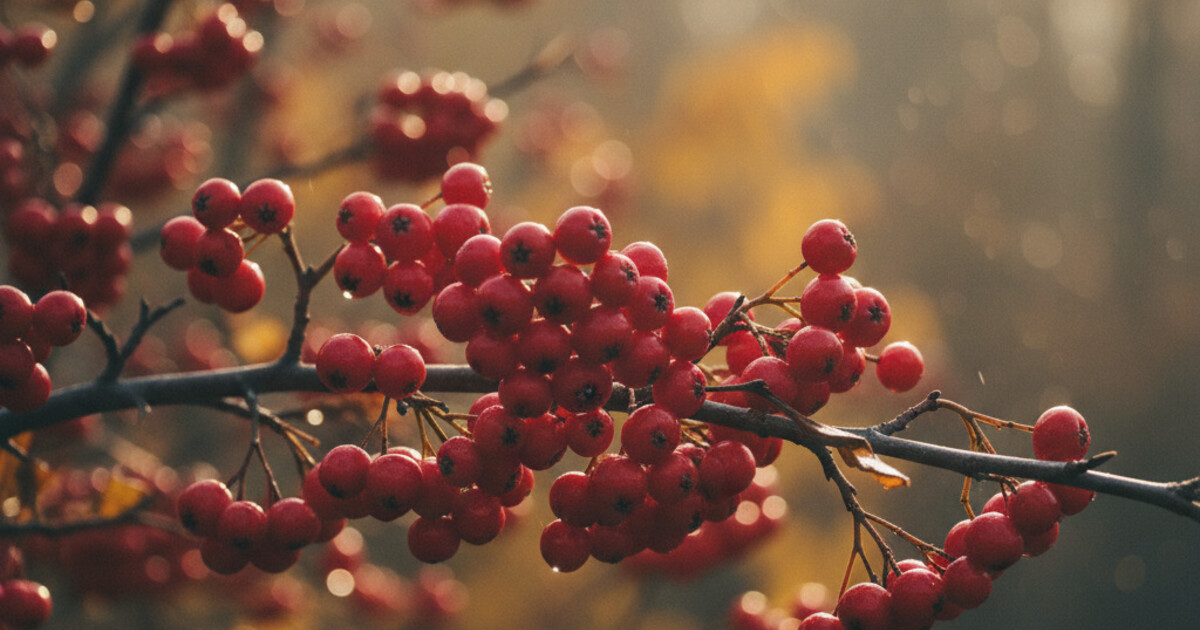
You’re out for a walk and spot a tree loaded with bright red berries. Birds are stripping the branches. You want to know what it is.
Red berries appear on more tree species than most people realize. Several common North American trees produce them, and the differences between species aren’t always obvious. Leaf shape, berry size, and bark texture all matter. This guide covers the 8 most common trees with red berries you’ll encounter — the kind of red berry tree people spot in parks, yards, and along trails — with specific field ID details for each.
Trees with red berries include hawthorn, American holly, crabapple, dogwood, cherry, serviceberry, mountain ash, and winterberry holly. Each species has recognizable features: cluster size, berry shape, and the presence or absence of a calyx (the small crown-like remnant at the base of each berry) can narrow your ID quickly.
Standing in front of one? Identify it from a photo in seconds — free, no sign-up needed.
8 Trees With Red Berries You’re Likely to Find
Eight tree species account for most of the red-berry sightings in North American parks, forests, and yards. Hawthorn (Crataegus spp.) produces small dark-red haws in dense clusters on thorned branches, ripening in late summer and persisting through winter. American holly (Ilex opaca) keeps its bright red berries year-round on stiff, spine-edged evergreen leaves. Crabapple trees (Malus spp.) produce small pome fruits with a five-pointed calyx scar at the base. Flowering dogwood (Cornus florida) offers glossy oval berries in clusters of 2 to 4, ripening in September. Cherry trees produce red fruit from June through July on branches with distinctive scaled or “burnt cornflake” bark. Serviceberry (Amelanchier spp.) ripens from red to blue-purple over a narrow window in early summer. Mountain ash (Sorbus spp.) displays flat-topped clusters of orange-red berries on compound-leafed branches. Winterberry holly (Ilex verticillata) stands out in winter with dense red berries on completely bare branches, long after the leaves have dropped.
Hawthorn Trees: Red Berries That Last Through Winter
Hawthorn berries, called haws, are small and round (typically 1/4 to 3/4 inch across) and ripen to deep red in late summer through fall. They grow in dense clusters and stay on the branches through winter, which makes hawthorn one of the easiest trees to spot when everything else has gone bare.
Look for the thorns. Hawthorns are almost always armed with stiff, sharp spines along the branches, ranging from 1 to 3 inches long — see the roundup of trees with thorns if the branches are what caught your eye first. The leaves are deeply lobed with toothed edges, similar to a small oak leaf.
Washington hawthorn (Crataegus phaenopyrum) is probably the most common species in eastern North America. It’s frequently planted as a street tree and in parks. The haws are smaller than those on most other hawthorns, and the clusters are particularly dense.
If you see a tree covered in red fruit with thorns on the branches, hawthorn is your first guess. For full species comparison, read the hawthorn tree identification guide.
American Holly: Red Berries on Evergreen Branches
American holly is one of the few trees that keeps its berries through the entire winter, making it impossible to miss against bare tree lines or snow.
The berries are small and round, about 1/4 inch across, growing in clusters of 3 to 5 along the branches. The leaves are the real giveaway: stiff and leathery, with sharp pointed teeth (spine-tipped lobes) along the edges. The leaves stay on the tree year-round, which is unusual for broadleaf trees in cold climates.
Holly is native to the eastern United States and grows from coastal swamps to upland forests. Female trees produce the berries; male trees don’t, so you’ll often find one berry-laden female surrounded by “empty” males nearby.
The bark on mature trees is thin and gray, sometimes mottled. Young twigs are greenish and slightly hairy.
Crabapple Trees: Tiny Fruits With an Apple-Like Calyx
Crabapple fruit looks exactly like a tiny apple, because that’s essentially what it is. Fruit size ranges from about 1/4 inch to just under 2 inches depending on the variety. The berries (technically pomes) are red, orange-red, or sometimes yellow, and persist on the branches from late summer through winter.
The most reliable ID feature is the calyx scar at the bottom of each fruit. Crabapples have a prominent five-pointed remnant, just like their larger cousins. Hold a berry up and look at the base. You’ll see it clearly.
Wild crabapples have thorns; ornamental varieties usually don’t. In spring, crabapples produce white or pink flowers before fruit develops. In winter with fruit still hanging, look for the calyx scar and the alternately arranged branches.
Many parks and suburban streets are planted with ornamental crabapples, making them one of the most common red-berry trees you’ll encounter. The crabapple tree identification guide covers ornamental vs. wild species in detail.
Dogwood Trees: Glossy Oval Berries in Fall
Flowering dogwood (Cornus florida) produces small, oval red berries in tight clusters of 2 to 4, ripening in September and October. The berries are shiny and brilliant red, about 1/2 inch long with a small pointed tip.
Look for the distinctive leaves: oval with smooth edges and parallel veins that curve toward the leaf tip (called arcuate venation). This vein pattern is one of the clearest dogwood tells. The leaves turn burgundy in fall just before dropping.
Kousa dogwood (Cornus kousa), an Asian species widely planted in North America, produces raspberry-like aggregate fruits rather than individual berries. They’re pink to red and roughly 1 inch across. Kousa blooms about 3 weeks later than flowering dogwood.
The bark on mature flowering dogwoods is blocky and breaks into small square plates, sometimes described as alligator-like. For the full comparison of dogwood species, see the dogwood tree identification guide.
Cherry Trees: Red Summer Fruit That Darkens Quickly
Wild cherries ripen in early to midsummer, turning from yellow-green to bright red and eventually dark red or purple when fully ripe. They’re small, usually 1/4 to 1/2 inch across, and hang in clusters along the branches.
The immature fruits are red for a few weeks before ripening fully. By mid-July in most regions, wild cherries have darkened. This timing window is when people most often mistake them for a “red-berry tree.”
Black cherry (Prunus serotina) is the most common native cherry in eastern North America. It grows to 60 to 80 feet tall. The bark on mature trees is dark gray, broken into small scaly plates often described as “burnt cornflakes.” This bark pattern is one of the clearest field marks.
Pin cherry (Prunus pensylvanica) is smaller and more shrubby, with berries that stay bright red at full ripeness. It’s common in disturbed areas and along forest edges.
The cherry tree identification guide covers both native and ornamental species.
Serviceberry: The First Red Berries of Summer
Serviceberry produces some of the earliest-ripening fruit of any North American tree. Berries are ready in June in most regions, starting red and ripening quickly to dark blue-purple. You’ll see them at the red stage for only 1 to 2 weeks each year.
The berries look like small blueberries, about 1/4 inch across, growing in loose clusters on drooping stems. They’re sweet and commonly made into jam or baked goods.
ID features include smooth gray bark, oval leaves with fine teeth along the edges, and drooping white flower clusters in early spring. Serviceberry often grows at forest edges and along stream banks.
In early spring, serviceberry is one of the first flowering trees in the eastern US, putting on a show of white flowers while the canopy is still bare. See the full serviceberry tree identification guide for species details.
Mountain Ash: Orange-Red Berries on Compound Leaves
Mountain ash isn’t a true ash tree (it’s more closely related to apples and pears), but it produces some of the most striking red berries of any North American tree.
The berries grow in large, flat-topped clusters called corymbs, with each berry about 1/4 to 1/3 inch across. They ripen to bright orange-red in August and September, and birds strip them fast.
The leaves are pinnately compound, with 9 to 17 leaflets arranged along a central stem. This compound leaf structure is one of the key ways to tell mountain ash apart from other berry-producing trees.
American mountain ash (Sorbus americana) is native to the eastern US and Canada. European mountain ash (Sorbus aucuparia) has been widely planted as an ornamental and now grows throughout North America.
Winterberry Holly: Bare Branches Covered in Red
Winterberry is a deciduous holly, meaning it drops its leaves in fall. What’s left is a bare tree covered in dense clusters of bright red berries. If you see a bare-branched shrub or small tree with red berries packed tightly along every twig in December or January, winterberry is your answer.
The berries are round, 1/4 to 1/3 inch across, and cling to the branches through most of winter. They’re a key food source for birds after most other berries are gone.
Winterberry grows in wet areas, particularly along stream banks, swamps, and wet forest edges. It’s native to the eastern US and is widely planted in rain gardens and wet landscape areas.
The leaves (before they drop) are elliptical with finely toothed edges. Bark is smooth and gray.
How Tree Identifier Can Help You ID Your Red Berry Tree
When you spot a tree with red berries and aren’t sure which species you’re looking at, a photo gets you an answer in seconds.
The Tree Identifier app works from photos of leaves, bark, fruit, or the whole tree shape. Take a clear photo of the berries with the branch and leaves in frame, submit it, and the app identifies the species with a confidence score. You’ll see the species name, key characteristics, and habitat information for the ID.
The app works offline too. Download the species data before your hike and it runs without a signal, which matters when you’re in the woods away from cell service. You get 2 free identifications per day with no subscription required, and it’s available on iOS and Android at treeidentifier.app.
Frequently Asked Questions
Which trees have red berries in fall and winter?
Hawthorn, American holly, crabapple, and winterberry holly all produce red berries that persist into fall and winter. Hawthorn and crabapple berries can stay on branches through January or February. American holly keeps its berries all season. Winterberry holly is especially visible in winter because the leaves drop, leaving bright red berries exposed on completely bare branches.
How do you tell holly berries from hawthorn berries?
Hawthorn berries grow in loose clusters on branches with sharp thorns. They’re small, round, and dark red-brown. Holly berries grow in tight clusters of 3 to 5 along the branch, are brighter red, and the tree has stiff, spiny leaves that stay on year-round. Hawthorn leaves are lobed and toothed; holly leaves have spine-tipped points.
What’s the difference between dogwood berries and cherry fruits?
Dogwood berries are oval and shiny red, growing in tight clusters of 2 to 4 in September to October. Cherry fruits are rounder, ripen from green to red to dark in June to July, and hang in loose clusters on long stems. The bark tells them apart quickly: dogwood has blocky, plate-like bark while cherry has distinctive “burnt cornflake” scaling.
Is a “redberry tree” the same as a “red berry tree”?
For most searches, yes. “Redberry tree,” “red berry tree,” and “tree with red berries” all point to the same goal: naming a tree that’s carrying red fruit. Written as one word, though, “redberry” is also the common name of a few specific plants. Redberry juniper (Juniperus pinchotii) grows across Texas and the Southwest, and redberry buckthorn (Rhamnus crocea) is common in California chaparral. So if someone sends you to look at a “redberry tree,” check whether they mean one of those named species or just a tree with red berries in general.
Are the red berries on these trees dangerous?
It varies by species, and this guide is about identifying trees, not judging what’s edible. Some ornamental berries can upset the stomach if eaten, so it’s worth knowing what you’re looking at before letting kids or pets near a low-hanging branch. For the trees most worth steering clear of, read our guide to poisonous trees to avoid.
Can I identify a tree by its berries alone?
Berries are a useful clue but rarely enough on their own. Berry size, color, and cluster shape narrow the options significantly. You’ll get a faster, more confident ID by also looking at the leaves, bark texture, and overall tree shape together. An AI identification app works best with a photo that includes berries, leaves, and branch structure in the same frame.
Wrapping Up
The 8 trees most likely to be the source of red berries you encounter in North America: hawthorn, American holly, crabapple, dogwood, cherry, serviceberry, mountain ash, and winterberry holly. Leaf shape and berry cluster structure are the two most reliable field marks for telling them apart.
If you want a faster answer next time you’re out, Tree Identifier can ID any of these from a photo of the leaves, berries, or bark. It’s free to start, works offline, and is available on iOS and Android at treeidentifier.app.
Identify a tree from your photo — free
Upload a leaf, bark, or whole-tree photo and get the species in seconds. No signup.
Confidence:
Unlock the full species profile
Free in the app — with unlimited identifications.


AI result for guidance — the app gives full species details and works offline.
Want unlimited identifications?
Get the full species profile, photos and details — free in the app, with unlimited scans.
- Unlimited identifications
- Full species profiles & details
- Works offline, anywhere
- Save and revisit your finds
Elena Torres
Tree Identifier Team