How to Tell What Kind of Wood Furniture Is Made Of
You pick up an old dresser drawer and it weighs more than you expected. Or you’re standing in an antique shop, staring at a chest, wondering whether it’s solid walnut or pine stained dark. Knowing what kind of wood furniture is made of tells you how durable it is, how to refinish it, and what it’s worth. The clues are already in the wood itself.
Furniture wood gives itself away through color, grain pattern, weight, and texture. Most pieces built before the 1980s were solid wood throughout. Many modern ones layer a thin veneer over engineered substrates. A few targeted checks tell you which you’re dealing with before you buy, restore, or strip anything down.
To identify what kind of wood furniture is made of, check four things: color (oak is golden with ray flecks, walnut is dark brown, cherry is reddish-brown), grain texture (open and coarse vs fine and tight), weight (dense hardwoods feel heavy for their size), and end grain inside a drawer, which shows solid wood vs veneer.
The Most Common Furniture Woods and How to Spot Them
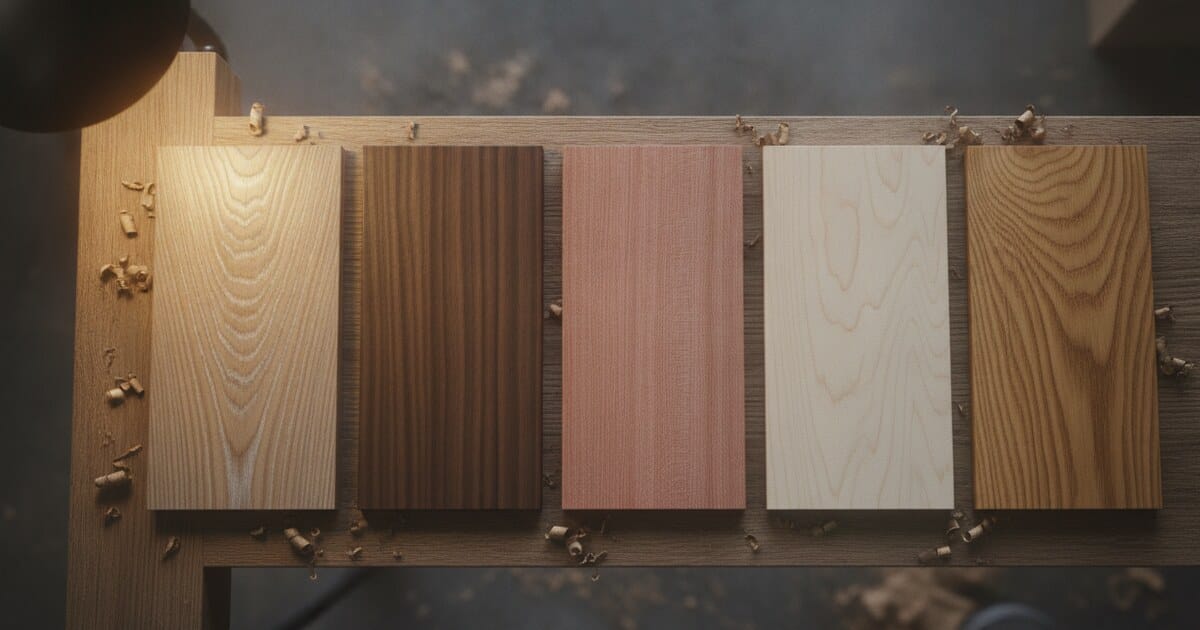
Six species account for most hardwood furniture you’ll encounter in North American and European homes. Oak ranges from pale straw to warm golden-brown with a Janka hardness of 1,290 lbf (red oak) or 1,360 lbf (white oak) and shows prominent silvery ray flecks on quartersawn surfaces. Walnut runs dark chocolate-brown with 1,010 lbf hardness and straight to slightly wavy grain. Cherry starts pinkish-red at 950 lbf and darkens to reddish-brown over years of light exposure, with fine, uniform grain. Hard maple is creamy white to light-tan at 1,450 lbf, the toughest of the group, with nearly invisible grain and a smooth surface. Mahogany falls around 800-900 lbf with reddish-brown tones and a ribbon-stripe figure in quartersawn cuts. Pine is the softest common furniture wood at 870 lbf (yellow pine), with amber tones and concentric growth ring lines that no hardwood species replicates. Density and grain together put you in the right neighborhood for most identifications.
Teak is worth a separate mention. It’s golden-brown to dark brown with a slightly oily surface you can feel when you run your palm across it, plus a faint leathery smell when scratched. Its Janka hardness is 1,070 lbf. Teak dominated outdoor and yacht furniture through the mid-20th century, and antique teak pieces are still common at estate sales.
For a deeper breakdown of each species, including how freshly cut color differs from aged patina, the complete wood identification guide covers each one in detail.
How to Read Wood Grain to Identify Furniture
Grain tells you more than color, because finish and stain change color. Grain doesn’t change.
There are three things to look for: pore size, pore arrangement, and ray flecks.
Pore size separates open-grained species from tight-grained ones. Oak, ash, and mahogany have large pores visible to the naked eye. Run your fingernail across the surface at a low angle and it’ll catch in those pores. Maple and cherry have tiny, diffuse pores and feel glassy even when unfinished.
Pore arrangement tells you the species family. Oak, ash, and chestnut are ring-porous: their large pores form distinct lines that follow the growth rings, creating a bold alternating pattern. Walnut, cherry, and maple are diffuse-porous: pores scatter evenly across each growth ring for a softer, more uniform look.
Ray flecks are oak’s clearest signature. Quartersawn or rift-sawn oak shows silvery streaks running perpendicular to the main grain direction. No other common furniture wood produces rays this large or this dense. If you see a lacy fleck pattern across the face grain, you’re almost certainly looking at oak.
For close-up examples of each pattern, the types of wood grain patterns guide covers straight, interlocked, ring-porous, and figured grain side by side.
Physical Tests That Don’t Need Any Tools
Visual checks narrow it down to a shortlist. These four quick tests help you pick the right answer from that shortlist.
Weight: Pick up a drawer or lift one corner of the piece. Solid hardwood is dense. A red oak dining chair runs 15-20 lbs; the same chair in pine or MDF weighs noticeably less. If the piece feels light for its size, it’s probably softwood, veneer over particle board, or MDF.
Smell: Freshly scratched wood carries a species-specific scent. Teak smells oily and leathery. Cedar is sharp, almost medicinal. Pine is resinous. Walnut has a mild, slightly nutty note. Scratch the underside of a shelf or the inside wall of a drawer box, then take a quick sniff. Finished surfaces won’t help because the finish masks the wood’s smell completely.
Fingernail test: Press your fingernail firmly into a hidden spot. Pine and soft woods dent easily. Oak, maple, and walnut resist. A clear indent means either a softwood or thin veneer over a soft substrate.
End grain inspection: End grain is exposed wherever wood is cut across its growth rings: inside drawer boxes, on the underside of a tabletop at the edge, or on the bottom of a leg. Ring-porous species (oak, ash) show distinct alternating bands of large and small pores. Diffuse-porous species (walnut, cherry, maple) look more uniform across the rings. Solid wood shows continuous end grain; veneered pieces show a thin wood layer (typically 1/16 to 1/8 inch) bonded over a substrate that looks completely different underneath.
Solid Wood, Veneer, or Engineered Wood?
Knowing the species matters less if you don’t also know how the furniture is constructed. Construction type affects value, repair options, and longevity.
Solid wood: Grain continues through the full thickness of the board. All four edges of a panel show the same grain as the face. You can sand and refinish it many times without risk. Steam can raise minor dents.
Veneer: A thin layer of real wood, usually 1/16 to 1/8 inch thick, bonded to plywood or MDF. The face looks identical to solid wood. Check the edges at corners: you’ll often find a paper-thin line where the veneer wraps, or end-grain banding with a different grain direction than the face. Chips at corners expose the substrate beneath.
MDF and particle board: Slice off a small chip from a hidden edge and you’ll see uniform gray-brown filler with no grain structure at all. MDF is dense and smooth inside; particle board shows visible wood chips or flakes in cross-section. Both accept paint well but can’t be refinished to a clear finish like solid wood.
Most furniture built after the 1970s mixes all three: solid wood for legs and structural frames, veneered panels for flat door and drawer faces, MDF or particle board for drawer bottoms and hidden panels. Pre-1900 antique pieces are far more likely to be solid wood throughout, though many have been refinished in colors that disguise the original species.
How Tree Identifier Can Help You Name a Wood
When color, grain, and physical tests still leave you with two or three candidates, a photo-based identification closes the gap quickly.
Tree Identifier includes wood species recognition alongside its tree identification tools. Photograph the exposed wood (end grain inside a drawer, a worn patch of bare surface, or a freshly sanded area), submit the photo, and the app returns the most likely species with a confidence score. It reads grain pattern, pore structure, and color tone directly from the image.
The app gives you 2 free identifications per day on iOS and Android, no subscription required. For a quick check without downloading anything, the free browser tool at treeidentifier.app/tools/wood runs the same analysis with one free scan per visit.
Wood recognition works best on bare, unfinished surfaces or worn areas where the grain is exposed. For painted or heavily stained pieces, the fingernail test and end grain check will still be your most reliable first step.
Frequently Asked Questions
Is there an app to identify wood furniture?
Yes. Tree Identifier includes a wood species recognition feature that identifies furniture wood from photos. It reads grain pattern, pore structure, and color tone and returns the most likely species with a confidence score. The iOS and Android app offers 2 free scans per day with no subscription. A free browser version at treeidentifier.app/tools/wood works without downloading anything.
How do I tell if furniture is solid wood or veneer?
Check the edges. Solid wood shows grain on all four sides of every board. Veneered pieces show a thin top layer (typically 1/16 to 1/8 inch) over a different substrate. Look closely at corners and drawer fronts: chips or peeling spots expose the substrate below. Inside a drawer box, end grain looks continuous in solid wood and layered in veneered construction.
What does oak furniture look like?
Oak is golden to warm brown with prominent ray flecks: silvery streaks that run perpendicular to the main grain on quartersawn or rift-sawn surfaces. The pores are large and open, visible without magnification. The grain is bold and pronounced. Red oak has a slight pinkish undertone; white oak runs more golden. The oak wood identification guide covers both species in detail.
Can you identify wood by its smell?
Sometimes. Teak smells distinctly oily and leathery when scratched. Cedar is sharp, almost medicinal. Pine is resinous. Walnut has a mild, faintly nutty smell. This test works best on fresh cuts or scratched areas. Finished surfaces smell like the finish, not the wood, so scratch a hidden spot first to get the actual wood scent.
How do I tell mahogany from walnut?
Color and grain are the main tells. Walnut is darker and more uniformly brown, with straight to slightly wavy grain and a matte surface feel. Mahogany is lighter and more reddish-brown, often with a ribbon-stripe visible in quartersawn cuts (alternating light and dark bands). Mahogany also has larger, more open pores than walnut and a coarser surface texture at the same finish level.
If you’ve got a piece you can’t pin down, photograph the end grain or a worn area of bare wood and run it through Tree Identifier. The wood recognition feature covers hundreds of species and returns results in seconds. Download the app on iOS or Android, or use the free web scanner at treeidentifier.app to identify furniture wood from your next estate sale find.
Identify a tree from your photo — free
Upload a leaf, bark, or whole-tree photo and get the species in seconds. No signup.
Confidence:
Unlock the full species profile
Free in the app — with unlimited identifications.


AI result for guidance — the app gives full species details and works offline.
Want unlimited identifications?
Get the full species profile, photos and details — free in the app, with unlimited scans.
- Unlimited identifications
- Full species profiles & details
- Works offline, anywhere
- Save and revisit your finds
Elena Torres
Tree Identifier Team