Types of Wood Grain Patterns: Straight, Figured and More
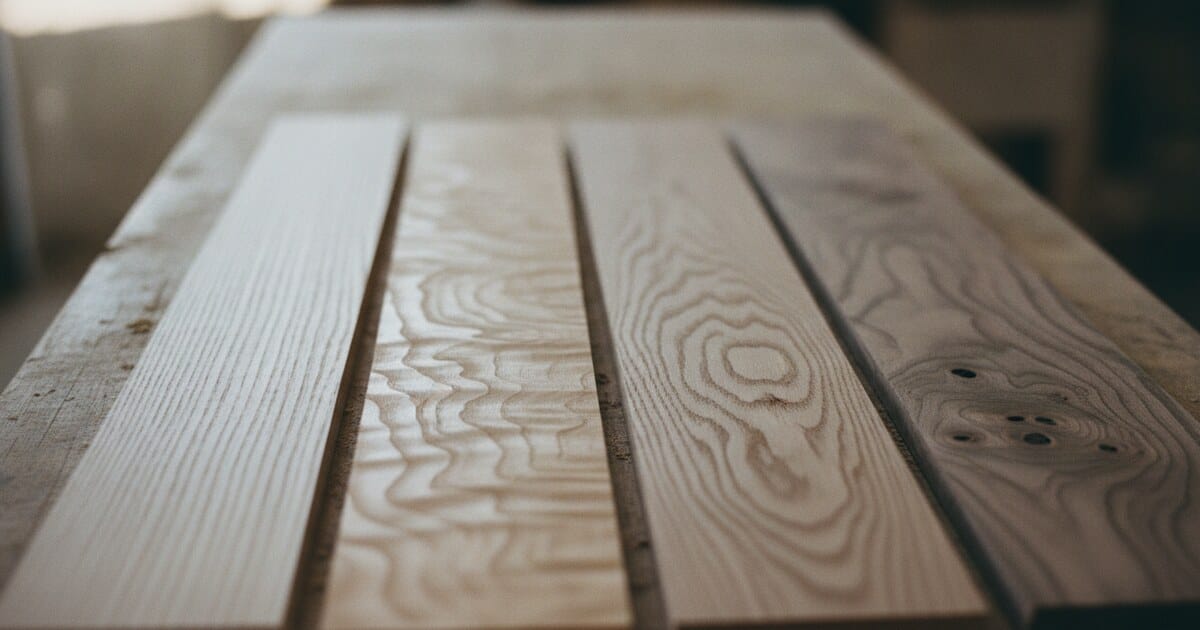
Pick up two boards milled from the same species and they can look completely different. One face shows cathedral arches sweeping up the center; another runs in tight vertical lines; a third has small swirling dimples scattered across it like fish scales. That variation all comes from grain, and knowing the types of wood grain patterns tells you more than how a board looks. It predicts how the wood will move with humidity changes, how easy it is to plane, whether you need grain filler before finishing, and which sawing cut to ask for at the lumber yard.
Wood grain is the arrangement of a tree’s fibers relative to the log’s vertical axis. Every growing season builds new cells, and how those cells form and orient determines the grain pattern you’ll see on every board you mill from that log.
Types of wood grain patterns fall into 3 overlapping dimensions: fiber direction (straight, spiral, interlocked, wavy, irregular), pore structure (open, closed, semi-open), and decorative figure (bird’s eye, burl, fiddleback, ribbon). Sawing method is the fourth dimension that determines which of those properties shows on the board’s face.
The main types of wood grain patterns are straight grain (fibers parallel to the log axis), interlocked grain (fibers reverse direction each growth cycle, creating ribbon figure), wavy grain (constantly shifting fibers that produce fiddleback), burl (swirling growth around a stress mass), and open vs. closed grain based on pore size. Sawing method determines which pattern appears on the board’s face.
What Is Wood Grain and Why Does It Matter?
Wood grain forms from cells laid down during each year of growth. Hardwoods split into two main pore structures: ring-porous species (oak, ash, elm) produce large earlywood vessels 0.2–0.5 mm wide followed by dense latewood, while diffuse-porous species (maple, birch, cherry) spread smaller vessels of 0.02–0.05 mm evenly across each ring. Softwoods skip vessels entirely, relying on tracheids 10–50 micrometers wide. Fiber direction creates 6 grain types: straight grain runs parallel to the log axis and is strongest in compression; interlocked grain reverses spiral direction each annual increment, producing ribbon figure on quartersawn mahogany and sapele; wavy grain creates fiddleback, the shimmer pattern on violin backs and figured furniture panels. Grain structure affects Janka hardness directly: ring-porous white oak reaches 1,360 lbf, while diffuse-porous hard maple reaches 1,450 lbf, because maple’s uniform fiber distribution resists indentation more evenly across the full growth ring.
Grain also controls workability. Straight-grained wood planes cleanly in either direction. Interlocked grain tears out if you feed it against the reversal. Knowing the grain type before you start saves boards from the scrap pile.
6 Types of Wood Grain Patterns by Fiber Direction
This is the first and most structurally important dimension. It describes how the tree’s fibers grew relative to the central log axis.
Straight Grain
Fibers run approximately parallel to the log’s vertical axis. Straight-grained boards are predictable: they plane easily, split cleanly, and dry with minimal distortion. Most structural lumber is graded partly on how straight the grain runs. White oak used in timber framing and Douglas fir used in joists are typically straight-grained, and that’s not coincidental. Both species are selected partly because straight grain maximizes bending strength.
Interlocked Grain
Fibers reverse spiral direction with each successive annual growth cycle. One year’s fibers angle left; the next angle right. You can’t see this from the face of a flat-sawn board, but quartersawn, it produces ribbon or stripe figure because light hits each alternating layer at a different angle. Mahogany, sapele, and teak all grow interlocked grain naturally. Flat-sawn interlocked grain tears out badly when planed, so reading the edge of the board first to find the correct feed direction saves a lot of grief.
Wavy Grain
The fiber direction shifts constantly rather than reversing cleanly. Quartersawn, wavy grain produces fiddleback: parallel ripples that shimmer as you tilt the board. Curly maple and figured sycamore are the most common sources. Wavy grain is difficult to flatten by hand because the feed direction needs to keep changing, but it’s among the most decorative grain types in furniture and instrument making.
Spiral Grain
Fibers grow in a helix around the trunk rather than straight up. Trees with steep spiral grain twist or cup severely as they dry. You can sometimes spot it on a standing tree: diagonal lines in the outer bark follow the fiber pattern beneath. Many tropical species grow spiral grain, which partly explains why some exotic lumber moves unpredictably after milling.
Irregular Grain
Fibers deviate unpredictably around knots, crotches, or other growth disturbances. Irregular grain produces striking visual patterns but tears out with edge tools. The crotch figure, where a trunk forks into two main branches, is one of the most sought-after sections in a log because the compressed fibers in that zone create a dense, feather-patterned piece unlike anything from the main trunk.
Diagonal Grain
This one isn’t a tree trait. Diagonal grain appears when a straight-grained log gets sawn off its vertical axis, so the face of the board cuts across the fibers at an angle. It’s a milling defect in structural timber. Standards like NHLA grading rules limit grain slope to 1:20 in load-bearing applications because diagonal grain reduces bending strength well below what the species is rated for. In decorative work, mild diagonal grain causes no problems.
Open vs. Closed Grain: The Pore Structure Dimension
Pore size determines whether a surface needs filling before finishing and how oil and stain absorb. This dimension runs perpendicular to fiber direction: a board can be straight-grained and open-grain (quartersawn white oak) or straight-grained and closed-grain (rift-sawn maple).
Ring-porous (open-grain) species produce large, visible pores in the earlywood band. Oak, ash, and elm are the classic examples. On white oak, those vessels run 0.2–0.5 mm wide, easily visible without magnification. Open-grain woods need a grain filler before film finishes like lacquer or polyurethane, or the finish sinks unevenly into the pores over the first few coats. Oil finishes skip the filling step but penetrate more deeply, producing a different visual result.
Diffuse-porous (closed-grain) species distribute small, even pores across the full growth ring. Maple, cherry, birch, and beech fall here. Their pores run 0.02–0.05 mm, invisible to the naked eye. Film finishes build evenly on closed-grain surfaces without any pore-filling prep. That’s why maple is the go-to for painted cabinetry: two coats of primer over a closed-grain surface produce near-glass smoothness. Maple vs. birch wood covers how these two diffuse-porous species compare in hardness, figure, and finishing behavior.
Semi-open-grain species sit between the two groups. Walnut, mahogany, and teak have moderately sized vessels that may or may not need filling depending on the finish. For oil, no prep needed. For high-gloss lacquer, a light fill coat helps.
Decorative Wood Grain Figure Patterns
Decorative figures are striking visual patterns that form when fiber direction or growth abnormalities create unusual optical effects. They’re specific expressions of the grain types above, not a separate category.
Bird’s eye appears most reliably in hard maple. Small cone-shaped fiber depressions create dimple-shaped eyes across the face. The most widely accepted cause links it to stress from climbing vines or environmental conditions during early growth, creating localized fiber distortion. Premium bird’s eye maple boards fetch 3–5x the price of plain maple.
Burl forms when a tree grows a tumor-like mass of dormant buds. Inside, fibers swirl chaotically in every direction. Burl slabs are almost impossible to work with edge tools because grain runs in every direction at once. Stabilized burl, resin-infused to fill the voids, is common in pen blanks and knife handles where the resin makes the otherwise unpredictable material workable.
Fiddleback is wavy grain seen on quartersawn stock, producing the parallel ripple pattern on the backs of fine violins. Curly maple is the most common source, but sapele and makore produce it too. The shimmer comes from how light reflects differently off each alternating peak and valley in the wave.
Ribbon figure is interlocked grain quartersawn. Alternating fiber layers appear light and dark as the viewing angle changes. It’s most visible in African mahogany, sapele, and anigre. A quartersawn sapele board with strong ribbon figure shows two grain properties at once: interlocked fiber direction as the underlying structure, ribbon figure as the visual result at the surface.
Spalting is caused by fungal colonization of partially dried or dead wood. Zone lines (black boundaries where competing fungal colonies meet) and fungal pigmentation create patterns no living tree can produce. Spalted maple and spalted beech are the most common sources. Fully spalted wood is too soft and punky for structural use; the ideal piece catches the fungal patterning before integrity degrades.
How Sawing Method Reveals Different Wood Grain Patterns
The same log produces dramatically different grain patterns depending on how it’s milled. Sawing method is the fourth dimension of grain appearance.
Plain-sawn (flat-sawn) is the most common cut. The saw runs tangentially through the log, producing the cathedral arch or flame pattern most people associate with wood grain. Growth rings hit the face at 0–35 degrees. Plain-sawn boards show the widest face variation from board to board and are most prone to cupping as moisture content changes.
Quarter-sawn cuts the log into quarters first, then saws each quarter with rings perpendicular to the face (60–90 degrees). The result is straight vertical grain on the face plus strong ray fleck in ring-porous species. White oak’s medullary rays run up to 25 mm long on quartersawn faces, producing the large silver-grey patches that define Arts and Crafts furniture. Oak vs. walnut wood shows how ray fleck helps distinguish the two species at a glance, since walnut lacks the same prominent rays.
Rift-sawn orients cuts at 30–60 degrees to the annual rings, producing clean linear grain with no ray fleck at all. It’s the most dimensionally stable cut but also the most wasteful of the log, which makes it the most expensive option. Architects specify rift-sawn oak for millwork and cabinetry when they want uniform grain across large panels without the fleck.
Live-sawn passes the log straight through the saw without repositioning, producing boards that include straight grain, cathedral arch, and near-quartersawn grain all in one piece depending on where in the log each board falls.
How to Identify Wood Type by Its Grain
Grain identification follows a consistent 3-step method: pore structure first, fiber direction second, figure third.
Start with end grain. Use a loupe or bright raking light across the end of the board. Visible rows of large pores concentrated in the earlywood = ring-porous (oak, ash, elm). Evenly distributed fine pores across the full ring = diffuse-porous (maple, cherry, birch). Moderately sized pores slightly larger near the ring start = semi-ring-porous (walnut, mahogany).
Then check fiber direction on the board’s edge. Straight parallel lines = straight grain. Diagonal lines crossing the edge = spiral or diagonal grain. Alternating diagonal lines that reverse = interlocked grain.
Then look at the face for figure. Cathedral arches = plain-sawn. Vertical lines with fleck = quartersawn ring-porous. Shimmering ripples = fiddleback. Small circular dimples = bird’s eye. Swirling pattern with no clear direction = burl.
A detailed walkthrough of this method, including the tyloses test for distinguishing white oak from red oak on end grain, is in how to identify wood by grain. For the full species-level identification process from pore structure through field tests, the wood identification guide covers each step.
Frequently Asked Questions
What are the different types of wood grain patterns?
Wood grain patterns fall into 3 main dimensions: fiber direction (straight, spiral, interlocked, wavy, irregular, diagonal), pore structure (open/ring-porous, closed/diffuse-porous, semi-open), and decorative figure (bird’s eye, burl, fiddleback, ribbon, spalting). Sawing method (plain, quarter, rift, live sawn) determines which dimension shows most prominently on the board’s face.
What wood has the best grain pattern?
Quartersawn white oak produces the most distinctive pattern, with pronounced silver ray fleck. For decorative figure, curly maple’s fiddleback and burr walnut slabs are among the most sought-after. For clean, consistent linear grain, rift-sawn white oak and quartersawn teak are the standard specification in high-end cabinetry and architectural millwork.
What is interlocked grain in wood?
Interlocked grain means the wood fibers reverse spiral direction with each successive annual growth cycle. Quartersawn, this creates ribbon or stripe figure because each alternating layer reflects light differently. Mahogany, sapele, teak, and many tropical species grow interlocked grain naturally. It’s visually striking quartersawn but tears out badly when planed flat-sawn against the reversal.
How does grain direction affect wood strength?
Straight grain is strongest in compression and tension along the grain axis. A knot (irregular grain) or steep diagonal grain can reduce a board’s bending strength by 50% or more compared to clear straight-grained stock of the same species. Structural lumber grades limit grain slope to 1:12 or 1:20 in load-bearing applications precisely for this reason.
How do I identify wood type by its grain pattern?
Start with end grain pore structure using a loupe: visible earlywood rows = ring-porous; even fine pores = diffuse-porous. Then check fiber direction on the board edge. Then look for figure on the face. That combination usually narrows you to a species group. For specific species, the Tree Identifier app reads wood grain patterns from a photo and returns species candidates with confidence scores.
The Tree Identifier app identifies wood species from photos of grain, color, and texture, including tricky cases like quartersawn vs. plain-sawn stock and figured pieces that don’t look like their plain-grain counterparts. Two free identifications per day on the app, or try a single scan free at treeidentifier.app/tools/wood-identifier.
Identify a tree from your photo — free
Upload a leaf, bark, or whole-tree photo and get the species in seconds. No signup.
Confidence:
Unlock the full species profile
Free in the app — with unlimited identifications.


AI result for guidance — the app gives full species details and works offline.
Want unlimited identifications?
Get the full species profile, photos and details — free in the app, with unlimited scans.
- Unlimited identifications
- Full species profiles & details
- Works offline, anywhere
- Save and revisit your finds
Elena Torres
Tree Identifier Team