How to Identify Cherry Wood: Color, Grain, and Gum Pockets
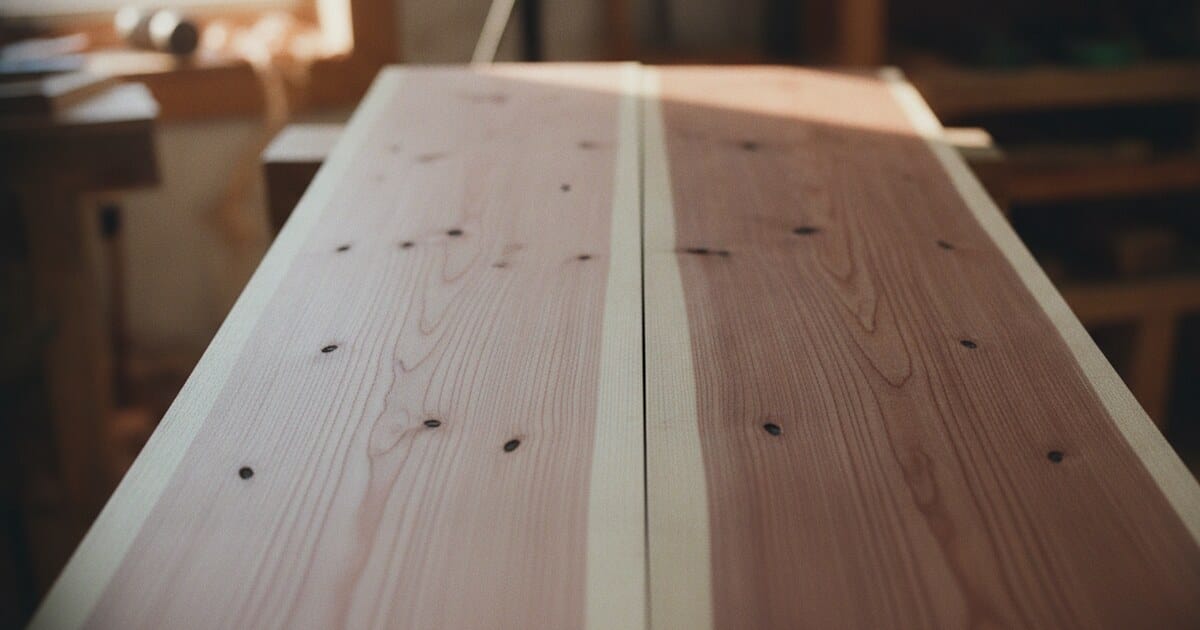
Pick up a board of freshly milled cherry and you’ll probably be confused. Fresh Prunus serotina is pale, almost peachy-tan. Nothing like the deep reddish-brown you see in finished cabinets and antique furniture. That color takes months to develop and years to deepen fully.
Three markers identify cherry quickly: gum pockets scattered through the heartwood, a sharp sapwood-to-heartwood color transition, and a semi-ring-porous end grain pattern. This guide covers each one, then compares cherry to its most common look-alikes — maple, walnut, and wood that’s been stained to pass as cherry.
To identify cherry wood, look for gum pockets: small dark oval spots embedded in the heartwood that appear in no other common cabinet wood. Fresh cherry is pale pinkish-tan with a creamy white sapwood border. End grain is semi-ring-porous, with earlywood pores slightly larger than latewood pores. With UV exposure, cherry darkens to rich reddish-brown over 6 to 12 months.
What Does Cherry Wood Look Like?
Freshly cut heartwood is light pinkish-tan, sometimes with a faint peachy or yellowish cast. The sapwood sits alongside it as a band of creamy white or pale yellow, and that contrast is itself a clue. Few other cabinet hardwoods have such a distinct two-tone division in the same board.
Color shifts fast with light exposure. Within 3 to 6 months the heartwood deepens toward amber and then reddish-brown. After 1 to 2 years it’s a warm, saturated reddish-brown. After 5 or more years, old cherry can read almost like dark mahogany. The change is permanent, driven by photochemical reactions in the wood’s phenolic compounds.
Prunus serotina (American black cherry) grows across eastern North America from Maine and Ontario south to northern Florida, and west to Minnesota and Kansas. Trees typically reach 50 to 80 feet, occasionally topping 100 feet on good sites. Janka hardness is 950 lbf, density around 36 lbs per cubic foot (580 kg/m³), and shrinkage runs 7.1% tangential and 3.7% radial (T/R ratio 1.9), making it moderately stable. Lumber runs $7 to 9 per board-foot for select/better grade. A handful of other Prunus species (wild cherry, chokecherry, pin cherry) share the “cherry” name commercially but are too small for standard lumber and rarely appear as solid wood furniture pieces.
The Gum Pocket Test: Cherry’s Most Reliable Tell
Gum pockets are the single most reliable way to confirm cherry. These are small, irregular cavities in the heartwood filled with dried resin. They show up as dark oval spots, short dark streaks, or occasionally tiny voids in the face grain. Run your fingernail across the surface and some will catch slightly.
No other common North American cabinet wood has them. Maple won’t have them. Walnut won’t have them. Mahogany won’t have them. Birch and alder — both often stained to mimic cherry — won’t have them either. Gum pockets in the heartwood mean cherry, or another Prunus species.
They’re scattered randomly through the heartwood and don’t appear in the sapwood. On a well-planed surface you can see them clearly as dark ovals, typically 2 to 8 mm long. In rougher lumber they may look like dark smudges or short mineral-style streaks, but a quick sand or plane pass exposes the cavity beneath.
One note: pitch pockets and mineral streaks are different things. Mineral streaks are faint, grayish-green staining from tannin-metal reactions in the live tree. Pitch pockets are actual cavities with a slightly glossy interior from the resin. Both are normal in cherry. Neither appears in maple or mahogany.
How to Read Cherry Wood Grain
Cherry has a mostly straight grain with a fine, uniform texture. The surface planes to a smooth, satiny finish with very little prep work, which is part of why it’s been a cabinetmaker’s choice for centuries. Occasionally you’ll find figured cherry (wavy or curly grain) in material cut from crotch sections or abnormal growth, but standard lumber is reliably straight.
The end grain is semi-ring-porous. Earlywood pores are visibly larger than latewood pores, but the transition between them is gradual. Under a 10x loupe the pores are small and round, arranged in a scatter that grades toward slightly larger at the growth ring boundary. This is distinct from ring-porous woods like oak, where the pore size jump is dramatic, and from diffuse-porous woods like maple, where pore size is nearly uniform across the ring.
Weight helps narrow it down further. Cherry runs about 36 lbs per cubic foot, noticeably lighter than hard maple (44 lbs/ft³) or hickory (51 lbs/ft³). It’s close to walnut (38 lbs/ft³), but walnut is consistently darker from the mill. Learning to read end grain is worth the effort — it’s covered in detail in the wood identification by grain guide.
Cherry vs. Maple, Walnut, and Other Look-Alikes
Cherry vs. maple. Maple is diffuse-porous: all pores are roughly the same size across the growth ring, giving end grain a smooth, even look under a loupe. Maple also has no heartwood/sapwood color division in most boards; it’s uniformly pale throughout. Most importantly, maple has no gum pockets. Pale, uniform wood with no gum pockets and no color transition is almost certainly maple.
Cherry vs. walnut. Fresh walnut starts dark chocolate brown straight from the mill. Cherry never does. Walnut is also semi-ring-porous but has larger, more open pores that are visible without a loupe on the end grain. At 38 lbs/ft³, walnut is slightly heavier than cherry (36 lbs/ft³) and feels denser in the hand. Neither wood has knots in fine lumber, but only cherry has gum pockets. The walnut vs cherry wood comparison covers grain, shrinkage, and aging in more depth.
Cherry vs. alder and birch (stained). Furniture labeled “cherry finish” or “cherry color” is often alder or birch with a reddish-brown stain. The stained version is uniform in color: no sapwood border, no gum pockets, and it won’t deepen with sun exposure. Real cherry has a creamy sapwood strip, has gum pockets in the heartwood, and will visibly darken if you set it near a window for a few weeks.
Cherry vs. mahogany. Mahogany (Swietenia macrophylla) is diffuse-porous and produces a ribbon figure on quartersawn surfaces from its storied rays. Cherry doesn’t. Mahogany is also denser (40 lbs/ft³) and starts life a deeper reddish-brown than fresh cherry. No gum pockets in mahogany. The cherry vs mahogany wood article has a full comparison with Janka data and CITES status. For a broader framework, the wood identification guide covers end grain analysis across all major cabinet species.
How to Spot Fake Cherry (Stained Wood)
A lot of mass-market furniture labeled “cherry” is alder, poplar, or birch stained to a reddish-brown color. Here’s how to tell.
First, look for a sapwood border. Real cherry boards often have a strip of creamy white sapwood along one edge or face. Stained wood is the same reddish color everywhere, because the stain soaks straight through without variation.
Second, check for gum pockets. They won’t be in stained wood. If the surface is perfectly uniform with no dark oval spots or small voids in the heartwood, be skeptical.
Third, do the sun test. Set a scrap piece near a south-facing window for two to four weeks. Real cherry deepens noticeably. Stained wood either stays the same or fades toward an orange-brown as the dye breaks down.
Fourth, sand a corner. A fine-grit sand pass on real cherry reveals the pinkish-tan base wood beneath any patina or finish. Stained wood reveals pale or gray base wood under the stain coat. The color difference is obvious.
Using a Photo to Identify Cherry Wood
If you’re at a lumber yard, antique shop, or estate sale and can’t do a full end-grain analysis, a photo-based wood ID tool can narrow it down fast. The Tree Identifier app identifies wood species from grain, texture, and surface appearance — snap a photo of the face grain, end grain, or a cut edge and it returns a species match with confidence scores.
The app works offline too, which is useful at reclaimed lumber yards and rural auctions where cell service is unreliable. You can also try the wood identifier tool in your browser without creating an account — one free scan per visit, no download needed.
Frequently Asked Questions
What’s the fastest way to identify cherry wood?
Check for gum pockets: small dark oval spots or short streaks embedded in the heartwood. No other common cabinet wood has them. If gum pockets are present, it’s almost certainly cherry. Confirm with the sapwood-to-heartwood color transition — cherry has a clear boundary between creamy white sapwood and pinkish-tan heartwood on the same board.
Why does cherry wood look so different in old furniture versus new lumber?
Fresh cherry is pale pinkish-tan. UV exposure triggers photochemical reactions in the wood’s phenolic compounds, progressively darkening the color to reddish-brown. The change builds over 6 to 24 months of normal light exposure and is permanent. Old cherry (10 or more years) can look nearly as dark as mahogany, which is why period antiques are often misidentified.
How do I tell real cherry from stained wood that looks like cherry?
Look for gum pockets (stained wood won’t have them), check for a creamy white sapwood border (stained wood is uniform color throughout), and sand a small hidden area. Real cherry shows pinkish-tan base wood under the patina; stained wood reveals pale or gray base wood under the stain layer. A 2 to 4 week sun test also works: real cherry deepens, stained wood doesn’t.
Is cherry wood harder or softer than maple?
Softer. Hard maple rates 1,450 lbf on the Janka scale, cherry rates 950 lbf. Cherry is also lighter at 36 lbs per cubic foot versus 44 lbs/ft³ for hard maple. Maple resists denting better and is the standard for bowling lanes and butcher blocks. Cherry is chosen for its color, workability, and the patina it develops over time.
Can I identify cherry wood without cutting or sanding it?
Yes, on unfinished surfaces. Face grain shows the fine, straight texture and gum pockets clearly. Check along board edges for the creamy white sapwood border. Freshly planed or sanded cherry also has a faint sweet scent from hydrogen cyanide compounds in the Prunus genus — faint but noticeable if you know what you’re smelling. On finished surfaces, gum pockets are often still visible as dark ovals beneath the clear coat.
Identify a tree from your photo — free
Upload a leaf, bark, or whole-tree photo and get the species in seconds. No signup.
Confidence:
Unlock the full species profile
Free in the app — with unlimited identifications.


AI result for guidance — the app gives full species details and works offline.
Want unlimited identifications?
Get the full species profile, photos and details — free in the app, with unlimited scans.
- Unlimited identifications
- Full species profiles & details
- Works offline, anywhere
- Save and revisit your finds
Elena Torres
Tree Identifier Team