Walnut vs Cherry Wood: Color, Grain and Hardness Compared
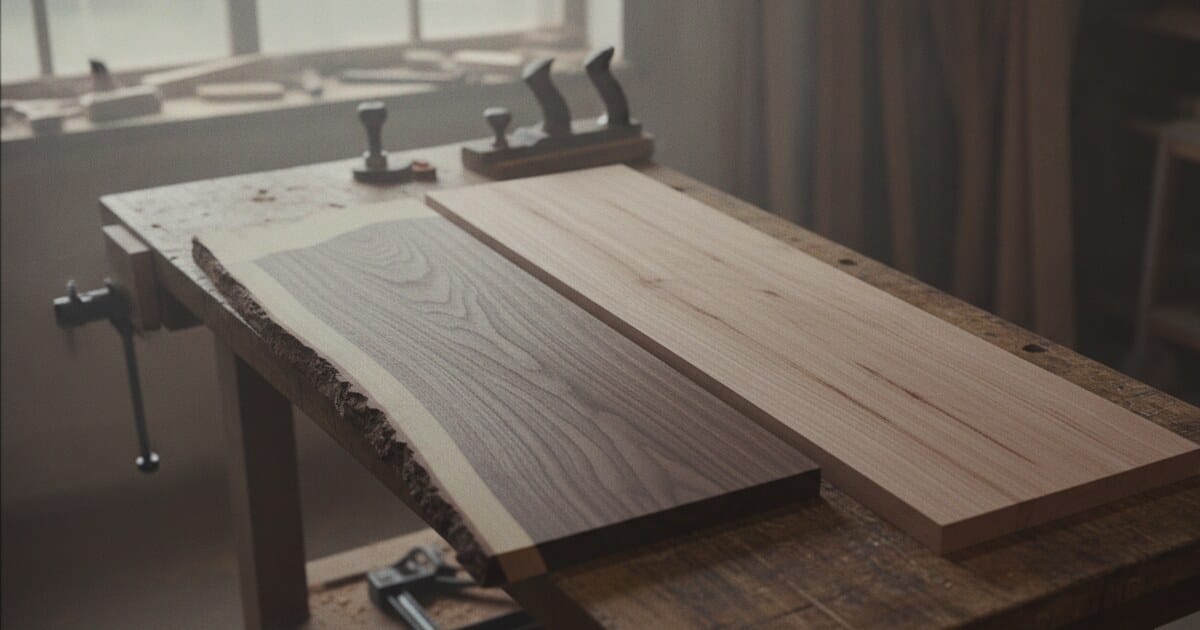
Comparing walnut vs cherry wood is one of the most common questions in American furniture making, and the answer surprises most people. Both are prized domestic hardwoods. Both machine cleanly, finish beautifully, and hold up for generations. But they start at opposite ends of the color spectrum, and that’s where most of the confusion begins.
Fresh walnut is obviously dark, a rich chocolate-brown you can’t mistake at the lumberyard. Fresh cherry is pale and pinkish, nothing like the deep reddish-brown it becomes after a year of UV exposure. Give both pieces a decade in a well-lit room and they can end up looking surprisingly similar. That aging behavior is the single most useful fact for anyone trying to choose between them or identify an older piece.
Walnut starts dark chocolate-brown and lightens slowly with age. Cherry starts pale pinkish-tan and deepens to reddish-brown after 6 to 12 months of UV exposure. Walnut is slightly harder (1,010 vs 950 Janka lbf) and costs more at $10-15 per board foot vs $7-9 for cherry. Both have fine grain, but walnut shows more open pores and occasional figure.
What Walnut Wood Looks Like
Black walnut (Juglans nigra) grows across the eastern United States, from Massachusetts south to Georgia and west to Kansas. The heartwood ranges from medium chocolate-brown to dark purplish-brown, sometimes with a faint greenish cast on freshly cut surfaces. Sapwood is creamy white to pale yellow, sharply distinct from the heartwood, and that contrast is one of the fastest visual ID tells when a board has sapwood edges.
Walnut’s Janka hardness is 1,010 lbf and density around 38 pounds per cubic foot. Tangential shrinkage runs 7.8%, radial shrinkage 5.5%, making it moderately stable. The pores are semi-ring-porous: earlywood shows a distinct band of larger pores visible without magnification, while latewood has smaller, scattered pores. Under a hand lens, walnut pores are noticeably larger than cherry’s. That size difference is the clearest end-grain comparison between the two species. Retail black walnut runs $10-15 per board foot for figured or wide stock; plain-sawn narrower boards drop to $8-10. At the top of that range, walnut costs roughly 50-80% more than comparable cherry.
The grain ranges from straight to wavy, and walnut produces more dramatic figure than cherry. Crotch pieces, burls, and curly walnut appear regularly and command a significant premium. Even straight-grained walnut has an open, somewhat coarse texture that catches light differently than cherry’s smoother face.
Walnut heartwood lightens slowly over time. A piece that started chocolate-brown may soften toward warm medium-brown after 20 to 30 years of indoor light exposure. Cherry does the opposite, and the transformation is much faster.
What Cherry Wood Looks Like
Black cherry (Prunus serotina) grows across a similar eastern range, from Nova Scotia and Minnesota south to Texas and Florida. Fresh-cut heartwood is the biggest surprise for buyers: it’s pale pinkish-tan, nowhere near the deep reddish-brown they expected from photos. The color shift happens through UV exposure and oxidation. Within 6 to 12 months, photo-reactive phenolic compounds in the wood drive the color toward warm reddish-brown. A decade-old cherry table can read as almost mahogany in tone.
Cherry’s Janka hardness is 950 lbf and density around 36 pounds per cubic foot. Tangential shrinkage runs 7.1%, radial shrinkage 3.7%, making it slightly more dimensionally stable across the width than walnut. The pores are semi-ring-porous with fine, evenly distributed pores much smaller than walnut’s, giving the surface a smooth, silky texture that takes oil and film finishes exceptionally well.
The most reliable visual ID tell for cherry is pitch pockets. These are small resin-filled voids in the wood, visible as dark oval patches or streaks on the face and edge of boards. Walnut doesn’t have them. Spotting even one pitch pocket on a board makes the identification straightforward. They’re easiest to find on flatsawn faces where the grain runs relatively flat across the board.
Cherry sapwood is pale yellow-white, distinct from the heartwood but the contrast is less dramatic than walnut. Where walnut’s creamy sapwood against dark chocolate heartwood creates a sharp two-tone look, cherry’s transition is more gradual.
Walnut vs Cherry: Side-by-Side
Here’s how the two species compare on the specs that matter for identification and buying decisions:
| Property | Black Walnut | Black Cherry |
|---|---|---|
| Botanical Name | Juglans nigra | Prunus serotina |
| Janka Hardness | 1,010 lbf | 950 lbf |
| Density | ~38 lbs/ft³ | ~36 lbs/ft³ |
| Tangential Shrinkage | 7.8% | 7.1% |
| Radial Shrinkage | 5.5% | 3.7% |
| Fresh Color | Chocolate-brown to dark purple-brown | Pale pinkish-tan |
| Aged Color | Warm medium-brown | Rich reddish-brown |
| Pore Type | Semi-ring-porous (larger pores) | Semi-ring-porous (finer pores) |
| Pitch Pockets | No | Yes |
| Retail Price | $8-15/bf | $7-9/bf |
Both species are rated straightforward to work with hand and machine tools. They glue reliably, hold fasteners well, and accept a wide range of finishes without issue. Walnut’s more open grain can telegraph sanding scratches if a film finish goes over unprepped wood; sanding to 180-220 grit and sealing pores before topcoat solves it. Cherry’s finer, more closed grain is slightly more forgiving on finishing, which is one reason it’s popular with beginners and professional furniture makers alike.
For a deeper look at how grain structure affects wood identification, see How to Identify Wood by Grain.
How to Tell Walnut from Cherry Wood
Color is the fast test on fresh wood: walnut is obviously dark, cherry is obviously pale. On aged wood that’s been finished and has years of patina, both can read as warm reddish-brown, which is where the identification gets harder.
End grain under a hand lens. Walnut pores are larger and more clearly defined in the earlywood band. Cherry pores are finer and more uniformly distributed. This test works on both new and old wood and doesn’t depend on color.
Pitch pockets. Look for small oval voids or dark resin streaks across the face or edge of the board. Cherry has them, walnut doesn’t. They’re most visible on flatsawn faces. Finding even one is enough to confirm cherry.
Sapwood contrast. Look for boards with sapwood edges. Walnut sapwood is dramatically lighter than its dark heartwood. Cherry sapwood is pale, but the contrast with the heartwood is less sharp. The more dramatic the two-tone contrast, the more likely it’s walnut.
Grain texture. On a planed face, cherry feels smoother to the touch due to its finer pores. Walnut feels slightly coarser. Run a fingernail lightly across the surface — it’s subtle but consistent.
Weight. A same-size piece of walnut (38 lbs/ft³) feels a bit heavier than cherry (36 lbs/ft³). The difference is small, not conclusive on its own, but useful when combined with other tells.
For antique furniture where finish hides the surface grain and color, flip the piece and check the unfinished underside or the inside of a drawer. That raw wood shows the original color, pore structure, and any pitch pockets without the distraction of stain or finish. The guide to identifying antique furniture wood covers this in more detail.
Which Wood Is Better for Furniture?
Both are excellent furniture woods. The choice depends on what you’re making, how you use the space, and what look you want to live with.
Choose walnut if:
- You want a dark, bold look immediately, without waiting for the wood to age
- The piece will take heavy daily use (dining table, desk, kitchen prep surface)
- You want dramatic grain and the possibility of figure or burl
- You’re OK paying a premium for the look
Choose cherry if:
- You want a piece that deepens and improves over the years as it develops patina
- You’re building fine furniture where a smooth, consistent grain surface matters (bedroom furniture, cabinets, chairs)
- You want slightly better width stability across wide panels
- Price per board foot is a factor in the decision
For cutting boards, cherry is often recommended because its closed grain surface is smooth and easy to clean. For high-traffic horizontal surfaces like dining tables, walnut’s slight hardness advantage matters, though both species handle normal furniture use well.
The aging behavior has real implications for interior design. A cherry dining table in a room with good window light will look noticeably darker and warmer after two years. Walnut changes more slowly and more subtly. If a piece needs to stay consistent with existing furniture over time, walnut is the lower-variation choice.
Both species pair well with each other in mixed pieces, once the cherry has had time to develop its color. New cherry (pale tan) next to walnut (dark brown) reads as a mismatch; aged cherry (deep reddish-brown) next to walnut (warm medium-brown) reads as intentional.
How Tree Identifier Can Help
Identifying wood species in the field, at a salvage yard, or in an antique shop is harder than it sounds. Finish, age, and patina all obscure the surface. The Tree Identifier app handles wood identification from photos: point the camera at the grain or end grain of the wood, submit the photo, and the AI returns a species match with confidence score.
The app works on cut wood, raw lumber, and wood samples, as well as living trees, leaves, and bark. If you’re at an estate sale wondering whether a dresser is walnut or cherry before committing to a price, the wood ID feature can give you a useful data point. The wood identifier tool at treeidentifier.app also gives you one free browser-based scan without downloading anything.
For a broader look at visual identification techniques, see How to Identify Wood and Cherry vs Mahogany Wood for a comparison of two other commonly confused American and tropical hardwoods.
Frequently Asked Questions
Does walnut or cherry wood last longer?
Both are durable domestic hardwoods that handle decades of indoor use without issue. Walnut’s slight hardness advantage (1,010 vs 950 Janka lbf) makes it marginally more resistant to surface dents on high-traffic pieces. For furniture kept indoors with normal care, both species last generations. The hardness difference is small enough that it shouldn’t be the deciding factor on its own.
Why does cherry wood change color so much?
Cherry contains photo-reactive phenolic compounds that oxidize under UV light. The shift from pale pinkish-tan to rich reddish-brown takes 6 to 12 months on pieces with regular light exposure. Some woodworkers leave unfinished cherry panels in direct sun for several hours before applying finish to jump-start the color shift. To slow it down, keep cherry furniture away from direct sunlight, or use a UV-filtering finish.
Can you mix walnut and cherry furniture in the same room?
Yes, and it works well once the cherry has had time to develop its color. Aged cherry’s reddish-brown tone and walnut’s warm medium-brown sit in a complementary range. The problem is mixing new cherry (pale tan) with walnut (dark brown), where the contrast reads as mismatched. If you’re buying new cherry, expect the first year to look different from what’s already in the room.
How do I identify walnut vs cherry on an antique piece?
Check the unfinished underside or inside of a drawer where the finish hasn’t penetrated. Look for pitch pockets on the wood face — small oval resin voids that appear in cherry but not walnut. On end grain, walnut pores are larger and more visible under a 10x hand lens. Walnut sapwood is dramatically lighter than its heartwood; cherry’s sapwood contrast is subtler. If the piece shows pin-sized dark streaks or oval patches across the grain, it’s cherry.
Black walnut and black cherry are both worth more than most domestic hardwoods they’re often compared to. Walnut gives you the bold look immediately and the confidence that a well-used dining table won’t show every dent. Cherry rewards patience: the piece you buy today will be richer and more beautiful in five years than it is now.
Try the Tree Identifier app to identify wood species from a photo — it covers both living trees and cut wood. You get 2 free identifications per day, and the wood identifier tool works in your browser without an app download.
Identify a tree from your photo — free
Upload a leaf, bark, or whole-tree photo and get the species in seconds. No signup.
Confidence:
Unlock the full species profile
Free in the app — with unlimited identifications.


AI result for guidance — the app gives full species details and works offline.
Want unlimited identifications?
Get the full species profile, photos and details — free in the app, with unlimited scans.
- Unlimited identifications
- Full species profiles & details
- Works offline, anywhere
- Save and revisit your finds
Elena Torres
Tree Identifier Team