How to Identify Mahogany Wood: Color, Grain & Tests
Mahogany is one of the most misnamed woods in the lumber trade. The label gets applied to at least four distinct species, ranging from genuine Swietenia to Philippine lauan, which shares nothing but a reddish color. Learning how to identify mahogany wood means knowing what the real thing looks like, what it feels like physically, and how to tell it apart from the common substitutes before you buy or refinish a piece.
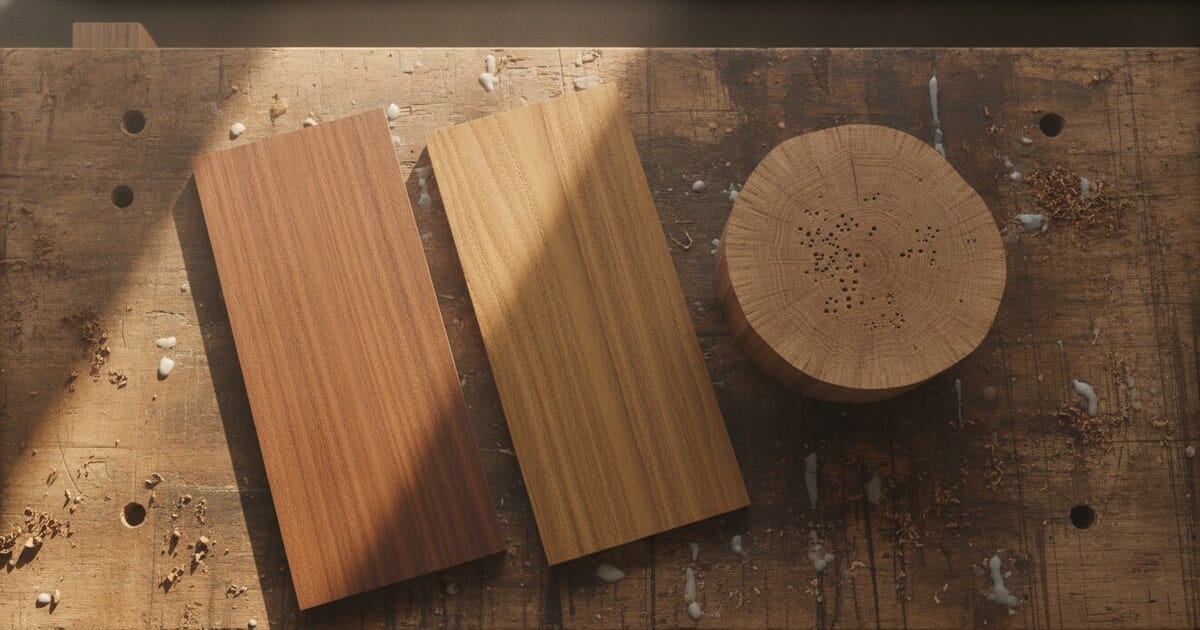
True mahogany (Swietenia macrophylla) is a diffuse-porous hardwood with reddish-brown heartwood that deepens with age. The grain is straight to interlocked, pores are visible but fine, and quartersawn surfaces show a ribbon figure: alternating light and dark stripes that shift with viewing angle. Janka hardness runs 800-900 lbf and density sits around 40 lbs per cubic foot.
What Mahogany Wood Looks Like
Freshly cut mahogany heartwood is pale pinkish-tan. Give it 6 to 12 months of sunlight and it deepens to a warm reddish-brown. Old pieces go further, settling into a rich chocolate-red with amber undertones. The color shift comes from phenolic compounds reacting to UV light, a predictable process that makes genuine mahogany darken rather than fade.
The sapwood is pale cream or yellowish-white, and the line between sapwood and heartwood is usually sharp on raw boards.
Swietenia macrophylla grows throughout 12 countries from Mexico down through the Amazon basin, reaching 40-60 meters in height with logs up to 2 meters across. Janka hardness runs 800-900 lbf, placing it softer than hard maple (1,450 lbf) but comparable to black walnut (1,010 lbf). Density is about 40 lbs per cubic foot. Tangential shrinkage sits at 4.1% and radial shrinkage at 2.5%, which gives mahogany a justified reputation for dimensional stability and resistance to warping. Mahogany has moderate to high natural durability and holds up well to outdoor exposure, which is why it appears in boat building and garden furniture. CITES Appendix II has covered Swietenia macrophylla since 2003, requiring permits for international trade. Kiln-dried boards currently sell for $15-30 per board foot depending on figure quality, with quartersawn stock at the high end. African mahogany (Khaya) runs $6-10 per board foot by comparison.
The most distinctive visual feature is the ribbon figure on quartersawn surfaces: alternating light and dark stripes that shift as you tilt the board. Interlocked grain catches light differently depending on the angle. It’s a signature of the Swietenia genus, and no other commonly available wood shows quite the same effect.
How to Identify Mahogany Wood by Grain and Pores
Mahogany is diffuse-porous. The pores distribute evenly across each growth ring rather than concentrating in a band near the earlywood. Under a loupe or good raking light, they appear as fine dots or short dashes running parallel to the grain direction. A hand lens isn’t required, but it helps confirm what you’re seeing. The pores are visible to the naked eye on a clean cross cut.
End grain is the most reliable test. A diffuse-porous pore pattern confirms you’re in the Swietenia or Khaya family. Ring-porous species like oak and ash show a distinct band of large pores in the earlywood and much smaller pores in the latewood. If your end grain is ring-porous, you’re not holding mahogany. For a detailed breakdown of reading pore patterns across wood types, the guide to identifying wood by grain walks through ring-porous, diffuse-porous, and semi-ring-porous structures.
Storied rays are a genus-specific tell. Hold the flatsawn face at an angle to raking light and look for faint horizontal ripple marks running perpendicular to the grain direction. These storied rays appear in Swietenia and in Khaya. Sapele also shows them, which is another reason sapele gets confused with mahogany. The ripple is subtle, but once you’ve seen it on a confirmed piece, you’ll recognize it reliably.
Grain direction ranges from straight to moderately interlocked depending on species and how the board was cut. Interlocked grain produces the ribbon figure on quartersawn stock and causes more tear-out when hand planing against it.
Swietenia vs. the Substitutes
The name “mahogany” gets applied to several woods that aren’t Swietenia. Here’s how to separate them.
African mahogany (Khaya ivorensis, K. anthotheca) is the most defensible substitute. Khaya comes from West and Central Africa, runs about 830-900 lbf Janka, and shares the diffuse-porous structure and storied rays of genuine mahogany. The differences are subtle: Khaya heartwood tends toward salmon-pink rather than the deeper red of aged Swietenia. Interlocked grain is usually more pronounced, giving more ribbon figure but also more plane tear-out. Pores are slightly larger on average. For most woodworking and furniture applications, Khaya is an honest representation of mahogany character.
Philippine mahogany (meranti/lauan) is a different matter. The name covers dozens of Shorea species with widely varying properties. Dark red meranti runs 800-1,000 lbf; light red meranti can fall below 500 lbf. Pores are much larger than Swietenia’s, the wood is lighter for its size, and there’s no storied-ray ripple. Lift a board: if it feels noticeably light compared to other pieces in the same stack, you’re probably holding lauan.
Santos mahogany (Myroxylon balsamum) isn’t related to mahogany at all; it’s a legume. At 2,000+ lbf Janka, it’s far denser than Swietenia. The reddish-brown color looks similar at a glance, but the weight difference is immediate and obvious. Santos mahogany also shows ring-porous end grain, which separates it cleanly from the diffuse-porous Swietenia and Khaya.
Cuban mahogany (Swietenia mahagoni) is genuine mahogany, the most valued of the three Swietenia species. It’s been commercially unavailable since the 1940s due to overharvesting. What’s sold as Cuban mahogany today is usually Honduran (S. macrophylla) or antique stock salvaged from old furniture. Genuine Cuban mahogany is finer-grained and denser than Honduran.
For help identifying which wood species you’re dealing with in antique or period furniture, the guide to identifying antique furniture wood covers period pairings and color-aging patterns for common hardwoods.
Practical Tests for Identifying Mahogany
Visual inspection gets you most of the way, but a few physical checks help confirm.
Weight test. At 40 lbs/ft³, genuine mahogany has a characteristic heft. Lauan varies widely (28-40 lbs/ft³ depending on species), so a lightweight board is a flag. Santos feels immediately heavy. The weight test rules out outliers on both ends quickly.
Fingernail test. Press a fingernail firmly into an inconspicuous spot on raw wood. Genuine mahogany dents slightly but resists deep gouging. Lauan is softer and marks more easily. Santos barely dents at all. It’s not a precise measurement, but it gives a quick hardness read in the field.
Corner check on furniture. Look at a sharp corner or inside edge. Consistent grain wrapping around the corner means solid wood. A thin colored layer over a lighter substrate means veneer. Veneer isn’t a problem in itself, but it changes your refinishing options: a 0.5-1mm veneer tolerates one careful sanding, solid mahogany can be refinished repeatedly.
End grain cut. A fresh cross cut on diffuse-porous wood shows pores distributed evenly across the growth ring. This is the definitive test that separates mahogany and Khaya from ring-porous lookalikes. For a broader framework on reading wood from first principles, the guide to how to identify wood covers the full range of identification methods.
How Tree Identifier Helps
Photo-based wood identification works better than most people expect, especially when you shoot the end grain or a clean face grain in good light. The Tree Identifier app includes wood type recognition that covers commonly traded hardwoods, including Swietenia macrophylla, Khaya species, and other woods that are frequently mislabeled in the furniture market.
Take a clear photo showing the grain, submit it, and the app returns a species match with a confidence score. It’s useful when you’re sourcing used furniture, evaluating salvage lumber, or trying to confirm what you’re working with before committing to a finish. The wood identification tool is also available in your browser at treeidentifier.app/tools/wood-identifier for a quick scan without downloading the app.
For a side-by-side comparison of cherry and mahogany, two woods that share a pale pinkish-tan starting color and tend to get confused at the lumber yard, see the breakdown in cherry vs mahogany wood.
Frequently Asked Questions
How can you tell mahogany from walnut? Color direction is the clearest tell: mahogany starts pale and darkens toward red over time, while walnut starts chocolate-brown and lightens with UV exposure. Storied-ray ripple marks are present on mahogany’s flatsawn face but not on walnut’s, and the grain texture differs: mahogany is finer and more uniform.
Is African mahogany real mahogany? Khaya species belong to the same family (Meliaceae) as Swietenia and share the diffuse-porous structure, storied rays, and ribbon figure of genuine mahogany. For most woodworking purposes, African mahogany is an honest substitute. It runs about $6-10 per board foot versus $15-30 for Honduran mahogany, and it’s currently available without CITES restrictions.
What’s the difference between mahogany and Philippine mahogany? Philippine mahogany (lauan or meranti) comes from Shorea species, a completely unrelated plant family. The pores are larger, the weight is often lighter, and there’s no storied-ray ripple on the face grain. The name “Philippine mahogany” was a mid-20th-century trade marketing term, not a botanical classification.
Does mahogany have a smell? Freshly cut Swietenia macrophylla has a faint, mildly resinous scent that fades quickly in seasoned wood. Smell isn’t a reliable identification method on its own, but the absence of strong odor distinguishes mahogany from aromatic species like cedar or camphor wood.
Can you identify mahogany by end grain alone? End grain tells you quite a lot. The diffuse-porous pattern (evenly distributed pores across the growth ring) confirms you’re in the mahogany or African mahogany family rather than ring-porous species like oak or ash. Combined with color, storied rays, and weight, end grain is usually enough to confirm or rule out Swietenia and Khaya with confidence.
Identifying mahogany reliably comes down to four signals: reddish-brown heartwood that deepens with age, fine diffuse-porous end grain, storied-ray ripple marks on flatsawn surfaces, and weight around 38-42 lbs per cubic foot. When all four line up, you’ve got genuine mahogany. When one is off, check which substitute species fits the remaining evidence. If you’re working with a mystery piece of wood, the Tree Identifier app’s wood recognition feature can match it to a species from a grain photo. Try it at treeidentifier.app/tools/wood-identifier.
Identify a tree from your photo — free
Upload a leaf, bark, or whole-tree photo and get the species in seconds. No signup.
Confidence:
Unlock the full species profile
Free in the app — with unlimited identifications.


AI result for guidance — the app gives full species details and works offline.
Want unlimited identifications?
Get the full species profile, photos and details — free in the app, with unlimited scans.
- Unlimited identifications
- Full species profiles & details
- Works offline, anywhere
- Save and revisit your finds
Elena Torres
Tree Identifier Team