Planting Cashew Trees: Growth and Care Guide
Cashew trees are more forgiving than most tropical fruit trees, but they have firm requirements. Get the climate, drainage, and spacing right from the start, and a single tree can produce nuts for 25 years or more. This guide covers everything you need to know about planting cashew trees, from choosing your planting material to picking your first harvest.
Planting cashew trees requires a frost-free climate (USDA zones 10-12), fast-draining soil with a pH of 5.0-6.5, and full sun. Plant a grafted sapling at the start of the wet season, spacing trees 8-10 meters apart. Water weekly the first year. Expect a first small harvest in 18-24 months from a grafted tree, or 3-5 years from seed.
Where Cashew Trees Grow
Cashew trees (Anacardium occidentale) are native to northeastern Brazil’s Atlantic coast, where they’ve grown in the Caatinga scrubland of Piauí, Ceará, and Rio Grande do Norte for thousands of years. Today, commercial cultivation spans 52 countries across the tropics, with Vietnam producing roughly 40% of global supply, followed by India and Ivory Coast. The tree reaches 10-12 meters tall at maturity; dwarf cultivars top out at 6 meters and suit smaller plots. Planting cashew trees requires USDA zones 10-12, as temperatures below 10°C (50°F) cause severe damage and frost kills the tree outright. First fruits arrive 3-5 years from seed or 18-24 months from a grafted sapling, with full production peaking around age 7-8. Productive trees live 20-30 years. Annual global cashew nut production is approximately 3.9 million tonnes (FAOSTAT 2022). Cashew apple output sits at roughly 3.7 million tonnes per year, though most goes unused since only the nut is traded commercially at scale.
In the US, outdoor cashew growing works in South Florida, Hawaii, and parts of coastal Southern California. Zone 9 is borderline: container growing and overwintering indoors gives you a shot. Below zone 9, cashews belong in a greenhouse.
Cashews evolved on poor laterite soils in their native range, so they don’t demand rich earth. What they can’t tolerate is standing water. Roots rot quickly in heavy clay or compacted soil, even from brief waterlogging during establishment.
How to Plant Cashew Trees Step by Step
Choosing your planting material
Grafted saplings are almost always the better choice for home growers. You’ll see fruit in 18-24 months instead of 3-5 years, and grafted trees reliably reproduce the parent’s nut size and flavor. Seeds cost less but give unpredictable results: some seedlings produce generously, others barely at all.
If you’re starting from seed, remove the outer husk and soak the nut in water for 24 hours before sowing. Plant it 4-5 centimeters deep with the pointed end facing down in soil above 25°C. Germination takes 4-8 days in good conditions.
Preparing the soil
Dig a planting hole 60 centimeters wide and 60 centimeters deep. Mix the excavated soil with 5-10 kilograms of compost and 200 grams of superphosphate if your soil is phosphorus-deficient. For heavy clay, work in coarse sand and gravel to open up drainage. Target a pH of 5.0-6.5; anything above 7.0 triggers micronutrient deficiencies that show up fast as yellowing leaves.
Spacing and site selection
Give each cashew tree 8-10 meters of clearance on all sides. A mature tree’s canopy spreads up to 8 meters across, and crowded trees develop anthracnose fungus from poor airflow during rainy seasons.
Pick a south-facing position away from buildings or large trees that block afternoon sun. Six to eight hours of direct sun daily is the minimum; more is better.
Cashew trees need more room than most fast-growing trees commonly planted in home landscapes, so factor that into your site plan before you dig. A 10-meter mature canopy is substantial. Keep the planting spot well away from structures and utilities. Our guide on the best trees to plant near a house covers safe spacing principles that apply to any large-canopy species.
Planting the sapling
Plant at the start of your wet season if you’re relying on rainfall, or any time of year with irrigation. Set the sapling at the same depth it sat in its nursery container. Backfill, firm the soil gently around the roots, and water deeply right away. Build a low earthen ring around the base to channel water toward the root zone for the first few weeks.
Stake the young tree in a windy spot. Use a loose figure-8 tie to a single stake for the first 6 months to keep it upright without constricting trunk movement.
Cashew Tree Care After Planting
Watering
The first year is the only time cashew trees need consistent watering. Water deeply once a week during dry periods: roughly 20-30 liters per session, enough to wet the top 40 centimeters of soil. Resist the urge to water more frequently. Cashews hate sitting in moisture, and overwatering kills more young trees than drought does.
After 2-3 years, established trees handle long dry seasons without any irrigation. This drought tolerance makes cashews practical in warm-climate gardens where water access is limited.
Fertilizing
Apply a balanced 10-10-10 NPK fertilizer at planting, mixed into the backfill soil rather than spread on the surface. In years two and three, switch to a potassium-heavy formula (like 12-6-22) to support flowering and fruit development. Potassium toughens the cashew apple’s cell walls and directly affects yield.
Skip fertilizer during the dry season when no water is available. Nutrients without moisture burn roots.
Pruning
Cashews need minimal pruning. Remove dead or crossing branches in the first two years to build a clean scaffold structure. After that, prune lightly after harvest to remove weak shoots and open the canopy for better light. Skip pruning during flowering and fruiting (usually late dry season into early wet season): you’ll cut off buds along with branches.
Dwarf cultivars hold a tighter shape naturally and need even less intervention.
Common pests and diseases
The cashew stem and root borer (Plocaederus ferrugineus) is the most destructive pest across South and Southeast Asia. It bores into the trunk near the soil line; early signs include sawdust-like frass at the base. Cut out and destroy infected wood immediately. Painting the lower trunk with a lime-sulfur mixture deters egg-laying females.
Tea mosquito bugs (Helopeltis spp.) puncture young shoots and cashew apples, leaving dark necrotic spots. Neem oil sprays applied every 7-10 days during flush growth periods keep populations manageable.
Anthracnose fungus (Colletotrichum gloeosporioides) turns flowers and young nuts brown during wet weather. Good spacing and avoiding overhead irrigation during flowering cut the risk considerably.
When to Harvest Cashews
Grafted trees can yield a small first crop in their second year: 1-2 kilograms of nuts is a realistic expectation. By year 4-5, expect 5-10 kilograms annually from a healthy tree. Full production (20-30 kilograms per tree) arrives around years 7-10 and holds steady for another 20 years from a well-maintained specimen.
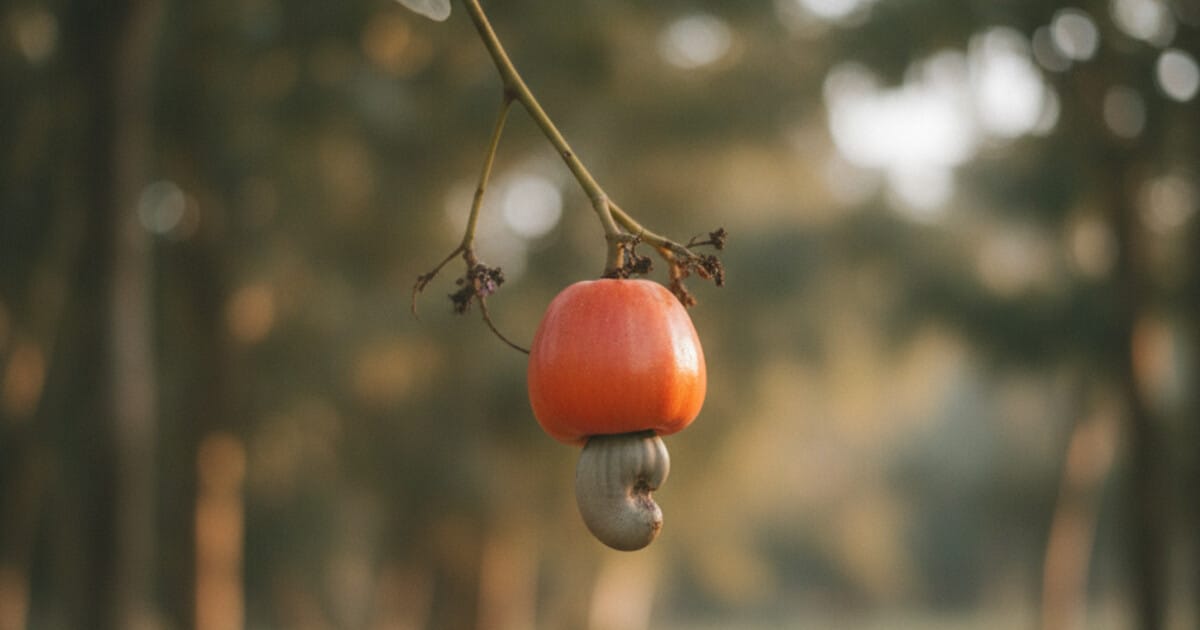
Cashews fruit once a year, typically during the dry season when temperatures hold above 20°C. The cashew apple (the swollen, fleshy pedicel) turns bright red or yellow at maturity, depending on variety. The kidney-shaped nut hangs from the base of the apple.
Harvest when the apple drops on its own or releases with a gentle tug. Wear gloves when handling fresh cashew nuts: the shell contains cashew nut shell liquid (CNSL), a caustic compound with effects similar to urushiol, the irritant in poison ivy. Never shell raw cashews without roasting or steam-processing first. Commercial processors heat-treat cashews specifically to neutralize CNSL before the shelling stage. This is why cashews sold as “raw” in stores have actually been lightly steamed.
How Tree Identifier Helps with Cashew Trees
Young cashew trees can be tricky to tell apart from related species in the Anacardiaceae family. The leaves are oval with a notched tip, similar to several tropical species. Bark on young trees is smooth and pale gray, which doesn’t give much away on its own.
If you spot a tree you think might be a cashew, the Tree Identifier app can confirm it from a leaf, bark, or flower photo. It covers thousands of species, including both wild and cultivated cashew. The app works offline too, so it’s useful in an orchard or remote garden without cell service.
You get 2 free identifications per day on iOS or Android. You can also try the web-based tree identifier for a quick browser check.
If you’re planting cashews alongside ornamental trees or other fruiting species in a food forest layout, the app helps you track what’s in the ground and confirm species ID when labels fade or volunteer seedlings appear from dropped fruit.
Frequently Asked Questions
How long does a cashew tree take to produce nuts?
Grafted cashew trees typically bear their first small crop in 18-24 months. Trees grown from seed take 3-5 years to first fruit. Full production (20-30 kg per tree annually) arrives around years 7-10. A healthy cashew tree stays productive for 20-30 years from that point, making the long establishment period worthwhile for most growers.
Can cashew trees grow in pots?
Dwarf cashew varieties can grow in large containers (200-liter minimum) if you’re in zone 9 and need to bring them indoors during cold months. Container trees produce less than ground-planted trees and need more frequent fertilizing and watering. They won’t reach full size, but they can fruit reliably in warm conditions with enough sun.
Why do cashews have to be roasted before eating?
Raw cashew shells contain CNSL (cashew nut shell liquid), a caustic compound that causes severe skin irritation similar to poison ivy. Roasting or steam-processing neutralizes it before shelling. “Raw” cashews in health food stores have actually been lightly steamed; truly unprocessed cashews are hazardous to handle and shell without proper protective equipment.
What’s the difference between a cashew nut and a cashew apple?
The cashew apple is the swollen, fleshy pedicel (stem) that turns red or yellow when ripe and looks like a small pear. The actual drupe (the cashew nut) hangs from the base of the apple. Botanically, the nut is the true fruit. The cashew apple is edible and sweet, but it’s fragile and ferments quickly, so it rarely appears in export markets.
How much space does a cashew tree need?
Plant cashew trees 8-10 meters (25-32 feet) apart on all sides. At maturity, the canopy spreads up to 8 meters wide. Crowded trees produce less fruit and are more prone to fungal disease from restricted airflow. Dwarf cultivars can be planted slightly closer at 6-8 meters, but standard varieties need the full spacing to reach their production potential.
Cashew trees reward patient growers with decades of reliable production once they’re settled in. If you want to identify a young cashew or track the species in your garden, download Tree Identifier and snap a photo of the leaf or bark for an instant ID. Available on iOS and Android, with offline mode for field use.
Identify a tree from your photo — free
Upload a leaf, bark, or whole-tree photo and get the species in seconds. No signup.
Confidence:
Unlock the full species profile
Free in the app — with unlimited identifications.


AI result for guidance — the app gives full species details and works offline.
Want unlimited identifications?
Get the full species profile, photos and details — free in the app, with unlimited scans.
- Unlimited identifications
- Full species profiles & details
- Works offline, anywhere
- Save and revisit your finds
Elena Torres
Tree Identifier Team