Banksia Identification: Flowers, Leaves, and Species Guide
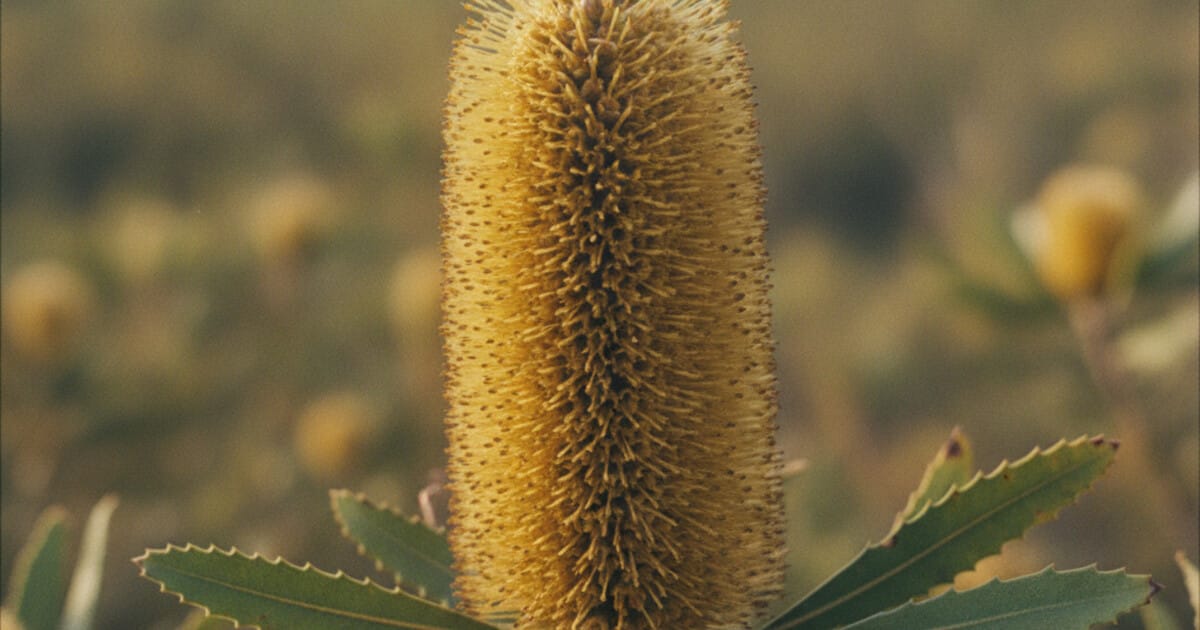
That cylindrical golden spike rising from stiff, toothed leaves is one of Australia’s most distinctive plant signatures. If you’ve walked through a Perth garden, a coastal heathland in New South Wales, or a national park in Queensland, you’ve probably passed a banksia. The genus covers roughly 173 species, from low ground-hugging shrubs to trees taller than a house, and they’re worth knowing by sight. This guide covers the key identification features and the species you’re most likely to encounter across Australia.
Banksia is an Australian native genus in the Proteaceae family with roughly 173 species, almost all endemic to Australia. Identify it by stiff, often serrated leaves, dense cylindrical flower spikes carrying hundreds of individual flowers, and woody seed cones that stay on the plant for years. Colours span pale yellow, orange, red, and pink.
What Is a Banksia?
The genus Banksia sits in the Proteaceae family alongside grevillea, waratah, macadamia, and proteas from southern Africa. They share that family’s hallmark: complex, tightly packed flower spikes fed by large quantities of nectar.
The genus Banksia was named after Sir Joseph Banks, who collected specimens during Captain Cook’s 1770 voyage aboard HMS Endeavour. Banksia belongs to the Proteaceae family, alongside grevillea, waratah, and macadamia. The genus holds approximately 173 accepted species, of which roughly 150 are endemic to Australia; the remainder extend into Papua New Guinea and the Aru Islands of Indonesia. Species range from prostrate shrubs under 0.5 metres to B. integrifolia, a coastal tree reaching 25 metres. Flower spikes range from 5 to 30 cm long and 2 to 13 cm wide, carrying up to 1,000 individual flowers on a single cone axis. After flowering, woody cones 5 to 30 cm long develop with follicles embedded in the cone surface; in fire-adapted species the follicles stay sealed for years and open only after fire, releasing seeds into the ash bed. Southwest Western Australia holds more than 60 banksia species in the Swan Coastal Plain alone.
Banksias are a critical food source for honeyeaters, red wattlebirds, eastern spinebills, and black cockatoos. The dense nectar-rich spikes evolved alongside Australian birds over millions of years, and several bird species depend on banksia woodland for winter foraging.
How to Identify Banksia by Leaves, Flowers, and Cones
Three features make banksia identification straightforward once you know what to look for.
Leaves are stiff and leathery, alternately arranged on the stem. Most species have serrated or toothed margins, though some (like B. integrifolia) have smooth edges. The underside of many banksia leaves is pale to white, contrasting with the darker upper surface. Leaf shape ranges from narrow and linear (in species like B. attenuata) to broad and oval (in B. coccinea).
Flower spikes are the most recognisable feature. Each spike is a dense cylindrical or globe-shaped inflorescence made up of hundreds to thousands of individual flowers. Each flower follows the Proteaceae structure: four tepals, a single style, and pollen presented on the style tip before the flower fully opens. This pollen-presenter mechanism is similar to that used by grevillea, though in banksia it appears as part of a mass display rather than individual curved flowers. Colours span pale yellow (B. integrifolia), golden orange (B. attenuata), bright scarlet-red (B. coccinea), and orange-gold with purple styles (B. spinulosa).
Woody cones persist on the plant long after the flowers die. The cone surface shows a mosaic of old flower bases, and embedded within it are the follicles: woody capsules that hold the seeds. In fire-adapted species, the follicles stay sealed for years, opening only when heat triggers them. This is why banksia cones from species like B. serrata stay on the branch for a decade or more, gradually weathering to grey. The cone shape itself is diagnostic: B. prionotes has a distinctive acorn-shaped cone, while most other species have roughly cylindrical ones.
Bark varies by species. Young banksias often have smooth grey bark that roughens and fissures with age. B. serrata is notable for its deeply tessellated (chequered) grey bark on older stems, making it identifiable even without foliage or flowers.
Common Banksia Species in Australia
Banksia serrata (Old Man Banksia) is the species most people picture. It grows up to 16 metres along the east coast from Queensland to Victoria, often on sandstone ridges and coastal heaths. The leaves are broadly oval with deeply serrated margins; the flower spikes are creamy yellow, 10 to 20 cm tall. The deeply furrowed grey bark on older trees gives this species a gnarly look, and May Gibbs immortalised B. serrata cones as the villainous Big Bad Banksia Men in her 1918 children’s book.
Banksia integrifolia (Coast Banksia) is the most widespread species in eastern Australia, growing from far north Queensland down to Victoria. It can reach 25 metres and tolerates salt-laden coastal winds better than most. Leaves are smooth-edged on the upper surface and white-felted below; flower spikes are pale yellow to pale olive, appearing from autumn into winter. This is the banksia you’re most likely to spot in coastal gardens and road-side plantings.
Banksia attenuata (Firewood Banksia) is the most common banksia in the Perth region, dominating the banksia woodland that once covered most of the Swan Coastal Plain. It grows to 8 metres, with narrow linear leaves and bright golden-yellow spikes up to 30 cm long. It’s a key food source for honeyeaters and Carnaby’s black cockatoos in WA.
Banksia coccinea (Scarlet Banksia) is restricted to the southern coast of Western Australia and is arguably the showiest species. The scarlet-red and grey two-tone flower spikes grow up to 12 cm tall, and the broad, oval leaves have deeply serrated margins. It rarely exceeds 3 metres, which puts the flowers at eye level in the wild. The cut flower trade uses B. coccinea heavily from WA plantations, so you may recognise it from florist arrangements.
Banksia spinulosa (Hairpin Banksia) grows as a dense shrub across eastern Australia’s coast and ranges. The spikes are orange to gold with dark purple styles, and the narrow leaves have finely toothed margins. It flowers prolifically in autumn and winter, making it one of the most common banksias in east coast native gardens.
Banksia prionotes (Acorn Banksia) is a WA species named for its distinctive acorn-shaped orange flower buds before they open into a full cream-coloured spike. The leaves are long, narrow, and deeply serrated, and the plant grows to around 10 metres in the wild. It flowers from late summer through winter.
Where Banksia Trees and Shrubs Grow
Banksia country is overwhelmingly Australian. The southwest corner of Western Australia, around Perth and the Swan Coastal Plain, holds the world’s greatest concentration of banksia species, more than 60 in an area roughly 400 km across. This banksia woodland is listed as an endangered ecological community due to urban expansion in the Perth metro region.
On the east coast, banksias grow in coastal heathland, dry sclerophyll forest, and on sandstone ridges. B. serrata and B. integrifolia are common from southern Queensland through New South Wales and into Victoria. Queensland’s wallum heathlands along the Sunshine and Gold Coasts support B. aemula and several other coastal species.
Banksias don’t grow in rainforest or persistently wet environments. They’re adapted to sandy, nutrient-poor soils and periodic fire. The further you are from these conditions, the less likely you are to encounter them in the wild.
In gardens, banksias are widely cultivated across southern Australia. Many smaller cultivars do well in pots and are available from native plant nurseries. If you spot one in a garden outside its natural range, the flower spike colour and leaf shape are still reliable ID starting points.
Using Tree Identifier to Confirm a Banksia Species
With 173 species, distinguishing one banksia from another takes some practice. The Tree Identifier app lets you photograph the plant and get an AI-powered identification with confidence scores.
For banksias, the flower spike is the single best photo subject. A clear shot of the full spike shows colour, shape, and size, the three features that separate most species quickly. If the plant isn’t flowering, photograph the leaves (upper and lower surface), any visible cone, and the bark. The app accepts photos of any plant part.
Banksia cones are worth photographing even when empty and weathered. The follicle pattern on the cone surface differs between species, and the app’s visual recognition picks up on shape and texture even from dried specimens.
The app works offline after you download species data, useful when you’re deep in WA banksia woodland or remote coastal heathland with no signal. Two free daily identifications are included without a subscription.
For separating banksia from other Australian Proteaceae, the grevillea identification guide covers the structural differences between grevillea, banksia, and waratah flower heads. The waratah identification guide explains how the waratah’s compact dome contrasts with the banksia’s elongated cylinder.
Frequently Asked Questions
What does a banksia look like?
A banksia has stiff, leathery leaves (often with serrated margins) and a distinctive cylindrical or globe-shaped flower spike made up of hundreds of individual flowers. After flowering, a woody cone with embedded seed follicles stays on the plant for years. Flower colours range from pale yellow to orange, red, and pink depending on the species.
Are banksias trees or shrubs?
Both. About a third of banksia species grow as multi-stemmed shrubs under 3 metres, while others are single-stemmed trees reaching 8 to 25 metres. B. integrifolia and B. serrata are the largest tree forms on the east coast. B. coccinea and most WA species are compact shrubs.
When do banksias flower in Australia?
Flowering times vary by species and region. Many WA species (including B. attenuata and B. coccinea) flower in late summer through winter. East coast species like B. integrifolia flower from autumn into early winter. B. spinulosa flowers in autumn across eastern Australia. Some species flower twice a year in mild coastal gardens.
Are banksias related to grevillea and waratah?
Yes. Banksia, grevillea, and waratah all belong to the Proteaceae family, the same plant family as macadamia and South African proteas. They share a common ancestor from the ancient supercontinent Gondwana. The flower structure is similar across the family (packed inflorescences, prominent styles), but each genus has a distinct inflorescence shape and seed dispersal strategy.
Why do banksia cones stay on the plant for so long?
Many banksia species are serotinous: their woody follicles stay sealed until heat from a bushfire opens them, releasing the seeds into the ash bed below. This fire-dependency is why you’ll see old grey cones clinging to branches for years. In the wild, banksias can regenerate rapidly after fire because of this stored seed bank on the plant.
Spotted a banksia on a walk and want to confirm the species? Photograph the flower spike and upload it to Tree Identifier. The AI compares your photo against thousands of species and returns a match with confidence scores. Download the app on iOS or Android and use 2 free identifications per day.
Identify a tree from your photo — free
Upload a leaf, bark, or whole-tree photo and get the species in seconds. No signup.
Confidence:
Unlock the full species profile
Free in the app — with unlimited identifications.


AI result for guidance — the app gives full species details and works offline.
Want unlimited identifications?
Get the full species profile, photos and details — free in the app, with unlimited scans.
- Unlimited identifications
- Full species profiles & details
- Works offline, anywhere
- Save and revisit your finds
Elena Torres
Tree Identifier Team