Ghost Gum Tree: Bark, Leaves and Identification Guide
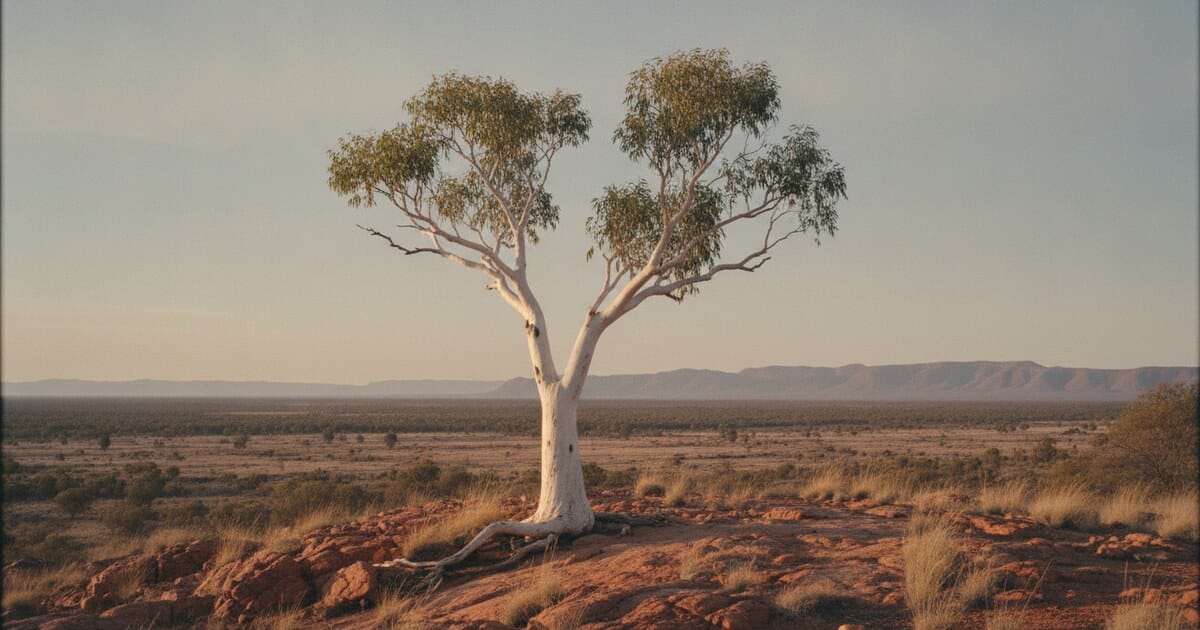
Stand in central Australia at dusk and one tree stops you. The trunk glows chalk-white against red sand and darkening sky, looking more like something painted onto the landscape than something that grew from rock. Locals call it the ghost gum, and the name earns itself every twilight. Despite being one of Australia’s most recognized trees, plenty of visitors can’t put a species name to that luminous bark, let alone distinguish it from the handful of similar smooth-barked trees sharing the same arid country. This guide covers every identification feature: bark, leaves, flowers, fruit, habitat, and how to separate ghost gum from its lookalikes.
Ghost gum (Corymbia aparrerinja) is an arid-zone eucalypt native to central Australia, growing to 20 metres on rocky slopes and dry creek beds. It’s identified by smooth white-to-cream bark that sheds seasonally, narrow lanceolate leaves 5-16.5 cm long, white flower clusters of 7, and small cup-shaped capsules roughly 1 cm long.
What Is the Ghost Gum Tree?
Ghost gum belongs to the genus Corymbia, family Myrtaceae, in the bloodwood group alongside spotted gum and lemon-scented gum. For most of its botanical history it was grouped with the eucalypts under the name Eucalyptus papuana var. aparrerinja, first formally described by Blakely in 1936. In 1995, botanists Hill and Johnson reorganized the bloodwoods and ghost gums into their own genus, Corymbia, based on distinct differences in fruit structure, bud arrangement, and bark behavior.
The common name “ghost gum” refers to the bark. On a moonlit night the chalky white trunk seems to absorb and return light, giving the tree a pale, hovering presence in the dark landscape. The specific epithet aparrerinja comes from the Arrernte language, reflecting the central Australian custodianship of this tree that stretches back thousands of years.
At least 24 species across Australia share the “ghost gum” label. When Australians say ghost gum without qualification, they almost always mean Corymbia aparrerinja, the species of the MacDonnell Ranges and red-sand country around Alice Springs.
How to Identify Ghost Gum Bark
Bark is the fastest field test and the single most distinctive feature. The entire trunk and all branches are smooth. No rough patches at the base, no fibrous stringy texture, no tessellated grey plates. That smooth-all-the-way-down quality immediately separates ghost gum from ironbarks, stringybarks, and box eucalypts, which all carry rough bark on at least the lower trunk.
The color shifts through the year. Fresh bark runs white to cream, often with pinkish tinges where older bark recently peeled away. Through the dry season the surface becomes powdery and chalky, almost phosphorescent in strong afternoon light. Run your hand across the trunk and you’ll sometimes lift a fine white dust on your fingers. That seasonal powdering is a reliable diagnostic.
The closest lookalike, Corymbia blakei (Blakely’s red gum), overlaps into Queensland. The field test: examine the lower trunk carefully. C. blakei retains rough, tessellated grey bark on the lower trunk and larger branches. If you see any blocky grey texture at the base, it’s not C. aparrerinja. Ghost gum is smooth from root flare to the smallest branchlets.
Leaves, Flowers and Fruit
Corymbia aparrerinja reaches up to 20 metres and is classified in family Myrtaceae. Originally described as Eucalyptus papuana var. aparrerinja (Blakely, 1936) and elevated to species by Hill and Johnson in 1995, it sits within the bloodwood group of the genus Corymbia. Adult leaves are lanceolate to falcate (slightly scythe-curved), 5-16.5 cm long and 0.7-3.2 cm wide, with petioles 0.5-2 cm long. Flower buds form in groups of 3 on axillary side-branches and 7 at terminal positions; individual buds are obovoid to pyriform, 0.6-0.7 cm long and 0.5-0.6 cm wide. Flowers are white. Fruit capsules are cupular to cylindrical, 0.9-1.3 cm long and 0.7-0.9 cm wide, thin-walled with 3 valves enclosed at or level with the rim. Seeds are brown, saucer-shaped, 4-6 mm long. The range runs from the Gibson Desert in Western Australia east to Barcaldine in Queensland, and north to Tennant Creek and Mount Isa.
Flowers emerge from around April through August (the central Australian dry season). White blooms clustered in 7s at branch tips draw honeyeaters, lorikeets, and hundreds of insect species. After flowering, the small cup-shaped capsules develop and persist on the tree for months, so you’ll find capsule-bearing branches even on dormant specimens long after flowering ends. The 3-valve cup shape distinguishes Corymbia capsules from the more complex multi-valve capsules on many true eucalypts.
Where Ghost Gum Trees Grow
Ghost gum is endemic to arid and semi-arid central Australia. The range runs from the Gibson Desert in Western Australia east across the Northern Territory to Barcaldine in central Queensland, and north to Tennant Creek on the Barkly Tableland and Mount Isa. The Northern Territory sits at the core, with the densest stands in the MacDonnell Ranges, the Simpson Desert fringe, and creek systems draining the Arrernte and Anmatyerre country.
Typical habitat is rocky slopes and ridgelines, red sandplains, and dry creek flats. Ghost gums anchor themselves in cracks on exposed rock outcrops where other trees can’t establish, their roots threading deep into fissures to reach groundwater. That access to subsurface moisture lets them survive central Australia’s brutal dry seasons, including years when surface rainfall drops below 250 mm.
You won’t find ghost gums in the tropical north or wetter coastal zones. The combination of arid climate, rocky or sandy substrate, and red-soil country is the habitat signature. If you’re seeing it in a garden south of its natural range, someone planted it deliberately.
Ghost Gum vs Similar Trees
Ghost gum vs lemon-scented gum: Both are Corymbia species with smooth pale bark. The lemon-scented gum (Corymbia citriodora) has leaves releasing a strong citronella scent when crushed (a 10-second test that ends the debate), a more coastal Queensland distribution, and white-to-grey-to-pink bark that develops a salmon tinge rather than the uniform chalk-white of ghost gum. Crush a leaf: if it smells like insect repellent, it’s lemon-scented.
Ghost gum vs Corymbia blakei: Blakely’s red gum shares the Queensland ghost gum niche. The field separator is the lower trunk: C. blakei holds tessellated grey patches on the base and larger branches; C. aparrerinja is smooth throughout. Check the base before committing to a species.
Ghost gum vs snappy gum: Snappy gum (primarily Eucalyptus leucophloia and E. brevifolia in the Pilbara and northern WA) also has smooth, pale bark in arid country. These are classified as Eucalyptus, not Corymbia, and their capsule valves and bud arrangements differ. If you’re in the Pilbara rather than central Australia, smooth white-barked trees are more likely snappy gums.
Ghost gum vs spotted gum: Spotted gum (Corymbia maculata) has a mottled bark pattern from uneven shedding, creating grey, white, cream, and tan patches across the trunk. That patterned texture is unmistakable and nothing like the uniform white of ghost gum. Spotted gums also grow in eastern coastal forests, well outside ghost gum country.
The Cultural Weight of the Ghost Gum
No tree in Australia carries more cultural weight per square centimetre of bark. The Arrernte people have lived alongside ghost gums for at least 20,000 years. The trees appear in songlines and served as clan boundary markers across the arid landscape. The bark dust scraped from trunks was applied to ceremonial headbands during ritual gatherings. Medicinally, the gum exuded from wounds worked as a leech repellent and antiseptic for burns; bark preparations treated chest infections and eye conditions.
Western Arrernte artist Albert Namatjira built an international reputation partly on these trees. He produced approximately 2,000 artworks across his career, many featuring ghost gums in the MacDonnell Ranges. His watercolors brought the outback landscape to audiences who had never seen central Australia, and the ghost gum became one of the most recognized symbols of the Australian interior. A pair of ghost gums he painted repeatedly near Alice Springs were nominated for the national heritage register before arsonists destroyed them in January 2013.
In Arrernte dreamtime, the Southern Cross constellation represents a ghost gum with two sulphur-crested cockatoos attempting to perch on its branches, a story that maps both the tree and the bird precisely where both actually occur in central Australian sky and country.
How to Identify Ghost Gum With an App
Ghost gum’s chalk-white trunk is one of the more photogenic features in Australian botany, which makes it one of the easier trees to photograph for identification. A clear shot of the smooth white trunk against surrounding landscape captures the color contrast that makes species separation reliable.
Tree Identifier reads photos of bark, leaves, and whole-tree silhouettes to return a species ID with a confidence score. For ghost gum, photograph the full trunk (to show the smooth-all-the-way-down texture), a mid-canopy branch with leaves visible, and a close-up of the leaf surface to capture the lanceolate shape and gloss. Those 3 angles give the AI enough data to separate ghost gum from Corymbia blakei, lemon-scented gum, and snappy gum species.
The app works offline after you’ve downloaded the species database, which matters because ghost gums grow in remote country where cell coverage is unreliable. Load the data before heading into the MacDonnell Ranges or the Gibson Desert fringe. Tree Identifier starts free with 2 identifications per day, or try the web-based tree identifier for a quick browser scan without downloading anything. The app is available on iOS and Android.
For a wider look at the Australian trees in this cluster, the banksia guide covers the Proteaceae family and links to the full library of native species guides.
Frequently Asked Questions
Is ghost gum a eucalyptus tree? Ghost gum (Corymbia aparrerinja) was classified as a eucalyptus until 1995, when botanists Hill and Johnson moved the bloodwoods and ghost gums into the separate genus Corymbia. Both Corymbia and Eucalyptus sit within the family Myrtaceae, so ghost gums are closely related to eucalypts but are no longer classified within the genus Eucalyptus.
Why does ghost gum bark glow white? The chalky white color comes from the smooth, thin outer bark that sheds seasonally in small flakes, revealing fresh pale bark underneath. As the surface dries, it develops a fine powdery texture that scatters light effectively. The white bark also functions as a heat reflector, reducing how much solar radiation the trunk absorbs in central Australia’s extreme temperatures.
How tall does a ghost gum grow? Most ghost gums reach 8-15 metres in the wild, with taller specimens up to 20 metres in favorable creek-bed habitats where groundwater access is reliable. Growth is slow in arid conditions, typically constrained by rainfall and the tree’s ability to reach subsurface moisture through cracks in rocky substrate.
Where are the best places to see ghost gums? The MacDonnell Ranges near Alice Springs, Northern Territory, have the most accessible stands. Standley Chasm, Ellery Creek Big Hole, and Ormiston Gorge all have mature ghost gums growing alongside creek beds. The trees are also common through the Arrernte, Anmatyerre, and Warlpiri country of the central Northern Territory.
What wildlife depends on ghost gum trees? Flowering ghost gums attract honeyeaters, lorikeets, and large numbers of insect species during the April-August flowering window. Older trees develop trunk hollows used by ringtail possums, sugar gliders, and nesting birds. The sulphur-crested cockatoo has a specific cultural connection to ghost gum in Arrernte tradition, reflecting a genuine ecological relationship between the two species.
Ghost gums define central Australian landscapes as much as the red sand does. Their white trunks mark creek lines from the air, guide bushwalkers toward water in the ranges, and have shaped Australian visual culture through a century of painting. Knowing the species name and identification features gives you a different relationship with the tree: you’re reading the landscape, not just passing through it.
If you spot a smooth white-barked gum and want a species confirmation, Tree Identifier reads bark or leaf photos in seconds, available on iOS and Android, free to start with 2 identifications per day.
Identify a tree from your photo — free
Upload a leaf, bark, or whole-tree photo and get the species in seconds. No signup.
Confidence:
Unlock the full species profile
Free in the app — with unlimited identifications.


AI result for guidance — the app gives full species details and works offline.
Want unlimited identifications?
Get the full species profile, photos and details — free in the app, with unlimited scans.
- Unlimited identifications
- Full species profiles & details
- Works offline, anywhere
- Save and revisit your finds

Elena Torres
Tree Identifier Team