Waratah Identification: Leaves, Flower, and Habitat
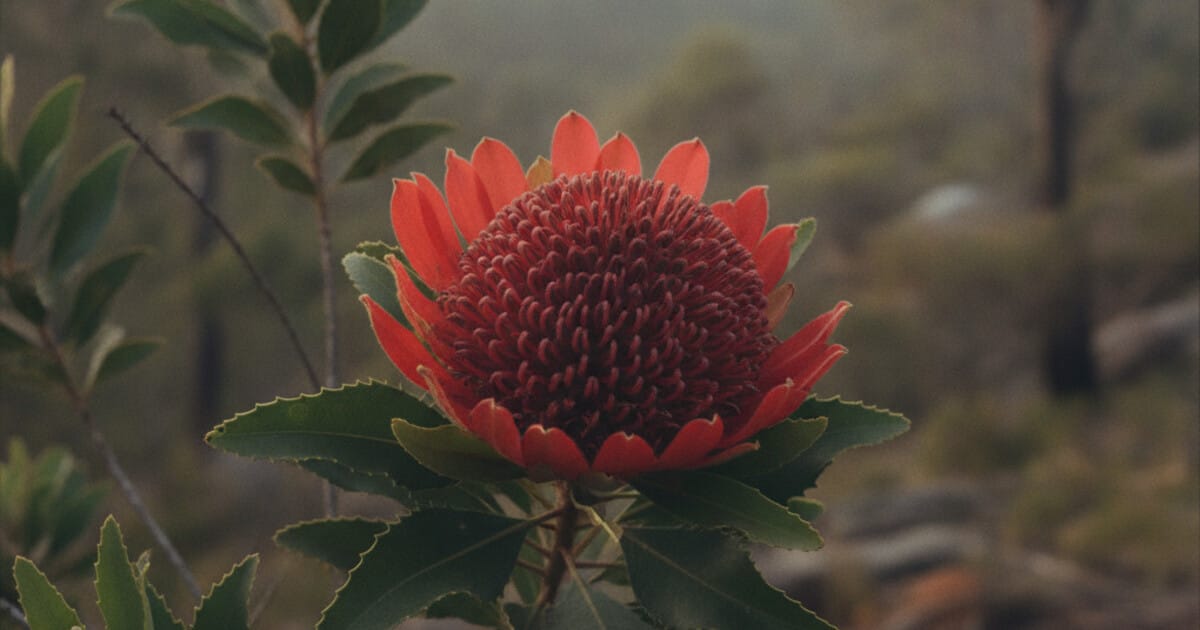
If you’ve walked through Sydney’s sandstone bush in spring and spotted a ball of crimson tucked into the scrub, there’s a good chance it was a waratah. Telopea speciosissima is one of the most visually striking plants in the Australian bush: a stiff-stemmed shrub that produces dense globular flower heads so vivid they’re visible from 50 metres away. The waratah has been NSW’s floral emblem since 1962 and appears on the state’s coat of arms. Beyond the famous flower, waratah identification involves recognizing its distinctive serrated leaves, understanding its sandstone habitat, and knowing how the other 4 Telopea species across Victoria and Tasmania differ from the Sydney Basin classic. This guide covers all of it.
Waratah is identified by its large, globe-shaped crimson flower heads (8 to 12 cm across), dark green leathery leaves with irregular serrated edges (15 to 30 cm long), and stiff upright stems. All 5 Telopea species are endemic to southeastern Australia. NSW waratah (T. speciosissima) flowers from September to November in sandstone heath and dry sclerophyll forest.
What Is a Waratah?
Telopea is a genus of 5 species, all endemic to southeastern Australia and all in the family Proteaceae. The genus name comes from the Greek telopos, meaning “seen from afar,” which fits a flower visible across open bush from considerable distance.
The waratah genus (Telopea) contains 5 species restricted to southeastern Australia: T. speciosissima (NSW), T. oreades (Victoria and southern NSW), T. aspera (mountain waratah, Blue Mountains), T. mongaensis (Braidwood waratah, southern tablelands NSW), and T. truncata (Tasmania). T. speciosissima’s inflorescence holds 200 to 250 individual tubular florets per head, each curved and opening from the outer ring inward, arranged around a central core within a ring of bright red bracts. Flower heads measure 8 to 12 cm across. The species grows primarily on Hawkesbury sandstone in the Sydney Basin and Blue Mountains, typically between sea level and 1,000 metres elevation. It reaches 1 to 4 metres in height, occasionally to 6 metres in sheltered gullies. Bloom season runs September through November across most of its range. T. speciosissima is listed as vulnerable under NSW biodiversity legislation in parts of its range, and it’s commercially cultivated around Bowral and the Southern Highlands for the cut flower trade.
Telopea plants are obligate resprouters: most species resprout from a woody rootstock (lignotuber) after fire. That adaptation underpins their dominance in fire-prone sandstone heathland where few other tall shrubs compete.
Waratah Identification by Leaves and Stems
The leaves are large, stiff, and distinctive. T. speciosissima leaves run 15 to 30 cm long on average, among the largest of any native shrub in its range. Four features define them:
- Dark green upper surface: glossy when young, more matte on older leaves
- Irregular serrated margins: teeth are coarse and unevenly spaced, not fine and regular like a saw blade
- Red midrib and petiole: the central vein and leaf stalk on actively growing specimens often show a red or pink flush
- Leathery texture: thick and stiff, with a slightly corrugated surface
Stem architecture is also useful. Young stems are smooth with a slight red-green tint. The branching pattern is sparse rather than dense; waratahs don’t fill out into a bushy mound the way many native shrubs do. The plant puts its energy into height and flower production rather than lateral spread.
For comparison, lilly pilly leaves (Syzygium) are smaller (5 to 12 cm), oval, and entirely smooth-edged, with no serration at all. If your mystery plant has coarse serrated margins at this size, waratah is a strong candidate. For a broader approach to using leaf shape across species, see the guide to tree identification by leaf shape.
The Waratah Flower: The Most Reliable Identifier
The waratah flower head is the clearest confirmation when in bloom. Each inflorescence is a compound structure: 200 to 250 individual tubular florets packed into a dome and surrounded by a ring of bright red bracts. Those bracts are modified leaves, not petals. They serve as the visual signal to pollinators, mainly honeyeaters such as red wattlebirds and New Holland honeyeaters.
Up close, you can see the individual curved florets opening progressively from the outer ring toward the center. Color in T. speciosissima is uniformly crimson, with no bicolor patterning. The head sits on a stiff pedicel at the stem tip, typically 1 to 3 heads per stem on a mature plant.
Bloom time runs September through November in most NSW locations. In the Blue Mountains, colder conditions push flowering toward October and November. Southern Highlands cultivars grown for the cut flower trade can be forced earlier, with some available from late August.
Old inflorescences leave behind a woody follicle (seed pod) that splits open when ripe, releasing winged seeds. Spotting those persistent follicles on a bare stem in summer or autumn can confirm a waratah even without any current blooms. The follicle shape, roughly 5 to 8 cm long and narrowing to a curved tip, is distinctive.
For other Australian trees that also produce vivid red growth in spring and summer, compare the lilly pilly’s berry clusters to this flower: they target different ID features, but both make trees with red berries a useful reference when unfamiliar Syzygium and Telopea are growing near each other in a garden context.
Where Waratah Grows in Australia
T. speciosissima is tied closely to a specific geology. It grows almost entirely on nutrient-poor sandstone soils, concentrated in:
- The Sydney Basin, from the coast out to the Blue Mountains escarpment
- The Blue Mountains and tablelands, west to roughly Lithgow and Oberon
- Coastal sandstone heath from Newcastle south to approximately Nowra, in heath and dry sclerophyll woodland
Outside NSW, the wild distribution drops off sharply. A handful of sandstone outcrops in southeastern Queensland support small populations, and cultivated specimens appear in gardens across the country, but wild T. speciosissima is essentially a Sydney Basin endemic. It thrives in full sun on well-drained, acidic soils; it rarely establishes in clay or loam.
The other Telopea species occupy different niches:
- T. oreades (Victoria): mountain ash understory in the Otways, Strzelecki Ranges, Snowy Mountains foothills, and the northern face of the Victorian Alps. Shadier and more sheltered than typical speciosissima habitat, often in wet sclerophyll forest
- T. truncata (Tasmania): alpine and subalpine heathland, typically above 900 metres elevation, where shorter growing seasons mean later bloom
- T. aspera and T. mongaensis: restricted to specific localities in the Blue Mountains and southern NSW tablelands respectively, with limited natural range
One practical implication: if you’re in a Melbourne garden and you see a tall shrub with smaller, slightly paler red flower heads, T. oreades or a speciosissima x oreades hybrid is more likely than speciosissima. Range context matters here as much as physical features.
Waratah Species Identification: Telling the Five Apart
When a flower’s in bloom and you’re in NSW, T. speciosissima is hard to confuse. Where species overlap or you’re working from leaf evidence alone, these differences help narrow it down:
T. speciosissima (NSW waratah): leaves 15 to 30 cm with pronounced irregular serration; flower heads 8 to 12 cm, deep crimson; habitat is sandstone heath in the Sydney Basin and Blue Mountains. The most likely species you’ll encounter across NSW.
T. oreades (Victorian waratah): plant reaches 6 to 12 metres, far taller than other species. Leaves are less aggressively serrated with smoother margins. Flower heads smaller (6 to 8 cm) and slightly paler crimson. Found in cool temperate wet forest understory in eastern Victoria and southern tablelands NSW.
T. aspera (rough waratah): lower-growing, with rougher leaf texture and more prominent serration than speciosissima. Restricted to higher elevations in the Blue Mountains. Smaller flower heads with sparser bracts.
T. mongaensis (Braidwood waratah): the rarest of the five. Narrow natural range on the southern NSW tablelands around Monga National Park. It tends to hybridize with T. oreades where ranges overlap, producing intermediate forms.
T. truncata (Tasmanian waratah): smaller flowers, often pink to pink-crimson rather than deep red. Grows in Tasmanian highlands from October through December. The most geographically distinct species and the easiest to separate by range alone.
Hybrids exist in cultivation. ‘Shady Lady White’ and ‘Wirrimbirra White’ cultivars produce white or cream flower heads. Several speciosissima x oreades cultivars sold through nurseries show intermediate characteristics: more robust than T. oreades, with more variable leaf serration than typical speciosissima.
Identify Waratah with the Tree Identifier App
A close photo captures the key identification features clearly. Get the flower head in frame when one is present: a close-up showing the individual tubular florets and surrounding bracts gives the most diagnostic image the app can work with. For leaf-only ID outside of bloom season, photograph the full leaf showing the coarse serrated margins and red midrib against a neutral background.
The Tree Identifier app recognizes Telopea species from flower, leaf, bark, and stem photos. It covers the full genus, including garden cultivars and the smaller species outside NSW. The app works offline, which matters in sandstone heath areas where mobile signal cuts out. You can try 2 free identifications per day on iOS or Android, or test it without downloading via the tree identifier tool.
Two photos give better results than one when species overlap. A flower-head shot combined with a full leaf photo usually separates T. speciosissima from T. oreades in areas where both or their hybrids might appear.
Frequently Asked Questions
How do I identify a waratah?
Look for large crimson flower heads (8 to 12 cm across) with 200 to 250 individual curved tubular florets surrounded by red bracts. Outside of bloom season, identify it by its leaves: dark green, 15 to 30 cm long, leathery, with coarse irregular serrations along the margins and often a red midrib. Most wild waratahs in NSW grow on sandstone soils in heath or dry sclerophyll forest.
When does waratah flower?
NSW waratah (T. speciosissima) flowers September through November across most of its range. Higher elevation populations in the Blue Mountains typically peak in October and November. Victorian waratah (T. oreades) flowers on a similar timeline, though cooler mountain conditions can push it toward November and December. Tasmanian waratah (T. truncata) blooms October through December, later than mainland species.
Are there different species of waratah?
Yes, 5 species: T. speciosissima (NSW), T. oreades (Victoria and southern NSW), T. aspera and T. mongaensis (both restricted to parts of NSW), and T. truncata (Tasmania). T. speciosissima is the most widespread. T. oreades grows taller (6 to 12 metres) and has smaller flowers; it’s the waratah of Victoria’s mountain forests. T. truncata produces pink-crimson rather than deep red heads and grows in Tasmanian alpine heathland.
Where does waratah grow in Australia?
Wild waratahs are restricted to southeastern Australia. T. speciosissima dominates the Sydney Basin and Blue Mountains on nutrient-poor sandstone soils. T. oreades grows in the wet mountain forests of Victoria and the southern NSW tablelands. T. truncata is restricted to Tasmanian highlands above 900 metres. As a cultivated plant, waratahs appear in gardens across the country, though they perform best in well-drained, acidic soils in areas with cool winters.
Can the Tree Identifier app identify waratah from a photo?
Yes. The app recognizes Telopea species from flower, leaf, and stem photos. A close-up of the flower head showing individual florets is the most reliable input, but a clear leaf photo showing the coarse serrated margins and red midrib also works outside of bloom season. It covers the full Telopea genus and includes Australian native species alongside global coverage. Two free identifications per day are available on iOS and Android, with offline mode for use in remote areas.
Waratah season runs through spring across New South Wales, with peak bloom in the Blue Mountains typically landing in October. If you spot the crimson flower in the bush or want to confirm which Telopea species is growing in a garden, photograph it with the Tree Identifier app to get the species identification and full habitat details. Download free on iOS or Android with 2 identifications per day.
Identify a tree from your photo — free
Upload a leaf, bark, or whole-tree photo and get the species in seconds. No signup.
Confidence:
Unlock the full species profile
Free in the app — with unlimited identifications.


AI result for guidance — the app gives full species details and works offline.
Want unlimited identifications?
Get the full species profile, photos and details — free in the app, with unlimited scans.
- Unlimited identifications
- Full species profiles & details
- Works offline, anywhere
- Save and revisit your finds
Elena Torres
Tree Identifier Team