Lemon Scented Gum: Bark, Leaves and Identification Guide
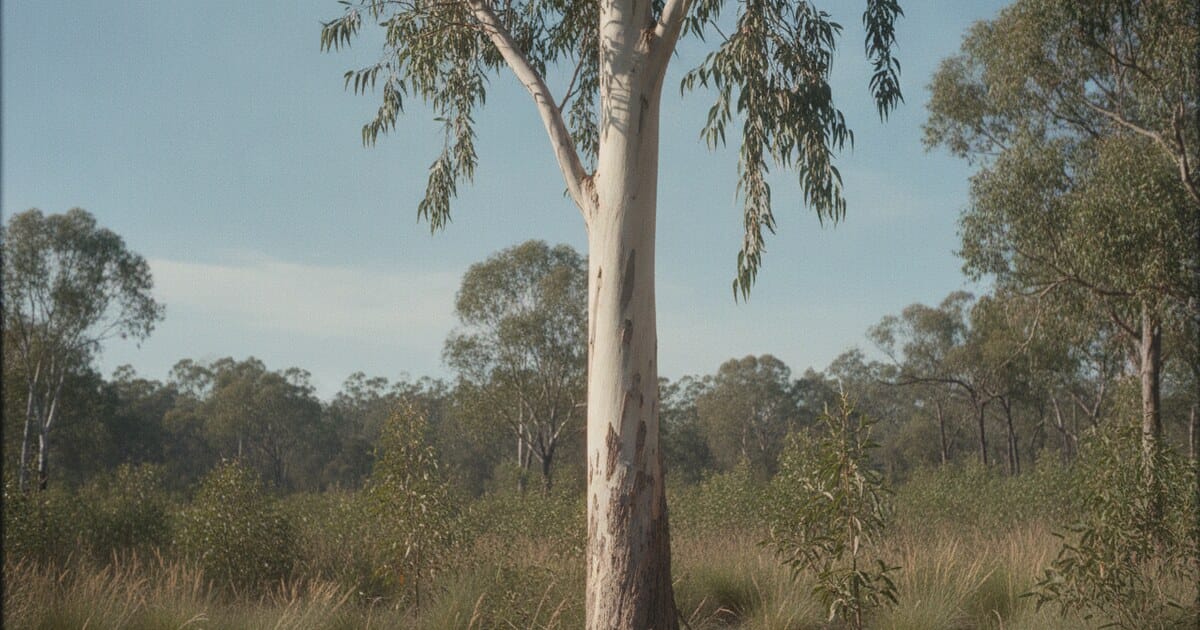
Walk past a lemon-scented gum on a warm afternoon and you’ll smell it before you see it. Crush a single leaf between your fingers and the fragrance is immediate: sharp, clean, and unmistakably citrus. This is Corymbia citriodora, one of the most recognisable Australian trees and one of the easiest to identify once you know its three signature features: a tall, smooth, ghost-white trunk, narrow leaves that reek of lemon, and white winter flowers held in branching clusters. Whether you’re spotting one in a city park or standing under a 40-metre specimen in Queensland’s dry ranges, this guide covers every field mark you need to make a confident ID.
Lemon-scented gum (Corymbia citriodora) is identified by its smooth, powdery white-to-cream bark, narrow lance-shaped leaves with a strong lemon scent, and small white flowers in late winter. Native to Queensland’s dry coastal highlands, it reaches 45 metres tall and was reclassified from Eucalyptus to Corymbia in 1995.
What Does Lemon Scented Gum Look Like?
A mature lemon-scented gum is hard to miss. The trunk rises straight and largely branchless for the first 10 to 15 metres, with a smooth, almost polished surface. The canopy is open and spreading, filled with long slender leaves that hang loosely and catch the breeze.
In Queensland’s dry coastal ranges, trees reach 40 to 45 metres. In southern Australian gardens and parks, most specimens top out at 15 to 25 metres. In either setting, the tree’s height and the clean white trunk make it stand out immediately.
Lemon-scented gum (Corymbia citriodora) is one of eastern Australia’s tallest flowering trees, reaching 40 to 45 metres in its native Queensland range and typically 15 to 25 metres in cultivation. The tree was reclassified from the Eucalyptus genus to Corymbia in 1995, based on structural differences in the buds, flowers, and fruit capsules. Its bark is smooth and powdery, shedding in irregular patches to reveal surfaces ranging from near-white through cream, soft pink, and pale grey. Mature trunks are strikingly clean with almost no rough or stringy texture. The leaves are narrowly lanceolate, 8 to 15 centimetres long, and contain up to 2 percent essential oil by weight, dominated by citronellal. That citronellal content produces the unmistakable lemon fragrance when foliage is crushed. Flowers are white and arranged in branching panicles, typically appearing from late winter through spring. The tree is native to the dry coastal highlands and inland tablelands of Queensland and northern New South Wales.
How to Identify Lemon Scented Gum Bark
The bark is the most reliable field mark, and it’s unlike any other gum tree. Where most eucalypts hold rough, stringy or fibrous bark on the lower trunk, Corymbia citriodora sheds its outer layer through summer in broad, papery strips. What remains is smooth and slightly chalky to the touch.
Fresh-shed areas are pale white or cream. As the bark ages through the season it deepens into greys, soft pinks, and copper tones. By late spring, a single trunk can show three or four colours simultaneously, which gives older trees their distinctive mottled, almost spectral appearance from a distance.
At the base of very old trees, a short stocking of rougher grey bark sometimes persists. The upper trunk stays smooth year-round. From 50 metres away, that gleaming white column is often enough to confirm the species.
Lemon Scented Gum Leaves: Shape and Scent
Adult leaves are narrowly lanceolate: they taper to a fine point at both ends and sit on a short stalk. Typical measurements are 8 to 15 centimetres long and 0.7 to 1.5 centimetres wide. The upper surface is dull grey-green; the underside is slightly paler.
Juvenile leaves on coppice regrowth or young trees look quite different. They’re broader, paler green, and covered in fine hairs. The plant transitions to narrow adult foliage as it matures, so very young trees can initially resemble other smooth-barked species.
Crush a leaf to confirm. The fragrance from citronellal, the primary compound in the essential oil, is unmistakable. No other common gum tree in Australia produces that sharp, clean lemon smell. The oil makes up 0.5 to 2 percent of the fresh leaf weight and is the basis of commercial “lemon eucalyptus” products worldwide.
Flowers, Buds, and Fruit Capsules
Lemon-scented gum flowers are small, white, and carried in branching panicles (clusters of clusters). Each individual flower opens by shedding a cap to reveal a dense brush of white stamens. The main flowering period runs from late winter into spring, though some trees put out a secondary flush in early summer.
The flower buds are a useful ID feature: they’re club-shaped and arranged in groups of three on branching stems. This three-bud arrangement is one of the structural differences that separates Corymbia from true Eucalyptus species, where buds are more commonly carried in groups of seven.
Fruit capsules are woody and urn-shaped, 8 to 12 millimetres long, with three to four valves enclosed inside the rim. They stay on the tree long after flowering and turn from grey-green to brown as they age. Spotting a cluster of those small urn-shaped capsules is a reliable off-season confirmation.
Where Lemon Scented Gum Grows in Australia
Wild populations grow across Queensland’s dry coastal ranges and tablelands, from Marlborough in the central-north through the Brigalow Belt to the Queensland-New South Wales border region. The tree favours sandy and gravelly soils on hillsides and ridges, where drainage is sharp and dry periods are common.
Outside its native range, lemon-scented gum is one of the most widely planted eucalypt species in the world. Parks and streets in southern Australia, South Africa, California, the Mediterranean, and parts of South America all host mature specimens. The combination of striking appearance and commercially valuable essential oil drove that spread.
Young trees are frost-sensitive and need protection in their first few winters. Established trees handle light frosts and extended dry spells. In humid coastal zones, they’re prone to a fungal leaf disease that causes early defoliation, though they generally recover the following season.
For identifying other native trees commonly planted alongside lemon-scented gum in Australian parks, the banksia identification guide covers a full range of native species by region and feature.
Lemon Scented Gum vs Spotted Gum
These two species confuse a lot of people, and for good reason: both are tall, smooth-barked gums native to coastal eastern Australia. The fastest test is the leaf crush. Lemon-scented gum smells sharply of lemon. Spotted gum (Corymbia maculata) has little to no fragrance when you crush its foliage.
The bark patterns differ too. Spotted gum sheds in irregular flakes, leaving a mottled surface of grey, cream, and brown patches arranged somewhat randomly across the trunk. Lemon-scented gum sheds more evenly and produces a cleaner, more uniform trunk colour, especially on younger bark.
Leaf shape also separates them. Spotted gum leaves tend to be slightly broader and shinier, with a more pronounced mid-vein. Lemon-scented gum leaves are narrower and have a dull rather than glossy surface.
Finally, habitat: in areas where both species grow, lemon-scented gum typically occupies the drier ridges and exposed slopes, while spotted gum prefers slightly heavier soils and more sheltered positions on the lower slopes.
Lemon Scented Gum Uses
Timber
The timber is hard, dense, and durable. Commercial applications include power poles, mining timbers, heavy construction, housing frames, flooring, and tool handles. The hardness makes it difficult to work with hand tools, but it finishes well and resists rot and insect attack without treatment. Queensland’s timber industry harvested large volumes of lemon-scented gum through the twentieth century.
Essential Oil
Commercial oil extraction from the leaves is a major industry, particularly in Queensland and Brazil. The oil is rich in citronellal, the compound responsible for the lemon scent. Citronellal is used directly as an insect repellent and as a chemical precursor for manufacturing other fragrance compounds used in perfumery and cosmetics.
Products made from oil of lemon eucalyptus are included on the US CDC’s list of recommended insect repellents for use against disease-carrying mosquitoes. That listing makes lemon-scented gum one of the few plants with a botanically derived mosquito repellent recognised by a major public health authority.
Honey
Lemon-scented gum is a significant apiary tree in Queensland. The honey it produces is pale to medium amber in colour, slow to crystallize, and mild in flavour. Beekeepers value it partly because the flowering period, mainly late winter and early spring, fills a gap in the honey-flow calendar when few other major sources are available.
How Tree Identifier Helps
If you’re looking at a smooth-barked gum and want to confirm whether it’s lemon-scented gum or a close relative like melaleuca, a photo gets you an answer in seconds. The Tree Identifier app analyses bark texture, leaf shape, and overall form and returns a species ID with a confidence score.
The app’s offline mode means you can get results in remote bushland without cell coverage. Take one photo of the bark and one of a leaf, submit both, and compare the results. With 2 free identifications per day, there’s no cost to try. You can also use the free web tool at treeidentifier.app/tools/tree-identifier to scan from your browser.
Frequently Asked Questions
Is a gum tree the same as eucalyptus?
Most gum trees are eucalypts, but the terms don’t perfectly overlap. “Gum tree” generally describes trees in the Eucalyptus and Corymbia genera with smooth, shedding bark. Lemon-scented gum was reclassified from Eucalyptus to Corymbia in 1995, so calling it either a gum tree or a eucalyptus is technically correct.
What is the scientific name for lemon-scented gum?
The scientific name is Corymbia citriodora. Before 1995 it was classified as Eucalyptus citriodora, and that older name still appears in some garden books and nursery catalogues. The reclassification was based on differences in bud arrangement, flower structure, and fruit capsule anatomy that set the bloodwood group apart from true eucalypts.
What’s lemon eucalyptus oil good for?
The essential oil from lemon-scented gum leaves contains high concentrations of citronellal, which repels mosquitoes and other insects. Products derived from oil of lemon eucalyptus appear on the CDC’s recommended repellent list. The oil is also used in perfumery, cleaning products, candle fragrance, and as a starting material for making other fragrance compounds.
How fast does lemon-scented gum grow?
In favorable conditions during its first decade, lemon-scented gum typically adds 1 to 2 metres of height per year. Growth slows considerably once the tree reaches maturity, typically around 15 to 20 years in cultivation. Garden specimens in poor soils or dry climates grow more slowly, often 0.5 to 1 metre per year.
Is lemon-scented gum the same as lemon eucalyptus?
Yes. “Lemon eucalyptus” is the internationally used common name for Corymbia citriodora, particularly in the context of essential oil products and insect repellents. In Australia, “lemon-scented gum” is the standard common name. Both names refer to the same species.
If you’ve spotted a tall, clean-trunked gum and want to confirm the species, the Tree Identifier app can analyse your photo and return a species ID with the key characteristics. Download Tree Identifier on iOS or Android, or try the free web scanner at treeidentifier.app/tools/tree-identifier.
Identify a tree from your photo — free
Upload a leaf, bark, or whole-tree photo and get the species in seconds. No signup.
Confidence:
Unlock the full species profile
Free in the app — with unlimited identifications.


AI result for guidance — the app gives full species details and works offline.
Want unlimited identifications?
Get the full species profile, photos and details — free in the app, with unlimited scans.
- Unlimited identifications
- Full species profiles & details
- Works offline, anywhere
- Save and revisit your finds
Elena Torres
Tree Identifier Team