Angophora: Identification Guide to Australia's Apple Gums
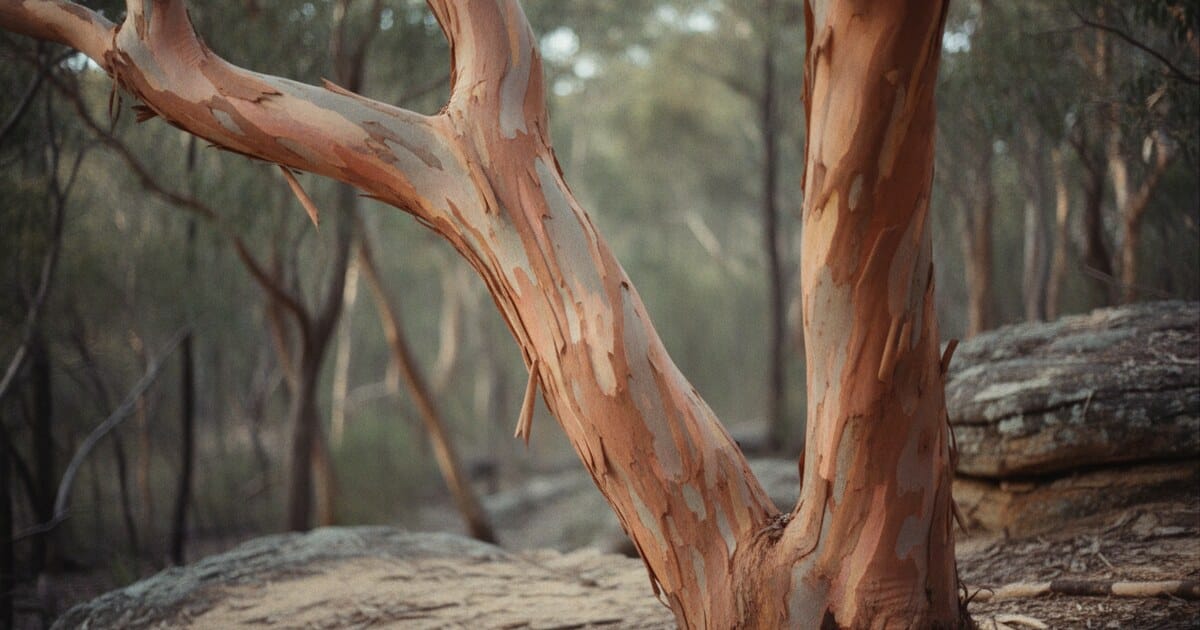
Walk the bush near Sydney on a dry summer morning, and there’s a good chance you’ll pass an angophora before you can name it. The sinuous, salmon-pink trunk rising from sandstone scrub, smooth bark peeling in thin sheets to reveal fresh terracotta underneath: it’s one of eastern Australia’s most striking trees. Angophora trees are frequently misidentified as eucalypts because they share the same sandy woodlands and belong to the same plant family. This guide covers how to identify angophora in the field, the main species you’ll encounter, and the clearest ways to separate the genus from its eucalypt relatives.
Angophora is a genus of about 12 flowering tree and shrub species in the family Myrtaceae, all native to eastern Australia. Known as apple gums, they’re closely related to eucalypts but distinguished by opposite leaves, visible white petals, and ribbed, urn-shaped fruit capsules. The most recognizable species is Angophora costata, Sydney’s iconic smooth-barked apple.
Tree Identifier can confirm an angophora species from a single photo of the leaf, bark, or flowers. It works offline for bush walks on sandstone ridges without cell coverage. 2 free identifications per day, no subscription needed. Download on the App Store
What Is Angophora?
Angophora is a genus of about 12 flowering tree and shrub species in the family Myrtaceae, all native to eastern Australia. The genus sits within tribe Eucalypteae alongside Eucalyptus and Corymbia, and the three are often confused in the field. Angophora is set apart by two reliable field markers: opposite leaves and visible white petals.
Adult Eucalyptus trees carry alternate leaves and their petals fuse into a cap (the operculum) that falls away before the flower opens. Angophora flowers open with 5 separate white petals and a ribbed hypanthium cup beneath them. The fruit is equally diagnostic: a ribbed, urn-shaped capsule roughly 1.5-2.5 cm across, resembling a small apple, which gave the genus its common name “apple gum.”
The 12 species range from Sydney’s iconic Smooth-barked Apple (Angophora costata) at 20-25 m tall to the compact Dwarf Apple Gum (Angophora hispida) at 4-8 m. All 12 species grow in eastern Australia, from coastal Queensland and New South Wales down into parts of Victoria.
The genus name comes from Greek, meaning “bearing goblets,” a reference to the ribbed cup that holds the flower and later the seed capsule. Indigenous Australians have used the genus for centuries. The bark and sap of Angophora costata were used in traditional medicine, and the dense timber has been split and worked by hand for tools and implements.
How to Identify an Angophora Tree
Four features separate angophora from eucalypts and other myrtaceous trees in the field. You only need one or two of these to narrow it down quickly.
Opposite leaves. This is the most reliable marker. Hold a twig and look at how the leaves attach. On angophora, leaves grow in pairs directly across from each other on the stem. Most adult eucalypts have alternate leaves, offset up the stem. If the leaves are opposite, it’s almost certainly angophora.
Visible petals. Angophora flowers have 5 separate white petals you can see individually. Eucalyptus flowers don’t show petals at all. The operculum cap falls off before the flower opens, leaving only the stamens visible. When angophora blooms in late spring and early summer, the white flowers form dense terminal clusters across the crown.
Ribbed hypanthium. Look at the green cup that holds each flower. On angophora, it carries 5-10 clearly visible ribs running from base to rim. Most eucalypts have a smooth or lightly ridged hypanthium.
Ribbed fruit capsule. Once the flowers drop, the fruit develops: a woody, urn-shaped capsule 1-2.5 cm long with matching longitudinal ribs. Crack one open and you’ll find small winged seeds inside.
Bark varies by species. Angophora costata has smooth, peeling bark in pink, salmon, and grey tones that shed seasonally. Angophora floribunda keeps rough, deeply furrowed grey-brown bark throughout its life. Angophora hispida has flaky grey and brown bark with distinctly hairy young stems.
Common Angophora Species in Australia
Angophora costata — Smooth-barked Apple or Sydney Red Gum
The most recognizable species. Angophora costata grows 20-25 m tall in good conditions on Sydney’s sandstone ridges and coastal heathland. Its bark sheds seasonally, exposing smooth pink-orange new wood that gradually fades to grey. The leaves are sessile (no stalk), broadly lanceolate, 6-12 cm long, and held in opposite pairs. White flowers appear in December and January in large terminal panicles, attracting bees and honeyeaters. The trunk is often gnarled, with a wide, fluted base and dramatically twisted limbs. It’s the dominant tree across much of the Sydney Basin and among the most photographed trees in Australian bushland.
Angophora floribunda — Rough-barked Apple
Angophora floribunda keeps its bark throughout its life: rough, persistent, and deeply furrowed in grey-brown tones. The tree reaches 15-30 m, with petiolate leaves (a short stalk) 6-14 cm long. It grows across a wider range than A. costata, extending from coastal NSW into the tablelands and drier inland slopes and valleys. White flowers appear from October to January. Rough bark and petiolate leaves are the two quickest ways to separate it from the smooth-barked species.
Angophora hispida — Dwarf Apple Gum
Angophora hispida is a small tree or shrub to 4-8 m, usually multi-stemmed and spreading. The dense, bristly hairs on young stems, buds, and new leaves are unmistakable: no other angophora species has this. Flaky grey-brown bark. Cream flowers bloom November-January. It grows on coastal headlands and heath scrubs in NSW, often on exposed rocky outcrops where larger trees can’t hold on.
If you need a confirmed species match in the field, photograph the leaf (hold it flat showing the opposite pair), or photograph the bark for A. costata and A. floribunda. The Tree Identifier app handles all three species and runs offline for bush walks without signal.
Angophora vs Eucalyptus: Key Differences
Angophora and eucalypts are close relatives in tribe Eucalypteae and can share the same woodland, which is why the confusion is so common. These are the clearest separating features.
| Feature | Angophora | Eucalyptus |
|---|---|---|
| Leaf arrangement (adult) | Opposite | Alternate |
| Flowers | 5 visible white petals | No visible petals (operculum cap drops off) |
| Hypanthium | Ribbed with 5-10 ribs | Smooth or lightly ridged |
| Fruit | Ribbed, urn-shaped capsule | Variable by species |
The clearest single test is the leaf arrangement. Grab a twig and check whether the leaves are opposite or alternate. If they’re opposite, you’re looking at angophora.
Corymbia is a third related genus, sometimes called bloodwoods. Corymbia citriodora (lemon-scented gum) is a common example. Corymbia carries alternate leaves like eucalypts, so the opposite-leaf test rules it out quickly.
For more on eucalypt identification, the spotted gum guide covers Corymbia maculata in detail, and the lemon-scented gum guide walks through Corymbia citriodora. Both show the alternate leaf arrangement and smooth operculum that separate them from angophora.
Where Angophora Grows in Australia
Angophora is strictly an eastern Australia genus. Its range runs from southeastern Queensland down through coastal and tableland New South Wales into the northeast corner of Victoria.
Angophora costata is closely tied to Hawkesbury Sandstone soils in the greater Sydney Basin. It thrives on dry ridgetops, rocky outcrops, and coastal headlands where sandy, nutrient-poor soils give it an advantage. Its vertical range runs from sea level to around 500 m.
Angophora floribunda has the widest distribution, extending from coastal to semi-arid slopes and valleys. It tolerates harder clays and loams that A. costata avoids and appears throughout tablelands woodland communities across a 1,000 km north-south range.
Angophora hispida sticks to the coast, mostly on rocky sandstone headlands and coastal heath scrub in NSW. It’s sometimes planted in native gardens for its compact size and reliable November-January flowering.
Banksia and wattle trees often share the same sandy scrubland communities as A. costata and A. hispida. These coastal woodlands are some of the richest habitat in eastern Australia for native bees, honeyeaters, and seed-eating birds.
How Tree Identifier Helps You Identify Angophora
Identifying angophora in the field is easier with a photo than with a field guide. The Tree Identifier app reads leaves, bark, flowers, and fruit from a single photo, then returns a species match with a confidence score and detailed species information.
For angophora, the best photos to submit are:
- A twig showing opposite leaf pairs: this feature alone narrows the field significantly
- A bark close-up: smooth pink-orange bark points to A. costata, rough furrowed bark to A. floribunda
- Flowers or fruit: the ribbed capsule and white petals are strong confirmatory features
The app works offline, which matters on remote sandstone ridges where cell coverage is thin. It covers thousands of tree species including all major angophora. The free tier gives you 2 identifications per day, enough to confirm what you’re looking at and check a couple more trees on the same walk.
Frequently Asked Questions
How tall does Angophora costata grow?
Angophora costata typically reaches 20-25 m in ideal conditions, though many specimens on exposed sandstone ridges stay closer to 10-15 m due to wind exposure and thin soils. The trunk can be substantial on older trees, with a wide, buttressed base and dramatically twisted limbs that make it one of the most architecturally striking trees in Sydney bushland.
How many species of Angophora are there?
There are about 12 recognized Angophora species, all native to eastern Australia. The three most commonly encountered are A. costata (Smooth-barked Apple), A. floribunda (Rough-barked Apple), and A. hispida (Dwarf Apple Gum). Less common species include A. bakeri (Small-fruited Apple), A. subvelutina (Broad-leaved Apple), and A. melanoxylon (Black Apple).
What is the typical growth habit of Angophora hispida?
Angophora hispida is usually multi-stemmed and spreading, growing 4-8 m tall and 5-6 m wide. It suits compact native gardens and grows well in sandy, well-drained soils on exposed coastal sites. The hairy young stems and cream flowers from November to January make it one of the more visually distinctive angophora species to identify.
What are the key differences between Eucalyptus and Angophora?
The two clearest differences are leaf arrangement and flower structure. Angophora has opposite adult leaves; eucalypts have alternate adult leaves. Angophora flowers show 5 visible white petals; eucalyptus flowers lose their petals as an operculum cap that drops off before the flower opens. The ribbed fruit capsule and ribbed hypanthium also separate angophora from most eucalypts, though both genera belong to family Myrtaceae and tribe Eucalypteae.
The Tree Identifier app reads leaves, bark, or flowers from a photo and returns the species in seconds, with habitat and identification notes to back up the result. It’s the fastest way to confirm an angophora on your next bush walk.
Identify a tree from your photo — free
Upload a leaf, bark, or whole-tree photo and get the species in seconds. No signup.
Confidence:
Unlock the full species profile
Free in the app — with unlimited identifications.


AI result for guidance — the app gives full species details and works offline.
Want unlimited identifications?
Get the full species profile, photos and details — free in the app, with unlimited scans.
- Unlimited identifications
- Full species profiles & details
- Works offline, anywhere
- Save and revisit your finds

Elena Torres
Tree Identifier Team