Moreton Bay Fig: Leaves, Bark and Identification Guide
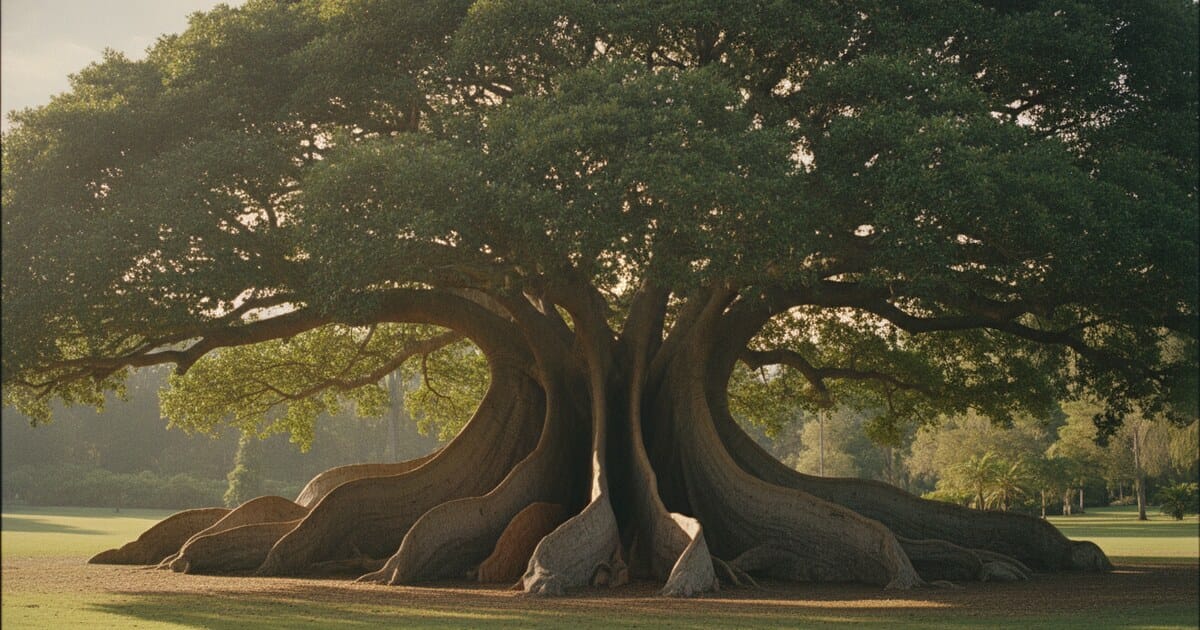
Walk past a Moreton Bay fig and you stop. The trunk can be wider than a car, with flat, fin-like buttress roots radiating outward like the walls of some ancient fortress.
Ficus macrophylla is one of Australia’s most dramatic trees, and once you know its features, it’s unmistakable. This guide covers the key ID markers: leaves, bark, buttress roots, fruit, and how it compares to other banyan figs.
The Moreton Bay fig (Ficus macrophylla) is a large evergreen tree native to eastern Australia, growing to 60 meters in the wild. Leaves are 10-30 cm long, glossy dark green above, rusty-brown below. Massive buttress roots flare from the trunk base, and the 2-2.5 cm fruit ripens from green to purple. Also called the Australian banyan, it’s a strangler fig.
What Does a Moreton Bay Fig Look Like?
The Moreton Bay fig doesn’t look like any tree you’d find in a temperate garden. In open ground, the canopy spreads dramatically, sometimes over 50 meters wide. The trunk swells into flat, wall-like buttress roots at the base before rising into a single massive column. The overall silhouette is broad and imposing, with dense, dark green foliage that holds year-round.
Ficus macrophylla is a large evergreen banyan tree native to eastern Australia, ranging from the Wide Bay-Burnett region of Queensland south to the Shoalhaven River in New South Wales. In its native coastal rainforest habitat, it receives 1,200-1,800 mm of annual rainfall on rich alluvial soils. Wild specimens reach 60 meters (200 feet) tall, with the tallest recorded at 70.6 meters (232 feet). Trunk diameter can reach 2.4 meters (8 feet). The canopy spreads 21-40 meters wide in cultivation and wider in open conditions. Growth runs around 91 cm per year, and these trees routinely exceed 150 years. The Lord Howe Island subspecies, F. m. f. columnaris, grows narrower and taller, shaped by that island’s topography. Planted specimens thrive in USDA hardiness zone 9 and warmer, where frosts are rare. Outside Australia, notable specimens live in California, New Zealand, South Africa, and southern Europe.
The tree is evergreen, holding its leaves year-round. In city parks, the spreading canopy makes it a popular shade tree, though the surface roots can buckle pavement and cause infrastructure problems over time.
Moreton Bay Fig Leaf Identification
The leaves are the most reliable way to confirm a Moreton Bay fig when you’re standing beneath one.
Shape and size: Each leaf is ovate-elliptical, between 10 and 30 cm long and 7-12 cm wide. The base is rounded and the tip comes to a short, blunt point. Leaves attach alternately along the branches, never opposite each other.
Upper surface: Glossy and dark green, smooth to the touch. The shine is distinctive, especially when the canopy catches direct sun. The midrib and veins are visible but not raised.
Lower surface: This is the key ID tell. The underside is a rusty or bronze-brown color, caused by fine hair-like structures on the surface. Flip a leaf and the color difference is immediate. No other common Australian fig shares this combination of size and rusty underside so reliably.
Texture: Leathery and stiff. Moreton Bay fig leaves don’t droop or flutter in light wind the way softer-leaved trees do. Even large leaves hold their shape.
Milky sap: Break a leaf stem and a white, milky sap bleeds out within seconds. All Ficus species produce this latex, and it’s especially visible in young growth.
If you can get one leaf in hand, the rusty-brown underside alone distinguishes the Moreton Bay fig from most other large-leaved figs you’d encounter in a park or garden.
Related Australian trees also worth knowing: the banksia and melaleuca share some habitat with the Moreton Bay fig along the eastern coastal strip, though their leaf shapes are quite different.
Bark, Buttress Roots, and Trunk
The bark of a Moreton Bay fig is grey-brown and rough, marked with irregular patches and blemishes. It doesn’t peel in long strips like many eucalyptus species. On older trees, the bark becomes more deeply textured around the base, where the buttress roots begin to flare.
The buttress roots are the defining visual feature of this species. They emerge from the lower trunk as flat, vertical flanges, sometimes reaching 2-3 meters in height before they blend into the main root system. From above, they radiate outward like the fins of a rocket or the spokes of a wheel.
Each buttress has a smooth, rounded upper edge with a sharp vertical drop on the outer face.
On very large specimens, the roots create walled alcoves around the base of the trunk, wide enough for a person to stand inside. The trunk itself can reach 2.4 meters in diameter, making it one of the broadest trunks of any tree found in Australia.
Aerial roots can develop from the branches on mature trees, similar to the classic banyan fig habit. These hang vertically and, if they reach the soil, thicken into woody secondary trunks. This process is the same mechanism that creates the famous multi-trunked spread of the Indian banyan (Ficus benghalensis), though Moreton Bay figs more commonly develop a single dominant trunk with spreading buttresses rather than a forest of aerial trunks.
Moreton Bay Fig Fruit
The fruit of Ficus macrophylla is a syconium: a fleshy, hollow structure with the tiny flowers enclosed inside rather than on the outside. This is how all figs fruit, though most people don’t see the flowers because they’re sealed within.
Each fig is roughly 2-2.5 cm in diameter, slightly smaller than a large marble. Immature fruits are green with pale cream-white spots. As they ripen, they darken to purple, and the pale spots persist, giving ripe fruit a distinctive stippled appearance.
Fruiting happens year-round on established trees, with the heaviest crop between February and May. Birds and fruit bats are the primary consumers in Australia, which is also how seeds get dispersed into the canopy of other trees, starting the next cycle of strangler fig growth.
The fruit is technically edible for humans, but it’s small, barely fleshy, and packed with seeds. Wildlife value is far higher than culinary value.
Is a Banyan Tree the Same as a Moreton Bay Fig?
Yes. The Moreton Bay fig is commonly called the Australian banyan because it grows with the same strangler fig behavior as the true banyan.
The original banyan is Ficus benghalensis, native to the Indian subcontinent. It became famous for its aerial roots that drop to the soil and thicken into additional trunks, allowing a single tree to spread across enormous areas. Over time, the “banyan” name spread to cover all strangler figs that share this growth pattern.
Ficus macrophylla behaves the same way. A seed lands in the fork of another tree, carried there by a fruit bat or bird. The seedling grows as an epiphyte, sending roots down along the host trunk.
Over decades, those roots tighten. The host tree eventually dies, and the fig becomes self-supporting.
The practical difference: the Indian banyan typically forms many aerial-root trunks and spreads horizontally across a wide area. The Moreton Bay fig more commonly grows as a single-trunk tree with buttress roots, though aerial roots do develop on very old specimens.
For species identification, the leaf underside color (rusty-brown in macrophylla, paler in benghalensis), the leaf size, and the native range all separate them cleanly.
Famous Moreton Bay Fig Trees
The most-cited specimens outside Australia show what this tree becomes with space and time.
Santa Barbara, California: Planted in 1877 from a cutting brought from Australia by Adeline Crabb, this tree has a trunk circumference of 38 feet and a canopy spread reaching 53 meters (175 feet) across. The City of Santa Barbara officially designated it a “tree of notable historic interest” in September 1970. It stands adjacent to the Amtrak station.
Balboa Park, San Diego: Planted for the 1915 Panama-California Exposition, this specimen measured 78 feet (24 meters) tall with a crown 123 feet (37 meters) wide as of 1996. Trunk girth reached 486 inches (about 12.3 meters). Foot traffic damaged its surface roots in the 1980s. After fencing and mulching in 1989, the tree recovered.
Pahi, New Zealand: Measured at 26.5 meters high and 48.5 meters wide in 1984. Trunk girth grew to 14.8 meters by 2011.
New South Wales: The tallest recorded Moreton Bay fig in Australia stands near Wollongong at 58 meters (190 feet), close to the tallest recorded specimen worldwide at 70.6 meters.
In Australia, the species stays close to the coast. It grows on rich alluvial flats and stream banks where rainfall reliably exceeds 1,200 mm per year, from central Queensland south through New South Wales. The wattle tree and spotted gum often share this eastern coastal habitat, though each occupies a slightly different ecological niche.
Identify It in the Field
If you come across a large, spreading fig tree and want to confirm the species, the Tree Identifier app can analyze a photo of the leaves, bark, or fruit and return a species match with a confidence score. It works from a single leaf photo or a shot of the whole tree, and covers thousands of species including Ficus macrophylla. The app includes 2 free identifications per day, with offline mode available for remote locations.
You can also try the free web tool at treeidentifier.app/tools/tree-identifier without downloading the app.
Frequently Asked Questions
Where is the largest Moreton Bay fig tree?
The Santa Barbara specimen, planted in 1877, is often cited as the largest in the United States, with a trunk circumference of 38 feet and a canopy spreading 53 meters across. In Australia, the tallest known tree stands near Wollongong at 58 meters (190 feet). A tree in Pahi, New Zealand, had a trunk girth of 14.8 meters as of 2011.
How fast does a Moreton Bay fig grow?
Young Moreton Bay figs grow around 91 cm (about 3 feet) per year under good conditions. Growth slows as the tree matures. In its native habitat, the tree receives 1,200-1,800 mm of rainfall annually, and planted specimens do best with reliable moisture and warm temperatures. USDA zone 9 is the practical cold limit for outdoor planting.
Is a banyan tree the same as a Moreton Bay fig?
Yes. The Moreton Bay fig is a type of banyan tree, sometimes called the Australian banyan. The original banyan (Ficus benghalensis) is native to India. The name “banyan” applies broadly to strangler figs that send aerial roots to the soil. Ficus macrophylla shares that growth behavior but is native to eastern Australia.
Are Moreton Bay figs native to Australia?
Yes. The species grows naturally along the eastern coast from the Wide Bay-Burnett region in central Queensland south to the Shoalhaven River area in New South Wales, on rich alluvial soils with high rainfall. The subspecies F. m. f. columnaris is endemic to Lord Howe Island. Outside its native range, it has been widely planted in California, New Zealand, South Africa, and the Mediterranean.
How do you identify a Moreton Bay fig leaf?
Flip the leaf over: the underside is rusty or bronze-brown, which is the most reliable field ID check. The upper surface is glossy, dark green, and smooth. Leaves are 10-30 cm long, ovate-elliptical, and arranged alternately on the branch. Break a leaf stem and a milky white sap bleeds out within seconds.
Identify a tree from your photo — free
Upload a leaf, bark, or whole-tree photo and get the species in seconds. No signup.
Confidence:
Unlock the full species profile
Free in the app — with unlimited identifications.


AI result for guidance — the app gives full species details and works offline.
Want unlimited identifications?
Get the full species profile, photos and details — free in the app, with unlimited scans.
- Unlimited identifications
- Full species profiles & details
- Works offline, anywhere
- Save and revisit your finds
Elena Torres
Tree Identifier Team