Blue Gum Tree: Complete Identification Guide
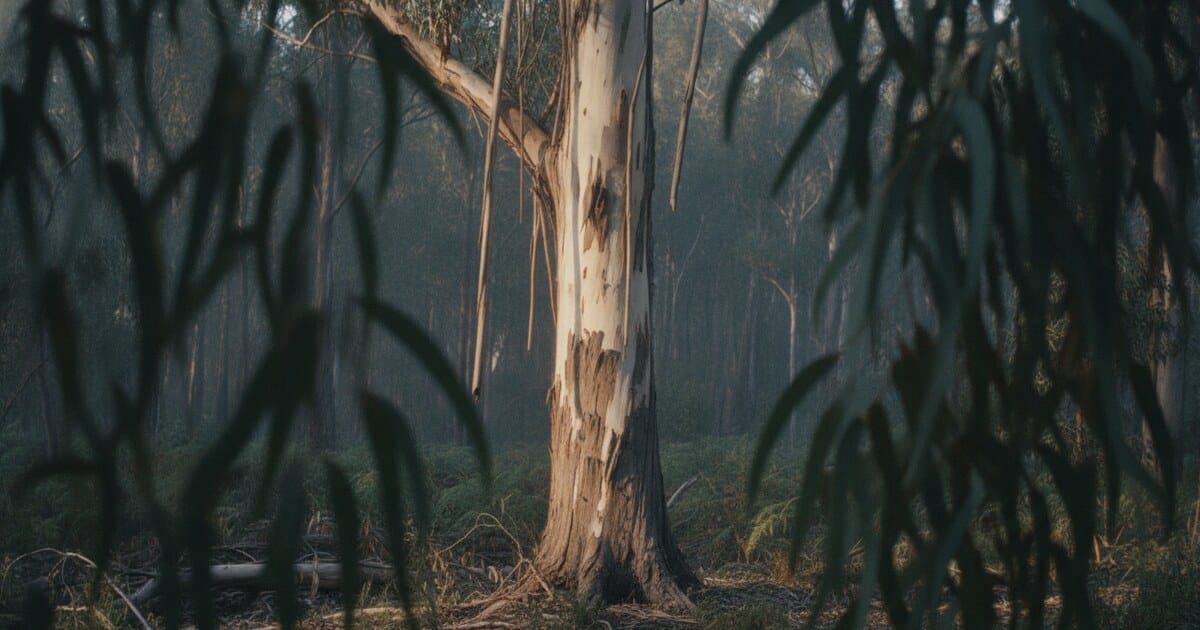
Most of Australia’s eucalypts shed bark in some fashion, but the blue gum does it in a way that stops you on the trail. Long ribbons and sheets peel from the upper trunk, revealing smooth panels of white, cream, and pale grey beneath. The juvenile leaves are a cold blue-grey oval. The adult leaves are a completely different shape entirely. Crush one and the sharp camphor-like scent settles any doubt about what you’re looking at. Blue gum trees are among the most recognisable eucalypts in southeastern Australia and among the most widely planted eucalypts on the planet. This guide covers how to identify one in the field, which subspecies you might be looking at, and why a native Tasmanian tree ended up covering 16,000 hectares of California.
Blue gum (Eucalyptus globulus) is a large eucalyptus from southeastern Australia with smooth shedding bark on the upper trunk, rough bark at the base, and two distinct leaf stages: oval blue-grey juveniles and narrow sickle-shaped adults 15-30 cm long. Trees reach 30-55 metres. Four subspecies are recognised.
What Is a Blue Gum Tree?
Blue gum is the common name for Eucalyptus globulus, a large evergreen in the family Myrtaceae. The “blue” refers to the waxy, glaucous coating on the juvenile foliage rather than any color in the mature canopy. Outside Australia it’s also called Tasmanian blue gum or southern blue gum.
The name isn’t pinned to a single species in Australian usage. Eucalyptus saligna, the Sydney blue gum, shares the same common name across much of New South Wales. When people outside Australia say “blue gum,” they almost always mean E. globulus.
Eucalyptus globulus is a large eucalyptus native to southeastern Australia, primarily the southeast coast of Tasmania, the Bass Strait islands, and coastal Victoria at Cape Otway and Wilson’s Promontory. Four subspecies are recognised: ssp. globulus (Tasmanian blue gum), ssp. bicostata (Victorian blue gum or eurabbie), ssp. maidenii (Maiden’s gum), and ssp. pseudoglobulus. Trees typically grow 30-55 metres tall, with exceptional individuals approaching 70 metres. The most reliable field identification involves the two-stage leaf change: juvenile leaves are opposite, oval, bluish-grey, and roughly 9 x 9 cm, coated in a waxy bloom; adult leaves are alternate, sickle-shaped, 15-30 cm long, and glossy dark green. Bark sheds in long strips on the upper trunk, revealing smooth white, cream, and grey patches beneath, while the base often retains rough fibrous bark. Blue gum was introduced into California in 1856 and now covers approximately 16,000 hectares from Humboldt County to San Diego County.
Blue Gum Tree Identification: Bark, Leaves, Flowers, and Fruit
Several features taken together make a confident identification. No single one works reliably on its own.
Bark: The upper trunk sheds bark annually in long ribbons and sheets, leaving a smooth surface that weathers from pale cream-white to grey or yellow-brown over the following months. At the base of mature trees the bark stays rough and fibrous, creating a two-zone trunk: ragged and dark below, smooth and pale above. That contrast is one of the fastest IDs from a distance.
Juvenile leaves: Young growth produces opposite, stalkless leaves that clasp the stem directly: oval to rounded, roughly 9 x 9 cm, with a powdery blue-grey waxy bloom. The stems are square in cross-section rather than round. Coppice regrowth after fire or cutting produces this juvenile type regardless of tree age, so a recovering stump and the tall canopy above it can look like two different species.
Adult leaves: Mature leaves hang on long petioles, sit alternate along the branch, and take a narrow sickle form (lanceolate to falcate), typically 15-30 cm long. The surface is dark green and glossy on the upper side, paler beneath. The pendulous habit means the canopy filters light heavily and creates dense litter below.
Flowers: The flower bud sits solitary in the leaf axil in ssp. globulus; other subspecies carry buds in groups of 3 or 7. The cap (operculum) is warty and ribbed and falls off as the flower opens, releasing a dense mass of white to cream stamens. Flowering happens mainly in winter and spring in the native range.
Fruit: The gumnut is hard and woody, blue-grey to grey, roughly 1.5-2.5 cm across, with 3-4 prominent ribs running lengthwise. The ribbed profile separates blue gum capsules quickly from the smaller, smoother gumnuts of many other eucalypts.
The Juvenile-to-Adult Leaf Transformation
Most eucalypts produce noticeably different juvenile and adult leaves, but in blue gum the shift is dramatic enough to confuse an otherwise confident identifier.
Young seedlings and regrowth shoots carry the classic blue-grey clasping leaves. A tree recovering from logging or wildfire often looks nothing like the canopy overhead. Opposite, stalkless, powdery-blue oval leaves growing from a large old trunk or stump are juvenile blue gum regrowth, not a different species.
The transition to adult leaves happens gradually, typically starting around 3-5 years on a free-growing tree. Once the tree reaches adult foliage it doesn’t revert except in coppice or after disturbance. Spotting both forms on the same tree is actually one of the most useful confirming observations.
The lemon-scented gum is another smooth-barked eucalyptus that can look similar from a distance; both species have pale shedding upper trunks and dark green mature canopies. The fastest separation is scent: lemon-scented gum carries a strong citronella smell when crushed, while blue gum produces a camphor-like scent. Scent plus the square-stemmed juvenile growth confirms blue gum.
Blue Gum Tree Range and Distribution
In Australia, blue gum’s native range is patchy and confined to the southeastern corner. The subspecies globulus occupies the southeast coast of Tasmania, the Bass Strait islands, and small coastal pockets in Victoria. Subspecies bicostata (Victorian blue gum) has a broader inland distribution across northern Victoria and New South Wales, and is the form most often encountered on the mainland.
Outside Australia, blue gum is one of the most widely planted trees in the world. Portuguese forestry introduced it to the Iberian Peninsula in the 19th century for pulpwood. It reached California in 1856 and spread quickly along the coast. Approximately 16,000 hectares are now planted from Humboldt County in the north to San Diego in the south, with the densest stands in the coastal fog belt near San Francisco.
Blue gum grows faster outside its native range than within it. Seedlings in favorable Hawaii conditions reportedly reached 4 metres at 2 years, and California’s tallest planted specimen exceeded 61 metres. The California Exotic Pest Plant Council lists it among exotic pest plants of greatest concern, with dense stands shading out native understory plants and bark strips carrying fire upward into the crowns.
Blue Gum Timber, Oil, and Other Uses
Despite its size, blue gum timber has a complicated commercial reputation. The wood is dense and hard, but it shrinks dramatically in drying and develops growth stress cracks that make milling for structural lumber difficult. Historical uses ran toward fence posts, mine props, poles, and railway sleepers rather than sawn boards; the wood burns well and makes high-quality charcoal, so firewood was also a significant end use.
The leaves are more commercially valuable than the wood. Eucalyptus oil, predominantly 1,8-cineole (eucalyptol), is steam-distilled from blue gum leaves for pharmaceuticals, cold and cough remedies, and cleaning products. Blue gum plantations across Portugal, Brazil, and southern Europe are grown almost entirely for pulpwood and paper.
One practical note: the ASPCA lists eucalyptus species including blue gum as toxic to dogs, cats, and horses. Ingestion of leaves or oil causes vomiting, drooling, and lethargy.
How to Identify a Blue Gum Tree in the Field
Start with the bark at eye level. Is the upper trunk smooth and pale with peeling ribbons, but rough and dark at the base? That narrows the field substantially among Australian eucalypts.
Next, check the leaves. If coppice or young growth is reachable, opposite blue-grey clasping leaves confirm juvenile blue gum almost immediately. In the adult canopy, look for long sickle-shaped pendulous leaves with a camphor scent when crushed.
Find a fallen gumnut below the tree. The ribbed, chunky capsule of blue gum looks quite different from the smaller or smoother capsules of spotted gum and most other smooth-barked eucalypts. The ribs are usually visible from a metre away.
If you’re working from a photo, the Tree Identifier app handles blue gum well from bark, leaf, or canopy shots. Upload a photo at treeidentifier.app to get a confirmed ID in seconds, with 2 free identifications per day on iOS and Android.
For a broader look at Australian native trees, the banksia guide links through to the full library of species identification articles in this series.
Frequently Asked Questions
Is a blue gum the same as a eucalyptus? Yes. Blue gum (Eucalyptus globulus) is a eucalyptus in the family Myrtaceae, and the genus covers more than 700 species across Australia, Southeast Asia, and the Philippines. Blue gum is one of the most recognisable, but it’s one species within a large and varied group.
What’s the difference between blue gum and Sydney blue gum? Eucalyptus globulus (Tasmanian or southern blue gum) and Eucalyptus saligna (Sydney blue gum) are separate species. Sydney blue gum typically grows 40-55 metres in its native coastal NSW habitat and has longer adult leaves and smaller, rounder capsules than E. globulus. The rough fibrous bark on Sydney blue gum also extends higher up the trunk than the base-only stocking on Tasmanian blue gum.
How fast does a blue gum tree grow? Blue gum grows 1-2 metres per year under good conditions. In favorable climates outside its native range (Hawaii, California, Portugal), growth can be faster: young trees have been recorded at 4 metres height at 2 years. Growth slows significantly once trees approach maturity.
Is blue gum invasive? In California and parts of southern Europe, blue gum is classified as invasive. It spreads via seed into disturbed soil, produces dense stands that shade out native understory plants, and accumulates flammable bark and leaf litter. In its native Tasmania and Victoria, it’s a native forest species with no invasive status.
How do you tell blue gum from lemon-scented gum? Both have smooth shedding pale bark and dark green adult canopies. The fastest separation is scent: crush a leaf from the adult canopy and blue gum produces a camphor-like smell, while lemon-scented gum (Corymbia citriodora) produces a strong citronella scent. Blue gum’s juvenile growth also produces opposite blue-grey clasping leaves; lemon-scented gum doesn’t have this juvenile stage.
Confirming a blue gum identification is straightforward once you know the two-stage leaf character, the ribbed gumnut, and the two-zone bark. If you’ve spotted one and want a species-level confirmation, photograph the bark, some leaves, and any fallen capsules, then run them through the Tree Identifier app: available on iOS and Android, with 2 free daily identifications and offline mode for remote bush walks.
Identify a tree from your photo — free
Upload a leaf, bark, or whole-tree photo and get the species in seconds. No signup.
Confidence:
Unlock the full species profile
Free in the app — with unlimited identifications.


AI result for guidance — the app gives full species details and works offline.
Want unlimited identifications?
Get the full species profile, photos and details — free in the app, with unlimited scans.
- Unlimited identifications
- Full species profiles & details
- Works offline, anywhere
- Save and revisit your finds

Elena Torres
Tree Identifier Team