Grevillea Identification: Flowers, Leaves, Species Guide
Australia has roughly 360 grevillea species, and if you garden in New South Wales, Queensland, or Western Australia, at least a few of them are probably growing nearby. Grevilleas sit in the family Proteaceae alongside waratah and banksia, sharing that gift for structurally unusual flowers that attract honeyeaters from across the yard. What makes grevillea identification tricky is the sheer variety: the genus spans everything from 20-centimetre groundcovers to 35-metre timber trees, with leaf shapes ranging from fine rosemary-like needles to broad lobed fronds depending on species. The flowers are the most reliable shortcut. A distinctive spider-like style that curves out of a fused petal tube is shared across the whole genus, making grevillea one of the more recognizable genera once you know what to look for. This guide covers the key ID features, the main species you’re likely to encounter, and how to separate similar-looking shrubs in the field.
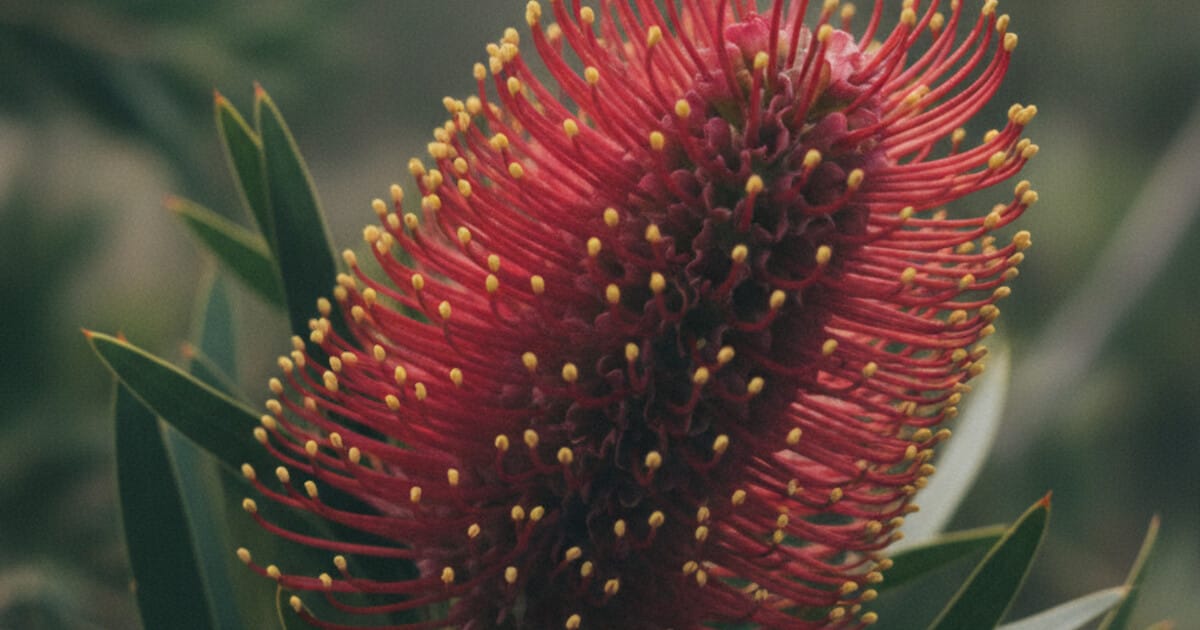
Grevillea is identified by its flowers: 4 tepals fused into a tube, with a long curved style tipped with a pollen presenter that protrudes outward. Flowers appear in toothbrush spikes, rounded clusters, or loose racemes depending on the species. Leaves are highly variable across the 360-species genus. Most wild and cultivated grevilleas attract honeyeaters, which can help confirm the identification.
What Is a Grevillea?
Grevillea is a genus of approximately 360 species in the family Proteaceae, the same family as waratah, banksia, and hakea. Around 250 of those species are native to Western Australia, with the remainder spread across Queensland, New South Wales, Victoria, South Australia, and the Northern Territory. A small number occur in New Guinea, New Caledonia, and Sulawesi. The genus spans a wide size range: from groundcovering forms that barely reach 20 centimetres to Grevillea robusta (silky oak), which reaches 35 metres in tall open forest in coastal Queensland and northeastern NSW. Most garden grevilleas sit between 0.5 and 3 metres. Flowers are produced year-round in many species, though most common garden cultivars peak in winter and spring. As nectar-rich Proteaceae, grevilleas are critical food sources for honeyeaters including red wattlebirds, New Holland honeyeaters, and eastern spinebills. The pollen presenter at the tip of the style is the most consistent ID marker across all 360 species.
Grevilleas share the Proteaceae family with waratah and banksia, but they produce a different type of flower. Where the waratah builds a compact dome of 200-plus florets, a grevillea presents each flower individually or in loose to dense racemes, giving a lighter, more open look.
How to Identify Grevillea by Flower
The flower is the most reliable identification feature across the genus. Grevillea flowers follow a consistent plan regardless of how different the plant sizes and leaf forms look:
- 4 tepals fused into a tube: The tube typically curves slightly as it opens. Tepals are all one type (undifferentiated), giving each flower its narrow tubular appearance
- A long, arched style: This curves back through the petal tube before the tepals fully open, carrying the pollen from the anthers to the tip before deposit. The style continues extending past the open tube, creating the spider silhouette
- Pollen presenter at the style tip: A small disc or knob at the end of the style. In species with racemes, you can see this presenter progressing through stages, from pollen-laden to clean, as flowers open from the base upward
Color varies widely. Orange and red dominate in woodland and forest species. Yellow appears in G. pteridifolia (golden grevillea). White and cream show up in G. parallela and G. floribunda. Pinks appear in G. sericea and many ornamental cultivars.
Inflorescence type helps narrow identification further:
- Toothbrush spikes: one-sided cylindrical racemes where flowers line just one face of the stalk (G. banksii, G. robusta, ‘Robyn Gordon’)
- Round or domed clusters: spider flowers packed into a compact head (‘Coconut Ice’, G. rosmarinifolia)
- Loose curved racemes: fewer flowers, more spread out, often 6 to 12 per raceme (G. lanigera, G. lavandulacea)
Grevillea Leaf Identification
Leaves vary more dramatically across grevillea species than flowers do. Three main forms cover most of the species you’re likely to encounter:
Pinnate or bipinnate (feathery, finely divided): Leaves cut into narrow lobes or leaflets, creating a fern-like appearance. G. robusta leaves reach 30 to 35 cm with a deeply divided structure. G. banksii leaves are smaller but similarly divided. This is among the most distinctive leaf forms in any Australian tree.
Needle-like (terete or narrow): Fine, stiff leaves 1 to 5 cm long, similar in feel to rosemary. G. rosmarinifolia takes its name directly from this resemblance. G. lanigera, ‘Canberra Gem’, and many WA species fall here. Most common in ornamental garden forms.
Lobed or toothed (broader forms): Wider leaves with shallow to deep lobing. G. aquifolium (holly-leaved grevillea) has prickly margins that closely resemble European holly. Less common in cultivation but distinctive in the field.
The underside of grevillea leaves often shows silky hairs, and many species have a clearly silvery or grey lower surface. The genus name references this: Grevillea derives from Charles Francis Greville, but the genus is also associated historically with descriptions of hairy leaf undersides. Holding a leaf to backlight reveals a clear midrib with lateral veins fading before they reach the margin.
Because grevillea leaf shape spans such a wide range, leaf alone is an unreliable single identifier. The guide to tree identification by leaf shape gives a useful framework for working through variable foliage when flowers aren’t present.
Common Grevillea Species in Australia
With 360 species, narrowing by region makes the ID task manageable.
Grevillea robusta (silky oak): The largest grevillea, reaching 35 m in coastal QLD and northeastern NSW. Fern-like bipinnate leaves 15 to 35 cm. Orange-yellow toothbrush flower spikes appear in late winter to spring. Widely planted as a street tree in warm cities. Commercially grown for timber (its wood grain resembles oak, explaining the common name).
Grevillea banksii (red silky oak): 3 to 7 m, mainly QLD. Bipinnate leaves similar in structure to G. robusta but smaller. Flowers are deep red or, in the white variety (G. banksii var. alba), cream. Toothbrush spikes 10 to 15 cm, appearing year-round in warmer areas. Popular in tropical and subtropical gardens.
Grevillea rosmarinifolia (rosemary grevillea): 1 to 2 m, native to southeastern NSW and Victoria. Fine needle-like leaves. Red and cream flowers from winter through spring. Among the most frost-tolerant grevilleas, seen frequently in southern Australian gardens and Canberra plantings.
Grevillea pteridifolia (golden grevillea): 3 to 8 m, NT and QLD. Fern-like divided leaves, bright golden-orange toothbrush spikes 10 to 15 cm from April through September. A significant nectar source for honeyeaters in savanna woodland.
Grevillea ‘Robyn Gordon’: A widely grown cultivar (G. banksii x G. bipinnatifida). Spreading shrub 0.5 to 1.5 m tall and 1.5 to 2 m wide. Red spider-toothbrush flower heads year-round with a winter peak. One of the most-planted grevilleas across Australia.
Grevillea ‘Coconut Ice’: Compact cultivar to 1.5 m. Needle-like leaves. Cream to soft pink rounded flower clusters through winter and spring. Common in low-maintenance garden plantings across the southeast.
Grevillea vs Hakea: Separating Similar Proteaceae
In garden and bush contexts, grevillea is most often confused with hakea. Both are Proteaceae. Both produce needle-like or lobed leaves. Both attract honeyeaters. The clearest difference is the fruit: hakea produces hard, woody, persistent follicles that look like small eggs bolted directly to the branches, staying for years; grevillea follicles are smaller, thinner-walled, and drop within a season or two. If the plant has stiff, persistent seed pods on every old branch, it’s almost certainly hakea.
When flowers are present, both genera produce a curved style with a pollen presenter. Hakea styles don’t extend as dramatically past the petal tube as grevillea styles typically do, though this is a subtle difference in borderline cases.
Banksia is less often confused (the distinctive banksia cone is hard to mistake), but young banksia plants before flowering can superficially resemble needle-leaved grevilleas. Banksia flowers form dense cylindrical cones; grevillea produces open racemes.
For another commonly planted east coast native that grows alongside grevillea in gardens, the lilly pilly guide covers Syzygium leaf and berry features. Lilly pilly and grevillea are often planted together in coastal NSW hedging schemes.
Identify Grevillea with the Tree Identifier App
A close-up of the flowers gives the most diagnostic photo. Get the style and pollen presenter in frame, and include enough of the inflorescence to show whether it’s a toothbrush spike, rounded cluster, or loose raceme. For G. robusta and G. banksii, a full-leaf photo adds significant diagnostic value because the large fern-like leaves are nearly as distinctive as the flowers.
The Tree Identifier app covers Grevillea species and common cultivars from flower, leaf, and bark photos. It handles native Australian species and the ornamental cultivars that appear in gardens across the country. Offline mode works in areas with patchy signal, which matters across WA and NT where many wild grevilleas grow well outside mobile coverage. Two free identifications per day are available on iOS and Android.
Where possible, take 2 photos: one of the flower head and one of the leaf showing both upper and lower surface. That combination usually reaches species or cultivar level rather than genus alone.
Frequently Asked Questions
How do I identify a grevillea?
Grevilleas are identified by their flowers: 4 fused tepals forming a tube, with a long curved style tipped with a pollen presenter that protrudes outward, creating a spider-like silhouette. Flowers appear in one-sided toothbrush spikes, rounded clusters, or loose racemes depending on species. Leaves range from needle-like to finely divided to broader and lobed, so leaf shape alone isn’t reliable across the whole genus without knowing the species group.
What is the difference between grevillea and hakea?
Both are Australian Proteaceae and can look nearly identical as shrubs before flowering. The clearest difference is the fruit: hakea produces hard, woody, persistent follicles that stay on the plant for years; grevillea follicles are smaller, softer-walled, and drop more quickly. When flowers are present, grevillea styles extend dramatically past the petal tube; hakea styles are similar in structure but less pronounced. Hakea spines on prickly-leafed species also tend to be more rigid than grevillea’s sharper-tipped leaves.
How many grevillea species are there in Australia?
There are approximately 360 described species, making Grevillea one of the largest genera in Proteaceae. About 250 are native to Western Australia. The remainder grow across QLD, NSW, VIC, SA, and NT, with a small number in New Guinea and New Caledonia. Taxonomy is still being revised as DNA analysis resolves older groupings, so species counts vary slightly by source.
Do grevilleas grow outside Australia?
Wild grevilleas are almost entirely Australian, with a handful of species in New Guinea, New Caledonia, and Sulawesi. As cultivated plants, grevilleas are grown in South Africa, California, and parts of Mediterranean Europe where the climate suits them. G. robusta in particular is widely planted as a street tree in subtropical cities worldwide, well beyond its native Queensland and NSW range.
When do grevilleas flower?
Flowering time depends on species. Many garden cultivars and WA species peak in winter and spring (May through October). G. robusta flowers in late winter to early spring (August through October) in coastal QLD and NSW. G. pteridifolia flowers April through September in the Top End. Some cultivars including ‘Robyn Gordon’ produce flowers year-round with light peaks. In regions with warm winters, a few flowers are usually present on established plants in any month.
If you’re trying to confirm what’s flowering in the garden or identify a grevillea species in the bush, a photo through the Tree Identifier app gets to genus and often species level in seconds. Download free on iOS or Android, with 2 identifications per day and offline mode for remote use.
Identify a tree from your photo — free
Upload a leaf, bark, or whole-tree photo and get the species in seconds. No signup.
Confidence:
Unlock the full species profile
Free in the app — with unlimited identifications.


AI result for guidance — the app gives full species details and works offline.
Want unlimited identifications?
Get the full species profile, photos and details — free in the app, with unlimited scans.
- Unlimited identifications
- Full species profiles & details
- Works offline, anywhere
- Save and revisit your finds
Elena Torres
Tree Identifier Team