Frangipani Tree: Leaves, Flowers and Identification Guide
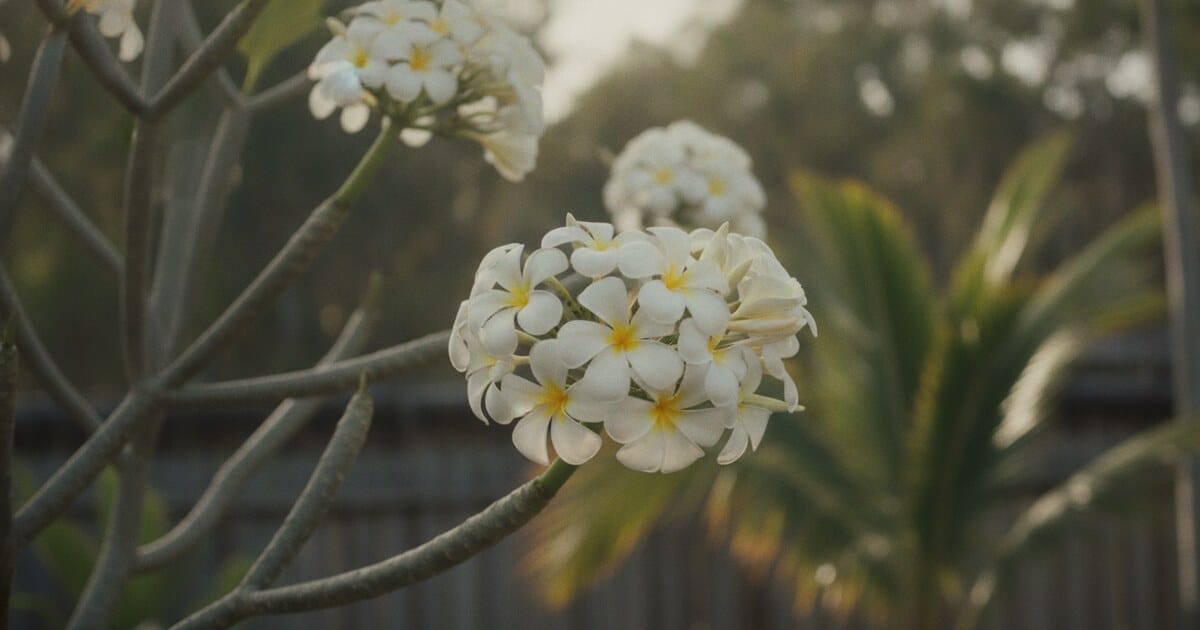
Walk past a frangipani in flower and you’ll know it before you see it. The scent arrives first: a heavy, sweet combination of jasmine, gardenia, and a faint citrus note that some botanists describe as the most recognizable floral fragrance in the tropics. Then come the flowers themselves, clusters of waxy 5-petalled blooms in white, pink, yellow, or red perched at the tips of swollen, gnarled branches.
Frangipani (Plumeria spp.) isn’t native to Australia, but it’s been grown in warm Australian gardens for well over a century. In tropical Queensland, the Northern Territory, and coastal Western Australia, it becomes a backyard fixture: slow to establish, long-lived, and surprisingly drought-tolerant once it settles in. Identifying one in bloom is easy. Identifying a bare-branched specimen in July takes a bit more knowledge.
Frangipani (Plumeria spp.) is a deciduous tropical tree identified by clusters of waxy 5-petalled flowers at branch tips, thick leathery leaves up to 30cm long, and gray-green scaly bark on gnarled, swollen branches. It grows 5 to 8 metres tall and belongs to the family Apocynaceae. Native to Mexico and Central America, it’s widely grown across tropical and subtropical Australia.
What Does a Frangipani Tree Look Like?
The flowers are the fastest recognition feature in the field. Each bloom has 5 overlapping waxy petals arranged in a pinwheel pattern, measuring about 5cm across. Colors run from pure white to pink, yellow, orange, and red, most commonly with a yellow center fading outward to white or pink at the petal edges. Flowers cluster at the very tips of branches in groups of 5 to 30 at once. The petals feel thick and rubbery, quite different from more delicate tropical blossoms.
Branch structure is equally distinctive. Stems are thick and swollen, almost succulent-looking, with smooth gray-green bark marked by small semi-circular scars where past leaves dropped. Older branches are gnarled and irregular, giving mature trees a sculptural, open appearance. The canopy stays sparse compared to most garden trees.
Cut or snap a stem and milky white sap bleeds from the wound immediately. That latex runs throughout the plant and is one of the most reliable field ID markers: few tropical garden trees combine milky sap with clustered flowers at branch tips and the characteristic swollen stem form.
Plumeria, the genus containing all frangipani species, belongs to the family Apocynaceae and comprises roughly 7 to 8 native species, though hundreds of cultivars have been developed from crosses involving P. rubra and P. obtusa. Wild frangipani grows naturally in Mexico, Central America, Colombia, and Venezuela in seasonally dry tropical forests at elevations up to 1,500 metres. Cultivated trees in Australian gardens typically reach 5 to 8 metres tall with a spread of 3 to 5 metres over 20 or more years. Flowers appear between spring and autumn (October to April in the Southern Hemisphere), each measuring about 5cm across with 5 overlapping waxy petals and a strong fragrance that combines jasmine, citrus, and gardenia notes. Leaves run up to 30cm long and 10cm wide, leathery and clustered at branch tips, dropping during winter dormancy in subtropical climates. USDA hardiness zones 10B to 11 cover the tree’s optimal climate range, matching tropical and subtropical Australia.
Frangipani Leaves, Bark, and Sap
Frangipani leaves are thick, stiff, and leathery with an oblong to ovate shape and a pointed tip. Standard size runs up to 30cm long and 10cm wide. They grow in rosette-like clusters at the very ends of branches rather than distributed evenly along stems: this clustering at the tips is one of the clearest identification features when the tree isn’t in flower. The top surface is dark green; the underside is lighter and slightly matte.
In subtropical climates, frangipani drops its leaves through winter. By July or August in Brisbane’s suburbs, most trees are completely bare. The branches stay green and fleshy during dormancy because frangipani stems can photosynthesize directly through their skin, one of the more unusual traits of the genus. New leaves push out in spring, often just ahead of or alongside the first flowers.
Bark on mature trunks and branches is gray-green and scaly. Where old leaves dropped, small raised semi-circular scars mark the bark along each branch. These scars accumulate over years and give older frangipani stems a characteristic bumpy, ridged pattern you can feel by running your hand along them. The sap is also diagnostic: break a small twig and the white latex appears within seconds.
Frangipani Species: Common Varieties in Australian Gardens
Most frangipanis in Australian gardens trace to Plumeria rubra, the common frangipani. It’s the species behind most pink, red, orange, and white-flowered cultivars. The species name “rubra” means red in Latin, though many cultivated forms actually produce pink, salmon, or white blooms with a yellow center.
Plumeria obtusa, the Singapore frangipani or white frangipani, keeps its leaves through winter in truly tropical climates rather than going fully dormant. The flowers are typically white with a yellow center, and the petals are slightly rounder and wider than those of P. rubra. The leaves are broader and blunter at the tip, which is where the species name “obtusa” (meaning blunt) comes from. You’re more likely to find it in Darwin and Cairns than in Brisbane or Sydney.
Dwarf cultivars are widely sold in Australian nurseries. These selections stay under 2 metres, suitable for pots and small courtyard gardens where a full-sized frangipani at 6 to 8 metres would overwhelm the space.
Frangipani in Australia
Frangipani arrived in Australia during the colonial period and has naturalized across tropical Queensland, the Northern Territory, and the Kimberley region of Western Australia. It thrives in the same hot, seasonally dry climates it occupies naturally in Mexico and Central America.
The wet-dry cycle of tropical Australia suits frangipani well. It goes dormant during the dry season, drops its leaves, then bursts into flower at the start of the wet. Inland Queensland towns often have century-old specimens in older gardens, with trunks as thick as a person’s thigh from decades of slow growth.
In cooler parts of Australia, particularly coastal New South Wales and parts of Victoria, frangipani grows but stays smaller and flowers less reliably. Frost kills branches back. A hard freeze can kill the plant outright. Gardeners in Sydney’s western suburbs sometimes lose trees in cold winters while coastal gardens 20km away come through without damage.
Frangipani grows well alongside other warm-climate Australian garden trees. Poinciana and bottlebrush share similar heat requirements and flowering periods, and the three species often appear together in tropical Queensland streetscapes and home gardens.
Frangipani vs Similar Tropical Trees
Three trees cause the most confusion with frangipani in Australian gardens.
Frangipani vs Magnolia: Magnolia produces large, waxy, fragrant flowers, which triggers the comparison. Magnolia flowers are solitary and carried on individual stems, with 9 to 12 or more petals arranged in a cup or globe. Frangipani flowers have exactly 5 petals and grow in clusters at branch tips. Magnolia stems contain no milky sap. Magnolia leaves are distributed along branches rather than clustered at tips.
Frangipani vs Oleander (Nerium oleander): Both belong to family Apocynaceae and both produce milky sap when cut. Oleander leaves are narrow, dark green, and arranged in whorls of 3 around thin, straight stems. Frangipani leaves are broad, leathery, and clustered at the tips of thick, swollen branches. Oleander flower petals share the same overlapping “pinwheel” pattern as frangipani, but the plant stays bushy rather than developing into a tree with a sculptural trunk.
Frangipani vs Gardenia: Gardenias are shrubs, rarely reaching tree height. The flowers are similar in scent but carry more petals (6 to 8 on a standard double gardenia) and the plant has glossy, dark evergreen leaves. Frangipani is deciduous and the leaves are far larger, with that distinctive tip-clustered arrangement.
The milky sap plus clustered branch-tip flowers plus swollen branch form is a combination unique to Plumeria in Australian gardens. Check all three and you can confirm an ID without needing the name.
Identify Frangipani with Tree Identifier
Frangipani in full bloom is one of the easier trees to name from a photo. Dormant trees in winter are a different story. The bare, swollen, gray-green branches with their semi-circular scar pattern don’t look like much until you recognize what you’re seeing. The Tree Identifier app reads photos of leaves, bark, flowers, or whole trees and returns instant species matches, including from bark and branch photos of leafless specimens. Two free identifications per day, no subscription needed to start. A browser-based tool is also at /tools/tree-identifier for quick in-browser ID without downloading the app.
Frequently Asked Questions
What is frangipani called in the US? In the US, frangipani is almost always called plumeria, the genus name. The name “frangipani” is standard in Australia, South Africa, and across Asia. Both words refer to the same genus (Plumeria). The name frangipani comes from a 16th-century Italian nobleman, Marquis Muzio Frangipani, associated with a perfume that had a similar scent.
What is special about a frangipani tree? Frangipani flowers for months rather than weeks, one of the longest bloom periods of any tropical garden tree. Despite the strong fragrance, the flowers contain little to no nectar. They attract hawk moths through scent mimicry without offering any reward, a deceptive pollination strategy. The stems also photosynthesize through bare winter months, keeping the tree alive while leafless.
Where do frangipanis grow best in Australia? Frangipanis grow best in tropical and subtropical Australia: across Queensland, the Northern Territory, and coastal Western Australia north of the Tropic of Capricorn. They need full sun, free-draining soil, and frost-free winters. Sydney can support frangipani in sheltered coastal spots, but frost risk in cooler inland suburbs limits reliable flowering and can kill plants outright in a hard winter.
What does frangipani smell like? Frangipani has a heavy floral scent that blends jasmine, gardenia, and a faint citrus note. The fragrance intensifies after dark, when hawk moths are most active as pollinators. Fresh blooms from P. rubra cultivars typically smell stronger than P. obtusa, though fragrance varies significantly between cultivars of the same species.
Is frangipani sap dangerous? Frangipani sap is a white milky latex that causes skin irritation in sensitive individuals and is toxic if ingested, particularly for children and pets. The Queensland Poisons Information Centre lists frangipani as a plant requiring caution. The toxicity runs throughout the plant but concentrates in the sap. Washing exposed skin quickly with soap and water reduces irritation risk.
Identify a tree from your photo — free
Upload a leaf, bark, or whole-tree photo and get the species in seconds. No signup.
Confidence:
Unlock the full species profile
Free in the app — with unlimited identifications.


AI result for guidance — the app gives full species details and works offline.
Want unlimited identifications?
Get the full species profile, photos and details — free in the app, with unlimited scans.
- Unlimited identifications
- Full species profiles & details
- Works offline, anywhere
- Save and revisit your finds
Elena Torres
Tree Identifier Team