Poinciana Tree: Leaves, Flowers and Identification Guide
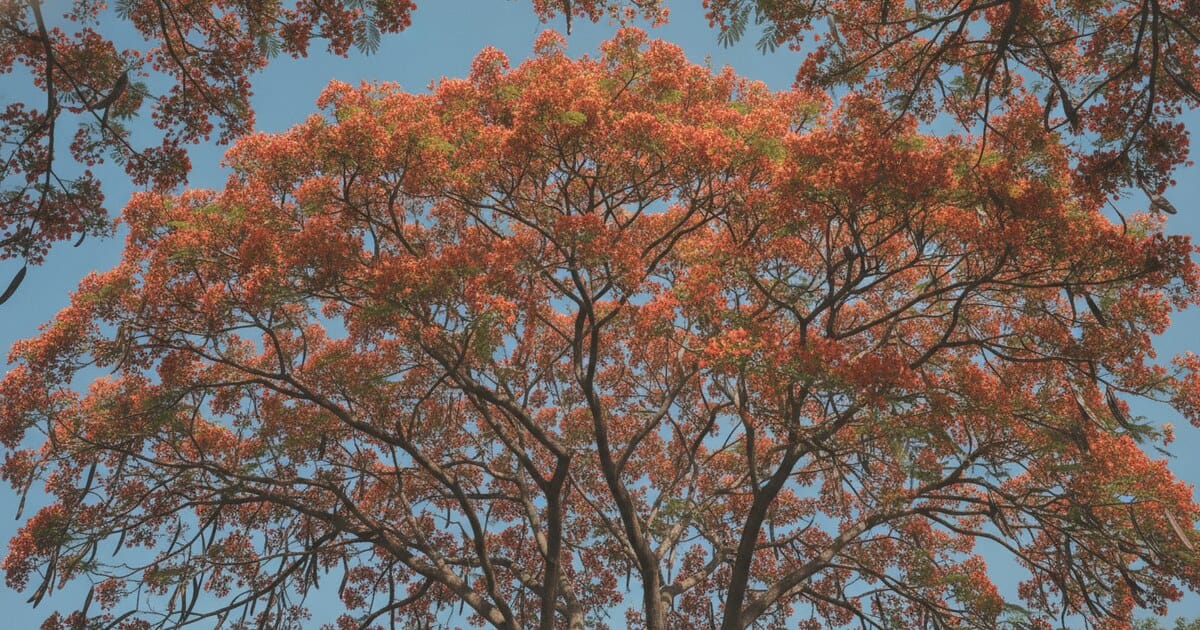
The poincianas in Cairns bloom so reliably that locals mark the calendar by it. When October arrives, the canopy on residential streets shifts from green to a dense wash of scarlet and orange that runs through January. It’s one of the most dramatic seasonal displays in Australian horticulture, and it belongs to a tree that isn’t even native to Australia.
Identifying a poinciana tree is one of the easier plant IDs once you know what to look for. In bloom, nothing else comes close to matching it. Outside the flowering season, bark structure, surface roots, and the long pods hanging through winter all confirm the species.
The royal poinciana (Delonix regia) is a tropical deciduous tree, 20-50 ft tall with a canopy spreading up to 100 ft wide. Its flowers have 5 scarlet petals including one yellow-streaked standard petal. Leaves are feathery compound fronds with hundreds of tiny leaflets. Seed pods reach 18-24 inches long. The tree thrives in USDA zones 9b-11 and blooms October-January in Australia.
What Does a Poinciana Tree Look Like?
The canopy shape gives it away first. A mature poinciana spreads 50-100 ft wide while topping out at 20-50 ft tall, so the crown is far wider than it is tall. The silhouette is flat-topped and umbrella-shaped, anchored low over the ground. From across a road, this horizontal spread looks unlike most other ornamental trees.
Delonix regia belongs to the family Fabaceae, native to the dry deciduous forests of northwestern Madagascar, where fewer than 10 wild trees survive today. Every poinciana you see in Australia, Florida, or the Caribbean descends from ornamental cultivated stock. It reaches 20-50 ft (6-15m) tall with a canopy spread of 50-100 ft (15-30m), growing up to 5 ft (1.5m) per year when young. Flowers have 5 petals: 4 rounded scarlet petals roughly 3 inches across, plus 1 larger standard petal streaked with yellow and white. Leaves are bipinnately compound with 10-25 pairs of pinnae, each carrying 10-25 leaflets, adding up to 500 leaflets per frond. Pods grow 18-24 inches (45-60cm) long, turn dark brown by winter, and hold 20-40 seeds. The tree fixes nitrogen through root bacteria, gradually improving soil over time. USDA hardiness zones 9b-11.
In full bloom, the tree often drops its leaves entirely, letting the flowers cover the crown without green competition. Up close, the 5-petal structure is the most reliable close-range marker: 4 equal scarlet petals arranged symmetrically around a slightly larger upright petal, called the standard, with yellow and white streaks across its base.
The foliage is bipinnate and fern-like. Each frond carries 10-25 pairs of smaller stalks (pinnae), and each pinna carries another 10-25 pairs of tiny leaflets. In a breeze, the fronds flutter and shimmer from a mid-green center. From a distance, the canopy looks almost lacy, distinctly different from the solid round-lobed canopy of an oak or the fine needle bundles of a pine.
How to Identify a Poinciana Tree by Bark and Pods
Outside the flowering season, bark and pods carry the ID. The bark is smooth and gray-brown on young trees, with a slight greenish tint from lichen on mature specimens. It develops shallow ridges with age but stays relatively unassuming. The bark alone won’t close a confident ID, so the pods and root structure do more work in winter.
Surface roots are a standout structural feature. They fan out from the base in broad, shallow buttresses that sit above the ground even on relatively young trees. This root habit is why horticulture guides recommend planting poincianas at least 15-20 ft from pavement and structures. The roots spread wide and have a history of lifting concrete footpaths over decades.
The seed pods are unmistakable once you’ve seen one. They hang in clusters, starting green in summer and turning dark brown as they dry through autumn. Each pod grows 18-24 inches long and about 2 inches wide, flat and slightly curved, with a tough woody shell that rattles when shaken. Pods stay on the tree through winter and drop in spring after releasing their seeds.
Each pod holds 20-40 seeds, smooth and tan-brown with a hard coat built for long-distance dispersal. The seeds are about the size of a large watermelon seed. That hard seed coat explains how a single tree native to a small pocket of Madagascar spread across six continents through the 19th and 20th centuries.
Poinciana Trees in Australia: Queensland and Beyond
The poinciana isn’t native to Australia, but it’s been woven into the landscape of tropical Queensland and the Northern Territory for well over a century. Introduced in the 1800s, it spread through coastal tropical zones where warm temperatures, seasonal rainfall, and free-draining soils closely match its native Madagascar habitat.
Cairns has the most celebrated poinciana presence in the country. Wide residential avenues in the northern suburbs fill with canopy shade and crimson bloom from October through January. The Cairns Botanic Gardens maintains specimens over 100 years old, and the annual poinciana season draws visitors from cooler southern states specifically for the display. Townsville, Darwin, and Rockhampton all have established street plantings that put on a similar show.
In the Sydney area, poincianas survive in sheltered near-coastal gardens but don’t flower as reliably. The cooler winters affect bud set, so full displays require consistent warmth year-round.
One practical note for Australian gardeners: the poinciana is listed as naturalized or invasive in parts of Queensland and the Northern Territory. Seeds germinate readily in disturbed bushland, particularly along creek banks, and the tree can crowd out native species. In urban gardens it’s widely planted without issue, but it’s worth checking your local council guidelines before planting near natural vegetation corridors. The wattle tree and other native flowering ornamentals can deliver a similar visual impact in areas where poinciana planting is discouraged.
Is a Poinciana the Same as a Flame Tree?
In Australian casual conversation, both the poinciana and the Illawarra flame tree get called “flame tree” because both cover themselves in red during summer. They’re different species from different families, and the physical distinctions are straightforward once you know them.
The poinciana (Delonix regia) has open 5-petal flowers in scarlet to orange, with that distinctive streaked standard petal. Leaves are feathery and compound, made up of hundreds of tiny leaflets. The pods grow 18-24 inches, flat and woody. The tree is in the legume family (Fabaceae).
The Illawarra flame tree (Brachychiton acerifolius) is native to eastern Australia and belongs to the mallow family (Malvaceae). Its flowers are bell-shaped, waxy red tubes with no open petals. Leaves are deeply lobed and maple-like, completely different from poinciana fronds. Pods are black and boat-shaped, around 4 inches long, about a fifth of the length of a poinciana pod.
The fastest separation in the field: open 5-petal flowers pointing outward = poinciana. Tubular bell-shaped flowers with no visible petals = Illawarra flame tree.
In practice, Cairns and Darwin residents almost always mean Delonix regia when they say “flame tree.” In Sydney and the central coast, the same phrase more often refers to Brachychiton. The banksia, with its cylindrical flower spikes and woody cones, belongs to a completely different genus again, though all three feature in the iconic flowering-tree landscapes of eastern Australia.
How Tree Identifier Can Help
When a poinciana is in full bloom, the ID is obvious. The challenge comes in winter, when the leaves have dropped, the flowers are gone, and all that remains is bare branches, hanging pods, and the spread of surface roots.
Tree Identifier’s AI handles these out-of-season features. A photo of the bark, a pod on the ground, a single compound leaf from the spring flush, or even a branch silhouette can all pull up the species. The app works across thousands of tree species and returns a confidence score with each result. There are 2 free identifications per day to start, no subscription required, and offline mode keeps the app running on remote property walks without cell service.
The wood identification feature also covers Delonix regia timber. The reddish, fine-grained wood turns up occasionally in Queensland-made furniture, and a photo of the cut grain will flag the species.
Frequently Asked Questions
What is a poinciana tree known for?
The poinciana tree is known for its spectacular summer bloom, when scarlet and orange flowers cover the entire crown. In northern Australia, Cairns and Darwin mark the season by the trees firing up from late October through January. The tree is also known for its wide flat-topped canopy and long woody seed pods that rattle when shaken.
Is a poinciana the same as a flame tree?
In common Australian use, “flame tree” can refer to either the royal poinciana (Delonix regia) or the Illawarra flame tree (Brachychiton acerifolius). They’re different species. Poincianas have open 5-petal flowers and feathery compound leaves; Illawarra flame trees have bell-shaped flowers and lobed maple-like leaves. Poinciana pods grow 18-24 inches; Brachychiton pods are around 4 inches.
Where is the best place to plant a poinciana tree?
Poinciana trees need full sun, a frost-free climate (USDA zones 9b-11), and well-drained soil. They’re drought-tolerant once established and handle coastal salt spray. Plant at least 15-20 ft from pavement and structures, as the shallow surface roots spread wide and can lift concrete over time. In Australia, coastal Queensland, Darwin, and the Top End provide ideal conditions.
How fast does a poinciana tree grow?
Young poinciana trees grow up to 5 ft (1.5m) per year in their first decade under good conditions. Growth slows as the canopy fills out and the tree matures. Trees grown from seed typically flower within 5-8 years; grafted or cutting-grown specimens may bloom in 3-4 years.
Is the poinciana native to Australia?
No. The poinciana is native to the dry deciduous forests of northwestern Madagascar, where fewer than 10 wild trees survive today. All cultivated poincianas in Australia descend from ornamental stock introduced in the 19th century. In parts of Queensland and the Northern Territory, the tree now regenerates from seed in natural areas and is considered naturalized or invasive.
Tree Identifier can confirm a poinciana from a leaf photo, a bark shot, or a pod on the ground. Download it on iPhone or Android for 2 free identifications per day, or try the web-based tree identifier at treeidentifier.app with no sign-up required.
Identify a tree from your photo — free
Upload a leaf, bark, or whole-tree photo and get the species in seconds. No signup.
Confidence:
Unlock the full species profile
Free in the app — with unlimited identifications.


AI result for guidance — the app gives full species details and works offline.
Want unlimited identifications?
Get the full species profile, photos and details — free in the app, with unlimited scans.
- Unlimited identifications
- Full species profiles & details
- Works offline, anywhere
- Save and revisit your finds
Elena Torres
Tree Identifier Team