Melaleuca Tree Identification: Bark, Leaves & Species
The soft papery bark peeling away in layers is what most people notice first about a melaleuca tree. Also called paperbark, tea tree, or honey myrtle depending on the species, melaleuca is one of the largest native genera in Australia, with close to 300 species growing from swampy coastal flats to WA’s dry heathlands. If you’ve walked through a Queensland wetland or seen those cream-white flower spikes along a creek bank, you’ve almost certainly been standing next to one. This guide covers the key features that make melaleuca identifiable in the field, the most common species you’re likely to encounter, and how to separate it from look-alikes like eucalyptus and bottlebrush.
Melaleuca trees are identified by their distinctive multi-layered papery bark, aromatic leaves with 3-5 parallel veins, and dense flower spikes with stamens fused into 5 bundles. Most species grow 2-10m; about 15 reach over 10m. With roughly 300 species, almost all endemic to Australia, they’re one of the continent’s largest and most ecologically important native genera.
What Does a Melaleuca Tree Look Like?
The melaleuca genus (family Myrtaceae) holds around 300 described species, with approximately 230 endemic to Australia. The name comes from the Greek words “melas” (black) and “leucon” (white), a reference to the dark charred bark on the trunk contrasting with paler branch coloring on many species. Trees range from 2-30m in height depending on species; about 15 exceed 10m, and at least 7 reach 20m or more. Melaleuca woodland and open forest covers around 63,000 square kilometres of Australia, roughly 5% of the country’s forested area. Western Australia holds the highest species diversity, with approximately 240 known species concentrated in the southwest. Beyond their visual identity, melaleucas support more than 400 insect species through their life cycles and provide key habitat for honeyeaters, lorikeets, spectacled flying foxes, and mahogany gliders. The genus also includes Melaleuca alternifolia, the commercial source of tea tree oil, whose active compound terpinen-4-ol was found in 1920s laboratory testing to be at least 10 times more effective than phenol as an antiseptic.
Most melaleucas have an upright, spreading habit with a fairly dense canopy. The overall silhouette varies by species. M. quinquenervia grows as a tall, straight-trunked tree; M. leucadendra has a weeping form with long drooping branches. Many smaller species are multi-stemmed shrubs that form dense thickets in coastal and swampy ground.
Melaleuca Bark: The Feature That Defines the Genus
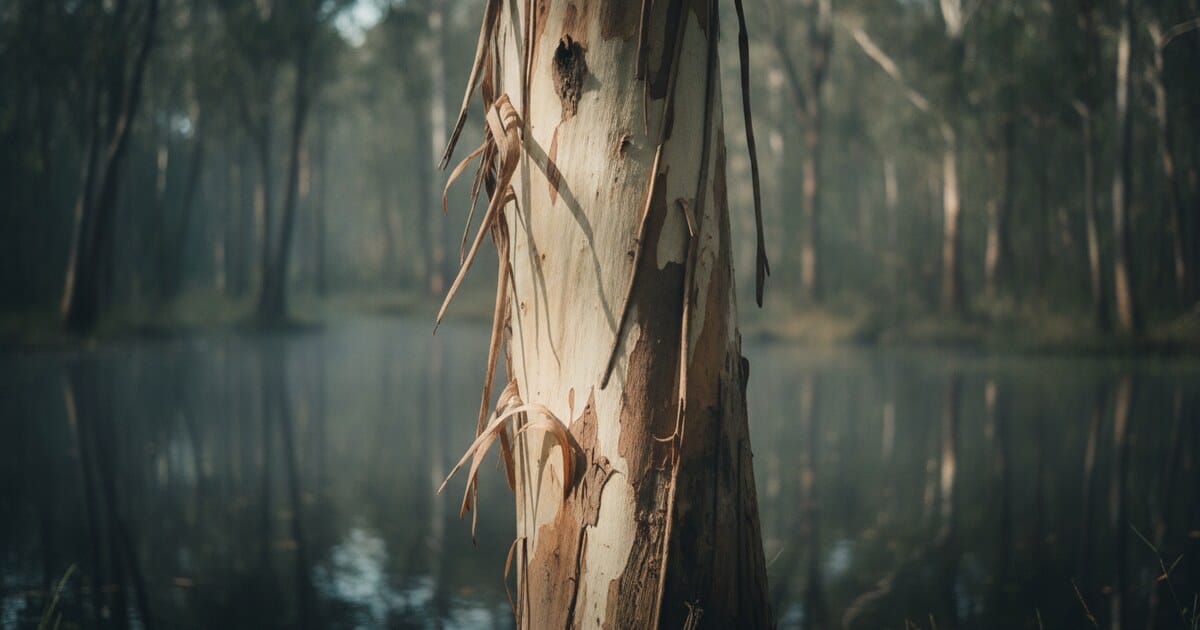
The layered papery bark is the single most reliable field ID marker. On larger species like M. quinquenervia and M. leucadendra, the outer bark builds up in multiple thin cork-like sheets that peel back easily, soft and almost tissue-thin, stacked in layers of cream, tan, and brown. On some mature trees, that accumulated bark reaches 5cm thick before the outermost layers fall away.
Bark color varies across species. Most show off-white to cream tones on younger branches, darkening to brown or near-black on the main trunk. A few species develop rougher, more fibrous bark without the papery quality, but the characteristic layering remains.
The bark also functions as fire insulation, protecting deeper wood while outer layers char and peel. After burns, melaleucas re-sprout vigorously from lignotubers or along the trunk. Aboriginal communities across northern Australia used the bark sheets for roofing material on shelters called “midja” and for wrapping food cooked in underground ovens.
Melaleuca Leaves and Flowers: Spotting the Details
Leaves
Melaleuca leaves are evergreen and arranged alternately along the stem. Size varies considerably across the genus — anywhere from 1-25cm long and 0.5-7cm wide — but most field encounters involve narrow lanceolate leaves in the 3-8cm range. The key visual feature is the parallel venation: most melaleuca leaves show 3-5 veins running lengthwise, rather than the single midrib with branching laterals you’d find on eucalyptus.
Crush a leaf and you get a strong aromatic smell. Many species release the camphor-forward, antiseptic scent associated with tea tree oil, though the exact character differs by species and is notably softer than crushed eucalyptus.
Flowers
Melaleuca flowers are arranged in dense cylindrical spikes or rounded heads along the branches, typically at branch tips. Each flower has 5 small petals, but they’re quickly overshadowed by the stamens. Those stamens fuse at their bases into 5 distinct bundles, with each bundle positioned opposite a petal. That bundled structure is the feature that historically separated melaleuca from bottlebrush.
Flower color ranges widely across the genus: white, cream, and pale yellow on the tree-sized paperbark species; pink, red, orange, or purple on smaller ornamental varieties. M. quinquenervia produces cream-white spikes from April to June. M. leucadendra blooms after significant rain, year-round, with fragrant creamy flowers.
After flowering, small woody capsules cluster tightly along the stem and often persist for years. That cupule arrangement along the stem is a useful secondary ID feature.
Common Melaleuca Species in Australia
Broad-leaved Paperbark (Melaleuca quinquenervia)
The most widely recognized species. It grows to 20m or more along the east coast from Sydney to Cape York and across the Top End. Leaves are grey-green, 4-10cm long, with 5 prominent parallel veins, which is where “quinquenervia” (five-nerved) comes from. Cream-white flower spikes appear April to June. This species makes up around 90% of the canopy at Eubenangee Swamp near Cairns and dominates Queensland’s coastal wetland forests.
Long-leaved Paperbark / Weeping Paperbark (Melaleuca leucadendra)
The largest paperbark, reaching 25-30m in some locations. Found from Rockhampton north to Broome and across the Top End. The drooping branches and long leaves (up to 15cm) distinguish it from M. quinquenervia at a glance. Flowers after rain, any time of year, with fragrant creamy spikes. It’s one of the most fire-tolerant melaleucas and a signature tree of Top End floodplains.
Scented Paperbark (Melaleuca squarrosa)
A compact species, typically 3-5m, with very small leaves under 1cm and pale grey bark. Creamy or pale yellow flowers. Common in Victorian and Tasmanian heathlands and swamps. The tiny leaves and shrubby form make it easy to separate from the large paperbarks at a glance.
Tea Tree (Melaleuca alternifolia)
Grows to about 7m, mainly in northern NSW and southeastern Queensland. Narrow leaves are 10-35mm long. This is the commercial source of tea tree oil, cultivated in plantations along the NSW north coast. Crushed leaves produce the strongest antiseptic scent of any melaleuca. If you’re on the NSW coast and smell that sharp medicinal oil when brushing against a shrub, M. alternifolia is likely nearby.
Melaleuca trees often grow alongside other Australian natives. In coastal and riparian zones, you’ll commonly find grevillea species sharing the same habitat, and in drier or coastal scrub, casuarina frequently grows alongside melaleuca. Banksia species occupy similar sandy and heathland environments in WA and along the east coast.
Melaleuca vs Eucalyptus vs Bottlebrush
These are the three most common cases of field confusion. Here’s how to separate them:
Melaleuca vs Eucalyptus
Both have aromatic leaves and grow in similar habitats. The differences show up clearly in bark and flowers:
- Bark: Eucalyptus bark peels in smooth ribbons or rough fibrous plates; melaleuca bark peels in soft, tissue-thin papery layers that stack visibly on the trunk.
- Leaves: Eucalyptus shows a single midrib with branching lateral veins; melaleuca shows 3-5 parallel veins running the length of the leaf.
- Flowers: Eucalyptus flowers are fluffy pom-poms in clusters, with free and numerous stamens; melaleuca stamens fuse into 5 distinct bundles.
- Capsules: Eucalyptus produces large woody gumnuts; melaleuca capsules are much smaller, clustered tightly along the stem.
Melaleuca vs Bottlebrush (formerly Callistemon)
Taxonomically, Callistemon has been absorbed into Melaleuca, so all bottlebrushes are now classified as melaleucas. In the field, the old distinction still works visually. Classic bottlebrush types have stamens that are free or loosely grouped, forming the distinctive brush appearance. Classic paperbark melaleucas have stamens fused into 5 tight bundles. The bark clinches it: paperbarks have the layered papery sheets; bottlebrush types have rougher, more fibrous bark without that quality.
How Tree Identifier Helps With Melaleuca ID
Melaleuca species can be hard to separate in the field, especially when you’re looking at an unfamiliar paperbark and aren’t sure if it’s M. quinquenervia or M. leucadendra. Tree Identifier’s AI works from photos of bark, leaves, flowers, or the whole tree, so you don’t need to find every feature at once.
The app covers Australian native species including the major paperbark species. A photo of those distinctive papery bark sheets, the characteristic flower spikes, or a close-up of a leaf cluster will usually return a confident match. The offline mode means you get results without a signal, useful when you’re deep in a Queensland wetland or a WA heath with no reception.
Try it in your browser first at treeidentifier.app/tools/tree-identifier, 1 free scan per visit, no app download required.
Frequently Asked Questions
Is melaleuca the same as tea tree?
It depends on context. Melaleuca alternifolia is the species most people mean when they say tea tree — it’s the commercial source of tea tree oil. Other melaleuca species also carry the tea tree common name. “Paperbark” refers to the tree-sized species with layered bark, and “honey myrtle” applies to many smaller shrubby members of the genus. All three common names belong to the same genus.
How many melaleuca species are there in Australia?
Around 300 described species, with approximately 230 endemic to Australia. The remaining species grow in Malaysia, Indonesia, New Guinea, the Solomon Islands, and New Caledonia. Western Australia has the highest diversity, with roughly 240 known species concentrated in the southwest. About 15 species grow to tree size (over 10m); the majority are shrubs or small multi-stemmed plants.
Can you identify melaleuca from its bark alone?
In most cases, yes. The multi-layered papery bark is distinct enough to separate melaleuca from eucalyptus, acacias, and other Australian trees. Peel back the outer layers gently and you’ll see the stacked sheets of compressed bark — that layering doesn’t occur in any other common Australian tree genus. The cream-to-white coloring combined with the soft, spongy texture is a reliable field marker.
Where do melaleuca trees grow in Australia?
Across the continent, but concentrated along wetlands, creek banks, and swampy coastal ground. M. quinquenervia dominates coastal flats and wetlands in Queensland and NSW. M. leucadendra is the signature tree of Top End floodplains and Kimberley river systems. WA has the highest species count, many of them heathland shrubs in the southwest. In total, melaleuca woodland and open forest covers about 63,000 sq km of the country.
Is melaleuca invasive?
In Australia, melaleuca is a native keystone species. Outside Australia, Melaleuca quinquenervia is one of the most damaging invasive trees in Florida, where it was introduced in the early 1900s. It grows densely in the Everglades, crowding out native marsh vegetation, and the state spends millions of dollars annually on control. In its native Australian range, the same tree is a protected and ecologically critical wetland species.
Spotted a paperbark on a hike or along a creek and want a species name? Download Tree Identifier, snap a photo of the bark, leaves, or flower spike, and get an AI identification in seconds — it covers Australian native species and works offline when you’re away from reception.
Identify a tree from your photo — free
Upload a leaf, bark, or whole-tree photo and get the species in seconds. No signup.
Confidence:
Unlock the full species profile
Free in the app — with unlimited identifications.


AI result for guidance — the app gives full species details and works offline.
Want unlimited identifications?
Get the full species profile, photos and details — free in the app, with unlimited scans.
- Unlimited identifications
- Full species profiles & details
- Works offline, anywhere
- Save and revisit your finds
Elena Torres
Tree Identifier Team