River Red Gum: Leaves, Bark and Identification Guide
Australia’s most widely distributed eucalyptus grows along nearly every major inland river on the continent. The river red gum (Eucalyptus camaldulensis) covers all mainland states, colonising floodplains and riverbanks that would defeat most other trees. These trees reach 45 metres in height, live past 1,000 years, and survive flooding for up to four years without dying. Once you know the bark, you won’t confuse it with anything else.
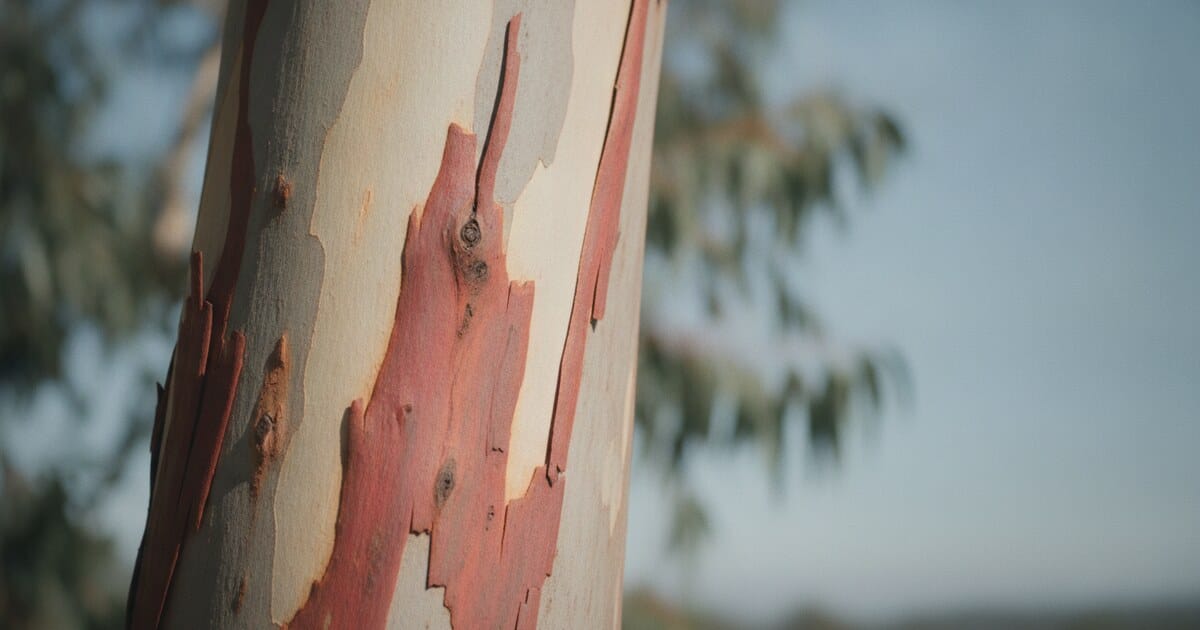
A river red gum’s mottled cream, grey and white bark is the fastest field identifier. The trunk sheds in short flakes year-round, revealing patches of pink and red beneath smooth outer surfaces. Leaves are lance-shaped, slightly curved, and dull grey-green on both surfaces. Flower buds appear in clusters of 7 to 9, with white blooms opening December through February.
What Does a River Red Gum Look Like?
The river red gum is a large tree with a heavy, spreading crown and often twisted, muscular branches. Open-grown specimens build broad, irregular crowns; trees crowded along a riverbank grow taller and narrower, reaching 15 to 20 metres before branching. Mature trunks are stout and sometimes buttressed at the base.
Height ranges from 12 to 45 metres depending on water availability and age. Trees on reliable floodplains near the Murray-Darling Basin regularly push past 30 metres.
Eucalyptus camaldulensis belongs to family Myrtaceae and is the most widely distributed of all eucalypts, occurring in every mainland Australian state. Five subspecies are recognised based on bud shape, juvenile leaf waxiness and venation: subsp. camaldulensis (Murray-Darling Basin), subsp. obtusa (tropical north), subsp. acuminata (northeastern Australia), subsp. simulata (tropical Queensland), and subsp. subcinerea (semi-arid interior). Height ranges from 12 to 45 metres. Trees live up to 1,000 years and tolerate flooding for 2 to 4 years without dying. Timber density runs approximately 900 kg/m³. The species grows in regions receiving 250 to 600 mm of annual rainfall but survives on as little as 150 mm or as much as 1,250 mm. River red gums are the most widely planted eucalyptus in arid and semi-arid regions globally, valued for timber, honey production and shade on degraded rangeland.
River Red Gum Bark: The Fastest Field Identifier
The bark is what distinguishes this tree at a glance. A river red gum’s trunk is smooth and continuously mottled in cream, white, grey, and patches of pink to deep red. The colours shift as the outer bark peels away in short ribbons and irregular flakes throughout the year, uncovering fresh pale surfaces beneath.
Near the base, older trees carry a short skirt of rougher, fibrous bark before the smooth section takes over higher up. This transition sits low on the trunk, typically within the first metre. Above it, the smooth mottled bark continues all the way into the larger branches.
The mottling pattern separates river red gum from spotted gum (Corymbia maculata), which has a similarly smooth trunk but with a dimpled or pitted surface texture rather than flowing colour patches. Paperbark melaleuca trees also shed bark, but those layers are thick, papery white sheets rather than tight, multicoloured flakes.
Leaves, Flowers and Fruit
Adult leaves are lance-shaped and slightly curved, measuring roughly 7 to 22 cm long and 0.7 to 2.5 cm wide. Both surfaces carry the same dull grey-green colour. This sets river red gum apart from species with a paler or hairy leaf underside. Crushed leaves release the classic eucalyptus oil scent.
Flower buds sit in clusters of 7 to 9 on a flattened stalk. The buds are beak-shaped, with a pointed operculum (the cap that splits off at flowering). That beak shape is the clearest way to separate river red gum from Blakely’s Red Gum (E. blakelyi), whose buds have a blunt, cone-shaped cap. Flowers open white to cream from December through February. Heavy flowering only happens every 2 to 3 years, triggered by seasonal conditions rather than a fixed calendar.
Fruit are hemispherical to cup-shaped woody capsules, 5 to 10 mm wide. Three to four seed valves extend above the capsule rim, a reliable secondary ID mark. Seeds are tiny at around 700 per gram, with optimum germination at approximately 35°C on bare moist silt.
River Red Gum vs Similar Species
Three trees cause the most confusion for people working through Australian eucalypts:
Blakely’s Red Gum (E. blakelyi): Overlaps through inland NSW and southern Queensland. The bud shape settles it: Blakely’s has blunt, conical opercula, while river red gum’s are distinctly beak-shaped (pointed). Blakely’s also stays smaller, generally under 20 metres.
Spotted Gum (Corymbia maculata): Both trees have smooth, mottled trunks, but spotted gum’s bark develops a dimpled or pitted texture during shedding (December to February). The colour patches on spotted gum appear in smaller, more angular spots rather than the flowing bands of river red gum. Spotted gum also prefers dry sclerophyll slopes and ridges rather than floodplains — habitat separates them before you even check the bark.
Grey Box (E. microcarpa): Often grows on drier ridges and slopes directly adjacent to river red gum floodplains. Grey box keeps rough, fibrous bark all the way up the trunk. There’s no smooth upper section, making the two hard to confuse once you know what to look for.
Location alone filters out many lookalikes. A smooth mottled trunk on an inland Australian riverbank or floodplain points strongly to river red gum before you check a single leaf.
Where River Red Gums Grow
River red gum follows Australia’s inland river network like a line on a map. The species lines the Murray, Darling, Murrumbidgee, Lachlan, and hundreds of smaller inland rivers through Western Australia, South Australia, Victoria, New South Wales, Queensland and the Northern Territory.
The tree needs periodic inundation. Seedlings establish on bare mud left by receding floodwaters, and established trees rely on floods recharging soil moisture around their roots. They handle flooding for 2 to 4 years at a stretch, but permanent submersion eventually kills them.
Rainfall across river red gum country typically falls in the 250 to 600 mm band, with average temperatures swinging from lows of 3 to 15°C to highs of 27 to 40°C seasonally. The arid interior subspecies (subcinerea) pushes into country receiving as little as 150 mm per year, surviving on river-run water rather than direct rainfall.
Wildlife, Timber and Indigenous Uses
Old river red gums develop hollow limbs and trunks that support a wide slice of Australia’s woodland wildlife. Sulphur-crested cockatoos, powerful owls and gang-gang cockatoos nest in deep hollows. Common brushtail possums use smaller cavities for daytime shelter. Koalas feed on the leaves in parts of the species’ range, particularly along the Murray River.
The flowers are a significant honey source. River red gum honey is harvested commercially in Victoria and South Australia during the irregular but heavy flowering events.
Timber from river red gum is dense (approximately 900 kg/m³) and deep red in colour, with an interlocked grain that can be tricky to work but polishes to a high finish. It’s classified as Durability Class 1 for above-ground applications and has a long history in railway sleepers, bridge piers, fence posts and flooring. Indigenous Australians carved canoes, shields and coolamons (water-carrying vessels) from the timber. Bark and leaves were used medicinally, and the flowers provided sugary nectar eaten directly from the blossom.
The banksia and wattle tree occupy different ecological niches across Australian bush, but river red gum dominates where water meets dry country, making it one of the most ecologically pivotal trees on the continent.
Identifying River Red Gum with Tree Identifier
Photographing the bark, leaves and buds in a single session gives the Tree Identifier app the best chance of a clean species confirmation. Take one shot of the mottled trunk, then a close-up of a leafy branchlet showing both surfaces. If buds or fruit are visible, photograph those too — bud shape is a strong ID signal. The app handles multiple input types (leaves, bark, fruit) and works in offline mode on remote floodplain walks where mobile signal is unreliable.
Frequently Asked Questions
How can I tell a river red gum from other eucalypts?
Check the bark first: smooth, mottled cream to red, shedding in short flakes with no rough fibrous section on the upper trunk. Then check the flower buds, which are beak-shaped (pointed operculum) in groups of 7 to 9. Combined with a riverbank or floodplain location in inland Australia, those two features point directly to river red gum.
How long do river red gums live?
River red gums are among the longest-lived eucalypts, reaching 500 to 1,000 years in undisturbed floodplain environments. Age is difficult to confirm without core sampling because the heartwood often rots out, leaving hollow trunks that still support a full, healthy canopy for centuries.
Are river red gums protected?
River red gum woodlands are listed as threatened ecological communities in Victoria, NSW and South Australia, where clearing and river regulation have reduced old-growth stands significantly. Individual trees on private land may carry protection under state native vegetation laws. Check with your state’s environment agency before cutting or clearing.
What animals live in river red gums?
Hollow-bearing river red gums support sulphur-crested cockatoos, powerful owls, gang-gang cockatoos, common brushtail possums and micro-bats. Koalas feed on the leaves in parts of the Murray-Darling region. Flowers attract honeyeaters, lorikeets and commercially managed honeybees.
Can river red gum survive flooding?
Yes. River red gums tolerate submersion for 2 to 4 years, which is exceptional among eucalypts. Periodic flooding is part of their life cycle — seedlings establish on bare silt left by receding floodwaters, and adult trees rely on floods to recharge deep soil moisture. Permanent waterlogging will eventually kill them, but seasonal flooding is what they’re built for.
Identify a tree from your photo — free
Upload a leaf, bark, or whole-tree photo and get the species in seconds. No signup.
Confidence:
Unlock the full species profile
Free in the app — with unlimited identifications.


AI result for guidance — the app gives full species details and works offline.
Want unlimited identifications?
Get the full species profile, photos and details — free in the app, with unlimited scans.
- Unlimited identifications
- Full species profiles & details
- Works offline, anywhere
- Save and revisit your finds
Elena Torres
Tree Identifier Team