Casuarina Tree Identification: Leaves, Bark & Cones
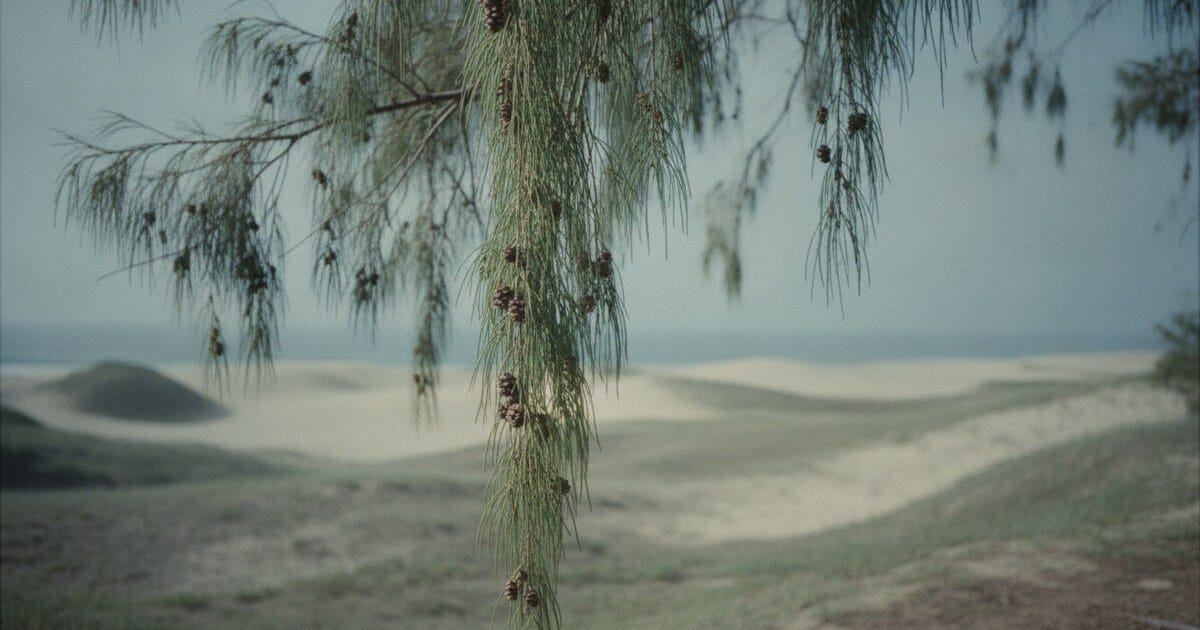
Casuarina trees puzzle first-time observers almost every time. The drooping gray-green branchlets look like pine needles. The woody fruits look like tiny pine cones. The bark is rough and fibrous, just like many conifers. Yet casuarinas aren’t conifers at all. They’re flowering plants that evolved to look remarkably like one, and once you know the real ID features, including the jointed stems, the whorled scale teeth, and the distinctive cone bracteoles, casuarinas become unmistakable in the field. This guide covers every key identification feature, walks through Australia’s main casuarina species, and explains how to tell a Casuarina from the closely related Allocasuarina.
Casuarina trees are identified by their jointed, needle-like photosynthetic branchlets, tiny scale-like leaves reduced to tooth-like whorls at each stem joint, and woody cone-like fruits containing winged seeds. They belong to the family Casuarinaceae, not the pine family, and include 17 species worldwide with 6 found in Australia.
What Does a Casuarina Tree Look Like?
From a distance, a casuarina looks like a weeping pine or a droopy spruce. The silhouette is loose and feathery rather than dense and stiff. Branches spread upward and outward from a stout trunk while the fine branchlets hang down like a curtain, moving easily in coastal breezes.
Up close, those “needles” turn out to be something different. Each slender branchlet is jointed, snapping apart cleanly at each node when bent. The actual leaves are reduced to tiny whorls of scale-like teeth ringing each joint, between 5 and 20 per whorl depending on species. The branchlets themselves do all the photosynthesis, turning gray-green in open sun or a deeper green in sheltered spots.
The Casuarinaceae family contains 4 genera and approximately 91 species across Australia, Southeast Asia, Malaysia, and Polynesia. The genus Casuarina holds 17 species, with 6 naturally occurring in Australia. Closely related Allocasuarina is endemic to Australia and comprises 61 species, ranging from small shrubs to forest trees reaching 30m. Together these two genera cover most of what Australians call “she-oaks,” named for the resemblance of their dense timber to that of European oak. Australia supports 1.3 million hectares of Casuarina forest type. Branchlets run 4-8 inches (10-20cm) long and roughly 0.5-1mm in diameter, arranged in whorls. Male trees produce catkin-like strobili; female trees produce small ovoid structures with vivid red filamentous pistils before setting woody cones. The plants are wind-pollinated and form nitrogen-fixing root nodules, which is unusual in non-legumes and a key reason casuarinas colonize nutrient-poor coastal sands so effectively.
The bark on mature casuarinas is brown, rough, and fibrous, exfoliating in longitudinal strips and giving the trunk a shaggy, layered texture. Younger stems stay smoother and gray. Casuarina cunninghamiana (river she-oak) develops distinctly fissured, blocky bark with age, while C. equisetifolia (beach she-oak) tends toward rougher, more regularly peeling strips.
Casuarinas share Australia’s coastal landscapes with other iconic natives. Banksia trees occupy similar sandy coastal habitats, and like casuarinas, they’ve adapted to nutrient-poor soils through specialized root systems.
Casuarina Identification by Branchlets and Leaf Teeth
The branchlets are the primary identification feature, and the leaf teeth at each joint are the most precise diagnostic tool in the field.
Each joint on a casuarina branchlet has a ring of tiny scale teeth, the vestigial leaves. Counting them separates species confidently, though you’ll need good light or a hand lens.
- C. cunninghamiana: 7-10 teeth per whorl, sharply pointed, with a brown ring about halfway along each tooth
- C. equisetifolia: 6-8 teeth per whorl, slightly shorter segments (about 6mm / one-quarter inch each)
- C. glauca: 12-17 teeth per whorl, branchlets often with a glaucous (blue-gray) cast in full sun
To count the teeth, break a fresh branchlet at a joint and examine the circular ring under good light. A phone macro camera works well if you don’t have a hand lens.
All casuarina species droop to some degree, but C. cunninghamiana branchlets hang more loosely and move more freely than those of C. equisetifolia, which are slightly stiffer. C. glauca often shows that blue-gray cast most clearly on new growth.
Run a handful of branchlets through your fingers and there’s no prickling, unlike actual pine needles. They feel more like bunches of fine wire than a spruce spray, which is a useful first-contact ID clue when you’re not sure what you’re looking at.
Cones and Seeds: The Key Second Feature
Casuarina fruit look like tiny pine cones but they’re built differently. They’re composed of woody bracteoles fused around winged nutlets, not true cone scales.
Cone size by species:
- C. equisetifolia: cones roughly 1-2cm long, oval to nearly round
- C. cunninghamiana: cones slightly smaller, fewer per cluster than equisetifolia
- C. glauca: cones 12-18mm, often carried in larger clusters along the branchlets
On Casuarina species, the bracteoles extend visibly beyond the cone body, giving the cone a slightly bristly or spiky edge. This is one of the clearest differences from Allocasuarina, where the bracteoles stay flush with or recessed below the cone surface.
Each cone releases dozens of winged nutlets (samaras) when the segments separate on hot dry days. The wings are grey to yellowish-brown and relatively dull, not shiny. Old woody cones often persist on the tree for months after releasing their seeds, so finding empty cones attached to drooping branchlets is a reliable year-round ID clue.
Common Casuarina Species in Australia
Casuarina cunninghamiana (River She-Oak)
The tallest species in the genus, reaching 30m on good river-bank soils. C. cunninghamiana grows along freshwater rivers and streams across Queensland, New South Wales, and Victoria, forming dense riparian stands that stabilize banks and reduce erosion. The bark on mature trees is fissured and blocky. It’s dioecious, so male and female flowers grow on separate trees. The 7-10 sharply pointed leaf teeth with a brown midpoint ring are the most reliable field ID feature.
Casuarina equisetifolia (Beach She-Oak)
The most globally distributed casuarina, found on coastal dunes and beaches from Myanmar through Southeast Asia to Australia and Polynesia. In Australia it appears on tropical and subtropical coastlines in Queensland and the Northern Territory. Unlike C. cunninghamiana, it’s monoecious (both male and female on the same tree). Cones are about 1-2cm, branchlet segments about 6mm, with 6-8 leaf teeth. It’s invasive in Florida, Hawaii, and parts of the Caribbean, where it displaces native vegetation on coastal dunes.
Casuarina glauca (Swamp She-Oak)
Tolerates brackish to nearly saline soils along estuaries and coastal lowlands in Queensland and New South Wales. The glaucous branchlets and higher tooth count (12-17 per whorl) distinguish it from the other coastal species. It’s moderately dioecious and often forms dense thickets along tidal creek banks where few other tree species can establish.
Australia’s she-oaks occupy similar ecological niches to other fire-adapted coastal natives. Grevillea and lilly pilly trees also thrive in the sandy coastal soils where C. equisetifolia is most common.
Casuarina vs Allocasuarina: What’s the Difference?
Both genera look alike in the field, and Australians routinely call both “she-oaks.” The split matters for precise identification and plant sourcing, because Allocasuarina are endemic to Australia while Casuarina species range across Asia and the Pacific.
| Feature | Casuarina (17 spp) | Allocasuarina (61 spp) |
|---|---|---|
| Range | SE Asia, Pacific, Australia | Australia only |
| Bracteoles on cone | Extend beyond cone body | Flush with or below cone |
| Dorsal protuberances | Absent | Present on bracteoles |
| Growth form | Trees only | Trees and shrubs |
| Samara color | Grey to yellowish-brown, dull | Often darker |
In practice: if you’re in inland Australia and find a she-oak that’s more of a shrub, it’s almost certainly Allocasuarina. On a coastal beach or a large river bank, Casuarina is the more likely genus. A hand lens showing bracteoles extending past the cone body confirms Casuarina.
The common name “she-oak” references the timber’s density. The wood is heavier and harder than most Australian softwoods but considered slightly softer than European oak, hence the “she” qualifier. It’s also called ironwood and beefwood in different regions.
How Tree Identifier Can Help
Casuarina branchlets and Allocasuarina branchlets look nearly identical to the naked eye in the field. Getting the genus right from a photo comes down to cone structure, and that’s where a photo ID tool earns its keep.
Tree Identifier’s AI reads branchlet texture, cone shape, bark pattern, and overall growth form from your photo, cross-checking across thousands of species entries to return an identification with a confidence score. You can submit the cone photo, a branchlet close-up, and a bark shot as separate inputs to build a more confident ID.
The app works offline, so it runs on remote coastal walks and river-bank surveys without cell service. Download Tree Identifier on the App Store or try the free browser tool at treeidentifier.app/tools/tree-identifier.
Frequently Asked Questions
Is casuarina a pine tree?
Casuarina is a flowering plant in the family Casuarinaceae, not a member of the pine family Pinaceae. Despite the needle-like branchlets, woody cones, and conifer-like silhouette, casuarinas are more closely related to oaks, beeches, and walnuts than to pines. The common name “Australian pine” is a misnomer based purely on appearance.
What is the difference between Casuarina and she-oak?
“She-oak” is a common name covering both genera in the family Casuarinaceae: Casuarina (17 species, 6 in Australia) and Allocasuarina (61 species, all endemic to Australia). Every casuarina is a she-oak, but most Australian she-oaks are Allocasuarina. The name references the timber’s density, similar to European oak but slightly softer.
Can casuarina fix nitrogen?
Yes. Casuarina trees form root nodules housing nitrogen-fixing bacteria (Frankia), similar to the nodules of legumes. This lets them colonize nutrient-poor soils like coastal sands and river gravels where few other trees establish. It’s one reason casuarinas are planted in coastal dune restoration projects across Australia and Southeast Asia.
How do you tell casuarina species apart?
Count the leaf teeth at a branchlet joint under a hand lens. C. cunninghamiana has 7-10 sharply pointed teeth with a brown midpoint ring. C. equisetifolia has 6-8 shorter teeth on 6mm segments. C. glauca has 12-17 teeth and blue-gray branchlets. Habitat also helps confirm: river banks for cunninghamiana, sandy ocean coasts for equisetifolia, estuaries and brackish lowlands for glauca.
Are casuarina trees native to Australia?
Six Casuarina species are native to Australia, with C. cunninghamiana, C. equisetifolia, and C. glauca being the most widespread. Additionally, all 61 Allocasuarina species are endemic to Australia. Together these two genera form a distinctive part of Australia’s native flora, particularly along coastlines, estuaries, and waterways.
Identify a tree from your photo — free
Upload a leaf, bark, or whole-tree photo and get the species in seconds. No signup.
Confidence:
Unlock the full species profile
Free in the app — with unlimited identifications.


AI result for guidance — the app gives full species details and works offline.
Want unlimited identifications?
Get the full species profile, photos and details — free in the app, with unlimited scans.
- Unlimited identifications
- Full species profiles & details
- Works offline, anywhere
- Save and revisit your finds
Elena Torres
Tree Identifier Team