Bottlebrush Tree: Leaves, Flowers and Identification Guide
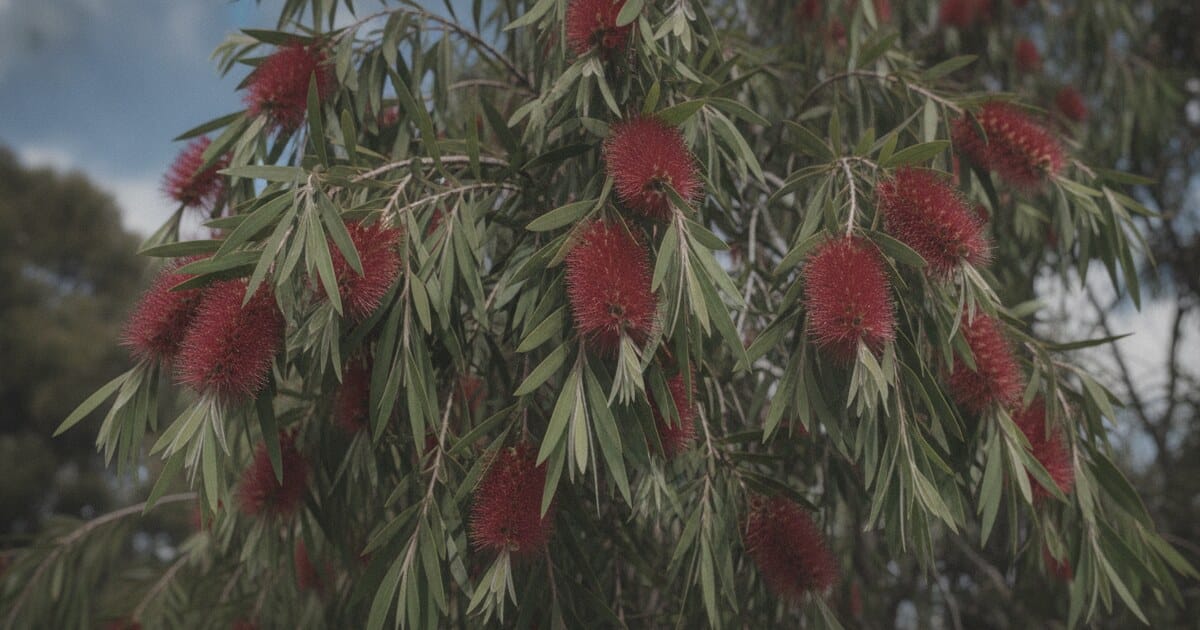
The bottlebrush tree’s flowers look exactly like what the name suggests: bright red cylindrical spikes that match the shape of a bottle brush. Those bristles aren’t petals. They’re hundreds of individual stamens, the male reproductive organs of the flower. The actual petals are tiny and drop off within days. What remains is that dense, vivid brush of color made entirely of stamen filaments.
Native to Australia and belonging to the family Myrtaceae, bottlebrush trees grow across warm climates worldwide as garden shrubs, street trees, and wildlife plants. Genus Callistemon holds roughly 40 species, all Australian natives. The flower spike is usually enough to confirm an ID in the field without anything else.
The bottlebrush tree (Callistemon) is an Australian native shrub or small tree identified by cylindrical red flower spikes made of free-standing stamens rather than petals. Spikes run 3 to 5 inches long. Mature height ranges from 6 to 25 feet depending on species. Most cultivated bottlebrushes grow in USDA zones 8 to 11.
What Does a Bottlebrush Tree Look Like?
The flower spike is the fastest identification feature. Each spike grows from a branch tip as a dense cylinder of color, typically 3 to 5 inches long. After blooming, the branch continues growing from the tip, leaving a ring of small woody seed capsules behind. Old branches accumulate years of those capsule rings spaced along their length, a feature rare on other Australian trees.
Leaves are evergreen, narrow, and lanceolate: roughly 1 to 3 inches long and under 0.5 inches wide, with a pointed tip and stiff texture. Hold a leaf up to sunlight and you’ll see small oil glands scattered across the blade, the same glands found in melaleuca and eucalyptus. Crush one and you’ll get a sharp, slightly medicinal scent.
Bark varies by species. Young stems tend to be papery or fibrous. Older trunks develop a gray-brown, furrowed texture. Weeping bottlebrush (Callistemon viminalis) has pendulous branches that arch and droop toward the ground, making it easy to separate from the more upright species at a glance.
Genus Callistemon comprises roughly 40 species, all native to Australia, concentrated along the eastern seaboard from Queensland through New South Wales and Victoria, with scattered populations in Western Australia. Most species grow below 3,300 feet elevation in wet sclerophyll forests, open woodland, and streambanks. All share three structural features: flower spikes composed of free individual stamens (not fused in bundles as in melaleuca), leaves with visible oil glands, and persistent woody seed capsules that cling to branches for years after flowering. Each spike holds 200 to 400 individual stamens packed along a central axis. The red color in those stamens comes from anthocyanins. Some higher-altitude species tolerate temperatures down to 14°F (-10°C), while most cultivated forms perform best in USDA zones 8 to 11. All Callistemon species were officially reclassified into genus Melaleuca in the 2006 botanical revision, though “Callistemon” remains the standard name in horticulture worldwide.
Bottlebrush Tree Species: Key Differences
Four species account for most bottlebrushes you’ll encounter in gardens and streetscapes.
Weeping bottlebrush (Callistemon viminalis, syn. Melaleuca viminalis) grows 15 to 25 feet tall with long, arching branches that droop at the tips. Flower spikes run 4 to 5 inches long, bright red. It’s the most widely planted species in warm climates and the one most commonly trained as a standard tree. USDA zones 8 to 11. Weeping bottlebrush is listed as invasive in Florida due to its spread into natural areas near waterways.
Crimson bottlebrush (Callistemon citrinus, syn. Melaleuca citrina) is the most cold-tolerant common species, handling zone 7 with some protection. It grows 6 to 15 feet with a denser, more upright habit. New foliage emerges reddish before hardening to green. The name citrinus comes from the lemony scent leaves release when crushed.
Lemon bottlebrush (Callistemon pallidus) produces pale yellow to cream-colored flower spikes rather than red, making it one of the simpler species to separate on sight alone. It stays compact at 6 to 10 feet and handles light frost. Useful for gardens where the red-flowering species would clash with surrounding plantings.
Stiff bottlebrush (Callistemon rigidus) has sharper, more rigid leaves than most bottlebrushes. It grows 6 to 10 feet and produces narrower red spikes. Older specimens develop a more open, airy branching structure.
The cultivar ‘Little John’ (a C. citrinus selection) stays under 3 feet, functioning more as a groundcover shrub than a tree. It’s commonly sold as a compact hedge plant.
Bottlebrush Leaves, Bark, and Seed Capsules
On all species, the leaf is narrow and lanceolate with a pointed tip and no visible leaf stalk. Leaves alternate along the stem. Standard length runs 1 to 3 inches; most species stay under 0.5 inches wide. Callistemon salignus (willow bottlebrush) runs slightly broader at up to 0.8 inches wide, with a more willow-like shape.
New growth on many species carries a silky, pinkish flush before hardening to mid-green. On crimson bottlebrush, this new growth is distinctly reddish. Leaf texture ranges from stiff to slightly leathery across the genus.
Bark on young shoots is typically reddish-brown and papery. On main stems and older trunks it becomes fibrous and gray-brown, peeling in strips on some species. Weeping bottlebrush has noticeably coarser bark than crimson bottlebrush.
The seed capsules are the feature that gives older stems their distinctive look: small, round, woody cups arranged in rings where flower spikes previously bloomed. They persist for years. On weeping bottlebrush, a branch can carry 10 or more years’ worth of capsule rings, each ring marking one flowering season. Some species have serotinous capsules that stay closed and only release seeds after heat or fire, a trait shared with several other Australian fire-adapted trees.
Bottlebrush vs Melaleuca: How to Tell Them Apart
Taxonomically the two are the same genus now. Callistemon was merged into Melaleuca in the 2006 APG III revision, with the transfer finalized in botanical literature by around 2020. Most nurseries still sell plants under Callistemon labels because the name recognition hasn’t shifted.
For field identification before you check a label, the stamen structure is the key test. Bottlebrush stamens are free and individually separate along the full length of the spike. Melaleuca stamens are fused at the base into 5 distinct bundles: look closely at a melaleuca flower and you’ll see clusters of stamens rather than individual filaments. This difference holds even between closely related species in the same genus.
Both share the same family (Myrtaceae), oil-gland leaves, woody persistent seed capsules, and Australian origins. The bark on many melaleuca species is more papery and layered (the paperbark group) compared to the fibrous-striping pattern typical of bottlebrush trunks.
For a full side-by-side comparison of bark textures and stamen structure, see the guide to melaleuca tree identification.
How Big Does a Bottlebrush Tree Get?
Size depends heavily on species and management.
Weeping bottlebrush (C. viminalis) left unpruned reaches 15 to 25 feet with a spread of 10 to 15 feet. Crimson bottlebrush (C. citrinus) stays shorter at 6 to 15 feet. Compact cultivars like ‘Little John’ stay under 3 feet.
Most species respond well to pruning immediately after flowering. Cut back by about one-third of the current season’s growth once the flowers fade. Cutting into older wood with no foliage risks killing that branch: bottlebrush doesn’t regenerate reliably from bare old wood. Regular light pruning after each bloom cycle keeps the plant compact and encourages more spikes the following season.
In the warmest USDA zones (10 to 11), fast-growing specimens can add 3 to 4 feet per year during their first few seasons before settling into slower growth. Plants in poor sandy soils typically stay at the lower end of their height range compared to the same species in richer conditions.
Bottlebrush trees are drought-tolerant once established, salt-tolerant, and perform best in full sun. Multiple bloom cycles per year in warm climates mean extended wildlife value across the seasons. The banksia genus, another Australian native, shares many of the same wildlife-attracting and fire-adapted traits in similar coastal and sclerophyll habitats.
Identify Bottlebrush with Tree Identifier
Bottlebrush and its close Myrtaceae relatives share enough leaf and bark features that photo ID can be tricky, even for experienced gardeners. The Tree Identifier app identifies trees from photos of leaves, flowers, bark, or the whole tree and can distinguish bottlebrush species from closely related genera. Two free identifications daily, no subscription required to start. A web-based tool is also available at /tools/tree-identifier for in-browser ID without downloading the app.
Frequently Asked Questions
What are the disadvantages of bottle brush trees?
The main drawbacks are invasiveness in warm, humid climates (weeping bottlebrush is listed invasive in Florida), frost sensitivity below zone 7 for most species, susceptibility to scale insects and borers when stressed, and messy seed capsule and flower debris. They also don’t regenerate readily from old wood after heavy pruning.
How big do bottle brush trees get?
Most garden bottlebrush species reach 6 to 25 feet tall. Weeping bottlebrush (Callistemon viminalis) is the tallest common species at 15 to 25 feet. Crimson bottlebrush (C. citrinus) stays 6 to 15 feet. The compact cultivar ‘Little John’ stays under 3 feet.
Can you cut back a bottlebrush tree?
Yes, prune immediately after flowering by cutting back about one-third of the current season’s growth. Don’t cut into old, leafless wood: bottlebrush doesn’t reliably regrow from bare wood and the branch may die back. Regular light pruning after each bloom cycle keeps the plant compact and encourages repeat flowering.
What are the benefits of a bottle brush tree?
Bottlebrush trees attract hummingbirds, bees, and butterflies. They’re drought-tolerant once established, salt-tolerant, and perform well in poor soils. Evergreen foliage provides year-round screening. In warm climates, most species bloom multiple times per year, providing extended color and wildlife habitat.
Is bottlebrush native to Australia?
Yes. All roughly 40 Callistemon species are native to Australia, concentrated along the eastern seaboard from Queensland through Victoria. They grow naturally in open woodland, wet sclerophyll forest, and along creek banks. The genus was merged into Melaleuca in botanical classification in 2006, though “Callistemon” remains the standard horticultural name.
Identify a tree from your photo — free
Upload a leaf, bark, or whole-tree photo and get the species in seconds. No signup.
Confidence:
Unlock the full species profile
Free in the app — with unlimited identifications.


AI result for guidance — the app gives full species details and works offline.
Want unlimited identifications?
Get the full species profile, photos and details — free in the app, with unlimited scans.
- Unlimited identifications
- Full species profiles & details
- Works offline, anywhere
- Save and revisit your finds
Elena Torres
Tree Identifier Team