Kurrajong Tree: Leaves, Flowers and Identification Guide
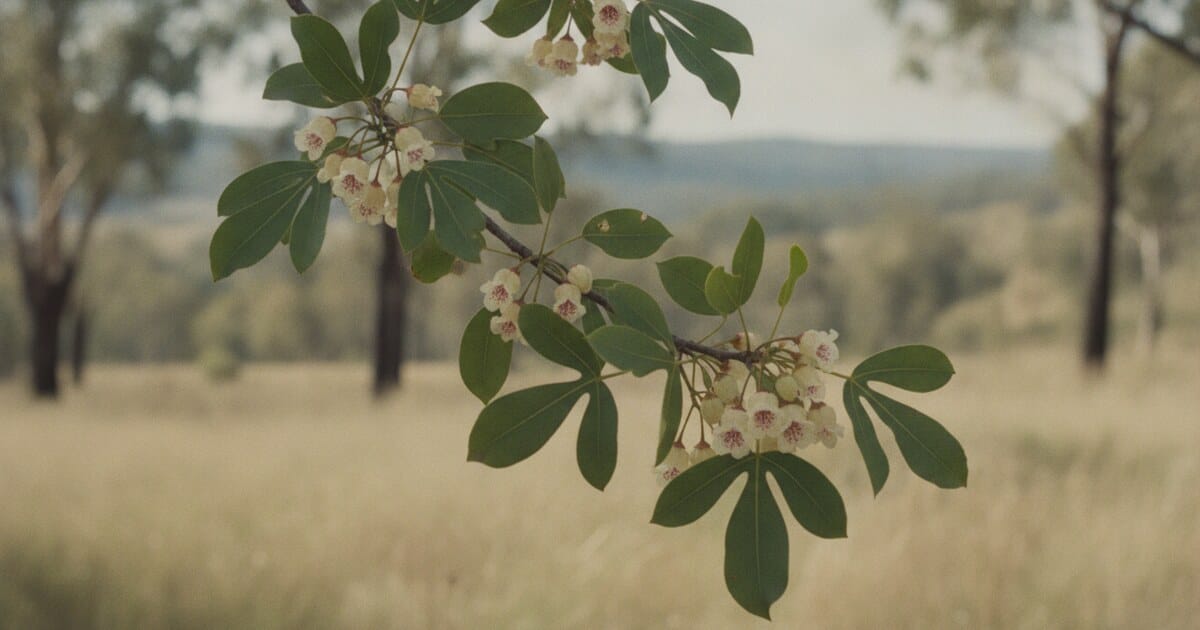
The kurrajong tree (Brachychiton populneus) is one of Australia’s most recognizable natives, but it’s also one of the trickiest to identify from leaves alone. On a single tree you’ll find simple oval leaves sitting right next to leaves with 3, 4, or even 5 deep lobes. Beginners often assume they’re looking at two different species. Add the ongoing confusion between kurrajong and the Queensland bottle tree, and it’s easy to see why this tree trips people up. This guide covers every identification feature you need, from bark and flowers to seed pods, along with how kurrajong grows and its long history of traditional use.
Kurrajong (Brachychiton populneus) is a drought-tolerant Australian native that grows 10-20 meters tall. It’s identified by leaf polymorphism: one tree produces both simple oval leaves and 3-5 lobed leaves simultaneously. Spring flowers are small and bell-shaped, white to cream with pink-red speckles inside the corolla. The boat-shaped woody seed pods contain yellow seeds covered in fine irritating hairs.
Kurrajong Tree Identification: Leaves, Bark, and Flowers
Leaf variability is the first thing to understand about kurrajong identification. A single tree produces leaves in completely different shapes at the same time. Simple ovate leaves (5-10 cm long, glossy green) grow on the same branches as leaves with 3-5 prominent lobes. This isn’t a disease sign or a stress response; it’s a normal feature of the species, and it’s the most reliable single character for field identification.
Native to the semi-arid inland regions of eastern Australia, the kurrajong (Brachychiton populneus) reaches 10-20 meters tall and 5-10 meters wide at full maturity. One of its most unusual traits is this leaf polymorphism: the same tree simultaneously produces simple oval leaves (5-10 cm, glossy green) and palmately lobed leaves with 3-5 lobes. Bark starts smooth and grey-green on young trees, developing a furrowed grey texture over decades. Flowers are bell-shaped, 1-2 cm wide, white to cream with pink-red speckling inside the corolla. The boat-shaped seed capsules, 1-7 cm long, contain yellow seeds encased in fine irritating hairs. Growth is slow to moderate; established trees are frost-tolerant to near freezing and survive on annual rainfall as low as 250 mm. The species has been widely planted as a street tree across Australia and in parts of the American Southwest, South Africa, and the Mediterranean.
Bark changes noticeably as the tree ages. On young trees it’s smooth and greenish-grey. Older specimens develop a furrowed, darker grey texture. The trunk is thick and cylindrical, occasionally swelling slightly toward the base on very old trees, which is part of where the bottle tree comparison comes from.
Flowers appear in spring and early summer (October to December in Australia). They form small bell-shaped clusters, cream to white with distinctive pink-red spotting inside the corolla tube. The flowers often appear on branches that are partly bare, which makes them conspicuous against the sky.
Seed pods are the clearest identifier at close range. They’re boat-shaped woody capsules, 1-7 cm long, that turn dark brown to nearly black when ripe. Each pod holds yellow seeds surrounded by fine, irritating hairs. Wear gloves if you’re handling them; those hairs lodge in skin easily.
Kurrajong vs Bottle Tree: Two Names, Two Species
The most common question about kurrajong is whether it’s the same as the bottle tree. The answer is no, but they’re close relatives.
Kurrajong (Brachychiton populneus) has a straight cylindrical trunk and grows across a wide range from Queensland down into New South Wales and Victoria, extending inland into semi-arid regions. The Queensland bottle tree (Brachychiton rupestris) has the swollen, barrel-shaped trunk the name describes, and it’s found in a tighter range of central Queensland.
Both belong to the same genus (Brachychiton) and share similar flowers and seed pods, which is the main source of confusion. Trunk shape is the most reliable distinction in the field: kurrajong trunks stay cylindrical throughout their life, while bottle tree trunks bulge dramatically at the middle and taper toward the top. Young specimens of both species look similar before that trunk character develops, which is where most of the mix-ups happen.
About 30 Brachychiton species grow across Australia, including the illawarra flame tree (Brachychiton acerifolius) with its vivid red flowers and the bottlebrush tree, which also has ornamental flowers and is widely used as a street tree. Kurrajong is the most widely distributed member of the genus. Our Australian native trees guide covers the full range of species you’re likely to encounter in the field.
How Big Does a Kurrajong Tree Grow?
Mature kurrajong trees reach 10-20 meters in height with a canopy spread of 5-10 meters. Street-planted trees in Australian cities often stay on the smaller end due to root restrictions and periodic pruning.
Kurrajong is semi-evergreen. In most climates it holds its foliage year-round, but it can shed some leaves during extended drought or cold periods. In its natural semi-arid habitat, partial leaf drop in dry spells is entirely normal; the tree recovers quickly when rain returns.
Growth is slow to moderate, particularly in the first few years while the root system develops. Once established, growth picks up, but significant trunk development takes years rather than months. Gardeners who want mature character have to plan ahead: a kurrajong planted today will provide good shade in 5-7 years and a genuinely architectural specimen by 15-20 years.
For planting purposes, allow a minimum of 5 meters clearance from structures. The root system is deep rather than aggressively spreading, but the eventual canopy spread of 5-10 meters needs room.
Growing Kurrajong: Sun, Soil, and Water
Kurrajong’s natural range in semi-arid inland eastern Australia tells you exactly what it prefers.
Sun: Full sun with 5 or more hours of direct light daily. It tolerates light afternoon shade but won’t reach its best form without an open, sunny position.
Soil: Sandy loam or loamy soil with good drainage. Kurrajong is highly susceptible to root rot in waterlogged conditions. Poorly drained clay soil is the one reliable way to kill a kurrajong. If you’re planting in clay, raise the bed or mix in grit before planting.
Water: Very drought tolerant once established, due to a deep taproot that accesses moisture well below the surface. Newly planted trees need regular watering for the first season. After establishment, deep monthly watering through summer is plenty in most climates. Mature trees in their natural range survive on 250-400 mm of rain per year.
Temperature: Hardy to near 0°C once established. Young trees are more cold-sensitive and should be protected during their first winter in colder climates. Kurrajong grows well in USDA hardiness zones 9-11, which covers coastal and inland California, southern Arizona, and similar Mediterranean and semi-arid climates.
Fertilizing isn’t necessary for established trees. A balanced slow-release fertilizer in spring can speed growth in young trees, but overfeeding produces soft, fast growth that’s more susceptible to frost.
Traditional Uses of Kurrajong Tree
Indigenous Australians used almost every part of the kurrajong, and the tree was considered one of the more valuable plants in the semi-arid interior.
The long taproot was dug up and eaten, particularly in times of drought. The fleshy taproot of young trees holds significant moisture, making it a survival food and water source in arid conditions. Seeds from the woody pods were roasted and eaten as a protein-rich snack or ground into flour. Research from the University of Sydney found kurrajong seeds contain approximately 25% fat and 18% protein, yielding about 348 calories per 100 grams. That’s roughly two-thirds the caloric density of peanuts, and substantially higher in protein than most native seeds.
Bark fiber was another key resource. Aboriginal groups across eastern Australia stripped kurrajong bark and spun the fibers into strong cordage, which was then woven into fishing nets, carrying bags, and twine. Kurrajong fiber is long and strong, making it one of the more practical fiber plants in inland regions where softer fiber plants aren’t available.
The gum that oozes from bark wounds was used medicinally by some groups for wound treatment and as an emergency food.
For modern gardeners and foragers, the seeds are edible after thorough roasting and careful removal of the irritating seed hairs. They have a mild, nutty flavor and have been documented as a reasonable coffee substitute when roasted and ground, though the taste is quite distinct.
How to Identify a Kurrajong Tree With Your Phone
In the field, leaf polymorphism is your fastest starting point. Look for a tree with both simple oval leaves and deeply lobed leaves growing on the same branches. That combination points almost exclusively to kurrajong among Australian native species.
For the seed pods: the boat-shaped woody capsules with yellow seeds inside are highly distinctive once you’ve seen them. The irritating hairs in the pod are noticeable if you handle them without gloves, which is another confirmation.
If you want an instant identification, the Tree Identifier app handles kurrajong from a photo of its leaves, bark, or seed pods. Photograph a leaf in clear light and the app returns species confirmation with a confidence score and detailed information about the tree. It works offline as well, so it’s useful on remote property walks or hikes in the inland where cell coverage is patchy.
Frequently Asked Questions
Is a kurrajong tree the same as a bottle tree?
No. Kurrajong (Brachychiton populneus) and the Queensland bottle tree (Brachychiton rupestris) are separate species in the same genus. The clearest distinction is trunk shape: kurrajong trunks are cylindrical, while the bottle tree has a dramatically swollen, barrel-shaped trunk. Both species have similar flowers and seed pods, which is the main source of confusion.
How big does a kurrajong tree get?
Mature kurrajong trees reach 10-20 meters tall with a canopy of 5-10 meters wide. Street-planted trees are usually smaller from pruning. Growth is slow to moderate; the tree develops its most distinctive character over 10-20 years.
Do kurrajong trees lose their leaves?
Kurrajong is semi-evergreen. It holds its leaves through most of the year but can shed some foliage during extended drought or cold periods. Partial leaf drop in dry conditions is normal behavior for the species, and regrowth follows when water becomes available.
Are kurrajong seeds edible?
Yes, after preparation. Aboriginal Australians roasted them and removed the irritating seed hairs before eating. University of Sydney research puts the nutritional value at roughly 25% fat and 18% protein, yielding 348 calories per 100 grams. Handle the raw seed capsules with gloves; the fine hairs inside are irritating to skin and eyes.
Where does kurrajong grow naturally?
Kurrajong is native to eastern Australia, primarily Queensland, New South Wales, and Victoria, in semi-arid inland regions. It’s been planted widely as a street tree throughout southern and eastern Australia and in similar climates overseas including California, Arizona, South Africa, and parts of the Mediterranean.
If you spot a kurrajong on a bush walk or around your property and want to confirm the ID, the Tree Identifier app can sort it out from a single photo. Take a clear shot of the leaf, bark, or seed pod, and the app returns species confirmation with details on habitat, properties, and identification markers. Two free identifications per day with no account needed. Download on iOS or try the free web tool in your browser.
Identify a tree from your photo — free
Upload a leaf, bark, or whole-tree photo and get the species in seconds. No signup.
Confidence:
Unlock the full species profile
Free in the app — with unlimited identifications.


AI result for guidance — the app gives full species details and works offline.
Want unlimited identifications?
Get the full species profile, photos and details — free in the app, with unlimited scans.
- Unlimited identifications
- Full species profiles & details
- Works offline, anywhere
- Save and revisit your finds
Elena Torres
Tree Identifier Team