Norfolk Island Pine: Bark, Leaves and Identification Guide
The name misleads. Norfolk Island pine belongs to Araucariaceae, an ancient conifer family that first appeared over 200 million years ago, not to Pinaceae, the true pine family. It shares its lineage with the monkey puzzle tree and the Wollemi pine, not with radiata or Scots pine. Spotting one is simple: few trees anywhere produce such a precise conical outline, with horizontal branch tiers spaced as evenly as rungs on a ladder. Knowing what you’re actually looking at, how its bark and foliage work, and how it differs from the Cook pine planted beside it in parks across Queensland and Hawaii, takes a closer look. This guide covers all of that.
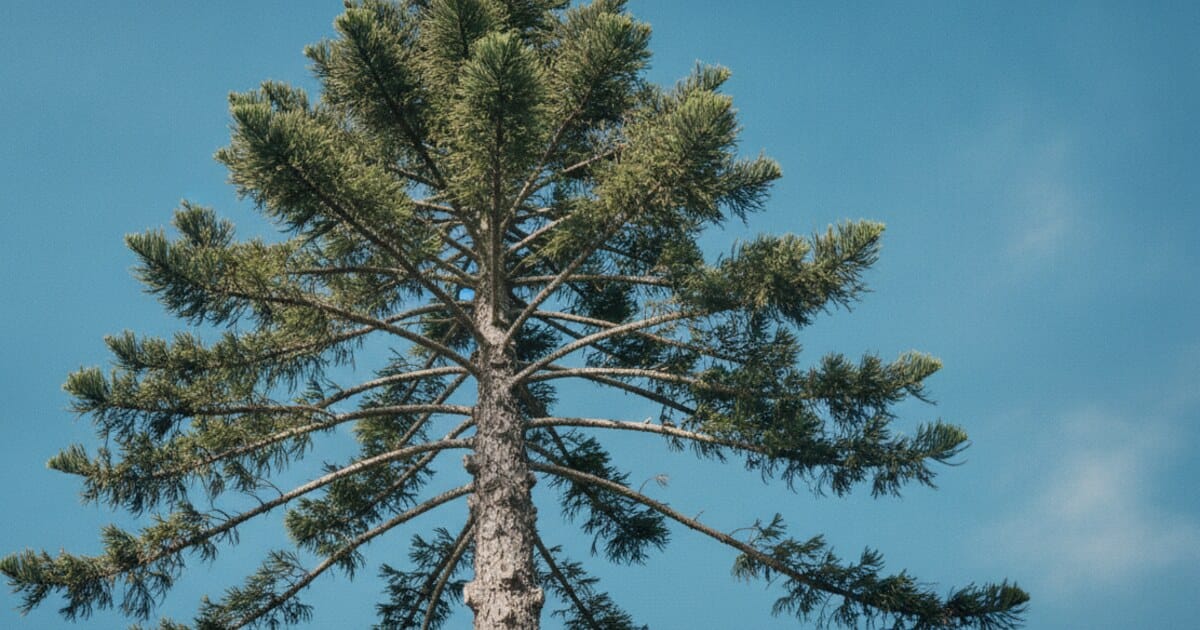
Norfolk Island pine (Araucaria heterophylla) is identified by its symmetrical conical crown, horizontal branches in whorls of 4 to 7 per level, and gray-brown bark that flakes in fine scales. Its foliage is dimorphic: juvenile trees carry awl-shaped needles to 12 mm, while adult leaves are denser and scale-like at 4 to 5 mm.
Not a True Pine: Taxonomy and Origin
Norfolk Island pine belongs to Araucariaceae, not Pinaceae. That matters for field identification because it means none of the structural features of true pines apply here: no needle bundles in fascicles, no long resinous cones, no deeply furrowed bark saturated with sap. Its closest relatives are the monkey puzzle tree (Araucaria araucana) of South America and the Cook pine (Araucaria columnaris) of New Caledonia. The Wollemi pine, discovered in a Blue Mountains canyon in 1994, belongs to the same family.
Norfolk Island pine (Araucaria heterophylla) is endemic to Norfolk Island, a 35-square-kilometre Australian external territory in the South Pacific at roughly 29 degrees south latitude. The Araucariaceae family first appeared in the Triassic period, over 200 million years ago, making them far older than Pinaceae. The genus Araucaria now spans South America, the Pacific, and Australasia. Wild heterophylla populations on Norfolk Island are listed as Vulnerable on the IUCN Red List; farming, invasive plant species, and decades of land clearing have reduced the natural forest significantly. Captain James Cook recorded the trees during his 1774 voyage and assessed them as potential ship mast timber. The wood proved too brittle under stress and large-scale logging was abandoned. The species name heterophylla comes from the Greek for “different-leaved,” referring to the visible shift between juvenile needle-like foliage and the shorter, denser scale-like leaves of adult specimens. Hawaiian woodturners still prize the timber for decorative bowls that can fetch thousands of dollars.
Bark and Foliage: How to Identify Norfolk Island Pine
The bark is gray-brown and exfoliates in thin, flat scales, giving the trunk a slightly papery surface at close range. That separates it from the deeply furrowed, resin-saturated surface of ironbark and from the long fibrous strips of stringybark eucalypts. On older specimens the trunk surface shows faint horizontal rings where branch whorls dropped away in earlier decades, leaving a series of subtle scars tracking the tree’s growth history.
Foliage is the most diagnostic feature. Young trees and new growth on mature specimens carry juvenile leaves: awl-shaped, curved inward, soft, and up to 12 mm long. These look convincingly needle-like from a distance and are partly why the tree earned a common name linking it to true pines. Mature branch tips carry adult leaves: scale-like, tightly overlapping, only 4 to 5 mm long, and bright dark green with a short pointed tip. Running a hand along an adult branchlet feels noticeably prickly despite those small dimensions. On a single mature tree both leaf forms are often present at the same time, juvenile on inner branches and new growth, adult on the outer branch tips.
Branches emerge from the trunk in precise horizontal whorls of 4 to 7 per node. That geometrical regularity is the fastest field character at distance. A casuarina or a true pine might produce needle-like foliage, but neither generates this kind of evenly-tiered, symmetrical branching pattern. Each whorl marks roughly one year of trunk growth, so the tier count on a young tree gives a rough age estimate.
Crown Shape and Height
In the wild on Norfolk Island, Araucaria heterophylla reaches 65 to 70 metres with trunk diameters exceeding 2 metres on the oldest specimens. A champion tree recorded in 2019 on Norfolk Island measured 55 metres tall with a diameter at breast height of 245 centimetres. The largest known trunk diameter in cultivation outside the native range is 317 centimetres, measured from a tree planted in Warkworth, New Zealand in the 1850s.
In cultivation in warm-climate gardens the tree commonly reaches 15 to 20 metres. As a potted houseplant, root restriction keeps most specimens under 2 metres. Growth rate in suitable conditions runs 30 to 50 centimetres of height gain per year while young, slowing as the tree matures. The slow growth is part of why specimens planted along Norfolk Island’s roads in the 19th century are still standing.
The crown is unmistakable from a distance: a series of evenly spaced, slightly drooping branch tiers tapering to a pointed apex, symmetrical on all sides. No Australian native eucalypt, casuarina, or banksia produces anything close to this profile.
Norfolk Island Pine vs Cook Pine
Cook pine (Araucaria columnaris) is the most common look-alike in parks and coastal gardens across Queensland, Hawaii, and California. Both species produce whorled branches and a conical crown. The differences are consistent.
Crown shape: Norfolk Island pine has a more open, pyramidal crown with branches that ascend gently toward the tips. Cook pine is narrower and more columnar, and its crown often leans noticeably toward the equator. A 2017 study of cultivated specimens worldwide documented that leaning behavior across multiple continents, averaging 8 degrees toward the equator on mature trees.
Branch angle: Norfolk Island pine branches emerge nearly horizontally, sometimes drooping slightly at the tips. Cook pine branches angle more steeply upward, reinforcing the columnar silhouette.
Foliage: Norfolk Island pine juvenile needles reach 12 mm. Cook pine juvenile foliage is shorter and more tightly pressed to the stem.
Where each grows: Cook pine is native to New Caledonia. In Australia it’s most common in coastal northern Queensland. A symmetrical, upright specimen in a southern Queensland park or garden is more likely to be Norfolk Island pine. A columnar, leaning specimen in Cairns or Townsville is more likely to be Cook pine.
Norfolk Island Pine in Cultivation
Outside its natural subtropical climate, the tree performs as a houseplant or as a feature tree in frost-free coastal gardens. In Australia, outdoor specimens are common in coastal Queensland, northern NSW, and parts of WA. USDA hardiness zones 9 through 11 suit permanent outdoor cultivation. In colder climates it’s sold widely as a potted indoor conifer, often used as a living Christmas tree due to its symmetrical profile and evergreen foliage.
One practical note for households with pets: Norfolk Island pine is toxic to cats and dogs. Ingestion can cause vomiting, depression, and loss of appetite. Fallen needles and branches carry the same risk as the living foliage, so placement matters in a home where pets have access to floor-level debris.
Topping the tree destroys its shape permanently. Norfolk Island pine’s conical form depends on the apical meristem at the crown tip. Araucaria species can’t generate a replacement central leader from a lateral branch after that tip is removed. A topped specimen grows an irregular, multi-stemmed crown it never recovers from.
How Tree Identifier Helps with Araucaria Identification
Cook pine and Norfolk Island pine look similar enough in a park or garden setting that separating them by eye alone is tricky, especially on younger specimens where the crown lean and branch angle aren’t yet pronounced. Tree Identifier recognizes both species from photos of the foliage, bark, or whole tree outline.
Take a photo of a branch tip showing both leaf forms, or photograph the bark surface and crown shape together. The app covers tropical and subtropical Australian species including the common Araucariaceae planted in Queensland and NSW parks. Two free identifications are available daily with no account required, and the app works offline for identifications in coastal areas without reliable signal. Get it for iOS or Android.
Frequently Asked Questions
How tall does a Norfolk Island pine get?
In the wild on Norfolk Island it reaches 65 to 70 metres. A champion specimen measured in 2019 stood 55 metres tall with a trunk diameter of 245 centimetres. In warm-climate gardens the tree commonly reaches 15 to 20 metres. As a potted houseplant, growth is restricted by the container and most specimens stay under 2 metres.
Can you cut the top off a Norfolk Island pine?
Cutting the top removes the apical meristem, and Araucaria species can’t grow a replacement central leader from a lateral branch. The tree loses its conical form permanently. A topped Norfolk Island pine produces an irregular, multi-stemmed crown that won’t self-correct regardless of how many years it continues growing.
What is the common name for Araucaria heterophylla?
Norfolk Island pine is the standard common name. It’s also called Norfolk pine and Norfolk Island araucaria. The “pine” in the name refers to its evergreen conifer appearance, not its botanical family. Araucaria heterophylla belongs to Araucariaceae rather than Pinaceae, so it’s unrelated to true pines.
How long does a Norfolk Island pine live?
Wild specimens on Norfolk Island are estimated to reach several centuries; some planted specimens in coastal New Zealand confirmed to the 1850s are still alive and growing. In warm-climate gardens in Australia, trees commonly exceed 100 years. In containers as houseplants, well-maintained trees typically last 20 to 30 years before root restriction and indoor conditions limit further growth.
Is Norfolk Island pine toxic to pets?
Yes, it’s toxic to cats and dogs. Symptoms of ingestion include vomiting, lethargy, and loss of appetite. If you keep one indoors or in a garden accessed by pets, fallen needles and branches carry the same risk as the live foliage. Keep animals away from debris around the base as well as from the foliage itself.
Identify a tree from your photo — free
Upload a leaf, bark, or whole-tree photo and get the species in seconds. No signup.
Confidence:
Unlock the full species profile
Free in the app — with unlimited identifications.


AI result for guidance — the app gives full species details and works offline.
Want unlimited identifications?
Get the full species profile, photos and details — free in the app, with unlimited scans.
- Unlimited identifications
- Full species profiles & details
- Works offline, anywhere
- Save and revisit your finds

Elena Torres
Tree Identifier Team