Lilly Pilly Tree: Species, Berries, and How to Identify It
If you’ve wandered through an eastern Australian garden or suburban street in the past decade, you’ve almost certainly stood near a lilly pilly without knowing it. These glossy-leaved trees and shrubs are among the most widely planted natives across Queensland, New South Wales, and Victoria, used for backyard hedges, street plantings, and rainforest revegetation projects alike. The common name covers roughly 50 native species in the genus Syzygium, each with slightly different fruit color, mature height, and growth habit. Sorting them out starts with the features they all share.
The identifying features are consistent enough across the group that you can confirm a lilly pilly quickly. New growth color, leaf texture, flower structure, and berry shape narrow the identification before you need to separate species from one another.
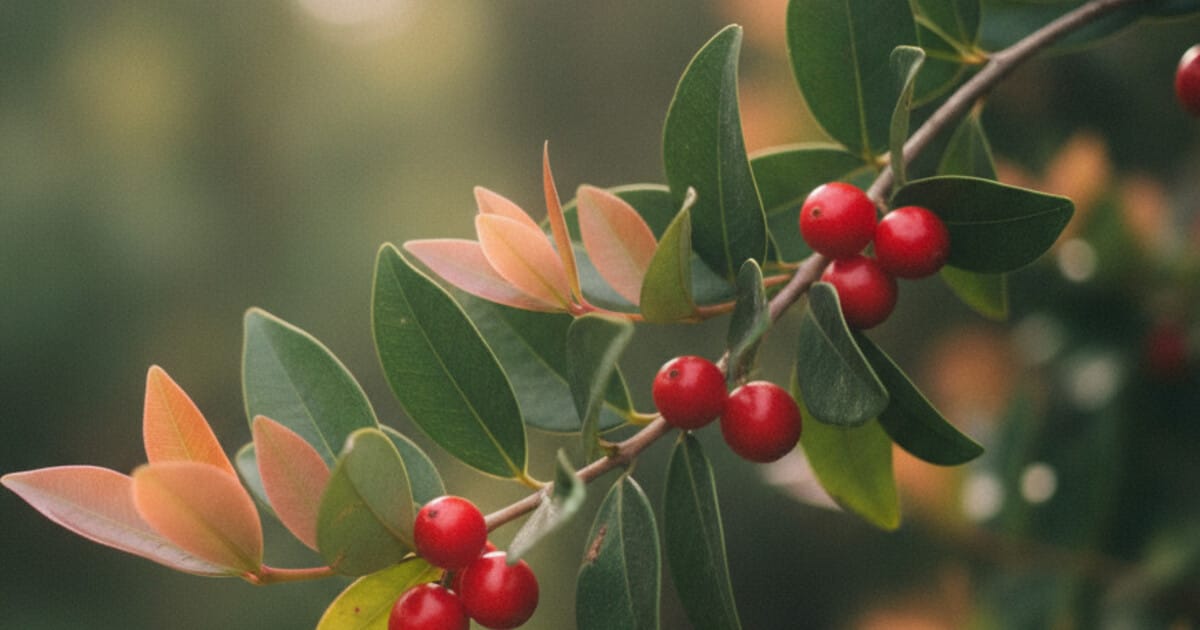
Lilly pilly is identified by three consistent features: glossy, oval leaves with distinctive coppery or pink new growth, clusters of small fluffy white flowers from late spring through summer, and round berries that ripen from white through pink to red or deep purple depending on species. Most are Syzygium natives found along eastern Australia’s coastal rainforest margins, from far north Queensland to northern Victoria.
What Is a Lilly Pilly?
Lilly pilly refers to roughly 50 Syzygium species native to the eastern Australian coast, from the wet tropics of far north Queensland south through New South Wales to northern Victoria. In the wild, species like the riberry (Syzygium luehmannii) reach 30 metres, though garden cultivars typically stay 3 to 8 metres. New growth is the single most reliable identification marker: almost every lilly pilly produces a flush of copper, bronze, or bright pink foliage before hardening to glossy green. Flowers appear from late September through January, consisting of small 4-petaled blooms packed with white stamens that give the characteristic fluffy appearance. Berry diameter ranges from 5 millimetres in riberry to 25 millimetres in magenta cherry cultivars. The genus Syzygium contains roughly 1,200 species worldwide; Australia’s native contingent concentrates in subtropical and warm temperate rainforest margins below 1,000 metres elevation.
Lilly pillies were reclassified from several genera across the 20th century. Acmena smithii and various Eugenia species are now all placed in Syzygium under current taxonomy. Older nursery tags and plant databases still carry those names, so if you see a plant labeled Acmena in an Australian garden center, it’s a lilly pilly.
Lilly Pilly Identification by Leaf and New Growth
The leaves are the fastest starting point. Lilly pilly leaves share four consistent traits across the group:
- Opposite arrangement: they grow in pairs directly across from each other on the stem, not alternating
- Oval to elliptical shape: tapering to a pointed tip, 5 to 12 cm long depending on species
- Glossy upper surface: bright green with a noticeable shine in sunlight
- Paler underside: the contrast between top and bottom surfaces is clear even at a glance
New growth is more distinctive than the mature leaves. Almost every lilly pilly species pushes out a flush of bronze, copper, or vivid pink foliage before the leaves harden to green. That color shift isn’t stress. In cultivars like ‘Blaze’ (Syzygium australe), the new growth is an intense red that fades over 4 to 6 weeks. Even species with more muted flushes show a noticeable color difference between fresh growth and the darker hardened leaves below it.
Crushing a leaf releases a faint, slightly spicy or clove-like scent. Syzygium is related to the clove tree (Syzygium aromaticum) and shares the oil chemistry. That scent, faint as it is, helps confirm genus when other features are ambiguous.
Leaf edges are smooth, with no serration or lobing. This separates lilly pilly from many species with similar oval leaves. For a broader look at how leaf shape helps with identification across tree species, see our guide to tree identification by leaf shape.
Lilly Pilly Flowers and Berries
Flowers appear from around October through January across most of eastern Australia, with timing varying by species, climate zone, and elevation. Each flower is small (around 1 cm across) with 4 white petals, but the dominant visual feature is the mass of white to cream stamens. These give the flowers a fluffy, almost bottlebrush-like appearance when in cluster. Clusters form at branch tips and in leaf axils.
After flowering, berries develop over 3 to 5 months. Mature berry color is one of the clearest species-level identifiers:
- Syzygium luehmannii (riberry): small, 8 to 10 mm, pear-shaped, ripening bright red
- Syzygium australe (brush cherry): medium, 12 to 15 mm, spherical, ripening dark red
- Syzygium smithii / Acmena smithii: larger, 12 to 25 mm, ranging white through pink to deep purple
- Syzygium paniculatum (magenta cherry): vivid magenta to dark purple, 15 to 20 mm
Every lilly pilly berry carries a small crown at the tip formed by the dried calyx lobes. That crown is visible even on fallen fruit and works as a reliable generic marker for Syzygium across the whole group.
Unripe berries are typically pale green to white, hardening and coloring through late summer and autumn. For comparison with other trees across Australia and beyond that produce red berry clusters, see trees with red berries.
Lilly Pilly Bark and Tree Form
Bark on young lilly pilly stems is smooth and green, turning gray-brown with age. On mature specimens, the surface develops a slightly rough or flaky texture with shallow fissures, but it never gets deeply furrowed like eucalypts or coarsely rough like many acacias. At eye level the bark looks comparatively clean and smooth.
Growth habit depends heavily on whether the plant is wild-grown or cultivated:
- Wild specimens: single or multi-trunked, reaching 20 to 30 metres in rainforest environments with a dense spreading canopy
- Garden specimens: typically multi-stemmed and densely branched from near the base, especially if regularly clipped as a hedge
- Compact cultivars: more upright and narrower than wild-type, selected partly for smaller root spread near paving
Young stems have a slightly four-angled or squarish cross-section when actively growing. That angular tip is a secondary Syzygium marker, easiest to see on thin new shoots.
Root systems are moderately vigorous. Established plants can develop surface roots in poorly drained soils, which matters when siting them near paths or concrete. Most council-approved cultivars have been selected with root behavior as part of the brief.
Common Lilly Pilly Species in Australian Gardens
Several cultivars dominate in Australian nurseries. Knowing the common ones speeds up field identification when you’re looking at a planted specimen.
Syzygium australe ‘Blaze’: one of the most widely planted hedge cultivars. Deep red new growth, dark green mature leaves, spherical red berries. Dense and upright to 3 or 4 metres without pruning. Found widely in NSW and QLD suburban gardens, particularly along boundaries where screening is the goal.
Syzygium smithii (Acmena smithii): sometimes labeled acmena or lilly pilly interchangeably in older nurseries. Larger leaves (to 12 cm), white to cream flowers, berries ranging white through pink to deep purple. More shade-tolerant than most. Common as a rainforest understory tree in coastal QLD and NSW.
Syzygium luehmannii (riberry): narrower leaves than brush cherry, pear-shaped berries ripening bright red. Naturally coastal in NSW and QLD. The canopy is fine-textured with a lighter, airier look than australe.
Syzygium paniculatum (magenta cherry): larger plant, reaching 15 metres or more in garden situations without management. Fruit is notably large and vivid magenta-purple, making it one of the easier species to separate on berry color alone. Used as a street tree in warmer coastal climates.
Compact cultivars (‘Backyard Bliss’, ‘Tiny Trev’, ‘Cascade’): selected for height under 2 metres, suited to tight hedges. Smaller leaves, typical pink to copper new growth, small red berries. These dominate VIC and SA plantings where space is more constrained.
Identify Lilly Pilly with a Photo App
A smartphone captures the key identification features clearly: new growth color, berry shape and color, leaf texture and arrangement, and bark. Get the new growth in the frame if any is present. The coppery or pink flush on fresh shoots confirms genus quickly even before you look at anything else.
The Tree Identifier app identifies Syzygium species from leaf, bark, flower, and berry photos. Take a close-up of the leaves showing the glossy upper surface and lighter underside, then a second shot of visible berries or flowers. The app works offline, which matters in bushland areas where signal drops out. Download on iOS or Android, or try the browser-based tree identifier tool before installing.
Two photos separate species more reliably than one. A leaf close-up combined with a berry shot usually closes the case between riberry and brush cherry, which look similar in leaf alone.
Frequently Asked Questions
How do I identify a lilly pilly?
Look for opposite, glossy green leaves with coppery or pink new growth, fluffy white flower clusters from October to January, and round berries with a small dried calyx crown at the tip. Berry color at maturity ranges from red to deep purple depending on species. Most are Syzygium natives found in eastern Australian gardens and rainforest margins from QLD to VIC.
What’s the difference between lilly pilly species?
Berry color and size are the clearest separators. Riberry (Syzygium luehmannii) produces small, pear-shaped red fruit around 8 to 10 mm. Brush cherry (Syzygium australe) produces spherical bright red berries at 12 to 15 mm. Acmena smithii berries range from white to deep purple and can reach 25 mm. New growth intensity also differs by cultivar: ‘Blaze’ produces vivid red, while wild-type species show a more muted copper flush.
Where does lilly pilly grow in Australia?
Naturally in subtropical and warm temperate rainforest margins along the eastern coast, from far north Queensland through coastal NSW to northern Victoria. As planted specimens they’re found across all mainland states; cold-hardy cultivars extend the range into cooler parts of VIC and SA. They grow best in well-drained but moisture-retentive soils and tolerate full sun and partial shade.
Is lilly pilly the same as Syzygium?
Yes. The common name “lilly pilly” refers to Australian species in the genus Syzygium. Some were previously classified as Acmena or Eugenia, so older references use those names. Acmena smithii and Syzygium smithii describe the same plant under current taxonomy. Modern botanical classification places all Australian lilly pillies within Syzygium.
Can the Tree Identifier app identify lilly pilly from a photo?
Yes. The app identifies Syzygium species from leaf, bark, flower, and berry photos. A close-up of the glossy leaves showing new growth color combined with a berry shot gives the app enough information for species-level identification in most cases. It covers Australian native species as well as the broader Syzygium genus and works with 2 free identifications per day.
If you’re in a garden center, a suburban park, or on a bush track in eastern Australia and spot glossy leaves with that coppery new growth flush, you’re almost certainly looking at a lilly pilly. Take a photo with the Tree Identifier app to confirm the species and access detailed habitat and characteristics information. It’s free on iOS and Android with 2 identifications per day.
Identify a tree from your photo — free
Upload a leaf, bark, or whole-tree photo and get the species in seconds. No signup.
Confidence:
Unlock the full species profile
Free in the app — with unlimited identifications.


AI result for guidance — the app gives full species details and works offline.
Want unlimited identifications?
Get the full species profile, photos and details — free in the app, with unlimited scans.
- Unlimited identifications
- Full species profiles & details
- Works offline, anywhere
- Save and revisit your finds
Elena Torres
Tree Identifier Team