Spotted Gum: Tree Identification Guide
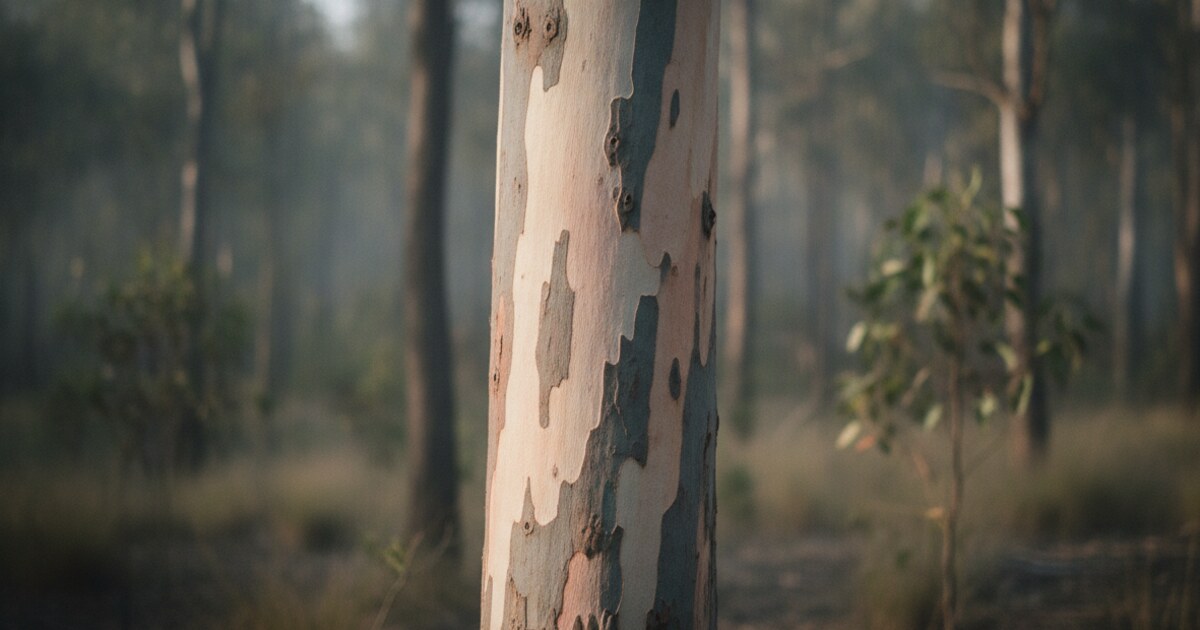
Spotted gum is one of Australia’s most recognisable native trees, and the bark gives it away every time. That smooth, blotched trunk covered in patchwork cream, pink, and bluish-grey is unlike anything else in the eastern Australian bush. Corymbia maculata grows across a coastal and sub-coastal strip from south-east Queensland down through New South Wales, with a small isolated population in East Gippsland, Victoria. Once you know what spotted gum looks like, you’ll pick it out from 50 metres.
Spotted gum (Corymbia maculata) is identified by its smooth, mottled bark that sheds in small irregular flakes, leaving patches of cream, pink, and grey on the trunk. Adult leaves are lance-shaped, 80 to 210 mm long, and the same green colour on both sides. White flowers come in clusters of 3 buds, followed by urn-shaped fruit capsules.
What Does a Spotted Gum Tree Look Like?
The bark is the signature. In summer, spotted gum sheds its outer layer in small, irregular flakes, revealing a mottled surface underneath. Colours shift between cream, pale grey, pink, and bluish-grey, and the trunk shows visible dimpling where the bark has lifted and fallen away. No other common eucalyptus in eastern Australia combines that spotted patchwork with this smooth, slightly textured feel.
Corymbia maculata belongs to family Myrtaceae and the Corymbia genus, which split from Eucalyptus in 1995. In open forest conditions it typically grows 15 to 45 m tall with trunk diameters of 0.5 to 1 m, though exceptional specimens approach 50 m and 2 m in diameter. The tree is native to a coastal and sub-coastal band running from south-east Queensland to southern New South Wales, with a separate population in East Gippsland, Victoria.
It favours sandy and loamy soils in dry sclerophyll forest, often on poorer sites where richer soils support competing species. Rainfall across its natural range falls roughly between 700 and 1,100 mm per year. The bark sheds from December through February, leaving the characteristic mottled surface of cream, grey, and pink. Outside shedding season the trunk stays smooth year-round, making identification consistent across all seasons.
The crown is moderately dense and rounded. The trunk runs clear for a good stretch below the first branches, giving mature trees a tall, clean silhouette that stands out against open woodland.
How to Identify Spotted Gum Leaves
Adult leaves are lance-shaped to slightly curved, 80 to 210 mm long and 12 to 30 mm wide. A short petiole (leaf stalk) of 10 to 25 mm connects each leaf to the branch. Both surfaces are the same dull green, which separates spotted gum from many eucalypts that carry a paler, whitish underside. Spotted gum leaves look identical from either angle.
Juvenile foliage is different. On young trees or coppice regrowth after fire or clearing, the leaves are rounder, broader, and sometimes faintly blue-green or glaucous. Once the tree reaches maturity, the adult lance-shaped leaves take over throughout the canopy.
Scent is a useful secondary check. Crush a spotted gum leaf and the smell is faint, barely detectable. This separates it quickly from close relatives that carry strong medicinal or lemon aromas, a test that becomes critical when comparing spotted gum with lemon-scented gum (covered below).
Spotted Gum Flowers and Fruit
Flowers appear from July to October across most of the range, with timing shifting later at higher altitudes and further south. Each cluster starts as 3 buds on a shared stalk, so that three-bud arrangement is a good field note when you’re on the branch. The buds are club-shaped, roughly 7 to 10 mm long, and open into creamy-white flower heads made up of stamens rather than petals.
Fruit follows as small urn-shaped or barrel-shaped capsules, 10 to 15 mm long, with a distinct ribbed rim at the top. The capsules remain on the branch for months after the seeds disperse. Out of flowering season, the persistent fruit capsules give you another confirmation point. Look for those small ribbed urns clustered on the branchlets in autumn and winter when no flowers are visible.
Where Spotted Gum Grows in Australia
The natural range covers a coastal and sub-coastal strip roughly 100 to 200 km wide. It starts in south-east Queensland around the Sunshine Coast hinterland and Blackall Range, then continues south through coastal and tableland New South Wales. A separate population grows in East Gippsland, well south and isolated from the main distribution.
Spotted gum favours sandy loams and lighter soils in dry sclerophyll and open forest communities. It grows alongside ironbarks, grey gums, and scribbly gums on coastal slopes and low ranges. You’ll also find it on sandy coastal flats alongside casuarina trees and other native species on fast-draining, lean soils.
The tree tolerates moderate frost and sustained dry periods. In the wild, fires clear the lower canopy and leave mature spotted gums with long, clean trunks below the crown. That straight-limbed silhouette above a clear trunk is part of what makes the species so distinctive at a glance.
Spotted Gum vs Lemon-Scented Gum
Lemon-scented gum (Corymbia citriodora) is the most common mix-up, partly because it’s sometimes sold and labelled as “blue spotted gum.” Both are smooth-barked Corymbia species that shed in patches, but separating them takes under a minute:
- Bark: Spotted gum has mottled, dimpled bark in cream, pink, and grey. Lemon-scented gum has a plainer, chalky-white trunk with very little dimpling and minimal patchwork colour.
- Leaf scent: Crush a lemon-scented gum leaf and the citronella-lemon smell hits you immediately. Spotted gum leaves have almost no scent. This is the fastest field test.
- Leaf width: Lemon-scented gum carries narrower leaves and a more open, airy canopy compared to spotted gum’s moderate crown density.
Both species grow across coastal Queensland and New South Wales, so range alone won’t separate them. The bark texture and leaf crush test do the job in seconds.
A third species worth knowing is Corymbia henryi, the large-leaved spotted gum, found in southern Queensland and northern New South Wales. Its leaves are noticeably larger than C. maculata. The Australian-tree guides at treeidentifier.app cover related species from similar woodland communities, including banksia, melaleuca (paperbark), and wattle trees.
Spotted Gum Timber Properties
Spotted gum is one of Australia’s most commercially valuable hardwoods, and understanding the timber helps with identification if you come across milled boards or cut wood.
Seasoned density sits at 990 to 1,010 kg/m³, well above teak (655 kg/m³) and most common softwoods. Janka hardness reaches approximately 11 kN (around 2,470 lbf), placing spotted gum among the hardest commercial timbers in Australia. The grain is often interlocked, which produces the “fiddleback” figure prized in flooring and feature cladding when boards are quartersawn. The natural greasiness of the wood helps it machine cleanly despite the density.
Above-ground durability is Class 1, with a life expectancy exceeding 40 years. In-ground contact drops to Class 2, or 15 to 25 years. Tangential shrinkage runs at 6.1% and radial at 4.3%. Common uses include hardwood flooring, outdoor decking, structural framing, wharves, bridges, railway sleepers, and tool handles where impact resistance matters. Spotted gum currently represents the highest volume native hardwood harvested in Queensland.
How Tree Identifier Can Help
Standing in front of a smooth mottled trunk in the bush, the Tree Identifier app gives you a fast second opinion. Photograph the bark, a cluster of leaves, or the fruit capsules. The app cross-references your photo against thousands of species and returns a match with a confidence score. Spotted gum’s distinctive blotched bark makes it one of the easier eucalypts to confirm, since the mottled pattern is consistent and recognisable year-round.
The app works on iOS and Android, identifies from photos of bark, leaves, flowers, fruits, and whole-tree shape, and includes detailed species profiles with each result. Species data can be downloaded for offline use, which is useful on remote coastal trails without cell service. Try it at treeidentifier.app or use the free web tool at treeidentifier.app/tools/tree-identifier.
Frequently Asked Questions
Is spotted gum a eucalyptus?
Spotted gum was classified as Eucalyptus maculata until 1995, when botanists reclassified it into the Corymbia genus based on genetic and morphological differences. Both genera belong to family Myrtaceae, so spotted gum is still a gum tree. Its correct current name is Corymbia maculata, though older texts and some nurseries still use the Eucalyptus name.
Why is it called spotted gum?
The name comes from the bark. Spotted gum sheds its outer layer in small irregular flakes during summer, leaving a mottled patchwork of cream, grey, and pink on the trunk. From a distance this patchwork looks spotted, and the pattern is consistent enough year-round that it became the tree’s common name across its range.
How tall does a spotted gum tree grow?
Spotted gum typically reaches 15 to 45 m in open forest conditions. On sheltered slopes with better soils, exceptional specimens approach 50 m with trunk diameters up to 2 m. Most trees you’ll encounter fall in the 25 to 40 m range, with trunk diameters between 0.5 and 1 m.
How do you tell spotted gum from lemon-scented gum?
Crush a leaf. Lemon-scented gum (Corymbia citriodora) has an immediate, strong lemon-citronella smell. Spotted gum has almost no scent. The bark is also different: spotted gum shows visible dimpling and a mottled cream-pink-grey pattern, while lemon-scented gum has a plainer, chalky-white trunk with less colour variation.
Where does spotted gum grow in Australia?
Spotted gum’s natural range runs along a coastal and sub-coastal strip from south-east Queensland through coastal and tableland New South Wales. A separate population grows in East Gippsland, Victoria. The tree favours dry sclerophyll forest on sandy and loamy soils with annual rainfall of roughly 700 to 1,100 mm.
Identify a tree from your photo — free
Upload a leaf, bark, or whole-tree photo and get the species in seconds. No signup.
Confidence:
Unlock the full species profile
Free in the app — with unlimited identifications.


AI result for guidance — the app gives full species details and works offline.
Want unlimited identifications?
Get the full species profile, photos and details — free in the app, with unlimited scans.
- Unlimited identifications
- Full species profiles & details
- Works offline, anywhere
- Save and revisit your finds
Elena Torres
Tree Identifier Team