Tea Tree Plant: How to Identify Australia's Iconic Native
Three different plants share the name “tea tree,” and mixing them up is easier than you’d think. When someone says “tea tree plant,” they might mean Melaleuca alternifolia (the source of tea tree oil), Leptospermum scoparium (manuka, the honey plant), or Camellia sinensis (the actual tea beverage plant). In Australia, the first two are the ones you’ll encounter in the bush, in gardens, and at the nursery. Getting the ID right matters: they look different, grow in different habitats, and have entirely different uses.
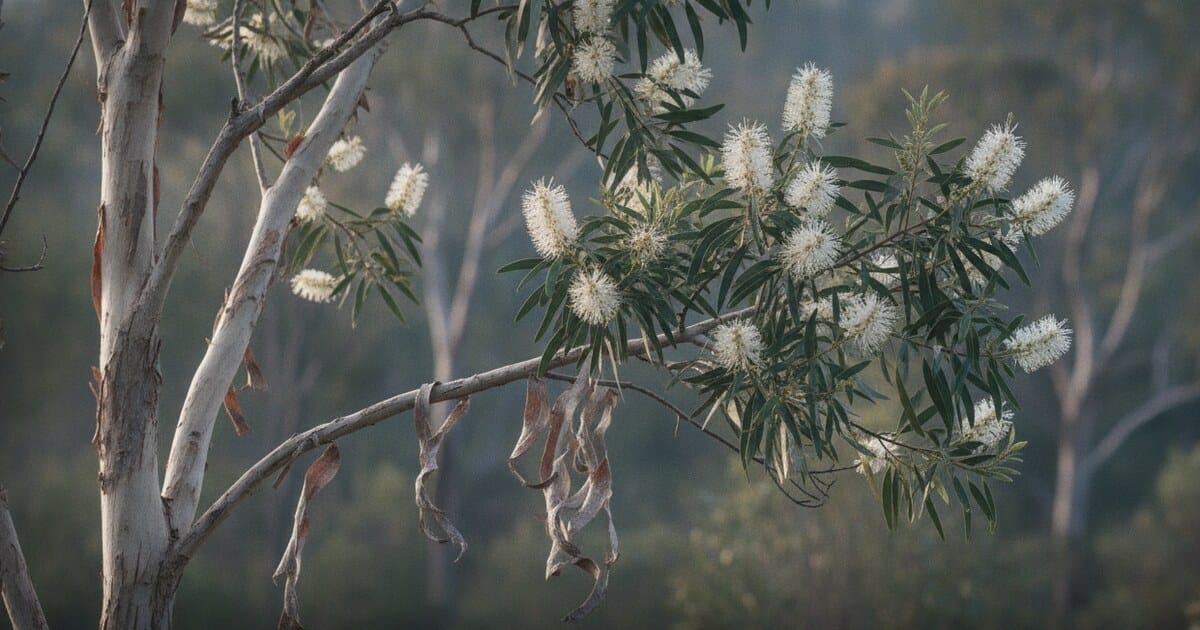
The tea tree plant most commonly refers to Melaleuca alternifolia, a small native Australian tree in the Myrtaceae family and the commercial source of tea tree oil. It has narrow aromatic leaves, papery white-grey bark, and white bottlebrush-like flower spikes. Leptospermum scoparium (manuka) shares the name but has short prickly leaves and single blooms rather than spike flowers.
Tree Identifier can confirm tea tree plant identification from a photo of the leaves, bark, or flowers. The app works offline for bush walks and remote hikes. 2 free identifications per day, no subscription needed. Download on iOS or Android
What Is a Tea Tree Plant?
The confusion around “tea tree” goes back to the 1770s. Botanists on Captain Cook’s voyages documented Aboriginal Australians and New Zealand Maori using the leaves of Leptospermum species to brew a herbal drink. Cook’s crew called it “tea tree” because the leaves brewed like tea. The name stuck, and later extended to Melaleuca alternifolia when colonists discovered its strong aromatic oil.
Three plants carry the tea tree name in everyday use:
- Melaleuca alternifolia (narrow-leaf paperbark or Australian tea tree): native to a 1,200 km² strip of coastal northeast New South Wales, in the floodplain country around the Richmond and Clarence river systems; now grown commercially across Australia for essential oil
- Leptospermum scoparium (manuka or New Zealand tea tree): native to southeastern Australia and New Zealand; 83 of the roughly 90 Leptospermum species are endemic to Australia
- Camellia sinensis (tea plant): the shrub that produces black, green, white, and oolong tea; native to China and Southeast Asia and unrelated to either Australian species
Melaleuca alternifolia and Leptospermum both belong to Myrtaceae, the same family as eucalypts, grevilleas, and the bottlebrush. Camellia sinensis belongs to Theaceae, an entirely separate family. When someone in Australia spots a “tea tree” growing beside a creek, they almost certainly mean Melaleuca alternifolia.
Commercially, Melaleuca alternifolia dominates. Australia produces 700-900 tonnes of tea tree oil per year, almost entirely from NSW and Queensland farms. The oil is distilled from the leaves and young stems; ISO standard 4730:2017 requires commercial tea tree oil to contain a minimum of 30% terpinen-4-ol, the main active compound. High-quality oil from certified Australian growers typically contains 40-45% terpinen-4-ol.
Aboriginal Australians in the Northern Rivers region used M. alternifolia leaves medicinally for thousands of years, primarily by inhaling vapour from crushed leaves or steeping them in water for wound care.
How to Identify Melaleuca alternifolia
Melaleuca alternifolia, the Australian tea tree, typically reaches 2-7m in its native habitat, though specimens in sheltered gullies can reach 10m. Four markers make the ID reliable.
Leaves: Narrow and linear, 1-3.5cm long and barely 1mm wide, with a pointed tip. They grow alternately on soft young stems. Crush a leaf between your fingers and you’ll get a sharp medicinal smell: this is the terpinen-4-ol oil that makes M. alternifolia commercially valuable, and it distinguishes this species from other white-barked Melaleuca species at a sniff.
For a broader look at the Melaleuca genus across Australia, the Melaleuca guide covers the full range of paperbark species.
Bark: Classic paperbark texture, white to light grey, peeling off in thin papery layers. The bark feels soft and spongy compared to the hard furrowed bark of ironbarks or the smooth-shedding bark of gums. Older specimens develop thicker, more layered paperbark at the base.
Flowers: White, bottlebrush-like spikes, 3-5cm long, appearing in late spring and summer (November to January in NSW). Individual flowers are tiny but packed densely along the spike, with long white stamens giving the spike its brushy look.
Fruit: Small woody capsules appearing in clusters along the stem after flowering, persisting on the stem for several years. These form rough grey knobs along older branches, a useful out-of-season ID marker.
Habitat: The clearest single clue. M. alternifolia grows almost exclusively in seasonally waterlogged soils: creek margins, swampy lowlands, and coastal floodplains in that narrow strip of northeast NSW. If you’re standing beside a coastal NSW creek looking at a small white-barked tree with a sharp medicinal smell, it’s almost certainly this species.
How to Identify Leptospermum scoparium (Manuka)
Leptospermum scoparium grows as a shrub to small tree, usually 1-5m tall. Its flowers look similar to M. alternifolia at a glance, but the two plants are easy to separate up close.
Leaves: Short, oval to narrow lance-shaped, 7-20mm long, with a sharp prickly tip. This is the fastest field check: if the leaves prick your finger, it’s Leptospermum, not Melaleuca. The leaves lack the strong medicinal scent of M. alternifolia.
Flowers: Single blooms with 5 separate petals, 8-15mm across, white to deep pink or red in garden cultivars. The flowers sit individually along the stems rather than massed into spikes.
Bark: Brown, fibrous, and shredding in thin strips. Rougher and more fibrous than the soft papery Melaleuca bark.
Fruit: Small, persistent woody capsules, 5-10mm across, opening at the top. The capsules stay on the plant for a year or more after flowering.
Range: Leptospermum scoparium grows naturally along the eastern coast of NSW and in Victoria, plus throughout New Zealand. L. laevigatum (coastal tea tree) is common on sandy soils around Melbourne and along the Victorian coast. The wide geographic spread means you’re more likely to encounter Leptospermum in the bush across most of southern and eastern Australia than the geographically restricted M. alternifolia.
Where Tea Tree Plants Grow in Australia
Melaleuca alternifolia is the most geographically restricted of the two. Its natural range sits almost entirely within northeast New South Wales, in the floodplain country roughly between Casino and Grafton. It needs saturated or seasonally waterlogged soils and doesn’t cope well with prolonged dry periods in its juvenile years.
Outside its native range, M. alternifolia grows on farms in the Northern Rivers region of NSW and in southeast Queensland, where Australia’s commercial tea tree oil industry runs. These areas have the right combination of subtropical climate, reliable rainfall, and flat alluvial soils for high-yield crops.
Leptospermum species are far more widespread. They appear in coastal heathlands, mountain slopes, dry sclerophyll forests, and cleared grazing land across every state. L. scoparium grows from sea level to 1,100m in both southeastern Australia and New Zealand. If you’re hiking in coastal Victoria, Tasmania, or the Blue Mountains, the shrubby white-flowered plants along the track are almost always Leptospermum rather than Melaleuca.
Tea Tree Plant Uses and Properties
Melaleuca alternifolia built Australia’s commercial tea tree oil industry. The oil contains dozens of compounds, but terpinen-4-ol does most of the work: it disrupts bacterial cell membranes and shows activity against a range of fungi and some viruses in laboratory studies.
Leptospermum’s commercial value comes through honey. Bees foraging on L. scoparium and related species (particularly L. polygalifolium in Queensland) produce manuka honey, which contains methylglyoxal (MGO) as its primary antibacterial compound. The MGO content varies significantly between Leptospermum species and locations.
Australian-produced manuka honey now competes directly with New Zealand exports, with Australia formally trademarking the name for domestic certification standards from 2024.
Both plants have deep roots in Indigenous use. Melaleuca bark was used to wrap and cook food across coastal NSW. Leptospermum species featured in several Aboriginal medicinal traditions, with leaves used in steam inhalation treatments.
Growing a Tea Tree Plant in Your Garden
Both species adapt well to cultivation outside their native ranges, though their preferences differ.
For Melaleuca alternifolia: give it full sun, reasonably moist soil, and room to reach 3-5m. It tolerates periodic waterlogging but doesn’t need boggy soil in the garden. Prune lightly after flowering to keep shape. Established plants handle frosts to around -5°C.
For Leptospermum scoparium: full sun, well-drained acidic soil, and protection from hard frosts until established. The many garden cultivars (some with red or pink double flowers) are more compact than the wild form, often reaching only 1-2m. These are sold in Australian nurseries simply as “tea tree” alongside Melaleuca species.
A quick nursery check: if the label says “tea tree” and the leaf is prickly, it’s Leptospermum. If the leaf is soft and aromatic when crushed, it’s Melaleuca.
Both plants flower reliably in spring, provide good habitat for honeyeaters and other nectar feeders, and are drought-tolerant once their root systems establish. The banksia is another good companion plant for similar wildlife-garden plantings in eastern Australia.
Frequently Asked Questions
What plant is called a tea tree?
In Australia, “tea tree” refers to Melaleuca alternifolia (the source of tea tree oil) or Leptospermum scoparium (manuka). Both are native Australian plants in the Myrtaceae family. Outside Australia, the name sometimes refers to Camellia sinensis, the plant whose leaves are processed to make black, green, and oolong tea. The two Australian species are entirely unrelated to Camellia.
Where do tea tree plants grow?
Melaleuca alternifolia grows naturally in a 1,200 km² stretch of coastal northeast New South Wales, in seasonally waterlogged soils around the Richmond and Clarence river systems. Leptospermum scoparium grows along the eastern coast of Australia from Queensland to Tasmania and throughout New Zealand, in a wider range of habitats including coastal heaths, mountain slopes, and forest margins.
How do you identify a tea tree from other plants?
The quickest test: crush a leaf. Melaleuca alternifolia has a sharp medicinal smell from its terpinen-4-ol oil. Leptospermum leaves are small, prickly-tipped, and barely fragrant. Melaleuca bark peels off in soft papery layers; Leptospermum bark is brown, fibrous, and rough. Both have small white flowers, but Melaleuca’s are massed into bottlebrush spikes while Leptospermum’s are single blooms spaced along the stems.
Is tea tree the same as the plant used for tea?
No. Tea tree (Melaleuca alternifolia or Leptospermum) is unrelated to the tea plant (Camellia sinensis). Tea tree oil from Melaleuca is used in topical products and is toxic when swallowed in quantity. Camellia sinensis is a completely different species grown for its leaves to make drinkable tea.
Can I use a photo app to identify tea tree plants?
Yes. Photos of the leaves, bark, or flowers give enough detail to distinguish Melaleuca from Leptospermum. The leaf shape alone (narrow and linear vs. short and prickly) is usually definitive.
If you’re trying to tell a tea tree apart from similar-looking plants in the field, the Tree Identifier app can get you a confident ID from a photo of the leaf, bark, or whole plant. Download on iOS or Android and use it on your next bush walk.
Identify a tree from your photo — free
Upload a leaf, bark, or whole-tree photo and get the species in seconds. No signup.
Confidence:
Unlock the full species profile
Free in the app — with unlimited identifications.


AI result for guidance — the app gives full species details and works offline.
Want unlimited identifications?
Get the full species profile, photos and details — free in the app, with unlimited scans.
- Unlimited identifications
- Full species profiles & details
- Works offline, anywhere
- Save and revisit your finds

Elena Torres
Tree Identifier Team