How to Identify Teak Wood: Grain, Color, and Simple Tests
Teak is one of the most counterfeited woods on the market. Outdoor furniture sellers routinely label lesser species as “teak-look” or “plantation hardwood,” and the price gap between real teak and its imitators runs to hundreds of dollars per piece. Knowing how to identify teak wood from grain, color, scent, and a few simple tests saves you from paying teak prices for something else entirely.
To identify teak wood, look for a straight, coarse grain with a slightly oily or waxy surface feel. Fresh teak is golden-brown; unfinished outdoor teak ages to silver-grey over 6-12 months. The heartwood smells faintly of leather when freshly cut or sanded. Water beads on the surface rather than soaking in.
What Does Teak Wood Look Like?
Fresh heartwood runs from honey-yellow to warm golden-brown. Give it a year outdoors without finishing and it turns silver-grey. Sand or scrape any surface and the gold comes right back. That color change is a teak signature, not a defect.
The sapwood is the clearest indicator of grade. It’s pale cream to almost white, and much softer than the heartwood. Grade A teak uses only the central heartwood, which is why finished Grade A pieces look so uniform. When you see cream-white streaks running through “teak” furniture, you’re looking at sapwood from Grade B or C material.
Surface texture is coarse. Run your hand across fresh teak and it feels slightly sandy or gritty, from the open pore structure combined with silica mineral deposits embedded in the wood fibers. That silica content is also one reason teak dulls saw blades faster than almost any other tropical hardwood.
Teak (Tectona grandis), family Lamiaceae, grows natively across India, Myanmar, Thailand, Laos, and Bangladesh, with natural Myanmar (Burmese) teak representing the historical gold standard for furniture and boatbuilding. Janka hardness is 1,070 lbf (4,740 N), harder than black walnut (1,010 lbf) but softer than white oak (1,360 lbf). Density runs around 655 kg/m³ (41 lbs/ft³). Radial shrinkage is just 2.6%, tangential 5.8%, making it among the most dimensionally stable of the tropical hardwoods at those density numbers. The heartwood’s water resistance comes from tectoquinone, a natural compound in the wood fibers that gives teak its characteristic oily feel and faint leather scent. Myanmar teak from slow-growth natural forest grows with tight annual rings, higher tectoquinone content, and deeper initial golden-brown color. Plantation teak from Indonesia and India grows faster, shows wider rings, and carries lower oil content. Still genuine Tectona grandis, but the working properties and long-term weathering performance differ noticeably between old-growth and plantation-sourced material.
How to Identify Teak Wood by Grain Pattern
Grain pattern is the fastest field check. Teak typically runs straight, with a uniform texture across the face. Look at the surface in raking light by holding it at an angle to a window: the grain lines should run roughly parallel without wild figure or irregular swirls.
Some teak shows interlocked grain, where the fibers alternate direction across each growth layer. On quartersawn faces this creates a subtle ribbon figure, alternating lighter and darker bands across the surface. That’s still teak. Mahogany also shows ribbon figure on quartersawn pieces, but the pore structure and oily surface feel distinguish them. For a closer look at how grain patterns work across species, the wood identification by grain guide covers the key differences in detail.
The ray pattern on teak is fine and closely spaced. You won’t see the prominent ray fleck you get on quartersawn white oak. Teak’s rays are there but inconspicuous, which is why the surface reads as smooth and uniform even when it’s coarse to the touch.
Common teak substitutes differ in measurable ways. Eucalyptus has a wavy, interlocked grain with fewer silica deposits and a drier feel. African iroko has a coarser, more irregular grain with visible white mineral deposits and a sour-sweet scent rather than the leather note. Pine shows obvious resin canals and dents easily under fingernail pressure. None of them combine the straight grain, oily surface, and leather scent that teak shows together.
End Grain: The Most Reliable Identification Method
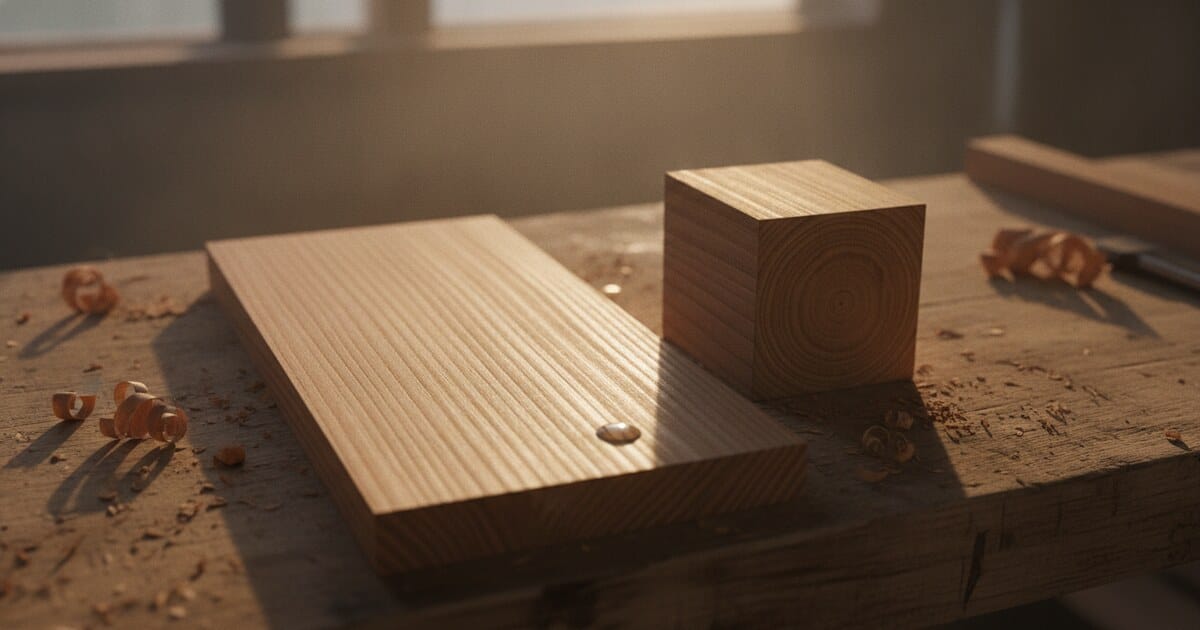
When you can access a cut end on a board or check an unfinished edge, end grain analysis is the definitive test. Teak is semi-ring-porous. Large pores cluster in the earlywood (the band formed at the start of each growing season), with smaller pores scattered through the latewood.
On magnification or under good light, the earlywood pores are large enough to see individually, roughly circular, spaced about 1-3 per millimeter. The latewood pores are visibly smaller and more scattered. This two-zone pattern sits between the dramatic ring-porous structure of oak (where the jump from large to small pores is sharp and obvious) and the fully diffuse-porous pattern of maple (where pore size stays uniform across the entire ring).
If the end grain shows uniform, evenly spaced pores with no size difference between early and late wood, it’s probably not teak. That’s the diffuse-porous signature of mahogany, cherry, or maple. For a side-by-side look at how mahogany’s diffuse-porous end grain differs from teak’s semi-ring-porous structure, the mahogany wood identification guide walks through both in detail.
The general approach to reading end grain patterns across multiple species is covered in the wood identification guide, which includes the ring-porous/diffuse-porous/semi-ring-porous spectrum that teak fits into.
Four Simple Tests That Confirm Teak
These tests work best on unfinished or freshly sanded surfaces. Varnish and teak oil finishes interfere with the water and scent tests, so focus on grain and end grain when inspecting finished furniture.
Water test. Teak’s high tectoquinone content makes it water-repellent. Drip a few drops on any unfinished surface. On real teak heartwood, the droplets bead and sit for at least 30 seconds. On sapwood or most substitutes, they spread and absorb within seconds.
Scent test. Freshly cut or sanded teak smells faintly of leather with a mild, slightly acidic undertone. Sand a small area and smell the dust. The scent isn’t sharp or resinous like pine. If there’s no detectable scent at all, that’s worth noting.
Weight test. At 41 lbs/ft³, teak is noticeably heavy. A teak outdoor chair that feels similar in weight to pine furniture is a red flag. Genuine teak chairs typically run 15-25 lbs depending on design and size.
Scratch test. Press a fingernail firmly into the surface. Teak resists well. Pine dents easily; most eucalyptus substitutes also show more give than real teak heartwood at equivalent thickness.
No single test is conclusive on its own. Pass all four checks and you’re looking at teak heartwood with high confidence. Three out of four on a finished piece is a reasonable indicator, with grain and end grain being the two that matter most.
Teak Grades and What They Mean for Identification
Grade A is cut from the heartwood center of mature trees, typically those over 25 years old. The color is even golden-brown with minimal knots, tight grain, and the highest natural oil content. This is what commands the highest price in furniture.
Grade B comes from outer heartwood. Some sapwood mixing is common, which shows as lighter streaks. Color variation is more pronounced, grain may be slightly more irregular, and oil content is lower. Still genuine teak, just less uniform.
Grade C includes significant sapwood. It’s much lighter in color, softer, and far less weather-resistant. Some sellers market Grade C or sapwood-heavy pieces as “economy teak,” technically accurate but misleading about long-term performance. It weathers faster, absorbs moisture more readily, and won’t last as long outdoors without regular finishing.
Plantation teak (Indonesia, India, Costa Rica) now makes up most of the commercial supply. It grows faster than old-growth Burmese teak, so the annual rings are wider and tectoquinone content is generally lower. Plantation teak is still genuine Tectona grandis and passes all the physical identification tests. The water beading is a bit less pronounced, the initial heartwood color tends to be lighter golden rather than deep honey-brown, and the leather scent is milder. That’s the practical difference, not a reason to dismiss it as fake.
How Tree Identifier Helps with Wood Identification
The Tree Identifier app includes wood type recognition alongside live tree identification. Point the camera at a piece of wood, flat face or end grain, and the AI analyzes grain pattern, pore size, texture, and color to suggest the species.
For teak, the best shots are of the end grain where the pore structure is clearest, or the face grain of an unfinished or freshly sanded surface. A varnished surface obscures grain detail and makes any photo-based identification less reliable. If possible, sand a small test area before photographing.
The app returns a species match with the characteristic features that led to that identification, useful as a cross-check against your physical tests. Two free identifications per day work for most buying situations. For a quick check without installing the app, the browser-based tool at treeidentifier.app/tools/wood-identifier runs on any device.
Frequently Asked Questions
Is plantation teak the same as real teak?
Plantation teak is the same species (Tectona grandis) as old-growth Burmese teak, so it’s genuine teak. Plantation-grown trees have wider annual rings and lower tectoquinone content because they grow faster, so the wood is slightly less dense and the water-beading effect is a bit weaker. All the physical identification tests still apply: straight grain, oily surface, faint leather scent, semi-ring-porous end grain.
Why does some teak feel dry, not oily?
Old or heavily weathered teak loses surface oil over time. Newly purchased furniture may also have been kiln-dried aggressively, which reduces surface oil. The underlying tectoquinone content in the heartwood fibers is still there. Apply teak oil or let rain wet the surface and the water-repelling behavior returns. A dry surface feel on older pieces doesn’t mean it’s fake.
How do you tell teak from iroko?
Iroko (Milicia excelsa) is one of the most common teak substitutes. Similar in density and initial color, but the grain is coarser and more irregular, with visible white calcium deposits in the pores rather than the silica grit of teak. The scent is very different: iroko smells faintly sweet or slightly sour, without the leather note. End grain shows a more diffuse-porous pattern in iroko vs. teak’s semi-ring-porous two-zone structure.
What’s the fastest way to check teak at a furniture store?
Bring a small bottle with a few drops of water. Drip on any unfinished underside or edge. Bead for 30+ seconds means good water resistance. Then scratch the edge firmly with a fingernail. Teak resists noticeably. Sniff any freshly scratched area for the faint leather note. If all three checks pass, you’re looking at heartwood teak. Ask for Grade A documentation if the price reflects it.
Can teak wood be identified from a photo?
Yes, with some limits. The AI in Tree Identifier and the web tool at treeidentifier.app/tools/wood-identifier can identify teak from grain and end grain photos. Clear, well-lit shots of unfinished or freshly sanded surfaces give the best results. A varnished surface obscures grain detail and drops accuracy, but the AI can still make a match in most cases.
Snap a photo of the wood grain with the Tree Identifier app for a species match in seconds. Available on iOS and Android with 2 free identifications daily, or try the browser tool at treeidentifier.app/tools/wood-identifier for an instant check on any device.
Identify a tree from your photo — free
Upload a leaf, bark, or whole-tree photo and get the species in seconds. No signup.
Confidence:
Unlock the full species profile
Free in the app — with unlimited identifications.


AI result for guidance — the app gives full species details and works offline.
Want unlimited identifications?
Get the full species profile, photos and details — free in the app, with unlimited scans.
- Unlimited identifications
- Full species profiles & details
- Works offline, anywhere
- Save and revisit your finds
Elena Torres
Tree Identifier Team