Cherry vs Mahogany Wood: Key Differences Explained
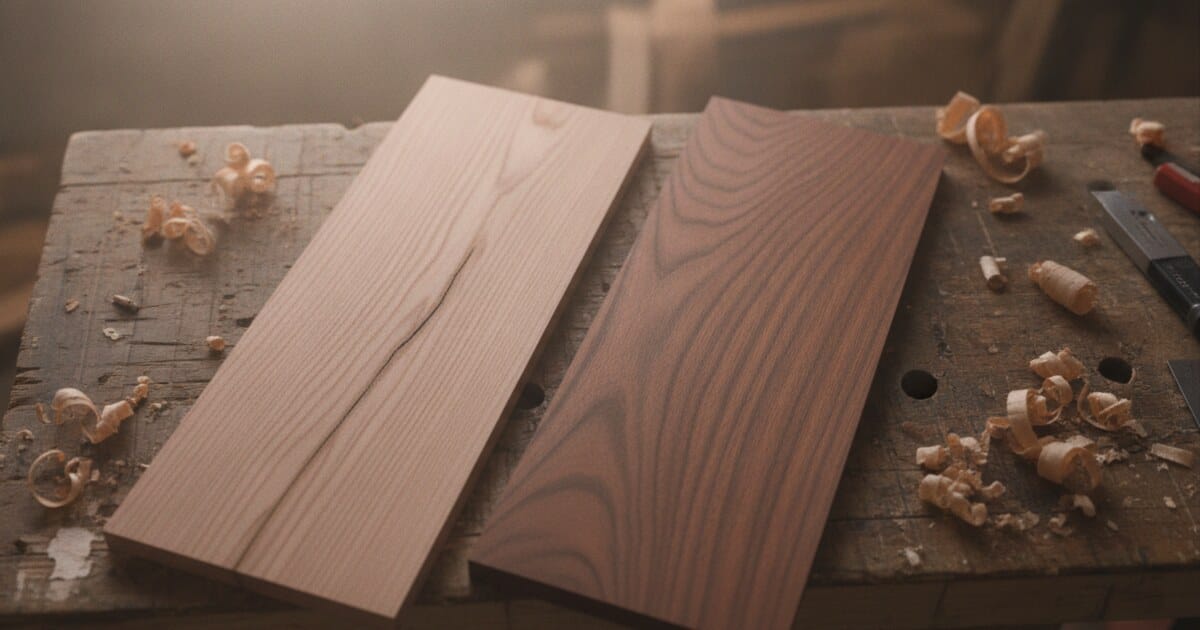
Cherry and mahogany appear in the same breath so often that buyers treat them as interchangeable. The differences are real, though, spanning color development, grain structure, seasonal stability, and price. Both are warm hardwoods that finish beautifully and age with character, but those differences matter when you’re choosing wood for a project.
This guide covers cherry vs mahogany wood across the dimensions that count: appearance, hardness, workability, cost, and where each performs best.
Cherry and mahogany are both hardwoods with close Janka ratings: cherry at 950 lbf, mahogany at 800-900 lbf. The key differences are color development (cherry starts pale pinkish-tan and darkens over 6-12 months of UV exposure; mahogany arrives reddish-brown from the mill), seasonal stability (mahogany moves less), and price (cherry at $7-8 per board foot versus Honduran mahogany at $15-30).
Cherry vs Mahogany Wood: Color, Grain, and Appearance
Black cherry (Prunus serotina) comes out of the mill as a pale, pinkish-tan wood. Six to twelve months of normal light exposure shifts it into warm reddish-brown through a photo-reactive process: UV light drives chemical changes in the wood’s phenolic compounds. Most woodworkers consider it one of the most satisfying natural color developments in domestic hardwood.
True mahogany (Swietenia macrophylla, the Honduran or big-leaf species you’ll find at most hardwood dealers) arrives already deep reddish-brown. Its grain runs straight to slightly interlocked, with consistent color across the face. On quartersawn boards, mahogany shows a ribbon figure: alternating bands of light and dark where the interlocked grain reverses direction and catches light at different angles.
Cherry’s grain is finer and more uniform, marked by pitch pockets: small lens-shaped cavities of dried resin that show as short black streaks or flecks in the face grain. Mahogany has no pitch pockets, making that pattern one of the most reliable visual identifiers between the two woods even on aged pieces. Cherry moves more seasonally than mahogany: tangential shrinkage of 7.1% versus 4.1%, radial 3.7% versus 2.5%, which translates to roughly an extra quarter inch of movement across a seasonal cycle in a 12-inch solid panel.
Understanding how grain patterns distinguish wood species is covered in detail in our guide to identifying wood by grain.
Hardness, Weight, and Durability
Cherry measures 950 lbf on the Janka hardness scale. Honduran mahogany (Swietenia macrophylla) tests around 900 lbf; African mahogany (Khaya ivorensis) runs about 830 lbf. The gap is narrower than most guides imply, and both woods behave similarly in everyday furniture use.
Density is close too. Cherry weighs about 36 lbs per cubic foot. Mahogany is slightly denser at 40 lbs per cubic foot: noticeable when moving large panels, but similar in finished furniture.
For rot resistance, mahogany has a clear advantage. It holds up in humid conditions and was used historically in boatbuilding and exterior millwork. Cherry has limited natural rot resistance and belongs in interior applications.
How to Tell Cherry from Mahogany by Eye
Color works on fresh-cut lumber. New cherry is pale pinkish-tan; new mahogany is already deep reddish-brown. Aged cherry darkens enough to closely resemble mahogany, which trips up buyers at antique shops and estate sales regularly. The full toolkit for identifying wood species covers more approaches, but these tells are the most reliable for cherry versus mahogany specifically.
Pitch pockets. Cherry has them; mahogany doesn’t. Look for short black streaks or flecks scattered through the face grain. Even one or two confirms cherry.
End grain pattern. Cherry is semi-ring-porous: early wood pores are slightly larger than late wood pores, giving a faint banded look on the end grain under a loupe. Mahogany is diffuse-porous, with pores roughly the same size throughout, yielding a uniform dot pattern.
Ribbon figure. On quartersawn faces, mahogany shows pronounced alternating light-dark bands. Cherry shows a gentler, more subtle figure with no strong ribbon effect.
Smell on a fresh cut. Cherry carries a faint almond-like scent from its benzaldehyde content. Mahogany has a cedar-like note.
Workability and Finishing: Cherry vs Mahogany
Both woods cooperate on the bench, which is why they’re staples in fine furniture shops.
Cherry cuts cleanly, planes without tearout on straight-grained sections, and holds fine detail in carvings. The finishing catch is blotching: cherry’s pores absorb oil-based stain unevenly across different grain densities. A pre-conditioner or a wash coat of shellac before staining prevents this. Many woodworkers skip the stain entirely and let cherry’s natural color develop.
Mahogany finishes more predictably. Its uniform grain absorbs stain evenly without a pre-conditioner, and it takes lacquer, oil, and paint equally well. The risk is interlocked grain sections: running a hand plane against the grain direction on these spots tears the surface instead of cutting it. Always check grain direction before planing.
Both woods glue well and hold screws without splitting when you pre-drill.
Cherry vs Mahogany: Cost, Availability, and Sustainability
Cherry is a domestic hardwood. Black cherry trees grow throughout the eastern United States, from southern Ontario into northern Florida and west to the Great Plains. That domestic supply chain keeps pricing stable: figured cherry typically runs $7-8 per board foot at most hardwood dealers.
Mahogany pricing covers a wide range because “mahogany” includes multiple species. African mahogany (Khaya) runs $6-10 per board foot and is readily available. True Honduran mahogany (Swietenia macrophylla) has been listed under CITES Appendix II since 2003, restricting harvest and trade and pushing clear stock to $15-30 per board foot.
Cherry is the simpler sourcing choice: it’s domestic, FSC-certified sources are easy to find, and it carries no import documentation requirements. Mahogany needs more care: verify which species you’re buying and request harvest documentation if you need legal-origin confirmation. When assessing antique pieces by wood species, the guide on identifying antique furniture wood covers what to look for by period and material.
Best Uses for Cherry and Mahogany Wood
Both woods handle furniture, cabinetry, and millwork. The differences show in specific applications.
Cherry works best in American Colonial and Shaker-style furniture, kitchen cabinetry where the aging patina is a selling point rather than a drawback, and turned objects where its tight, fine grain produces crisp detail. Matching cherry across a large panel set can be tricky since color-aging rates vary with individual board exposure.
Mahogany works best for formal or traditional furniture where a deep, uniform color is the goal from day one, musical instruments (guitar backs, violin ribs, piano keys) where dimensional stability affects tone consistency, boat trim and exterior millwork where rot resistance counts, and ornate carved pieces where uniform grain doesn’t fight the chisel.
If you need to assess whether a piece of furniture is solid wood or veneer before identifying its species, the guide on telling real wood from veneer and composite is a useful first step.
How Tree Identifier Helps You Identify Wood
Telling cherry from aged mahogany by eye takes practice. If you’re working with reclaimed lumber or evaluating a piece at an estate sale, a photo can get you to the answer faster.
Tree Identifier’s wood identification feature reads grain pattern, texture, and color from a photo and returns species identification with confidence scores. Photograph the end grain for the most accurate result: the pore pattern is the most distinctive characteristic and the hardest to confuse between species. The app covers thousands of wood species including black cherry, African mahogany (Khaya), and Honduran mahogany.
You get 2 free identifications per day with no account needed. The wood ID tool is also available in your browser at treeidentifier.app/tools/wood-identifier.
Frequently Asked Questions
Is cherry or mahogany better for furniture?
Both work well for furniture. Cherry is the better pick when you want a wood that ages with character and you’re working in a classic American or Shaker style. Mahogany suits formal or traditional pieces where a deep, uniform color is the goal from the start. For most indoor furniture, the choice comes down to aesthetics and whether you want to wait for the patina or start with it.
Does cherry wood look like mahogany?
Fresh-cut cherry looks nothing like mahogany: cherry is pale pinkish-tan, mahogany is already deep reddish-brown. After 6-12 months of UV exposure, aged cherry darkens to a warm reddish-brown that can closely resemble mahogany. The reliable distinction is pitch pockets: short black streaks in the face grain that appear in cherry but not in mahogany.
Which is more expensive, cherry or mahogany?
Cherry typically runs $7-8 per board foot. African mahogany (Khaya) is similarly priced at $6-10. True Honduran mahogany (Swietenia macrophylla) runs $15-30 per board foot due to CITES Appendix II trade restrictions imposed in 2003. Mahogany’s cost depends heavily on which species you’re buying.
Is mahogany harder than cherry wood?
Cherry is slightly harder at 950 lbf on the Janka scale. Honduran mahogany tests around 900 lbf; African mahogany around 830 lbf. The difference is small enough that both woods perform similarly in everyday furniture and cabinetry use. Mahogany is slightly denser at 40 lbs per cubic foot versus cherry’s 36 lbs.
Can you use cherry and mahogany together in the same piece?
It’s done in two-tone designs, but matching them is difficult. Fresh cherry’s pale color contrasts sharply with mahogany’s deep reddish-brown. Aged cherry gets closer in tone, but the grain character and natural sheen of the two woods differ enough that most furniture makers keep them separate.
Snap a photo of your wood with Tree Identifier to identify the species in seconds: the AI reads grain pattern and texture to distinguish black cherry, African mahogany, Honduran mahogany, and thousands of other species. Two free scans per day, no account needed.
Identify a tree from your photo — free
Upload a leaf, bark, or whole-tree photo and get the species in seconds. No signup.
Confidence:
Unlock the full species profile
Free in the app — with unlimited identifications.


AI result for guidance — the app gives full species details and works offline.
Want unlimited identifications?
Get the full species profile, photos and details — free in the app, with unlimited scans.
- Unlimited identifications
- Full species profiles & details
- Works offline, anywhere
- Save and revisit your finds
Elena Torres
Tree Identifier Team