Mahogany vs Walnut Wood: Color, Grain and Key Differences
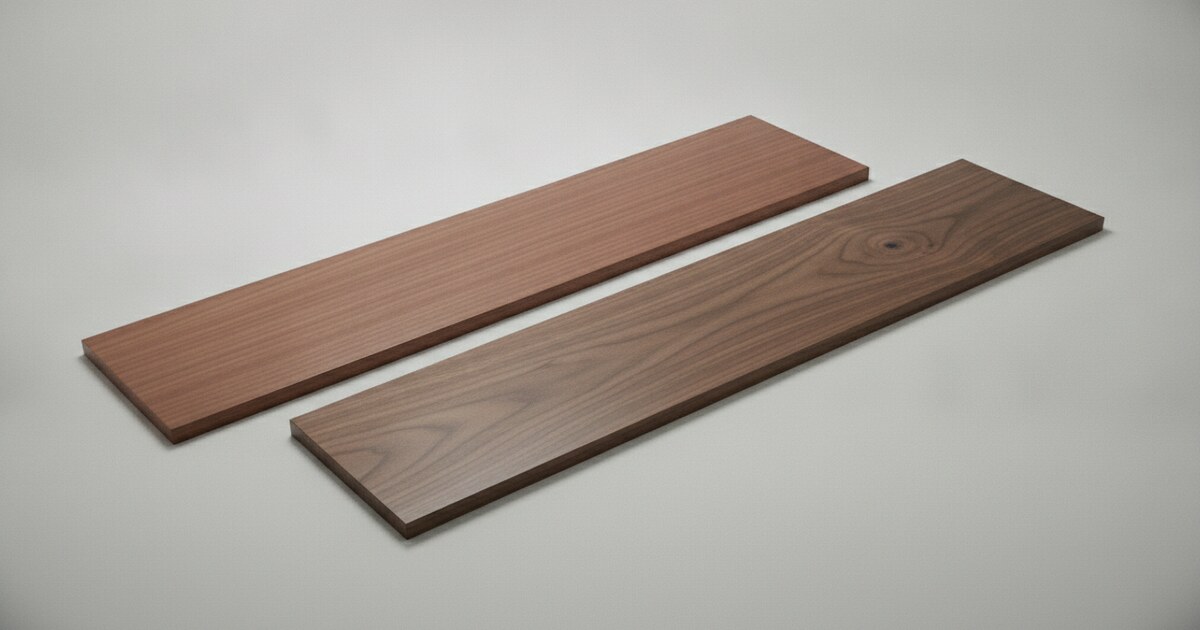
Both woods show up on the same premium furniture showroom floor, in overlapping price ranges, in similar brown tones. Under an oil finish, mahogany and walnut can be nearly impossible to separate by eye alone.
But they behave differently over decades. Their grain structures tell different stories under a loupe. And their color does something surprising with age: walnut starts darker and slowly lightens; mahogany starts lighter and deepens. Buyers who treat them as interchangeable end up disappointed when the patina moves the wrong way ten years in. This guide covers the differences that matter when you’re choosing between them or trying to identify a piece you already own.
Mahogany and walnut are both premium cabinet hardwoods that differ in hardness, stability, color aging, and price. Walnut (Janka 1,010 lbf) is harder than genuine mahogany (800-900 lbf) and moves significantly more across its grain. Mahogany starts reddish-brown and deepens with age; walnut starts dark chocolate and gradually lightens. Genuine mahogany runs $15-30/bf due to CITES trade restrictions; black walnut averages $8-15/bf.
Mahogany vs Walnut: Side-by-Side Numbers
The fastest way to understand these two woods is a direct property comparison.
| Property | Genuine Mahogany | Black Walnut |
|---|---|---|
| Janka Hardness | 800-900 lbf | 1,010 lbf |
| Density | 40 lbs/ft³ | 38 lbs/ft³ |
| Tangential Shrinkage | 4.1% | 7.8% |
| Radial Shrinkage | 2.5% | 5.5% |
| Price per Board Foot | $15-30 | $8-15 |
| End Grain Type | Diffuse-porous | Semi-ring-porous |
| CITES Regulated | Yes (App. II, 2003) | No |
Two numbers stand out: mahogany’s shrinkage (4.1% tangential, 2.5% radial) is remarkably low for a hardwood, which makes it stable in wide panels and door frames. Walnut moves nearly twice as much across its grain (7.8% tangential), so wide boards need more room to expand and contract with seasonal humidity.
Genuine mahogany (Swietenia macrophylla) grows across 12 countries from southern Mexico through Bolivia and Brazil, reaching 40-60 meters at maturity in old-growth forest. CITES Appendix II listing in 2003 restricted international trade: all exported timber now requires government permits, which drove prices sharply upward and pushed many North American suppliers toward African mahogany (Khaya ivorensis, ~830 lbf Janka, $6-10/bf) and meranti (Philippine mahogany, $4-7/bf) as substitutes. Black walnut (Juglans nigra) is native to the eastern United States and southern Ontario, growing best in the Ohio River valley on deep loam soils. Trees take 40-60 years to reach harvestable size, and long, knot-free boards are increasingly scarce, which explains walnut’s premium pricing despite no regulatory pressure. At 1,010 lbf Janka and 38 lbs/ft³, walnut is the harder and lighter-per-cubic-foot wood in standard workshop tests.
Color Over Time: The Aging Reversal
This is the difference that catches most buyers off guard.
Fresh walnut heartwood is deep chocolate-brown, sometimes with purplish or grayish undertones. It’s the darkest brown of any common North American cabinet hardwood. But walnut lightens with prolonged UV exposure. After 15-25 years in a sunlit room, walnut furniture can shift noticeably from near-black to a warm medium brown.
Mahogany moves in the opposite direction. Freshly cut, the heartwood is a medium reddish-brown, lighter than walnut in most cases. With age and UV exposure, it deepens: the reddish tones intensify, and the surface develops a characteristic warm glow. Quality antique mahogany from 18th and 19th-century English furniture shows this deepened color clearly.
The practical consequence: a walnut piece and a mahogany piece bought the same day can look strikingly similar 20 years later, after walnut has lightened and mahogany has deepened. Buy based on where each wood is going, not where it starts.
Sapwood contrast is also worth noting. Walnut’s sapwood is cream-white, completely distinct from the dark heartwood. Boards with sapwood edges show dramatic pale streaking that some designers prize and others reject. Mahogany’s sapwood is pale pinkish-buff, close enough to the heartwood that sapwood inclusions are far less visually jarring.
How to Tell Mahogany from Walnut
Color alone won’t reliably separate finished pieces. These three tests work better.
End grain under a loupe. Walnut is semi-ring-porous: the pores near the inner edge of each growth ring are noticeably larger, creating a subtle banded pattern. Mahogany is diffuse-porous: pores are roughly uniform throughout the growth ring, with no banding. This is the most reliable test on raw or freshly cut surfaces, and it works even on old pieces if you can reach an unfinished edge.
Storied rays and ribbon figure. Quartersawn genuine mahogany (and African mahogany) shows fine ladder-like ray patterns and ribbon figure from interlocked grain. Alternating light-dark stripes that run with the grain on a quartersawn board are a strong mahogany signal. Walnut doesn’t produce this ribbon effect.
Sapwood color. A cream-white edge against dark brown is almost certainly walnut. Mahogany’s sapwood is pale pinkish, not bright cream.
UV fluorescence (bonus test). Under a UV light, mahogany fluoresces reddish-orange; walnut fluoresces faintly blue-gray. This works through most oil and shellac finishes, which makes it useful on antique or veneered pieces where you can’t see end grain. The how to identify wood by grain guide goes deeper on loupe tests and pore pattern identification.
Hardness, Stability, and What They Mean for Your Project
Walnut’s 1,010 lbf Janka puts it comfortably in furniture and cabinetry territory: harder than cherry (950 lbf) and mahogany, softer than hard maple (1,450 lbf) or white oak (1,360 lbf). For flooring in residential settings with light traffic, walnut works. Mahogany’s 800-900 lbf is below what most flooring guidelines recommend for high-traffic areas.
Dimensional stability is where mahogany pulls ahead of walnut. With a tangential-to-radial ratio of roughly 1.6 and absolute numbers well below average for hardwoods, wide mahogany panels and door frames resist cupping and seasonal gap-and-swell cycles better than most alternatives. Walnut’s higher shrinkage numbers (7.8% tangential, 5.5% radial) mean furniture builders routinely use floating-panel construction on wide walnut pieces to accommodate seasonal movement. For the walnut vs cherry comparison, cherry falls between these two in stability.
Outdoor suitability: mahogany has moderate natural durability (Durability Class 3, European rating) and was widely used in boat building through the mid-20th century. Walnut is not rated for exterior use without regular refinishing.
Workability and Finishing
Mahogany’s reputation as the cabinetmaker’s wood of choice comes from how it behaves at every stage of the build.
The straight, fine grain planes cleanly with hand tools. Glue-ups are reliable. It accepts hardware threads without pre-drilling as often. Most finishes go on without blotching. The cellular structure means mahogany feels lighter in the hand than its 40 lbs/ft³ density suggests, reducing fatigue on long sessions.
Walnut is workable but less forgiving. Wavy or irregular grain in figured boards can tear out during planing if you’re not reading grain direction carefully. End grain absorbs stain unevenly on flat-sawn faces, so a pre-conditioner or seal coat helps before applying pigment stains. That said, walnut takes oil finishes beautifully and polishes to a deep, natural luster with relatively little effort.
For steam bending, mahogany is reliable. Walnut bends adequately but is less predictable on thick sections.
Which Mahogany Are You Actually Buying?
This distinction matters more than most guides acknowledge.
Genuine mahogany (Swietenia macrophylla, also called Honduran or big-leaf mahogany): CITES App. II since 2003, $15-30/bf. The benchmark species for tone, workability, and stability. Often labeled “true mahogany” or “genuine mahogany” by specialty suppliers.
African mahogany (Khaya ivorensis, K. anthotheca): $6-10/bf, Janka roughly 830 lbf, not CITES-listed. Comparable in workability and appearance. Slightly coarser grain and less color consistency than Swietenia, but a solid substitute for most furniture and millwork applications. Widely available at North American hardwood dealers.
Philippine/lauan mahogany (Shorea spp.): $4-7/bf, softer (600-900 lbf depending on species), coarser grain. Often sold as “dark red meranti” or “white lauan.” A different genus entirely, though the name persists in the trade for historical reasons.
If you’re buying “mahogany” from a big-box lumber yard, it’s almost certainly Khaya or Shorea. For instrument-grade tonewood or period furniture restoration, verify the species before buying. The how to identify mahogany wood guide covers end grain, ray patterns, and fluorescence across all three species.
Which Wood to Choose?
Choose mahogany for furniture, cabinetry, and musical instruments where dimensional stability and workability matter more than hardness. Wide panels, veneered doors, and carved detail work all benefit from mahogany’s low movement and clean machining. If budget allows, genuine Swietenia gives the best long-term result; African mahogany is a reliable, lower-cost alternative.
Choose walnut when you want the deeper starting color, the sapwood-heartwood contrast as a deliberate design feature, or you’re working in styles (mid-century modern, contemporary Scandinavian) where walnut’s grain character drives the aesthetic. For cutting boards, knife handles, and gun stocks, walnut’s higher hardness is a practical advantage.
Skip genuine mahogany if CITES documentation adds complexity to your supply chain. African mahogany gives you 90% of the performance at roughly a third of the price, with none of the trade paperwork.
For field identification of both species in more detail, the complete wood identification guide covers Janka testing, loupe techniques, and moisture content checks. Spotted an unknown piece of furniture and need a fast answer? The cherry vs mahogany identification guide includes additional visual ID methods that apply to mahogany vs walnut comparisons too.
Unsure what wood you’re looking at? Try the free wood identifier tool in your browser, or use the Tree Identifier app’s wood recognition feature with a photo of the grain or end grain surface.
Frequently Asked Questions
Is mahogany or walnut better for furniture?
Mahogany is easier to work with and more dimensionally stable (4.1% tangential shrinkage vs. walnut’s 7.8%), making it a better choice for wide-panel furniture, carved pieces, and anything that needs to stay flat in changing humidity. Walnut is harder (1,010 lbf vs. 800-900 lbf) and preferred for contemporary styles where its dark color and visible grain are part of the design intent.
Is mahogany worth more than walnut?
Genuine mahogany (Swietenia macrophylla) typically runs $15-30/bf, more than black walnut at $8-15/bf, because CITES Appendix II export restrictions since 2003 limit supply. African mahogany (Khaya) at $6-10/bf is usually cheaper than walnut. Price depends heavily on which species is sold as “mahogany” at a given supplier.
How do I tell mahogany from walnut on a finished piece?
Check the end grain with a loupe: walnut is semi-ring-porous (larger pores near each growth ring’s inner edge), mahogany is diffuse-porous (uniform pore size throughout). On quartersawn faces, genuine mahogany shows ribbon figure; walnut doesn’t. Under UV light, mahogany fluoresces reddish-orange; walnut fluoresces faintly blue-gray.
What is the disadvantage of mahogany wood?
The main disadvantages are price (genuine Swietenia runs $15-30/bf), CITES Appendix II trade restrictions that complicate sourcing in some markets, and a softer Janka rating (800-900 lbf) that limits suitability for high-traffic flooring. Genuine mahogany also requires sourcing verification to confirm it isn’t mislabeled African mahogany or Philippine lauan.
Try the Tree Identifier app to identify wood species from a photo — it works on cut lumber, end grain, and furniture surfaces as well as living trees. You get 2 free identifications per day, and the wood identifier tool gives you one free browser scan without downloading anything.
Identify a tree from your photo — free
Upload a leaf, bark, or whole-tree photo and get the species in seconds. No signup.
Confidence:
Unlock the full species profile
Free in the app — with unlimited identifications.


AI result for guidance — the app gives full species details and works offline.
Want unlimited identifications?
Get the full species profile, photos and details — free in the app, with unlimited scans.
- Unlimited identifications
- Full species profiles & details
- Works offline, anywhere
- Save and revisit your finds
Elena Torres
Tree Identifier Team