Oak vs Ash Wood: Grain, Hardness, and Uses Compared
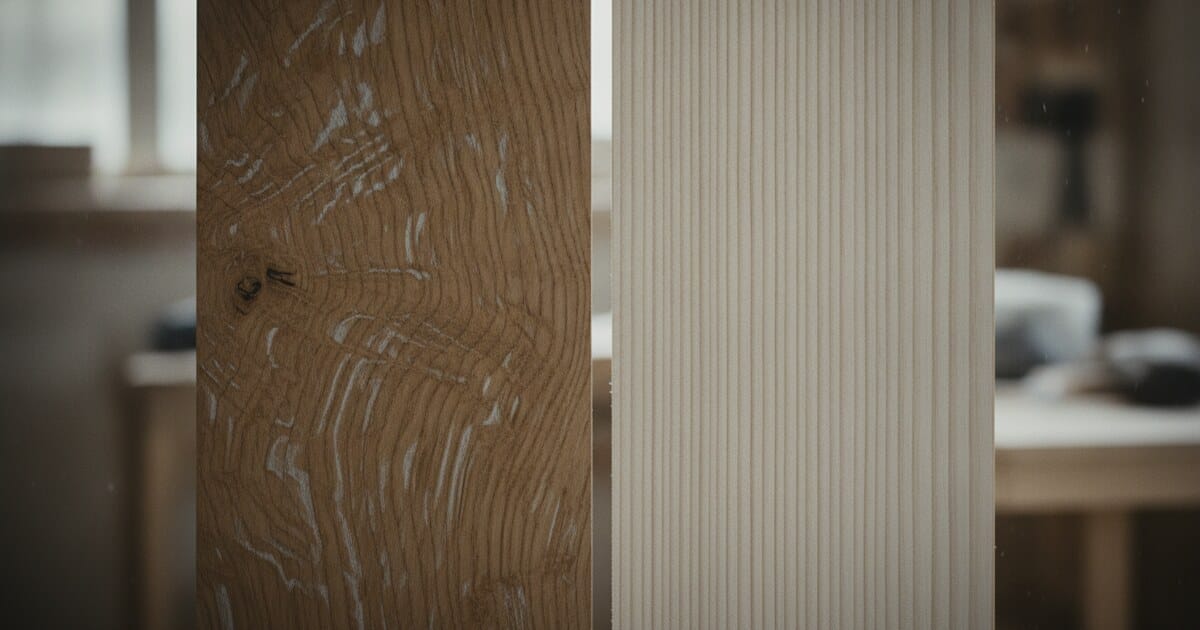
Oak and ash are two of the most popular hardwoods in North America and Europe, and they’re similar enough in weight, tone, and texture that woodworkers mix them up regularly. Both are ring-porous hardwoods with open grain, warm neutral tones, and strong reputations for durability. But they behave differently in the shop and hold up differently over time. Ash bends without breaking, which is why it ends up in baseball bats and axe handles. Oak resists moisture and rot, which is why it’s lined the inside of wine barrels for centuries. Whether you’re choosing lumber for a workbench, replacing kitchen floors, or trying to name an unmarked board at a salvage yard, knowing how to tell them apart is worth the two minutes it takes.
Oak and ash wood are close in hardness but differ in grain, tannin content, and best uses. Ash (Janka 1,320 lbf) has a straighter, paler grain and excellent flexibility, making it the choice for tool handles and sports equipment. Oak (Janka 1,290–1,360 lbf) has bolder grain, higher tannins, and greater rot resistance, better suited for flooring, furniture, and cooperage.
How Oak and Ash Look Different
Both woods have open, coarse grain, the defining visual characteristic of ring-porous hardwoods. At about a foot away, the differences are clear enough to call.
Ash runs pale. Fresh-cut boards are almost white with a light tan or cream cast, and the heartwood can drift toward a faint olive or gray-brown. The grain is straight and consistent, with growth rings forming neat parallel lines across the face grain. There’s very little visual complexity in a plain-sawn ash board, which is part of why Scandinavian and minimalist furniture makers love it.
Oak runs warmer. Red oak shows a pinkish-brown tone that deepens with age; white oak is more olive-brown with a slightly cooler, earthier cast. The grain is more variable, and on quartersawn cuts you’ll see medullary rays as streaky silver or gold fleck patterns across the face. Ash has no prominent ray fleck at all; those silver streaks are the fastest single tell for oak.
Oak and ash are both ring-porous hardwoods native to temperate forests across the Northern Hemisphere. White oak (Quercus alba) and red oak (Quercus rubra) dominate North American timber markets, while North American white ash (Fraxinus americana) and European ash (Fraxinus excelsior) represent the primary ash species in commerce. Oak’s most distinctive visual feature is its medullary rays: on quartersawn boards, these rays produce a silver-gold fleck pattern that ash completely lacks. Ash, by contrast, has exceptionally straight grain and higher wood-fiber uniformity than most hardwoods, which contributes to its shock-absorbing properties. On the Janka hardness scale, white oak scores 1,360 lbf, ash 1,320 lbf, and red oak 1,290 lbf (differences too small to matter in most applications). The practical dividing line is tannin content: oak is rich in tannins, which repel moisture, insects, and rot; ash contains almost none, making it less suitable for outdoor use but noticeably easier to stain and finish consistently.
Hardness and Durability: Which Wood Holds Up Better
A quick look at Janka numbers makes the two woods seem almost identical. White oak sits at 1,360 lbf, ash at 1,320 lbf, red oak at 1,290 lbf. In daily use, those 40–70 point gaps are irrelevant. A chair leg in either wood handles the same load.
The real durability gap comes down to tannin content, not hardness. Oak is rich in tannins, natural compounds that make the wood resistant to moisture, fungi, and insects. White oak takes this further: its cells fill with tyloses, microscopic ingrowths that physically block the pores and prevent liquid from moving through the wood. That’s why coopers have used white oak for wine and whiskey barrels for hundreds of years. Red oak doesn’t have tyloses, which is why it stays off the barrel list despite being nearly identical in hardness.
Ash has almost no tannins. Left outdoors without a protective finish, it deteriorates noticeably faster than oak. On interior projects or with regular finishing and upkeep, it performs fine, but ash decking exposed to rain without treatment won’t last.
One area where ash clearly beats oak: elasticity. Ash fibers absorb impact and flex back without splitting. Oak is strong but more brittle under sudden shock loads. That’s why nearly every wooden baseball bat, hockey stick, oar, and axe handle is ash or hickory. Oak doesn’t belong in those applications.
If you want help identifying which species you’re looking at on a piece of wood, the Tree Identifier app can recognize oak and ash from photos of the grain or cut surface (useful when the label is gone and the wood needs to be sourced correctly).
Which Wood Is Easier to Work With
Both woods cut, plane, and sand without drama, but ash has a slight edge in the shop.
Ash’s straight grain makes it predictable. It cuts cleanly across face, edge, and end grain, and it doesn’t tear out as readily as figured oak can. Because ash has no tannins, it accepts stains and dyes evenly: what you mix is what you get, with no blotching or uneven absorption. If you’re matching an existing stained piece, ash gives you more consistent results.
Oak is also workable, but its tannins create two specific complications. First, water-based polyurethane can react with oak tannins and produce a gray or greenish cast, particularly on red oak. Oil-based finishes generally work better without pre-sealing. Second, tannins can interfere with some PVA-based adhesives on older wood. A quick surface sand before gluing resolves this in most cases.
Both woods steam-bend reasonably well, but ash is the go-to for serious bending work. Windsor chair seat bows, barrel staves, and curved furniture components have traditionally used ash because it bends under steam and holds its shape without spring-back cracking.
For routing and carving, ash carves somewhat crisply along the grain. Oak has a slightly chunkier feel on detailed work, though both woods hold sharp edges in finished furniture without problems.
Oak vs Ash for Common Projects
Here’s how the differences translate into real-world choices:
Flooring: Both woods work well. White oak is the top choice for kitchens and bathrooms because tyloses give it better moisture resistance. Ash floors have a lighter, more contemporary look and work well in dry interior spaces. Note that ash availability has tightened across North America since the emerald ash borer (Agrilus planipennis), an invasive beetle from Asia first detected in Michigan in 2002, has killed hundreds of millions of ash trees. Ash lumber is harder to source in affected regions, and prices have shifted accordingly.
Furniture: Oak dominates for most furniture because of its tannin-based durability and the visual range available, from light blonde under a clear finish to deep espresso with a gel stain. Ash furniture has a cleaner, more uniform look that suits contemporary and Scandinavian styles.
Outdoor projects: White oak only. Ash isn’t suitable for outdoor use without heavy treatment and frequent maintenance.
Tool handles and sports equipment: Ash (or hickory). Its elasticity absorbs shock better than oak under repeated impact.
Barrels and cooperage: White oak exclusively, because of tyloses. Red oak and ash both fail for liquid containment.
Kitchen and cutting surfaces: Oak is the safer choice for food-contact surfaces. Tannins provide natural antimicrobial properties, and the wood’s density resists deep knife scoring.
How to Tell Oak from Ash Without a Label
If you’re staring at an unmarked board at a salvage yard, a few physical tests separate them fast.
Ray fleck check: Flip the board to the edge grain or a quartersawn face. Oak shows medullary rays as thin silver or golden streaks running perpendicular to the growth rings. Ash has no visible rays; the edge grain looks clean and parallel.
Color: Ash runs pale, nearly white or cream, occasionally with a faint yellow cast. Oak runs warmer, from pinkish-red (red oak) to olive-tan (white oak). If a board looks almost blonde or slightly yellow, it’s likely ash.
Smell: Freshly cut or planed oak has a distinct tannic, slightly acidic smell that most woodworkers recognize after working with it once. Ash has a milder smell with a faint sweetness.
Grain lines: Look down the length of the board face-on. Ash grain runs straight and parallel, almost like a barcode. Oak grain wanders more and may show faint medullary ray marks even on plain-sawn faces.
For a faster ID on an unmarked piece, the Tree Identifier app includes wood type recognition: photograph the end grain or face grain, and it returns the species along with key characteristics. It works on both oak and ash and covers dozens of other hardwood species commonly found at lumber yards and salvage shops. You can also try the free wood identifier tool in your browser without downloading anything.
For a broader look at wood identification techniques, the how to identify wood guide covers grain, density, smell, and scratch tests across dozens of species. For oak specifically, the how to identify oak wood guide breaks down the differences between red, white, and English oak. And for other hardwood comparisons, the maple vs birch wood article applies the same visual-test approach to two other commonly confused species.
Frequently Asked Questions
Is oak or ash wood stronger? They’re nearly identical in hardness: white oak 1,360 lbf, ash 1,320 lbf, red oak 1,290 lbf on the Janka scale. Oak is more durable outdoors due to higher tannin content and, in white oak, tyloses that block moisture. Ash is stronger under sudden impact because of its elasticity, which is why tool handles and sports equipment use ash rather than oak.
Which wood is better for furniture? Oak for most furniture, especially pieces that need to handle moisture or hold up over decades. Ash is excellent for contemporary furniture with a lighter, more uniform look. Ash accepts stains more evenly than oak, so if you want a predictable stained finish, ash makes the job easier.
Why is ash wood getting harder to find? The emerald ash borer, an invasive beetle from Asia first detected in Michigan in 2002, has killed hundreds of millions of ash trees across North America. This has reduced the available supply of ash lumber significantly in affected regions.
Does oak or ash look better? Depends on the goal. Oak has more visual character: richer tones, visible ray fleck, and more grain variation. Ash has a cleaner, more modern look with pale color and very straight grain. Scandinavian and contemporary furniture makers tend to favor ash for exactly that reason.
Can you use ash wood outdoors? Ash deteriorates relatively quickly outdoors without treatment because it lacks the tannins that give oak its natural rot resistance. For outdoor projects, white oak is the better choice. If you use ash outside, apply a penetrating oil or exterior-grade finish and reapply every 1–2 years.
When you’re working with unmarked boards or need to confirm a wood species before buying, a quick photo beats guessing at grain lines. The Tree Identifier app’s wood recognition feature identifies oak, ash, and dozens of other hardwoods from a photo of the cut surface or grain pattern, useful at lumber yards, salvage shops, and anywhere the label is long gone. Download the app on iOS or Android, or try the free web tool at treeidentifier.app/tools/wood.
Identify a tree from your photo — free
Upload a leaf, bark, or whole-tree photo and get the species in seconds. No signup.
Confidence:
Unlock the full species profile
Free in the app — with unlimited identifications.


AI result for guidance — the app gives full species details and works offline.
Want unlimited identifications?
Get the full species profile, photos and details — free in the app, with unlimited scans.
- Unlimited identifications
- Full species profiles & details
- Works offline, anywhere
- Save and revisit your finds
Elena Torres
Tree Identifier Team