How to Identify Walnut Wood: Color, Grain, and Key Tests
Walnut is one of the most prized hardwoods in North American woodworking, and also one of the most commonly misidentified. Dark cherry, stained mahogany, and certain oaks can look close enough at first glance to fool someone who doesn’t know the markers. The good news is that walnut has a consistent set of physical clues that make it reliably identifiable once you know the method. This guide covers color, grain, end grain, smell, weight, and patina, so you can identify walnut wood whether you’re looking at raw lumber, a piece of finished furniture, or a scrap in someone’s garage.
To identify walnut wood, check the heartwood first: chocolate brown with a purplish or gray cast, sitting in sharp contrast against creamy white sapwood. The grain is typically straight with a medium open texture and semi-ring-porous end grain. Freshly cut walnut has a mild nutty scent. Black walnut rates 1,010 lbf on the Janka scale.
What Walnut Wood Looks Like
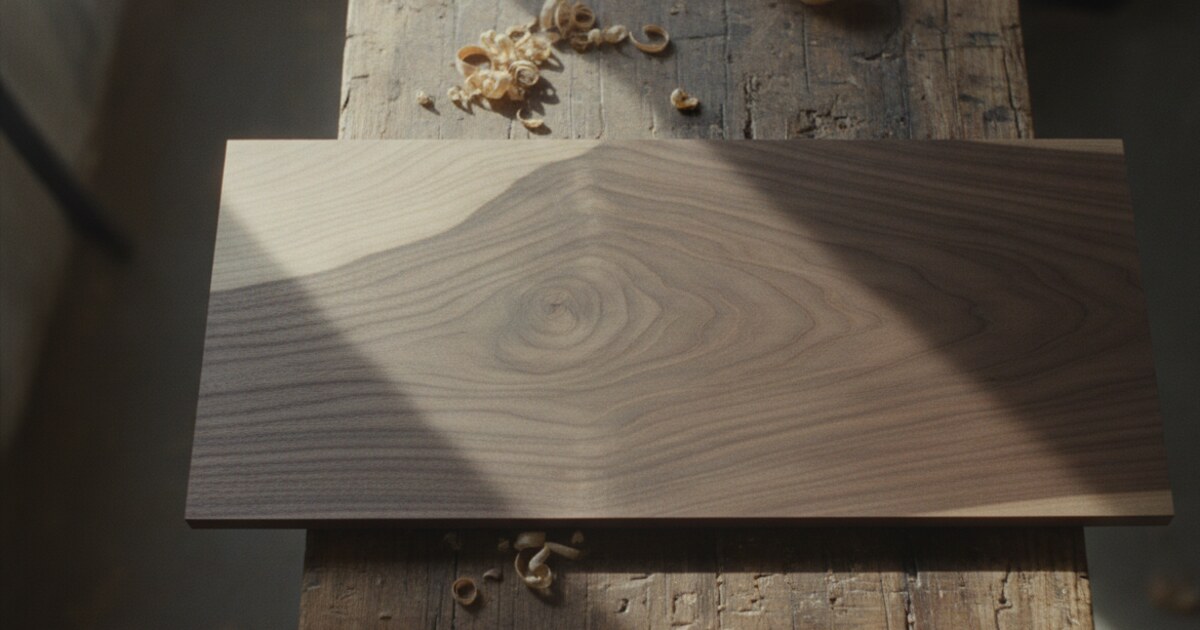
Color is the fastest first filter. Black walnut (Juglans nigra) heartwood runs from warm chocolate brown to deep chocolate brown, sometimes with purple or gray undertones that show up more or less depending on how the tree was dried. The sapwood is something else entirely: creamy white to pale yellowish-gray, usually 1 to 3 inches wide along the outside edges of a board.
That sharp heartwood-sapwood contrast is the most reliable early signal. Most dark hardwoods that get confused with walnut have more uniform cross-sections. Stained cherry, dark oak, and mahogany all lack that obvious creamy white border. When a board shows clearly differentiated zones, walnut should be your first candidate.
Black walnut (Juglans nigra) dominates North American woodworking and grows across the eastern United States and into the Great Plains. Heartwood ranges from medium to deep chocolate brown, with occasional purple or gray tones, particularly pronounced in air-dried and slow-dried stock. Sapwood runs 1 to 3 inches wide, distinctly creamy white. English walnut (Juglans regia), found in European and antique furniture, has lighter, grayer brown heartwood and rates harder at 1,220 lbf on the Janka scale. Claro walnut (Juglans hindsii) from California shows dramatic figure and a reddish-brown tone. Lighting changes how walnut reads: under fluorescent light the heartwood looks cooler and darker; under natural light it’s warmer and richer. Over decades, walnut heartwood lightens slightly while sapwood darkens, so antique walnut tends to read as a more uniform medium brown rather than the two-tone look of fresh stock.
How to Identify Walnut Wood by Grain and Texture
Walnut grain runs mostly straight, from one end of a board to the other with minimal deviation. Figured walnut (crotch figure, curly, burl) exists, but it’s premium specialty material, not typical yard lumber. If a board has wildly irregular grain but looks like walnut in color, check whether it might be a figured piece or a different species.
The texture is medium and open. On a freshly cut or sanded surface, individual pores are visible without magnification. Run your thumb across an unfinished face: walnut feels slightly coarser than cherry but noticeably smoother than red oak. That open-pore surface also means walnut absorbs stain and finish quickly and evenly.
End grain is where wood identification gets definitive. Walnut is semi-ring-porous: there’s a visible band of larger pores (earlywood) at the start of each annual ring, and smaller scattered pores through the rest (latewood). This pattern sits between diffuse-porous species like cherry and maple (uniform pores throughout) and fully ring-porous species like oak and ash (very pronounced earlywood pore band). If you can see the end grain on a piece you’re trying to identify, that intermediate semi-ring-porous pattern is a strong walnut signal. The how to identify wood guide covers this pore-pattern method across 15+ common species if you want a broader reference point.
The Smell Test and Other Quick Checks
Freshly cut walnut has a distinctive scent: mild, slightly nutty, and a bit sweet. It’s subtle, but it’s consistent. Cherry smells sharper and fruitier; mahogany has almost no scent; oak smells tannic and sharp. A quick pass with a saw, file, or belt sander brings the scent out. If you’re evaluating wood you can’t cut, scratching the surface with a nail sometimes releases enough to work with.
Weight is a useful cross-check. Black walnut has a density around 38 lb/ft³, with a specific gravity of 0.56. That puts it noticeably lighter than oak (about 45 lb/ft³) or maple (about 44 lb/ft³), but a bit heavier than cherry (about 35 lb/ft³). A board that looks like walnut but feels as heavy as oak deserves a second look.
Surface luster is one more signal. Walnut has a naturally lustrous surface that finishes smoothly without blotching. On a raw board, notice whether there’s a slight natural sheen even before any finish is applied. That quiet depth to the surface is characteristic.
Black Walnut vs English Walnut: Key Differences
Most walnut wood in North American shops and furniture is black walnut. English walnut turns up in European furniture and in some American antiques, particularly pieces made before the 20th century. The two are clearly related but visually distinct.
| Feature | Black Walnut | English Walnut |
|---|---|---|
| Color | Rich chocolate brown, purplish tones | Lighter brown, grayer cast |
| Janka hardness | 1,010 lbf | 1,220 lbf |
| Grain | Straight, occasionally wavy | Straight, often finer texture |
| Primary region | Eastern North America | Europe, Central Asia |
| Common use | Furniture, gunstocks, cabinetry | Furniture, gunstock veneers |
English walnut feels denser and harder than black walnut when you knock on it or press your thumbnail into the surface. The lighter, grayer tone is the clearest visual tell. For side-by-side comparisons with species that often get confused for walnut, the walnut vs cherry wood guide covers grain, gum pockets, and weight tests, and oak vs walnut wood gets into medullary rays, density, and porosity differences.
How to Identify Aged or Finished Walnut
Raw walnut is fairly easy to call. Finished or antique walnut is harder because stain changes the color and topcoat obscures grain detail.
On finished pieces, look first at any unfinished areas: the inside of drawers, the back of cabinet panels, the underside of a tabletop. These spots often retain raw or lightly finished wood where the color contrast and grain are still readable.
On antique pieces, expect a more uniform mellow brown. Decades of light exposure narrow the heartwood-sapwood color gap, so that sharp two-tone contrast in fresh walnut fades over time. The grain character doesn’t change, though. Look for the semi-ring-porous end grain at any exposed edge, like old dovetailed drawer fronts or the bottom panels of a chest. That pore pattern holds up through centuries.
One more tell on old walnut: the surface develops a warm, amber-tinged patina with depth to it. Stained wood looks flatter and more uniform when you tilt the piece in different light; walnut patina shifts and deepens as the angle changes.
How Tree Identifier Helps with Wood Identification
When visual and sensory tests leave you uncertain, a photo can settle it. Tree Identifier’s wood identification feature reads grain, color, and pore patterns from a photograph and matches them against a species database, returning a confidence-scored ID.
Take the photo in natural light on a clean, freshly cut or sanded surface. Flash flattens grain and washes out the color contrast that the AI relies on. Raw and unfinished surfaces produce more reliable results than heavily stained ones, though the app handles both. For wood samples, a photo of the end grain or a freshly surfaced face works best.
Tree Identifier gives you 2 free identifications per day on iOS and Android. If you’d rather not download the app first, try the free wood identification tool at treeidentifier.app/tools/wood for a quick browser-based check.
Frequently Asked Questions
How do I tell walnut from dark-stained cherry?
Look at unfinished areas first. Walnut heartwood is chocolate brown with a slight purplish cast; cherry is a cooler, more even reddish-brown. On raw surfaces, cherry often has visible gum pockets (small, dark resin deposits) that walnut doesn’t have. End grain is the clearest test: cherry is diffuse-porous (uniform pore distribution throughout), while walnut is semi-ring-porous (a visible earlywood pore band at each ring boundary).
What does antique walnut wood look like?
Antique walnut loses much of its heartwood-sapwood contrast over decades as both zones oxidize toward a warm medium brown. The grain character stays the same: straight, medium open texture, with a semi-ring-porous end grain. Antique English walnut pieces tend to have a finer grain and slightly lighter base tone than American black walnut. The surface patina on old walnut has a depth and warmth that’s difficult to replicate with stain.
Can I identify walnut wood from a photo?
A clear photo of a freshly cut or sanded surface in natural light gives a wood identification app enough to work with. The heartwood-sapwood color contrast, grain direction, and any visible end grain are the most useful cues. Tree Identifier’s wood ID feature cross-references grain and color patterns against its database and returns a confidence-scored result.
Is black walnut the only type of walnut wood?
Black walnut (Juglans nigra) dominates North American woodworking, but it’s one of several species. English walnut (Juglans regia) is the standard in European furniture and rates harder at 1,220 lbf. Claro walnut (Juglans hindsii) from California is known for dramatic figure and reddish-brown tones. Bastogne walnut is a Claro-English hybrid with burl-like figure. All share brown heartwood, creamy sapwood, and semi-ring-porous end grain.
If you’re trying to confirm a walnut identification and want a quick second opinion, try Tree Identifier’s wood ID feature. Take a photo of the grain or end grain in natural light and the app returns a species match in seconds. Download Tree Identifier on iOS or Android, or run a free scan at treeidentifier.app/tools/wood.
Identify a tree from your photo — free
Upload a leaf, bark, or whole-tree photo and get the species in seconds. No signup.
Confidence:
Unlock the full species profile
Free in the app — with unlimited identifications.


AI result for guidance — the app gives full species details and works offline.
Want unlimited identifications?
Get the full species profile, photos and details — free in the app, with unlimited scans.
- Unlimited identifications
- Full species profiles & details
- Works offline, anywhere
- Save and revisit your finds
Elena Torres
Tree Identifier Team