Wood Identifying Features of White Ash
White ash wood turns up in baseball bats, hammer handles, and hardwood floors, but it’s not always easy to pin down from a sample alone. The grain can look like oak at first glance, the hardness feels close to hickory, and the color shifts between pieces. Knowing the specific wood identifying features of white ash saves you time whether you’re restoring old furniture, sourcing lumber, or settling a workshop debate.
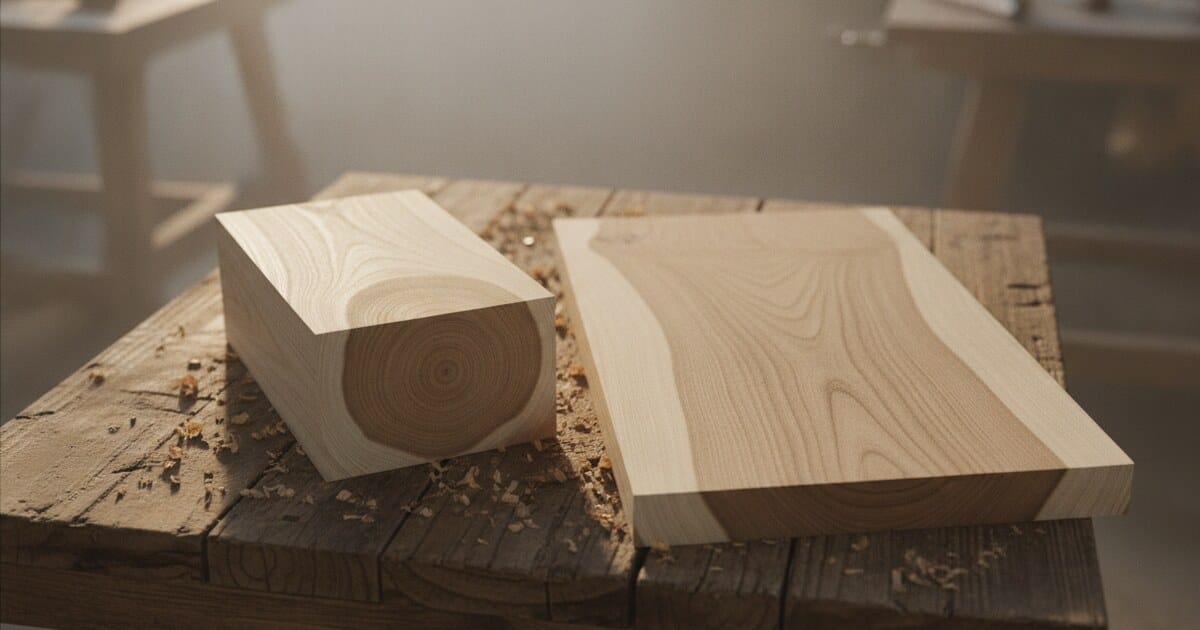
White ash wood has straight grain, ring-porous pores visible to the naked eye on an end-grain cut, and a wide creamy-white sapwood band that often runs 2-4 inches across. Heartwood is light to medium brown. Janka hardness is 1,320 lbf. The oversized sapwood band and ring-porous end grain together identify white ash faster than any other single test.
The Tree Identifier app includes wood type recognition alongside standard tree ID. Photograph the end grain or face grain, and it returns a species ID in seconds. Try it free on iOS or Android, 2 identifications per day at no cost.
Color and Appearance of White Ash Wood
The most useful visual clue is the sapwood. White ash carries one of the widest sapwood zones of any North American hardwood, often 2-4 inches thick on a full plank. That sapwood is creamy white to pale yellow, and it contrasts sharply with the heartwood. The boundary between them is usually a hard line, not a gradual fade.
Heartwood color runs light to medium brown. Some pieces show a faint olive or grayish cast, particularly in trees from cooler climates. Freshly sawn wood looks fairly neutral; the heartwood darkens slightly with age and light exposure, settling into a warm light tan over years.
On flat-sawn boards, the grain produces a prominent cathedral figure: sweeping arcs that run the full length of the board. On quartersawn pieces, that figure disappears and the grain straightens into parallel lines. Either way, white ash grain is straight. Wavy or interlocked grain is rare.
Grain and Pore Structure
White ash (Fraxinus americana) is a ring-porous hardwood: large pores form in the earlywood (spring growth) and are visible to the naked eye on an end-grain cut. This structure is shared with oak and hickory, but white ash rays are fine and inconspicuous, while red and white oak display large, prominent rays (often half an inch or more) visible across quartersawn boards. White ash growth rings run roughly 12 per inch in mature trees, compared to 28 per inch for black ash. Earlywood pores form one or two distinct rows; latewood pores are much smaller and scattered. Specific gravity runs around 0.60 air-dry, or roughly 42 lbs per cubic foot. The combination of ring-porous end grain, fine rays, and a wide pale sapwood band narrows identification to ash; growth ring count and sapwood width confirm white ash specifically.
To see the pores clearly, make a clean end-grain cut with a sharp chisel or pocket knife. The earlywood pores appear as a band of open holes at the inner edge of each growth ring. At 10x magnification, you can trace the rays crossing the rings. In oak, those rays are bold ribbon-like lines. In ash, they’re thin and easy to miss, which is the fastest way to separate the two species on a quartersawn face.
The cathedral figure on a flat-sawn face also helps. Oak’s prominent rays produce a ray-fleck pattern on quartersawn surfaces that ash never shows. If there’s no fleck on a quartersawn board, that removes oak from the list.
Field Tests to Confirm White Ash Wood
A few quick checks help narrow down an unknown hardwood at the bench:
Weight. At roughly 42 lbs per cubic foot, white ash is noticeably heavier than pine or basswood, about on par with red oak. Pick up a sample; it should feel dense and solid without being as heavy as hickory or hard maple. If the piece feels light, it’s probably not ash.
Scratch test. White ash has a Janka hardness of 1,320 lbf. Press your thumbnail firmly into the surface. It should leave almost no mark. A steel nail pressed hard will leave a shallow dent, but the wood resists more than softer hardwoods like black walnut (1,010 lbf) or poplar (540 lbf).
End grain exam. Make a fresh cross-cut and look at the end face. Ring-porous structure means large, open pores in a distinct band at the start of each growth ring. If the pores are evenly distributed across the ring (diffuse-porous, like maple or cherry), it’s not ash. Open the Tree Identifier app, photograph that end-grain cut directly, and get a species match within seconds. The app reads ring-porous pore patterns accurately from a photo. Download it for iOS or Android before you put the chisel away.
Smell. Fresh-cut white ash has a mild, faintly musty smell. It lacks the sharp resinous note of fresh pine and the chocolate-coffee scent of fresh black walnut. Ash smell alone won’t confirm species, but the absence of a strong odor rules out several other hardwoods.
Surface texture. Run a finger across a freshly planed face. White ash is coarse, with visible pores on the surface. Maple and cherry feel noticeably smoother because their pores are much smaller.
White Ash vs. Similar Hardwoods
Several common hardwoods get confused with white ash. Here’s how to separate them:
| Feature | White Ash | Red/White Oak | Hickory | Black Ash |
|---|---|---|---|---|
| Janka hardness | 1,320 lbf | 1,290-1,360 lbf | 1,820-2,260 lbf | 850 lbf |
| Pore structure | Ring-porous | Ring-porous | Ring-porous | Ring-porous |
| Medullary rays | Fine, narrow | Bold, wide | Fine to medium | Fine |
| Sapwood | Very wide, pale | Moderate width | White, often narrow | Wide, pale |
| Growth rings/inch | ~12 | ~8-15 | ~10-15 | ~28 |
| Weight (air-dry) | ~42 lbs/ft³ | ~44-47 lbs/ft³ | ~51-54 lbs/ft³ | ~34 lbs/ft³ |
White ash vs. oak. Hardness values overlap, pore structure is similar, and both have straight grain. The separator is medullary rays. Oak’s rays are wide, ribbon-like, and show up on any quartersawn surface without magnification. Ash rays are thin and inconspicuous. A 10x loupe confirms it in under a minute. Our oak vs. ash wood guide covers this comparison in more depth.
White ash vs. hickory. Hickory is substantially harder (1,820-2,260 lbf depending on species) and denser, around 51 lbs per cubic foot. A piece of hickory feels noticeably heavier than ash of the same dimensions. Hickory also tends to show more color variation, with dark brown or reddish streaks through both sapwood and heartwood.
White ash vs. black ash. These species are related, but the wood is different enough to separate. Black ash is softer (850 lbf), lighter (about 34 lbs/ft³), and grows primarily in swampy lowlands. Growth rings in black ash average around 28 per inch vs. 12 for white ash. Black ash splits cleanly along growth rings into thin splints, a property traditional basket-makers rely on. White ash doesn’t split this way.
White ash vs. green ash. The hardest separation. Green ash (Fraxinus pennsylvanica) looks almost identical in wood. Sapwood is typically a bit narrower on green ash, and heartwood runs slightly darker, but the difference is subtle. Commercially, green ash and white ash lumber are often grouped together under the generic “ash” label. Confirming the exact species usually requires the tree itself.
Common Uses That Help Confirm White Ash Wood
If you’re trying to identify an old piece of wood, knowing where white ash typically appears narrows things down quickly. White ash has a specific combination of properties that makes it the default choice for certain applications: straight grain for impact resistance, medium hardness for workability, and good shock absorption.
- Tool handles. Axes, hammers, hatchets, shovels, and rakes. White ash was the standard for tool handles in North America for over a century.
- Baseball bats. Major league bats were almost exclusively white ash until maple became popular in the 1990s. Ash bats flex slightly on impact; some hitters prefer that response.
- Sports equipment. Hockey stick shafts, lacrosse handles, oar shafts, and canoe paddles.
- Hardwood flooring. Popular for its hardness, consistent grain, and ability to take stain well.
- Furniture and cabinetry. White ash bends well with steam and finishes cleanly, making it practical for chair backs and curved pieces.
Finding wood in one of these applications labeled generically as “ash” almost always means white ash. It’s been the dominant commercial ash species in the eastern United States for over a century.
How Tree Identifier Helps Identify White Ash Wood
The Tree Identifier app has a wood type recognition feature built alongside the standard tree identification. You photograph the wood sample, and the AI identifies the species from grain pattern, texture, and color.
End grain works best for wood identification because the pore structure and ray patterns are most visible there. Make a clean cut, photograph it in good natural light, and upload it. The app reads the ring-porous pattern and cross-checks it against species in its database.
Face grain also produces good results for white ash because the cathedral figure and pore size are distinctive enough for the AI to work with. If you’re unsure which angle to photograph, take both.
The app works on iPhone and Android. Offline mode is available if you download the species data beforehand, which means it works on remote job sites or in a workshop without a signal. You get 2 free identifications per day without an account.
Frequently Asked Questions
How do I tell white ash wood from oak by looking at it?
Check the medullary rays. On a quartersawn face, oak shows wide, ribbon-like rays visible to the naked eye, often appearing as pale flecks across the surface. White ash rays are fine and inconspicuous, practically invisible without magnification. On flat-sawn boards, look at end grain: both are ring-porous, but the ray width difference is the clearest separator between the two species.
What is the Janka hardness of white ash wood?
White ash has a Janka hardness of 1,320 lbf (pounds-force). That puts it in the hard end of North American hardwoods, harder than black walnut (1,010 lbf) and softer than hard maple (1,450 lbf) or hickory (1,820-2,260 lbf). It’s close to red oak (1,290 lbf) and white oak (1,360 lbf), which is part of why the two species get confused.
Is white ash a hardwood or softwood?
White ash is a hardwood, botanically speaking, because it’s a flowering deciduous tree (angiosperm). Hardwood and softwood refer to the tree type, not the actual density of the wood. White ash is also hard in practice at 1,320 lbf Janka, unlike some softer hardwoods such as balsa or poplar.
What does white ash wood look like on the end grain?
The end grain shows a ring-porous structure: large, visible pores in a distinct band at the inner edge of each growth ring (earlywood), with much smaller pores scattered through the outer ring (latewood). The rays crossing the rings are fine and narrow. Growth rings on a mature white ash average about 12 per inch, which is tighter than black ash (28 per inch) and looser than many conifers.
How do I tell white ash from black ash by the wood?
The most reliable check is weight and hardness. Black ash weighs around 34 lbs per cubic foot compared to white ash at 42 lbs per cubic foot, so it feels noticeably lighter. Janka hardness is 850 lbf for black ash vs. 1,320 lbf for white ash. Growth rings in black ash are much tighter (about 28 per inch). Black ash also splits cleanly along growth rings when you wedge it; white ash doesn’t.
If you’ve got an unidentified hardwood at the bench and it has ring-porous end grain, a wide pale sapwood band, fine rays, and weighs about 42 lbs per cubic foot, white ash is the best fit. Download Tree Identifier free for iOS or Android to confirm the species from a photo, including cut lumber, old tool handles, or finished wood. The wood identification feature works the same as the tree ID: snap a photo, get a result.
For more on identifying wood species by structure, see the full how to identify wood guide and the section on how to identify wood by grain.
Identify a tree from your photo — free
Upload a leaf, bark, or whole-tree photo and get the species in seconds. No signup.
Confidence:
Unlock the full species profile
Free in the app — with unlimited identifications.


AI result for guidance — the app gives full species details and works offline.
Want unlimited identifications?
Get the full species profile, photos and details — free in the app, with unlimited scans.
- Unlimited identifications
- Full species profiles & details
- Works offline, anywhere
- Save and revisit your finds

Elena Torres
Tree Identifier Team