Oak vs Walnut Wood: Color, Grain, and Hardness
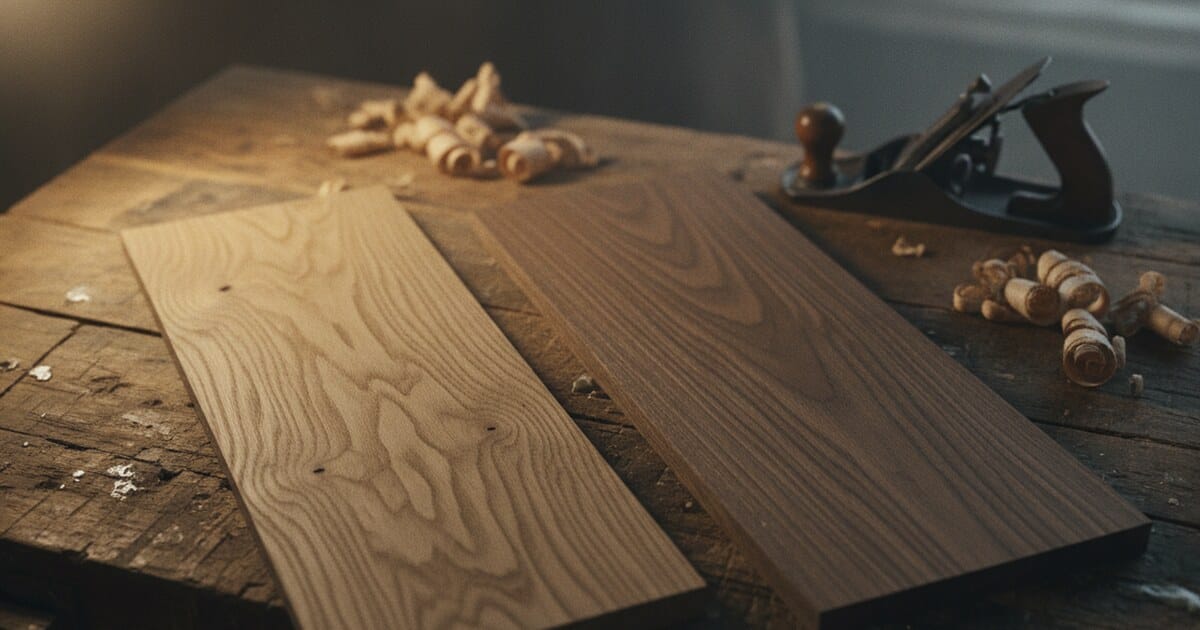
Some carpenters call them the yin and yang of American hardwoods. Oak is the light one: golden-tan, bold-grained, tough, and priced for large builds. Walnut is the dark one: chocolate-brown, quieter in texture, and noticeably pricier per board foot. Both appear constantly in American furniture, flooring, and cabinetry across the last two centuries. If you’re choosing between oak vs walnut wood for a project, or trying to identify a piece already in your home, the differences run deeper than color alone.
Oak and walnut differ mainly in color, grain, and hardness. Oak runs golden-tan with bold open grain and a Janka rating of 1,290-1,360 lbf. Walnut settles into deep chocolate-brown with finer, semi-ring-porous grain and a Janka of 1,010 lbf. Oak costs less and holds up better in high-traffic floors; walnut moves less with humidity changes and finishes beautifully without stain.
How to Tell Oak from Walnut at a Glance
Color is the fastest separator and works on both finished and raw wood. Fresh-sawn oak ranges from pale pinkish-tan (red oak) to warm golden-brown (white oak). Finished oak deepens gradually toward amber with decades of UV exposure, but the shift is slow and generally flattering. Fresh-sawn walnut is unmistakably dark: a deep chocolate-brown that sometimes carries faint purple undertones in the heartwood.
Sapwood gives you another quick check. Oak sapwood blends relatively close to the heartwood in color. Walnut sapwood is dramatically lighter, a pale cream or light tan that stands in sharp contrast to the dark center. Furniture makers usually trim it away, though some use it deliberately for two-tone contrast.
Surface texture works too on unfinished boards. Oak has a coarse, open surface with pores large enough to feel with a fingernail. Walnut feels smoother even before sanding. If you’re comparing raw boards at a lumber yard and can’t see the end grain clearly, texture alone usually settles the identification.
Grain and Pore Structure: The Fastest ID Method
End grain is where oak and walnut separate most definitively. Oak is ring-porous: its large earlywood pores, formed in spring, are clearly visible to the naked eye in cross-section, arranged in a distinct band around each annual growth ring. You can see them without magnification on any board or furniture leg. Walnut is semi-ring-porous: the pores are smaller and more evenly spread, with only slight variation between earlywood and latewood. If you have access to the end grain, this distinction takes about two seconds. A full breakdown of pore patterns across species is in the wood grain identification guide.
Quartersawn face grain tells a complementary story. Oak’s medullary rays, the tissue running from pith to bark, produce the broad silver-gray flecks that define quartersawn white oak. They’re prominent enough to see from across a room. Walnut’s rays are much finer and narrower, rarely forming a visible pattern. This feature alone identifies quartersawn oak from quartersawn walnut instantly.
Long-grain patterns differ in the flat-sawn look too. Oak tends toward a bold, somewhat wavy grain with clear contrast between growth rings. Walnut shows a straighter, more uniform grain with subtler ring lines, giving wide boards a quieter, more consistent appearance. The wood identification guide covers how to read pore structure and ray patterns across more species.
Oak vs Walnut: Hardness, Density, and Stability
These four measurements answer most practical questions about durability and movement:
| Property | Red Oak | White Oak | Black Walnut |
|---|---|---|---|
| Janka hardness | 1,290 lbf | 1,360 lbf | 1,010 lbf |
| Density | 44 lbs/ft³ | 47 lbs/ft³ | 38 lbs/ft³ |
| Tangential shrinkage | 8.6% | 10.5% | 7.8% |
| Radial shrinkage | 4.0% | 7.2% | 5.5% |
Black walnut’s Janka rating of 1,010 lbf puts it at the softer end of North American hardwoods, comparable to cherry (950 lbf) and roughly 300 lbf below both red oak (1,290 lbf) and white oak (1,360 lbf). In flooring, that gap shows up directly as scratch and dent resistance: white oak holds up noticeably better than walnut over five to ten years of daily use in kitchens and entryways. Walnut handles residential living rooms, home offices, and dining tables without trouble; its limits emerge in commercial spaces or heavy-use family kitchens. Density follows the same line: white oak at 47 lbs/ft³ is substantially heavier than walnut at 38 lbs/ft³, which matters in shipping weight and how pieces feel to move. Shrinkage is where walnut pulls ahead: its lower tangential shrinkage (7.8% vs white oak’s 10.5%) means walnut boards move less with seasonal humidity swings, reducing the risk of gapping in dry winters.
How Each Wood Ages with Light
Both species change color over time, but in opposite directions.
Oak holds its tone. Red and white oak shift modestly toward a deeper amber with UV exposure, but the change is slow and mostly flattering. A red oak floor from the 1990s looks older in a good way, with deepened warmth rather than any dramatic departure from its original color.
Walnut lightens. New black walnut starts dark and rich, but UV exposure pulls it toward a lighter, more golden-brown tone over years of window light. A walnut dining table near a south-facing window can show visible lightening within five to eight years. Keeping window treatments closed on bright exposures slows the process considerably.
The sapwood contrast in walnut also diminishes as the heartwood lightens toward the sapwood’s pale tone. On finished pieces where both were left visible, the contrast that looked dramatic at purchase often moderates over a decade of sunlight.
Price, Best Uses, and When to Choose Each
Oak runs $3 to $8 per board foot at most hardwood retailers, with red oak at the lower end and white oak at the higher. Walnut runs $8 to $15 for clear, kiln-dried boards, and significantly more for figured pieces or wide live-edge slabs. The gap shrinks on small projects: a walnut desktop adds maybe $40 to $60 more in lumber than oak. On a full kitchen’s worth of cabinet boxes, the same percentage premium can add $800 to $1,500.
Choose oak for:
- High-traffic floors, especially kitchens and entryways
- Cabinet boxes and face frames where cost matters across a large run
- Outdoor furniture (white oak only, whose closed tyloses resist moisture reliably)
- Any structural piece where hardness and wide availability drive the decision
Choose walnut for:
- Dining tables and benches where the surface does the visual work
- Live-edge slabs and statement pieces
- Smaller decorative builds where the cost premium is proportionally manageable
- Any piece where you want rich color without staining
Both woods take oil finishes, lacquer, and polyurethane well. Oak’s open grain accepts stain readily but can look blotchy without pre-conditioning. Walnut almost never needs stain: the natural chocolate-brown is rich enough, and darkening it further usually flattens the contrast in the grain. For a similar tradeoff between a utilitarian species and a warmer decorative one, the walnut vs cherry wood guide covers closely related choices at the same price tier.
How Tree Identifier Helps with Wood ID
When you’re trying to identify oak or walnut from salvaged lumber, an antique piece, or a sample board at a shop, a photo can settle the question faster than any written description. The Tree Identifier app’s wood identification feature analyzes photos of grain texture, pore structure, and surface appearance to return species-level results with a confidence score.
For oak versus walnut specifically, the contrast in pore size and ray pattern usually gives the AI a clear read from a standard face-grain photo. A close-up of the end grain improves accuracy further. The app works on both iOS and Android with 2 free identifications per day. If you want to check a sample without downloading anything, the wood identifier tool at treeidentifier.app/tools/wood-identifier runs one free scan per visit directly in the browser.
Frequently Asked Questions
Is walnut harder than oak?
Oak is harder than walnut. White oak scores 1,360 lbf on the Janka scale and red oak scores 1,290 lbf, while black walnut scores 1,010 lbf. That 280 to 350 lbf gap makes oak noticeably more resistant to scratches and dents, particularly in flooring and tabletops that take daily contact from chairs and dishes. Walnut is still a real hardwood; it just shows wear more quickly in high-traffic spots.
Which costs more, oak or walnut?
Walnut costs roughly twice as much as oak per board foot. Clear red oak typically runs $3 to $5, white oak $5 to $8, and black walnut $8 to $15 or more. That difference stays manageable on small projects but compounds fast on full room floors or kitchen cabinets, where the lumber bill can run 2 to 3 times higher for walnut than for comparable oak.
Can you stain oak to look like walnut?
You can stain oak dark to approximate walnut’s tone, but the grain pattern stays different. Oak’s prominent open pores and medullary ray flecks don’t disappear under a dark stain; they show through it. An experienced eye usually distinguishes stained oak from natural walnut by the visible pore lines and broad ray patterns that walnut doesn’t have. Gel stain reduces blotching but doesn’t eliminate the structural grain difference.
Which is better for furniture, oak or walnut?
Oak suits furniture that takes heavy daily use: kitchen chairs, benches, children’s tables, anything that gets scraped and bumped regularly. Walnut suits furniture where the surface is the point: dining tables, desks, and display pieces where the chocolate-brown grain does the decorative work. Both hold up fine under normal residential use; the decision usually comes down to budget and the visual look you’re after.
How do you identify oak versus walnut in an antique piece?
Color is the first check: oak runs warm golden-brown, walnut runs chocolate-brown even after decades of aging. On the end grain of a leg or drawer edge, oak shows clearly visible open pores in a ring-porous pattern; walnut’s pores are smaller and more evenly spread. Oak also shows prominent ray flecks on flat-sawn surfaces that walnut lacks. In aged, heavily finished pieces where color has shifted, end grain is the most reliable confirmation. The antique furniture wood identification guide covers period-specific wood pairings alongside these visual checks.
Identify a tree from your photo — free
Upload a leaf, bark, or whole-tree photo and get the species in seconds. No signup.
Confidence:
Unlock the full species profile
Free in the app — with unlimited identifications.


AI result for guidance — the app gives full species details and works offline.
Want unlimited identifications?
Get the full species profile, photos and details — free in the app, with unlimited scans.
- Unlimited identifications
- Full species profiles & details
- Works offline, anywhere
- Save and revisit your finds
Elena Torres
Tree Identifier Team