How to Identify Maple Wood: Color, Grain, and Tests
Maple wood shows up everywhere: kitchen cabinets, butcher block counters, hardwood floors, baseball bats. But grab a board at the lumber yard and it’s easy to second-guess yourself. Maple looks a lot like birch. Hard maple and soft maple look similar to each other. And once wood has been stained or finished, the differences narrow even further. This guide breaks down how to identify maple wood through visual markers, grain patterns, and a few quick hands-on tests that work even on finished pieces.
To identify maple wood, look for a pale cream color, fine uniform grain, and no visible pores on the end grain. Hard maple (Acer saccharum) is nearly white with a pink-buff cast; soft maple is slightly darker and grayer. Both are dense hardwoods with a diffuse-porous end grain that separates them from ring-porous species like ash and oak.
Maple Wood Color and Texture: What to Look For
Fresh-cut maple has a distinctive pale, almost creamy color. Hard maple sapwood sits in the white-to-light-cream range, sometimes with a slight pinkish or reddish-buff cast. The heartwood, when it appears, shifts toward a reddish-brown, but most maple lumber sold for furniture or flooring is predominantly sapwood, so pale cream is what you’ll see most often.
Soft maple runs a few shades darker. Silver maple (Acer saccharinum) and red maple (Acer rubrum) tend toward a grayish tan or light brownish tone. Color alone won’t give you a definitive ID, but it narrows things down fast.
The texture of maple is fine and even across the board. Run your fingers across the surface and you’ll feel almost no variation; the grain is close and tight. This smooth surface is part of why maple is popular for cutting boards and workbenches. It resists denting and scratching better than most light-colored hardwoods.
One critical note on stained maple: maple blotches badly under oil-based stains because it absorbs finish unevenly. If you’re looking at a piece of dark-stained wood and the stain looks patchy or uneven, maple is a strong candidate.
Hard Maple vs Soft Maple: Side-by-Side
The terms “hard maple” and “soft maple” refer to distinct species, not just quality grades. Hard maple is almost always Acer saccharum (sugar maple), the same species tapped for maple syrup. Soft maple covers several species: red maple (Acer rubrum), silver maple (Acer saccharinum), and bigleaf maple (Acer macrophyllum) on the West Coast.
Hard maple registers 1,450 lbf on the Janka hardness scale. That puts it among the hardest North American hardwoods, harder than white oak (1,360 lbf) by about 7%. Soft maple ranges from 700 to 950 lbf depending on species, roughly in the same range as black cherry or black walnut.
In practice, this means hard maple resists denting and scratching noticeably better. Flooring, gymnasium floors, and bowling alleys almost always use hard maple specifically because of this toughness. Soft maple works fine for furniture and cabinetry, but you wouldn’t use it where heavy foot traffic is expected.
Beyond hardness, hard maple has a slightly tighter, more uniform grain. Soft maple often shows streaks or mineral discoloration (grayish or greenish patches) that make it look less clean than hard maple. These mineral streaks are actually common in red maple logs and are one reason soft maple lumber is sometimes sold at a discount despite being perfectly structurally sound.
How to Identify Maple Wood by Grain Pattern
Grain pattern is one of the most reliable ways to confirm maple. Under normal circumstances, maple has a straight, close grain with a fine, consistent texture. But several figured variants show up frequently enough that recognizing them is useful.
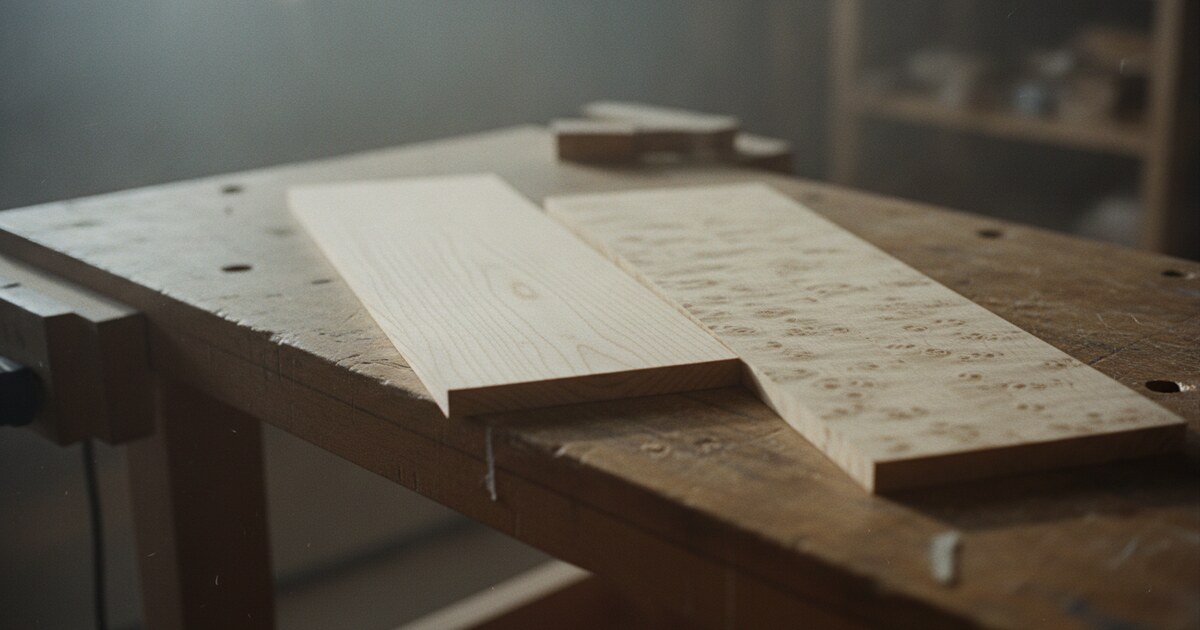
Bird’s eye maple shows small, round or oval figures scattered across the surface, each roughly the size of a bird’s eye (hence the name). This figure occurs in hard maple almost exclusively and is caused by abnormal growth indentations in the annual rings. Bird’s eye boards are rare enough to command a significant price premium.
Curly or tiger maple shows wavy, rippling lines running perpendicular to the length of the board. Tilt the board under a light and the figure appears to shift and move. This figure occurs in both hard and soft maple. It’s common enough in violin backs and guitar necks that luthiers often call it “fiddleback maple.”
Quilted maple has a three-dimensional puffy pattern, almost like fabric draped over a surface. It’s rarer than curly figure and tends to appear in bigleaf maple from the Pacific Northwest.
Spalted maple shows dark black lines running through the wood, created by fungal activity in a log that sat damp for a time before milling. The wood is still structurally sound when properly dried. Spalted boards are prized for decorative work but wouldn’t be used in structural applications.
If you’re working with plain, unfigured maple, look for consistent, straight grain with no dramatic color shift between adjacent boards. Grain lines run nearly parallel to each other, with no pronounced ray fleck like you’d see in quartersawn white oak.
Three Hands-On Tests for Confirming Maple
The End Grain Test (Most Reliable)
Flip the board over and look at the end grain. Maple is diffuse-porous: the pores (vessel openings) are so small they’re essentially invisible to the naked eye, and they’re distributed evenly across the growth rings rather than concentrated in a band.
Compare this to ash or oak, which are ring-porous hardwoods with clearly visible rows of large pores at the start of each annual ring. Ash’s end grain looks almost like a fingerprint with distinct lines of large holes. Maple’s end grain looks smooth and uniform, almost like fine stone.
This test works even on finished wood if you can see the end grain. A magnifying glass confirms it: under 10x magnification, maple end grain shows fine, evenly distributed pores with no clustering pattern.
The Weight Test
Hard maple is dense: roughly 44 lbs per cubic foot (705 kg/m³). Pick up a hard maple board and it’s noticeably heavy for its size: heavier than pine, heavier than poplar, heavier than many species that look similar in color. Soft maple comes in around 32–38 lbs per cubic foot, still meaningfully heavier than most softwoods.
If you’re comparing two similar-looking boards and one feels substantially heavier, the heavier one is more likely hard maple.
The Scratch Test
Hard maple resists fingernail scratches. Press a fingernail firmly into a hidden area: maple either leaves no mark or a very faint one. Birch, which can look almost identical to maple in color, is noticeably softer and shows a fingernail scratch more easily. Soft maple falls somewhere between the two, with some resistance but less than hard maple.
This test works best when comparing two pieces side by side. On its own, a single piece is hard to judge without a reference point.
Maple vs Look-Alike Species
Maple gets confused most often with birch, ash, and beech. Here’s how to separate them.
Maple vs birch: Both are pale, fine-grained hardwoods. The clearest difference is end grain: maple is diffuse-porous (no visible pores), birch is semi-ring-porous (faint lines of slightly larger pores appear at annual ring boundaries). Birch also has a slightly more pronounced ray pattern on flat-sawn surfaces and a distinct, slightly sweet smell when freshly cut. Hard maple is also significantly denser than yellow birch (Janka 1,260 lbf vs 1,450 lbf for hard maple). For a full breakdown of every visual and practical difference, the maple vs birch wood guide covers both species side by side.
Maple vs ash: Ash is ring-porous: its end grain shows obvious parallel rows of large pores at the start of each growth ring. Maple’s end grain shows no such pattern. Ash also has a much more pronounced, coarser grain on the face, with visible growth ring definition that creates a striped appearance. Maple’s face grain is smooth and uniform.
Maple vs beech: Beech and maple are close in color, but beech shows distinctive, small, reddish-brown flecks or rays scattered across flat-sawn surfaces (especially prominent on quartersawn beech). Maple’s surface is clean and uniform without these flecks. Hard maple (1,450 lbf) and American beech (1,300 lbf) are close in hardness, but the fleck test on the face grain separates them reliably.
For a deeper look at identifying different hardwoods by grain alone, the guide to types of wood grain patterns covers the visual differences across the most common North American species.
When You’re Not Sure: Use a Photo ID App
If you’re looking at a piece of wood and the hands-on tests still leave you uncertain, a photo-based identification can help. Tree Identifier’s wood recognition feature works from photos of the grain, texture, and surface, useful when you have a cut board or a piece of furniture without any original labeling.
The app handles multiple input types: grain patterns on flat-sawn faces, end grain texture, and even bark photos if you’re trying to match a log to a milled board. It works offline too, so you can use it at the lumber yard or in a workshop without a signal.
For identifying wood from a piece of furniture or a panel you can’t cut, the guide to how to tell what kind of wood furniture is made of walks through the same visual tests applied to finished pieces.
Frequently Asked Questions
Is maple wood a hardwood? Yes. Hard maple (Acer saccharum) is one of the hardest North American hardwoods at 1,450 lbf on the Janka scale, harder than white oak. Soft maple species (red maple, silver maple) are also technically hardwoods (they’re deciduous and broad-leaved), but they’re considerably softer than hard maple, ranging from 700 to 950 lbf.
What does maple wood look like compared to birch? Both are pale and fine-grained, but end grain separates them. Maple is diffuse-porous with no visible pores; birch shows faint semi-ring-porous lines. Birch also scratches more easily than hard maple. Side by side, maple tends to be slightly creamier and birch slightly more yellowish in tone.
How can I tell hard maple from soft maple? Color and weight are the fastest cues. Hard maple is almost white with a subtle pink-buff cast; soft maple is slightly darker, more grayish or tan, and often shows mineral streaks. Hard maple is also noticeably heavier (44 lbs/ft³ vs 32–38 lbs/ft³ for soft maple) and resists a fingernail scratch much better.
Does maple have a smell? Freshly cut maple has a mild, slightly sweet smell, but it’s subtle and not as distinctive as walnut (earthy, sharp) or cedar (aromatic, spicy). On finished or older wood, smell isn’t a reliable identifier.
Why is maple hard to stain evenly? Maple’s end grain absorbs stain faster than its face grain, which creates blotchy, uneven coverage. Pre-treating with a wood conditioner before staining helps. This blotching tendency is one reason maple is often sold with a clear or light finish, which shows the natural color better than any dark stain would.
Tree Identifier can help confirm a wood species from a photo before you buy or build. The wood recognition feature identifies maple, birch, oak, walnut, and hundreds of other species from grain and texture images. Get 2 free identifications daily, no subscription needed.
Identify a tree from your photo — free
Upload a leaf, bark, or whole-tree photo and get the species in seconds. No signup.
Confidence:
Unlock the full species profile
Free in the app — with unlimited identifications.


AI result for guidance — the app gives full species details and works offline.
Want unlimited identifications?
Get the full species profile, photos and details — free in the app, with unlimited scans.
- Unlimited identifications
- Full species profiles & details
- Works offline, anywhere
- Save and revisit your finds

Elena Torres
Tree Identifier Team