Wattle Tree Identification: Leaves, Flowers and Bark
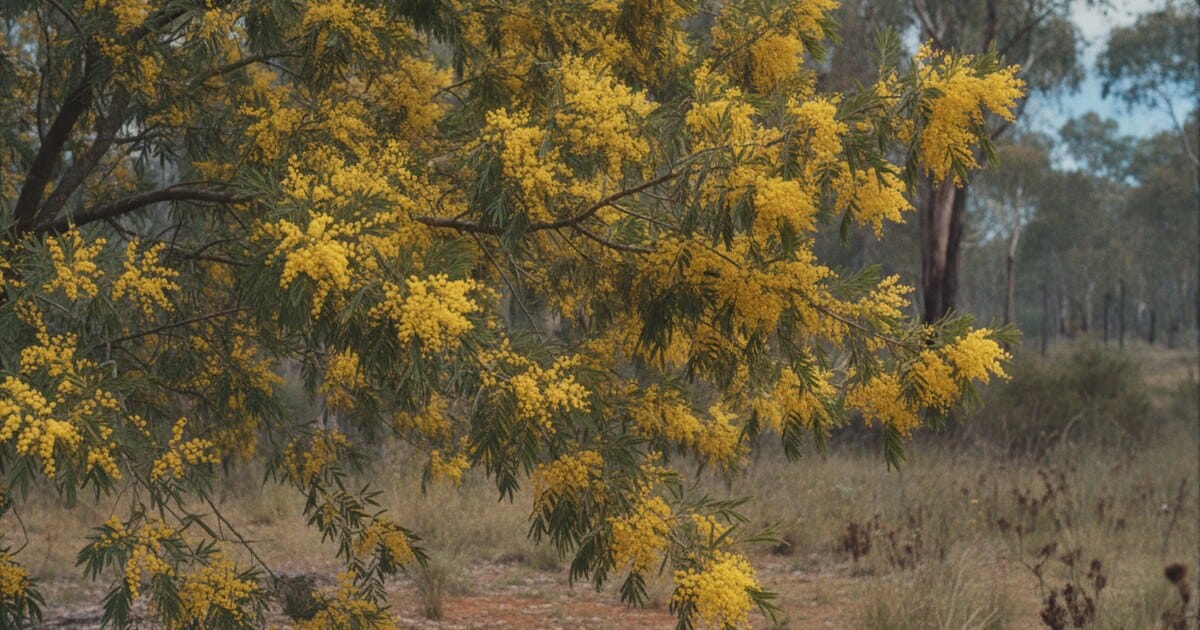
Wattle trees grow across nearly every corner of Australia, from coastal heath to arid desert to sub-alpine slopes. With close to 1,000 native species, the genus Acacia is the largest of vascular plants on the continent, and telling one species from another can feel overwhelming. The good news is that a handful of consistent features cut through the confusion quickly. This guide covers wattle tree identification by leaf type, flower structure, pod shape, and bark, plus a breakdown of five species you’re most likely to encounter.
Wattle trees belong to the genus Acacia in the family Fabaceae. You can identify most Australian wattles by their yellow flowers (either round pom-pom heads or cylindrical spikes), modified flat leaves called phyllodes, and curved seed pods. Many species grow 3-8m tall, bloom in late winter through spring, and produce nitrogen-fixing root nodules that enrich the surrounding soil.
What Does a Wattle Tree Look Like?
Most wattles are evergreen shrubs or small to medium trees ranging from 1m for low ground-cover forms to 25m for large timber species like Blackwood (Acacia melanoxylon). The overall silhouette varies widely: some grow upright and narrow, others spread broad and weeping. At a distance, the most reliable visual cue during bloom season is the mass of golden-yellow flowers that dusts branches in round clusters or rod-like spikes.
Acacia is the largest genus of vascular plants in Australia, with close to 1,000 native species out of roughly 1,350 worldwide. Western Australia hosts 450-500 species, most concentrated in the southwestern region. Wattles occupy every major habitat type: coastal scrub, dry woodland, rainforest margins, alpine heath, and arid red-sand country. Growth rates run 0.5-1m per year for most garden species, with short lifespans of 10-25 years typical for the faster-growing types. Individual flowers within each inflorescence number from 3 to 130+, arranged in either spherical heads (globose) or elongated spikes (cylindrical racemes). Australia celebrates Wattle Day on September 1 each year, and the Golden Wattle (Acacia pycnantha) has served as the national floral emblem since 1988. The Fabaceae connection means all wattles form nitrogen-fixing root nodules via bacterial symbiosis, so they’re reliable pioneers on disturbed or nutrient-poor ground.
Bark starts smooth and grey-green on young stems, then develops shallow ridges or fissures on older trunks depending on species. Some wattles, particularly non-Australian Acacia species (which are now reclassified into related genera), carry sharp thorns, but the vast majority of Australian wattles are thornless.
Wattle Leaves: Phyllodes vs Bipinnate
The leaf type is the single most important ID split in the wattle genus. Most adult Australian wattles carry phyllodes: modified flat petioles that function as leaves but aren’t. A phyllode attaches directly to the stem, shows no division into leaflets, and usually has one prominent midvein or several parallel veins running lengthwise. They can look like simple elongated leaves or broad curved blades, depending on species.
A smaller group of wattles retains true bipinnate leaves: feathery, fern-like foliage with rows of tiny leaflets arranged along a central stem. Silver Wattle (Acacia dealbata) and Cootamundra Wattle (Acacia baileyana) both show this pattern, giving them a soft, silvery-grey texture quite different from the shinier phyllode species. Bipinnate wattles tend to look more delicate at a distance and are often described as “mimosa-like.”
Some wattles are dimorphic: they produce bipinnate juvenile leaves that transition into phyllodes as the plant matures. Blackwood (Acacia melanoxylon) does this reliably, and the leaf changeover often puzzles people trying to ID young trees. If you’re looking at a wattle seedling or sapling, the adult leaf form won’t help you yet.
Phyllode shape narrows the field considerably once you’ve established the leaf type:
- Broad, sickle-shaped phyllodes (40-200mm long, one prominent vein): Golden Wattle (A. pycnantha)
- Long and narrow phyllodes (100-150mm, 10-20mm wide, 2-3 veins): Sydney Golden Wattle (A. longifolia)
- Curved phyllodes with 3-5 veins (70-130mm): Blackwood (A. melanoxylon)
- Bipinnate, blue-grey with glaucous coating: Cootamundra Wattle (A. baileyana)
- Bipinnate, silver-grey, 5-15cm long, 8-20 pinnae pairs: Silver Wattle (A. dealbata)
How to Identify Wattle Flowers
Wattle flowers are tiny individually but create striking displays through sheer number. Two structures are worth knowing.
Globular heads (also called capitula or pompoms) pack 15-130 individual flowers into a sphere 5-10mm across. You’ll find these on Golden Wattle, Cootamundra Wattle, Silver Wattle, and many others. The heads appear in racemes (rows along a branching stem) or singly from leaf axils. They’re the classic “pom-pom” look that most people picture when they think of wattles.
Cylindrical spikes are elongated rod-like clusters, 20-80mm long. Sydney Golden Wattle (A. longifolia) carries paired spikes in the axils of each phyllode, and the structure looks completely different from the globular-head species: more elongated, almost catkin-like. Spike-type species often have a distinct bloom window from globe-type species, so wattle country can show flowers across a wider season overall.
Flower color runs from pale cream through bright gold. Most of the familiar garden wattles land in the mid-to-deep yellow range. Bloom timing tracks latitude and elevation: many southeastern wattles flower July-October, while arid-zone species can bloom after rain at almost any time of year. If you photograph a wattle in flower, the inflorescence type (globe vs spike) combined with the phyllode or leaf shape will get you to species level most of the time.
Five Common Wattle Species
These five species account for most wattles encountered in gardens, roadsides, and bushland across southeastern Australia.
Golden Wattle (Acacia pycnantha) Australia’s national floral emblem since 1988. Broad, sickle-shaped phyllodes 40-200mm long with one prominent midvein. Flowers in dense globular heads arranged in short racemes of 20-40 heads, blooming July-October. Grows 3-8m tall. Native to NSW, Victoria, ACT, and South Australia; invasive in WA, Tasmania, and South Africa. The article Golden Wattle: Leaves, Flowers and Identification Guide covers this species in full.
Silver Wattle (Acacia dealbata) The “mimosa” sold across Europe for International Women’s Day. True bipinnate leaves with a silver-grey bloom from fine hairs, 5-15cm long with 8-20 pairs of pinnae. Globular heads in racemes of 20-30, pale to deep yellow, blooming late winter (June-August). Grows 10-30m in its native range across southeastern Australia and Tasmania, sometimes the tallest tree in a woodland stand.
Cootamundra Wattle (Acacia baileyana) Distinctive blue-grey bipinnate foliage with a glaucous (waxy) texture. Blooms prolifically July-September with dense bright yellow globular heads. Grows 5-10m. Native to a small region near Cootamundra, NSW, but widely planted and invasive across much of southern Australia. To separate it from Silver Wattle: the foliage is bluer and shorter, and the overall habit more compact and weeping.
Sydney Golden Wattle (Acacia longifolia) Long, narrow phyllodes 70-150mm long with 2-3 prominent veins. Cylindrical spike flowers 20-50mm long: these immediately separate it from the globular-head wattles. Blooms early (June-September). Grows 3-6m as a bushy spreading shrub to small tree. Common in coastal heath and dune systems from southeastern Queensland through NSW and into South Australia.
Blackwood (Acacia melanoxylon) The largest commonly encountered wattle, reaching 15-30m at maturity. Dimorphic: juvenile plants carry bipinnate leaves, while mature trees develop curved phyllodes 70-130mm long with 3-5 prominent veins. Creamy-white to pale yellow globular flower heads in short racemes, July-September. Produces tightly coiled, twisted seed pods (diagnostic). Commercially important for its dark, figured timber used in furniture and musical instruments.
Pods, Bark, and Supporting ID Features
Seed pods confirm family membership: all wattles are legumes, so pods follow the peapod template. Shapes diverge sharply between species. Golden Wattle produces flat, straight pods 50-130mm long with a cream-to-brown aril (seed coating). Silver Wattle pods are similar: flat and straight. Blackwood develops tightly coiled pods that spiral back on themselves, which is diagnostic for the species. Sydney Golden Wattle carries flat, straight pods 60-100mm long.
Bark provides supporting evidence rather than a standalone ID. Young wattles have smooth grey to grey-green bark. With age, bark becomes fissured, shallowly ridged, or rough-textured depending on the species. Silver Wattle and Blackwood develop dark grey-brown fissured bark as they mature. Golden Wattle tends to keep smoother bark on its stems.
Root nodules are worth knowing about: wattles fix atmospheric nitrogen through bacterial symbiosis with Rhizobium species. This gives them a colonizing advantage on disturbed, cleared, or recently burnt ground. Seeing wattles dominate a recovering bushland site isn’t accidental; they’re rebuilding the nitrogen base for the plants that follow.
Identify Any Wattle with Tree Identifier
Getting to species level with wattles is genuinely difficult, even for experienced botanists. The genus has close to 1,000 Australian species, and many share similar flowers while differing only in phyllode shape, pod structure, or regional distribution. The Tree Identifier app reads multiple inputs at once: phyllode or leaf shape, flower type, pod morphology, bark texture, and whole-plant habit. It covers both living trees and cut timber.
You get 2 free identifications per day with no subscription required. For a tricky wattle where phyllode shape isn’t obvious, submitting both a close-up of the foliage and a wider shot of the flowering branch gives the AI two data points to compare. The app works offline too, which matters on remote bush tracks where mobile data isn’t guaranteed. You can also try the free web-based tree identifier for a quick browser scan without downloading anything.
Frequently Asked Questions
What is a wattle tree? Wattle trees are Australian members of the genus Acacia in the family Fabaceae. Australia has close to 1,000 native Acacia species, making it the largest genus of vascular plants on the continent. They’re known for yellow flowers in globular heads or cylindrical spikes, modified flat leaves called phyllodes, and nitrogen-fixing root nodules. The Golden Wattle (Acacia pycnantha) is Australia’s national floral emblem.
Are wattle and mimosa the same tree? In Australia, the terms often describe the same plants. Silver Wattle (Acacia dealbata) is the florist’s mimosa sold across Europe, particularly for International Women’s Day. Globally, true mimosa belongs to a separate genus (Mimosa), while Australian wattles are Acacia. Outside Australia, plants called “mimosa” are sometimes Albizia julibrissin (silk tree), which is unrelated to Acacia entirely.
Why do wattle trees die so quickly? Most fast-growing wattles have short natural lifespans of 10-25 years. They function as pioneer plants: they colonize disturbed ground quickly, fix nitrogen, and make way for slower-growing plants that follow. Blackwood is an exception, reaching 50+ years. A wattle dying in a garden after 15-20 years is often completing its natural cycle rather than showing any problem. Waterlogged soil can accelerate decline in poorly drained spots.
What’s the difference between phyllodes and true leaves? Phyllodes are modified flat petioles that look like simple leaves but lack the blade structure of a true leaf. They attach directly to the stem and show one or several parallel veins but no division into leaflets. True bipinnate leaves have a central stem (rachis) lined with secondary stems (pinnae) carrying paired leaflets, giving them a feathery, fern-like appearance. Most adult Australian wattles have phyllodes; some start bipinnate as juveniles and transition later.
When do wattle trees flower in Australia? Bloom timing depends on species and location. Silver Wattle and Cootamundra Wattle peak in late winter (June-August). Sydney Golden Wattle starts as early as June. Golden Wattle blooms July-October. Many southeastern wattles flower through winter into spring. Arid-zone species flower after rainfall rather than following a strict seasonal calendar. The general window for most garden wattles runs late July through October.
Identify a tree from your photo — free
Upload a leaf, bark, or whole-tree photo and get the species in seconds. No signup.
Confidence:
Unlock the full species profile
Free in the app — with unlimited identifications.


AI result for guidance — the app gives full species details and works offline.
Want unlimited identifications?
Get the full species profile, photos and details — free in the app, with unlimited scans.
- Unlimited identifications
- Full species profiles & details
- Works offline, anywhere
- Save and revisit your finds
Elena Torres
Tree Identifier Team