Macadamia Tree: Leaves, Flowers and Identification Guide
Macadamia trees show up in Queensland rainforest reserves, Hawaiian orchards, and suburban backyards across warm coastal Australia. The nut is widely recognized, but the tree itself is frequently misidentified in the field. Two species produce commercial-quality nuts, and they differ in leaf arrangement, flower color, and shell texture. Knowing those markers makes identification reliable whether the tree is fruiting or not.
Macadamia trees are native Australian evergreens reaching 9 to 12 meters tall, recognized by whorled leathery leaves, long pendant flower racemes, and round hard-shelled nuts in a green husk. Two species are worth knowing for identification: Macadamia integrifolia (smooth-shelled, leaves in whorls of 3) and Macadamia tetraphylla (rough-shelled, leaves in whorls of 4). Both are native to southeastern Queensland.
What Does a Macadamia Tree Look Like?
Macadamia trees grow into broad, dense, rounded crowns that cast heavy shade. Mature specimens typically reach 9 to 12 meters (30 to 40 feet) in height with a spread nearly as wide. The canopy is thick and layered, with branches that sweep outward and slightly downward in older trees.
Bark on young branches is smooth and grey to grey-brown, with noticeable cream-colored horizontal lenticels running across the surface. These lenticels are one of the more reliable field markers: look for short pale dashes across grey-brown bark and you’re likely looking at a young macadamia branch. Older trunk bark develops shallow vertical fissures but stays far smoother than most rainforest trees of similar size.
New growth is the best distance clue. Emerging leaves on both species flush bronze-red to copper before maturing to dark glossy green. If you spot a Queensland rainforest-margin tree with deep green foliage and bronze new growth clustered in whorls at the branch tips, Macadamia is a strong candidate.
Macadamia trees (Macadamia integrifolia and Macadamia tetraphylla) are native Australian evergreens found in rainforest margins of southeastern Queensland and, for M. tetraphylla, northeastern New South Wales. They grow to 9 to 12 meters tall with dense rounded crowns. Leaves are leathery and arranged in whorls at each node: M. integrifolia has whorls of 3 leaves measuring 20 to 28 cm, while M. tetraphylla has whorls of 4 leaves up to 50 cm long with consistently spiny-toothed margins. Bark on young growth is smooth grey-brown with cream lenticels; older trunks develop shallow vertical fissures. Both species produce pendant flower racemes: creamy-white in M. integrifolia (15 to 30 cm long), cream to pinkish-mauve in M. tetraphylla (up to 38 cm). The round nut inside a split green husk has a smooth shell in M. integrifolia and a dimpled rough shell in M. tetraphylla.
Macadamia Leaves: Whorled, Leathery and Species-Specific
Leaf arrangement is the first thing to check on a suspected macadamia. Unlike most trees where leaves alternate or sit in opposite pairs, macadamias place their leaves in whorls: multiple leaves radiating outward from a single point on the branch at each node.
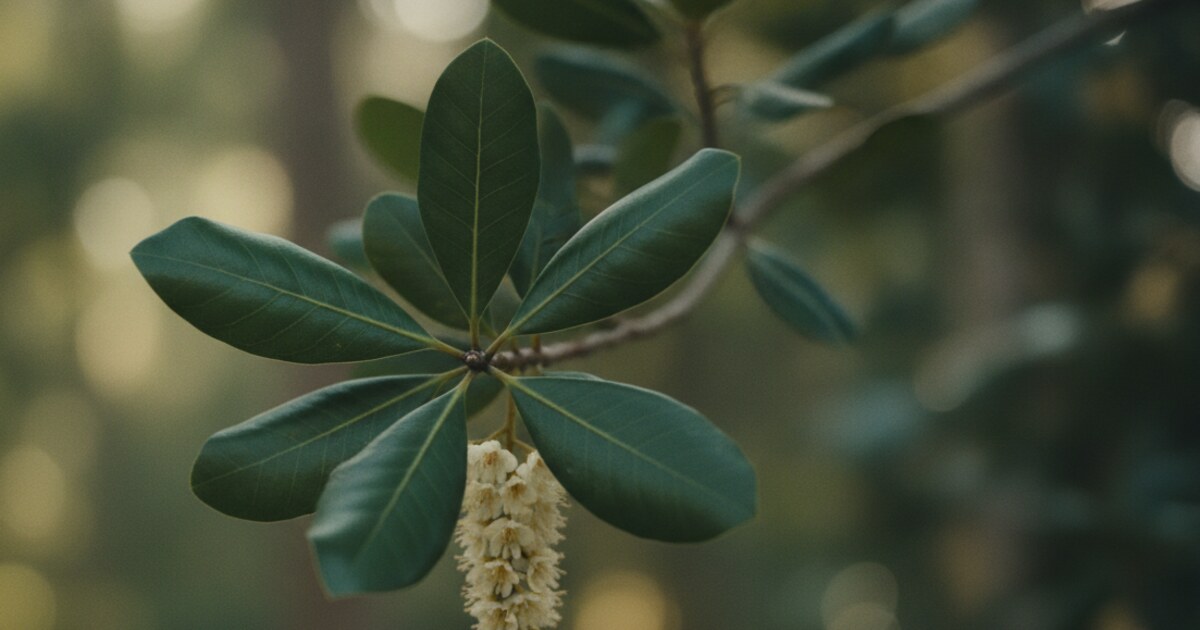
Macadamia integrifolia has whorls of 3 leaves, occasionally 2. Each leaf runs 20 to 28 cm (8 to 11 inches) long with a club-shaped outline and leathery texture. The margins are either smooth or gently wavy. Toothing is inconsistent: some leaves on the same tree are entire while others carry scattered small serrations.
Macadamia tetraphylla has whorls of 4 leaves, occasionally 3. These leaves are considerably longer, up to 50 cm (20 inches), and the margin toothing is always present and always spiny, with 33 to 40 sharp teeth on each side. If you press a leaf margin against your palm and it scratches noticeably, you’re holding M. tetraphylla. M. integrifolia margins, even when toothed, won’t scratch skin.
Both species have leathery, glossy upper surfaces with a prominent midrib running the length of the leaf. The underside is paler. New growth on both species emerges bronze to copper-red, which makes young foliage easy to spot from a distance when several leaf flushes appear simultaneously.
The field test: count leaves at a node, then check the margin. Four leaves with consistently spiny edges points solidly to M. tetraphylla. Three leaves with variable or smooth margins points to M. integrifolia. Hybrids between the two species occur (particularly in cultivation and at the contact zones of their native ranges) and can blur both the whorl count and the margin consistency.
Macadamia Flowers and Fruit
Flowers appear in late winter to spring across most of the native range, typically September to November in Queensland. Both species produce pendant racemes: long hanging clusters where dozens of small flowers are arranged closely along a central stalk, each with four petaloid sepals and no true petals.
Macadamia integrifolia racemes run 15 to 30 cm (6 to 12 inches) and carry creamy-white flowers. The overall look from a distance is a long pale spike hanging from branch tips, not unlike a bottlebrush raceme but slimmer and more delicate.
Macadamia tetraphylla racemes are longer, up to 38 cm (15 inches), and the flowers range from cream to distinctly pink or mauve. The pink tinge is the fastest species separator during flowering: pure cream to white points to M. integrifolia; any pink or mauve overtone points to M. tetraphylla.
After pollination, the fruit develops inside a round green husk roughly 3 to 4 cm across. This husk splits open as the nut ripens and begins falling naturally in autumn to winter.
Inside the husk sits the nut, famous for its hard shell. M. integrifolia shells are smooth; M. tetraphylla shells are rough and dimpled. The kernel inside holds up to 80 percent oil in M. integrifolia (with around 4 percent sugar) compared to 65 to 75 percent oil in M. tetraphylla (with 6 to 8 percent sugar). That higher sugar content in M. tetraphylla affects how kernels respond to commercial roasting processes, though both species produce edible, high-quality nuts.
Native Range: Where Macadamia Trees Grow
Both commercial species are native to a narrow coastal band of eastern Australia. Macadamia integrifolia grows in southeastern Queensland, concentrated in the hinterland between Brisbane and the Sunshine Coast. Macadamia tetraphylla has a wider range stretching from southeastern Queensland into northeastern New South Wales, as far south as the Coffs Harbour hinterland.
Both species favor the margins and gully walls of subtropical and warm-temperate rainforest, near-permanent streams, and moist sheltered slopes. They grow on red volcanic soils and basalt-derived loams where drainage is good but moisture stays consistent.
Wild macadamia populations are now at risk. Habitat clearing, grazing, and altered fire regimes have reduced remnant stands significantly. The banksia identification guide covers another Queensland genus under conservation pressure, with ecological links to the same warm coastal rainforest ecosystems where macadamias still occur.
Outside Australia, macadamia trees are grown commercially across USDA zones 9 to 10. Hawaii became the first major commercial producer in the early 20th century; South Africa, Kenya, and China have since grown into significant producers. In Australia, commercial orchards concentrate in northern NSW and southeastern Queensland, not far from where wild trees still grow in remnant rainforest patches.
Macadamia tetraphylla vs Macadamia integrifolia
The two species are straightforward to separate once you check the right features:
| Feature | M. integrifolia | M. tetraphylla |
|---|---|---|
| Leaf whorls | Usually 3 | Usually 4 |
| Leaf length | 20–28 cm | Up to 50 cm |
| Leaf margin | Smooth to slightly wavy | Always spiny, 33–40 teeth per side |
| Flower color | Creamy-white | Cream to pink/mauve |
| Raceme length | 15–30 cm | Up to 38 cm |
| Nut shell | Smooth | Rough, dimpled |
| Nut oil content | Up to 80% | 65–75% |
| Native range | SE Queensland only | SE Queensland + NE New South Wales |
In cultivation, hybrids are common and are frequently sold without species labeling. Checking three separate nodes for consistent whorl count and running your thumb along several leaf margins for the scratch test gives the most reliable field answer.
The bottlebrush tree identification guide is worth reading alongside this one: flowering macadamias can look visually similar to bottlebrush (Callistemon) species from a distance, since both produce pendant flower spikes from branch ends. The distinction is immediate at the leaf level: bottlebrush has alternate leaves, macadamia has whorls.
Production Timeline: How Long to First Nuts
Macadamia trees grown from seed take 8 to 12 years to produce their first nut crop. Grafted or air-layered cultivars (which copy the genetics of a productive parent tree) cut that timeline to 2 to 7 years depending on variety and site conditions.
A 10-year-old tree in good health typically yields 30 to 50 pounds of nuts per season. Yield increases as the tree matures, with older specimens capable of significantly heavier crops in good years.
Temperature sets the geographic limit. Mature trees tolerate brief dips to around -4°C (24°F) without fatal damage, but flower racemes die off at around -2°C (28°F). Since fruit set depends on flowers surviving, even a brief frost during bloom can eliminate the entire year’s crop. This cold sensitivity explains why commercial production concentrates in frost-free subtropical and tropical coastal zones.
Nuts don’t need immediate processing after falling. The shell is one of the hardest of any commercial tree nut, and cracking without a purpose-built tool usually damages the kernel. Commercial processors use calibrated crackers to apply controlled force. Backyard growers often use a vice or a dedicated hand cracker.
How Tree Identifier Helps with Macadamia ID
Identifying a macadamia confidently in the field means checking leaf whorl count, margin texture, flower color, and nut shell surface. Several species in Queensland gardens and parks carry whorled leaves, and hybrid cultivars blur the species lines further.
The Tree Identifier app photographs leaves, bark, flowers, or the whole tree and returns the species name with a confidence score. It draws on a database of thousands of species, covering both macadamia species and the ornamental relatives most often confused with them. You get 2 free identifications daily without a subscription, and the app works offline, which matters for rainforest reserve visits where mobile coverage cuts out.
Try a browser-based identification first at treeidentifier.app/tools/tree-identifier before downloading, no account needed for one free web scan.
Frequently Asked Questions
Are macadamia trees hard to grow?
Macadamia trees need frost-free winters, consistent moisture, and well-drained soil. USDA zones 9 to 10 suit them well. In those conditions they’re fairly low-maintenance once established, though slow to reach fruiting age from seed (8 to 12 years). Grafted varieties shorten the wait to 2 to 7 years. Outside subtropical climates, they can be grown in large containers and moved indoors before frost.
Can you eat macadamia nuts right off the tree?
Yes, once the outer green husk has split and the nut falls, the kernel inside is edible without cooking. The obstacle is the shell: macadamia has one of the hardest shells of any tree nut, and cracking it cleanly without a purpose-built cracker usually crushes the kernel. The kernel itself doesn’t require roasting; raw macadamia is creamy and sweet. The shell is the challenge, not the nut.
How many years does it take for a macadamia tree to produce nuts?
Seed-grown trees take 8 to 12 years to bear their first nuts. Grafted trees, propagated from a proven-producing parent, begin fruiting in 2 to 7 years depending on cultivar. By age 10, a healthy tree typically yields 30 to 50 pounds per season. Yield continues climbing as the tree matures.
Where do macadamia trees grow best?
Macadamia trees grow best in frost-free subtropical climates with consistent rainfall or irrigation, USDA zones 9 to 10. Their native habitat is southeastern Queensland and northeastern New South Wales rainforest margins, on volcanic and basalt-derived soils near streams. Commercially they’re grown in Hawaii, South Africa, Kenya, and coastal eastern Australia. They tolerate dry periods once established but perform best with reliable moisture through flowering and nut development.
If you want to identify a macadamia or any other Australian native on your next bush walk, try Tree Identifier at treeidentifier.app. Two free identifications daily, offline mode included, available on iOS and Android.
Identify a tree from your photo — free
Upload a leaf, bark, or whole-tree photo and get the species in seconds. No signup.
Confidence:
Unlock the full species profile
Free in the app — with unlimited identifications.


AI result for guidance — the app gives full species details and works offline.
Want unlimited identifications?
Get the full species profile, photos and details — free in the app, with unlimited scans.
- Unlimited identifications
- Full species profiles & details
- Works offline, anywhere
- Save and revisit your finds
Elena Torres
Tree Identifier Team